Within UFO Fiction Exchange
Alien communication
Alien communication is one of the most distinctive ways science fiction explores the relationship between UFO ideas and imagined encounters with non-human intelligence.
Page outline Jump by section
Introduction
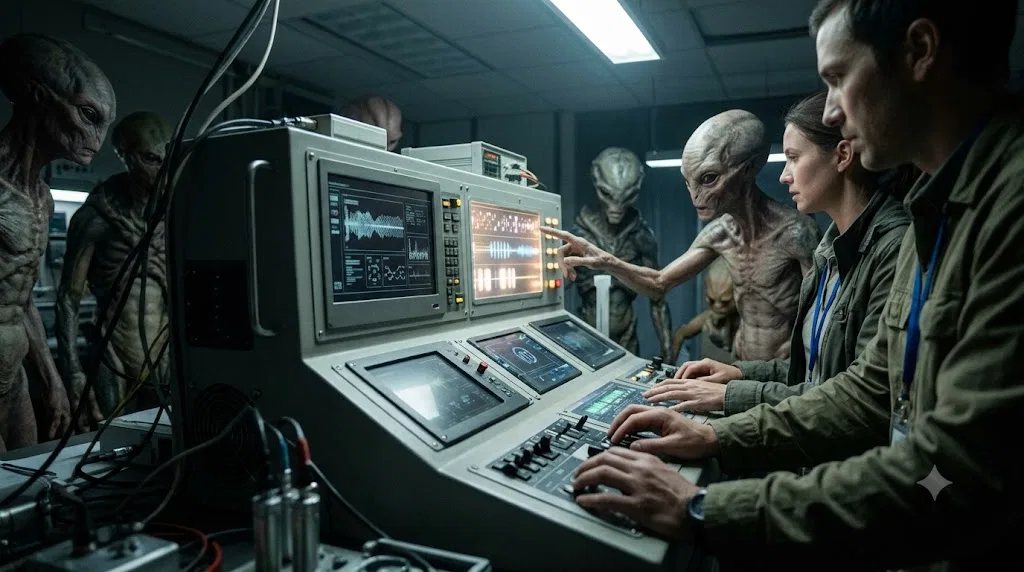
Alien communication is one of the most distinctive ways science fiction explores the relationship between UFO ideas and imagined encounters with non-human intelligence. Rather than focusing only on spacecraft or sightings, stories about alien communication ask a deeper question: if humans met an extraterrestrial civilisation, would we even recognise its attempts to speak? Science fiction has used alien languages, signals, symbols, telepathy and failed translations to examine the limits of human understanding and the assumptions behind the search for life beyond Earth.
The subject matters because communication is the point at which an encounter becomes a relationship rather than a simple observation. From attempts to decode mysterious signals in films such as Contact and Arrival to fictional translation systems in Star Trek, science fiction has repeatedly explored the scientific and philosophical problems that real researchers also consider: how to create a shared reference system, how to avoid misunderstanding, and whether intelligence elsewhere in the universe would think in ways humans can comprehend.
Why alien communication became central to science fiction
Early alien stories often treated extraterrestrials as invaders or mysterious visitors rather than potential conversational partners. As science fiction developed, writers increasingly became interested in what would happen after first contact. The challenge was no longer just reaching another world, but finding a way to exchange meaning across completely different forms of life.
This shift reflected changing ideas about extraterrestrial intelligence. Mid-20th-century UFO culture often portrayed unknown objects as possible evidence of advanced visitors, while science fiction began exploring more complex possibilities: aliens who were peaceful but incomprehensible, civilisations with radically different values, or beings whose methods of communication did not resemble human speech at all.
One of the most influential examples is the idea that mathematics or science might provide a universal foundation for contact. This concept influenced both fictional stories and real attempts to communicate with hypothetical extraterrestrial civilisations. The Voyager Golden Record, launched in 1977, attempted to represent Earth through images, sounds, music and greetings in 55 languages, using scientific information and symbolic instructions as possible bridges between species.[NASA Science]science.nasa.govScience Golden Record OverviewNASA ScienceGolden Record Overview - NASA ScienceApril 7, 2025…
The hardest problem: finding a shared language
Science fiction often presents translation as much more difficult than simply converting words from one language to another. Human languages depend on shared experiences, cultural references and assumptions about the world. An alien civilisation might perceive reality differently, making even basic concepts difficult to exchange.
When words do not mean the same thing
The Star Trek: The Next Generation episode “Darmok” is one of the best-known fictional examinations of this problem. The episode presents the Tamarian language, which relies heavily on references to historical events and mythology. Although a universal translator can identify individual words, it struggles to interpret the cultural meaning behind them. The story suggests that translation requires more than vocabulary; it requires knowledge of another civilisation’s history and way of thinking. The linguistic challenge explored in the episode has even inspired academic work examining metaphor-rich translation and machine interpretation.[arXiv]arxiv.orgPicard understanding Darmok: A Dataset and Model for Metaphor-Rich Translation in a Constructed LanguageJuly 17, 2021…
This idea appears throughout science fiction because it challenges a common assumption: that an intelligent species would organise thoughts in a human-like way. A truly alien language might not have nouns, speech sounds or even linear sentences. Some fictional aliens communicate through patterns, colours, mathematics, emotions or shared mental states rather than spoken language.
The fear of misunderstanding
Many alien communication stories are built around uncertainty rather than successful conversation. A message may be interpreted as a threat when it is intended as a greeting, or humans may mistake an unfamiliar form of intelligence for something primitive or hostile.
This theme connects strongly with UFO narratives, where unexplained observations have often been shaped by expectations about alien motives. Science fiction uses communication failures to explore how much of an encounter is determined by the observer’s assumptions rather than by the alien itself.
Signals, messages and the search for contact
Science fiction frequently overlaps with real scientific discussions about how humans might communicate with extraterrestrial intelligence. The search for extraterrestrial intelligence (SETI) examines whether advanced civilisations might produce detectable signals, while fictional stories imagine what might happen if such a signal were found and understood.
Carl Sagan’s novel Contact became one of the most famous examples of this approach. It imagined a message from an extraterrestrial civilisation hidden within a transmission from space. The story focused less on the discovery of aliens themselves and more on the scientific, political and emotional consequences of decoding their communication.
Real-world projects have also grappled with the same question of how to make a message understandable without shared language. NASA’s Voyager Golden Record included a symbolic cover explaining how to play the record, along with images, sounds and scientific information intended to provide a basic introduction to humanity. The project acknowledged the uncertainty involved: there was no guarantee that another civilisation would find the record or interpret it correctly.[NASA Science]science.nasa.govScience Golden Record ContentsNASA ScienceGolden Record Contents - NASA ScienceApril 7, 2025…
Arrival and the idea that language changes thought
One of the most influential modern examples of alien communication in science fiction is the film Arrival (2016), based on Ted Chiang’s short story “Story of Your Life”. Instead of depicting aliens as technologically superior attackers, the story focuses on linguistics: understanding an alien written language whose structure challenges human ideas about time and meaning.
The film draws attention to a real debate in linguistics often associated with the Sapir-Whorf hypothesis, which examines whether language influences how people perceive and organise reality. Science fiction has used this idea to imagine communication with beings whose minds may operate according to entirely different principles.
The importance of Arrival is that the central conflict is not solved by military power or engineering. It is solved through patience, interpretation and cooperation. The story presents communication itself as the technology required for first contact.
Different visions of alien communication
Science fiction has developed several recurring models for how humans might communicate with extraterrestrial life:
- Radio signals and coded messages: Stories such as Contact imagine aliens using technology-based signals that humans must decode.
- Universal translation systems: Franchises such as Star Trek explore the possibility that advanced technology could overcome language barriers, while also showing situations where translation fails.
- Mathematical communication: Some stories assume that mathematics, physics and patterns could provide common ground between civilisations.
- Non-verbal communication: Films and novels often imagine aliens communicating through images, sounds, biological signals or changes in perception.
- Telepathy or direct mental contact: Older science fiction frequently used mind-to-mind communication as a way to bypass the problem of language entirely.
Each approach reflects a different idea about what intelligence means. If intelligence is connected to technology and mathematics, then signals may be the best route. If intelligence is tied to consciousness and experience, communication may require understanding another species’ way of perceiving reality.
UFO culture and the changing image of alien contact
The way science fiction portrays alien communication has influenced how people imagine UFO encounters. Early flying-saucer stories often emphasised mysterious arrivals and possible threats, but later works increasingly focused on dialogue, diplomacy and uncertainty. The alien visitor became less like a monster to defeat and more like an unknown civilisation to understand.
This change mirrors broader discussions about humanity’s place in the universe. Stories about communication with aliens are rarely only about aliens; they are also about human problems such as mistrust, cultural conflict and the difficulty of understanding unfamiliar perspectives.
The most lasting contribution of alien communication stories is therefore not a prediction of what extraterrestrials will be like. Instead, they provide a way to examine one of the biggest challenges of any possible contact scenario: recognising another intelligence on its own terms rather than forcing it into familiar human categories.
Amazon book picks
Further Reading
Books and field guides related to Alien communication. Use these as the next step if you want deeper reading beyond the article.
Contact
Rating: 4.0/5 from 21 Google Books ratings
In the year 1999 a multinational team of astronauts sets out to discover the secrets of the universe.
The Sparrow
"Set in the 21st century - between 20 and 60 years from now - The Sparrow is the story of a charismatic Jesuit priest and talented lingui...
Embassytown
From the award-winning author of Perdido Street Station and The City & the City "Richly conceived." The New York Times Book Review Embass...
eBay marketplace picks
Marketplace Samples
Live-tested eBay searches with available results related to this page.
Selected fromalien poster oneBay.co.uk.



Endnotes
1.
Source: science.nasa.gov
Title: Science Golden Record Overview
Link:https://science.nasa.gov/mission/voyager/voyager-golden-record-overview/
Source snippet
NASA ScienceGolden Record Overview - NASA ScienceApril 7, 2025...
Published: April 7, 2025
2.
Source: science.nasa.gov
Title: Science Golden Record Greetings
Link:https://science.nasa.gov/mission/voyager/golden-record-contents/greetings/
Source snippet
NASA ScienceGolden Record Greetings - NASA Science...
3.
Source: arxiv.org
Link:https://arxiv.org/abs/2107.08146
Source snippet
Picard understanding Darmok: A Dataset and Model for Metaphor-Rich Translation in a Constructed LanguageJuly 17, 2021...
Published: July 17, 2021
4.
Source: science.nasa.gov
Title: Science Golden Record Contents
Link:https://science.nasa.gov/mission/voyager/golden-record-contents/
Source snippet
NASA ScienceGolden Record Contents - NASA ScienceApril 7, 2025...
Published: April 7, 2025
5.
Source: science.nasa.gov
Title: the voyagers in popular culture
Link:https://science.nasa.gov/missions/the-voyagers-in-popular-culture/
6.
Source: jpl.nasa.gov
Title: the voyagers in popular culture
Link:https://www.jpl.nasa.gov/news/the-voyagers-in-popular-culture/
7.
Source: science.nasa.gov
Title: voyager at 30 the golden record
Link:https://science.nasa.gov/missions/voyager-program/voyager-at-30-the-golden-record/
8.
Source: science.nasa.gov
Title: howdy strangers
Link:https://science.nasa.gov/missions/voyager-program/howdy-strangers/
9.
Source: jstor.org
Link:https://www.jstor.org/stable/10.7560/330142
Source snippet
Arrival | JSTORJanuary 1, 2024 — Image: Cover of Arrival Arrival David Roche Series: 21st Century Film Essentials Copyright Date: 2024 Pu...
Published: January 1, 2024
Additional References
10.
Source: slashfilm.com
Title: Why Everyone In The Star Trek Franchise Speaks English, Explained
Link:https://www.slashfilm.com/2127385/star-trek-why-everyone-speaks-english-universal-translator/
Source snippet
April 7, 2026 — WHY EVERYONE IN THE STAR TREK FRANCHISE SPEAKS ENGLISH, EXPLAINED By Witney Seibold April 7, 2026 12:30 pm EST Image: Cap...
Published: April 7, 2026
11.
Source: nationalgeographic.com
Title: The Golden Records tell the story of Earth
Link:https://www.nationalgeographic.com/science/article/NASA-golden-records
Source snippet
Will alien worlds ever find them? | National GeographicJune 18, 2025 — THE GOLDEN RECORDS TELL THE STORY OF EARTH. WILL ALIEN WORLDS EVER...
Published: June 18, 2025
12.
Source: syfy.com
Title: By Cassidy Ward Dec 16, 202
Link:https://www.syfy.com/syfy-wire/reimagining-voyagers-gold-record-and-its-message-to-aliens
Source snippet
Reimagining Voyager's Gold Record and Its Message to AliensDecember 16, 2023 — SCIENTISTS ARE DREAMING UP A SEQUEL TO VOYAGER'S GOLD RECO...
Published: December 16, 2023
13.
Source: youtube.com
Title: Arrival Movie’s Language: Talking in Circles
Link:https://www.youtube.com/watch?v=Qd8zT1YAUck
Source snippet
Dr. Banks Decodes Heptapod Language (FULL SCENE) | Arrival This scene illustrates a central science-fiction depiction of alien communicat...
14.
Source: youtube.com
Title: Dr. Banks Decodes Heptapod Language (FULL SCENE) | Arrival
Link:https://www.youtube.com/watch?v=m8-H5j538oM
Source snippet
Disclosure Day raises a big question: How do you talk to aliens?...
15.
Source: youtube.com
Title: Disclosure Day raises a big question: How do you talk to aliens?
Link:https://www.youtube.com/watch?v=iF9Erkepfv0
Source snippet
102: The science and fiction of Sapir-Whorf...
16.
Source: mediascot.org
Link:https://www.mediascot.org/atmosphere/arrival/extra
17.
Source: friducation.com
Link:https://friducation.com/2021/11/darmok-a-failure-to-communicate/
18.
Source: creativeteachingsite.com
Link:https://www.creativeteachingsite.com/startrek.html
19.
Source: everything.explained.today
Link:https://everything.explained.today/Interlac/