Within Science fiction
How Star Trek Imagined Phones Before Phones
Star Trek's communicator imagined personal wireless contact that later echoed in the development of modern mobile communication.
On this page
- The fictional communicator and its design idea
- Real mobile technology comparisons
- Why predictions matched human needs
Page outline Jump by section
Introduction
The Star Trek communicator is one of the clearest examples of science fiction shaping expectations for future personal technology. First appearing in the 1960s television series, the handheld device allowed Starfleet officers to contact each other wirelessly from distant locations, presenting a vision of instant personal communication before mobile phones existed as everyday consumer products. The communicator did not directly invent the mobile phone, but it helped define what a future communication device could look like: portable, personal, wireless and always available.[Frontiers]frontiersin.orgFrontiersFrontiers | Designing the future: Star Trek as visual culture, speculative design, and imagination activator in human–technology…

The strongest influence appeared not in the underlying engineering of cellular networks, which developed through telecommunications research, but in the design language and cultural imagination surrounding mobile devices. The communicator became a visual model for compact, flip-open phones, most famously echoed by Motorola’s StarTAC in the 1990s. Its lasting importance lies in how Star Trek transformed a technical possibility into a familiar human expectation: that people should be able to reach one another wherever they are.[Smithsonian Magazine]smithsonianmag.comSmithsonian MagazineFrom 'the Brick' to the iPhone, the Cellphone Celebrates 50 YearsApril 3, 2023…
The fictional communicator and its design idea
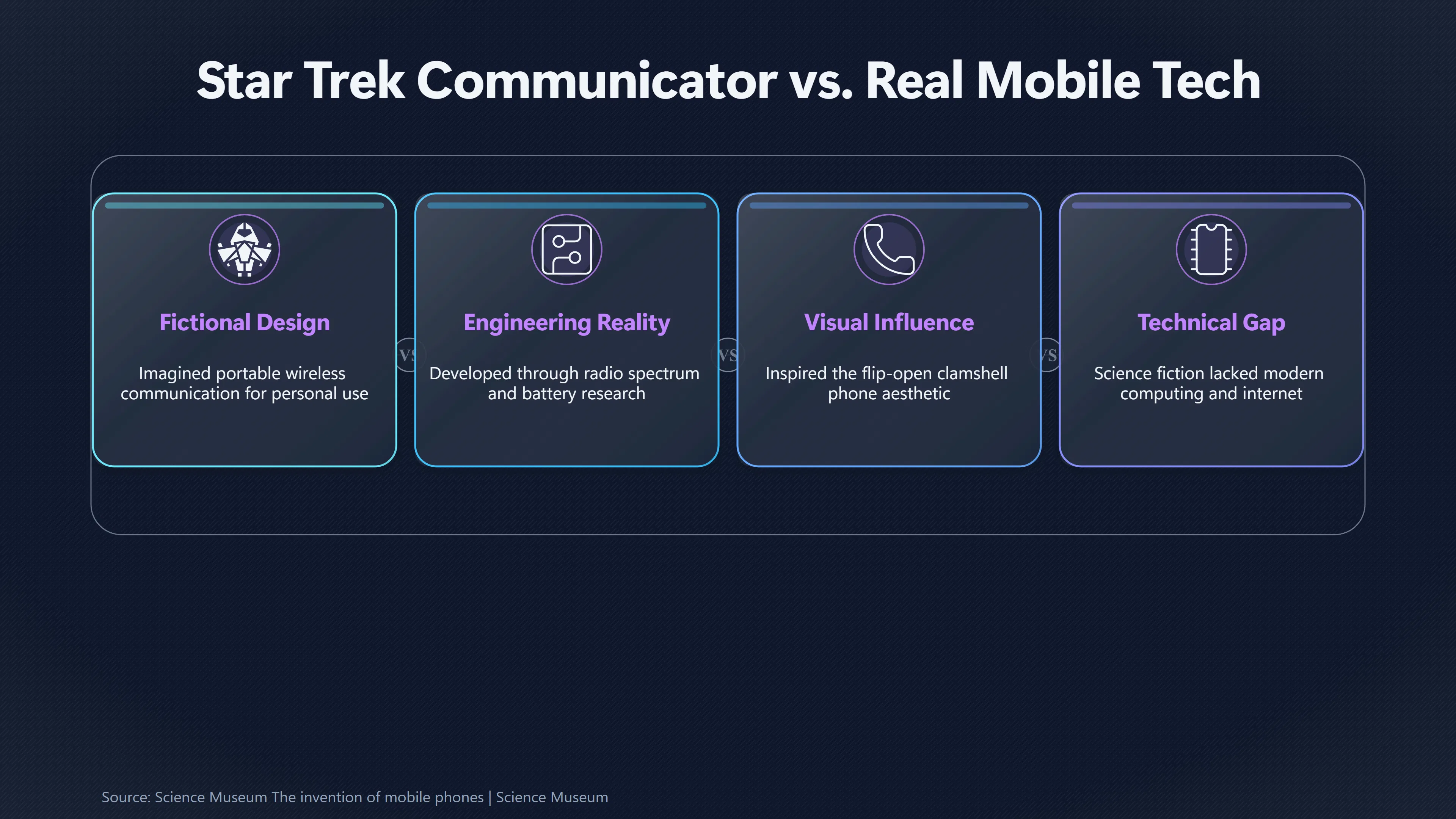
The original Star Trek communicator was introduced in 1966 as a compact two-way device carried by members of the USS Enterprise crew. Unlike the bulky radios and vehicle-based communication systems of the period, it suggested a future where communication equipment could be small enough to carry personally. The device opened with a flip motion, activated a connection quickly and allowed characters to speak across large distances with little effort.[Science Museum]sciencemuseum.org.ukScience Museum The invention of mobile phones | Science MuseumScience Museum The invention of mobile phones | Science Museum
The important prediction was not that future engineers would copy every component of the fictional prop. The communicator’s imagined technology relied on concepts far beyond contemporary engineering, including fictional forms of long-range transmission. Instead, the lasting idea was behavioural: communication would become detached from a fixed location. A person would no longer need to find a telephone booth, desk phone or radio station; the communication system would travel with them.
This distinction helps explain why the communicator belongs within the wider relationship between UFO themes and science fiction rather than as a literal technological forecast. Science fiction often imagines advanced civilisations possessing effortless communication systems, but those stories also influence human designers by suggesting what kinds of tools people might want. The communicator represented an imagined future in which advanced technology served ordinary human interaction rather than simply demonstrating scientific power.
The design also created a strong visual association between mobility and communication. The act of flipping open the device became part of its identity, signalling that a connection was about to begin. Decades later, this same physical gesture became familiar through clamshell mobile phones.[Smithsonian Magazine]smithsonianmag.comSmithsonian MagazineFrom 'the Brick' to the iPhone, the Cellphone Celebrates 50 YearsApril 3, 2023…
Real mobile technology comparisons
The relationship between the Star Trek communicator and mobile phones is often described as a direct prediction, but the history is more complicated. Engineers were already developing mobile communication systems before Star Trek appeared. Research into cellular networks, radio technology and portable telephones had been underway for years, and the first handheld mobile phone call was made by Motorola engineer Martin Cooper in 1973.[Science Museum]sciencemuseum.org.ukScience Museum The invention of mobile phones | Science MuseumScience Museum The invention of mobile phones | Science Museum
The communicator’s influence is therefore best understood as inspiration and design symbolism rather than the source of the technology itself. Cellular networks required advances in radio spectrum management, miniaturised electronics, batteries and infrastructure. Those technical foundations came from engineering research rather than from science fiction concepts alone.[Science Museum]sciencemuseum.org.ukScience Museum The invention of mobile phones | Science MuseumScience Museum The invention of mobile phones | Science Museum
Where Star Trek had a clearer impact was in the appearance and public understanding of mobile phones. Motorola’s later StarTAC, released in 1996, became one of the earliest successful flip phones and closely resembled the communicator’s compact folding form. The visual similarity helped create a popular connection between Star Trek’s imagined future and real consumer technology.[Smithsonian Magazine]smithsonianmag.comSmithsonian MagazineFrom 'the Brick' to the iPhone, the Cellphone Celebrates 50 YearsApril 3, 2023…
From communicator shape to everyday phone design
The comparison between the communicator and early mobile phones can be seen in several shared ideas:
- Portability: Both imagined communication equipment small enough to carry anywhere.
- Personal ownership: The communicator belonged to an individual rather than a shared location.
- Instant access: Users expected a connection without complicated preparation.
- Simple interaction: Opening or activating the device was designed to feel natural.
The modern smartphone has moved far beyond the communicator. Today’s phones combine voice calls with internet access, navigation, photography, entertainment and artificial intelligence features. In that sense, Star Trek underestimated the amount of computing that would eventually fit into a handheld device while accurately capturing the social desire for constant connectivity.[Frontiers]frontiersin.orgFrontiersFrontiers | Designing the future: Star Trek as visual culture, speculative design, and imagination activator in human–technology…
Why predictions matched human needs
The communicator became influential because it identified a lasting human need rather than a specific technical solution. People have always wanted to communicate across distance, whether through letters, telegraphs, landline telephones or radio. Star Trek imagined a future where that desire was fulfilled through a device carried by each person.
This is why science fiction predictions often succeed in broad concepts even when they fail in technical detail. Writers and designers may not know exactly how engineers will solve a problem, but they can recognise patterns in human behaviour. The communicator predicted that communication would become more immediate, more mobile and more integrated into daily life.
The device also influenced how the public imagined advanced technology. Before widespread mobile phones, many people encountered the idea of personal wireless communication through science fiction. The communicator made the future feel familiar by presenting advanced technology as something simple enough for anyone to use.[Frontiers]frontiersin.orgFrontiersFrontiers | Designing the future: Star Trek as visual culture, speculative design, and imagination activator in human–technology…
At the same time, the communicator shows the limits of the idea that science fiction “predicts” inventions. The real mobile phone emerged from decades of scientific research and industrial development. Star Trek did not reveal a hidden technology waiting to be built; it provided a cultural blueprint for what successful technology should achieve.[Science Museum]sciencemuseum.org.ukScience Museum The invention of mobile phones | Science MuseumScience Museum The invention of mobile phones | Science Museum
The enduring legacy of the Star Trek communicator is therefore not that it was an exact blueprint for the smartphone. Its importance is that it helped people imagine communication as something personal, wireless and unrestricted by place — an expectation that later became central to modern mobile technology.
Amazon book picks
Further Reading
Books and field guides related to How Star Trek Imagined Phones Before Phones. Use these as the next step if you want deeper reading beyond the article.
The Innovators: How a Group of Hackers, Geniuses, and Geeks C...
A revelatory history of the people who created the computer and the Internet discusses the process through which innovation happens in th...
The Victorian Internet: The Remarkable Story of the Telegraph...
A new paperback edition of the first book by the bestselling author of "A History of the World in 6 Glasses"--the fascinating story of th...
The Shallows: What the Internet Is Doing to Our Brains
Finalist for the 2011 Pulitzer Prize in General Nonfiction: “Nicholas Carr has written a Silent Spring for the literary mind.”—Michael Ag...
The Future of the Mind: The Scientific Quest to Understand, E...
Recording memories, mind reading, videotaping our dreams, mind control, avatars, and telekinesis - no longer are these feats of the mind...
eBay marketplace picks
Marketplace Samples
Live-tested eBay searches with available results related to this page.
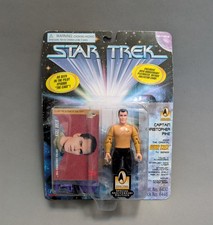
Selected fromStar Trek collectible oneBay.co.uk.

Endnotes
1.
Source: frontiersin.org
Link:https://www.frontiersin.org/journals/communication/articles/10.3389/fcomm.2026.1797425/full
Source snippet
FrontiersFrontiers | Designing the future: Star Trek as visual culture, speculative design, and imagination activator in human–technology...
2.
Source: sciencemuseum.org.uk
Title: Science Museum The invention of mobile phones | Science Museum
Link:https://www.sciencemuseum.org.uk/objects-and-stories/invention-mobile-phones
3.
Source: smithsonianmag.com
Link:https://www.smithsonianmag.com/innovation/from-the-brick-to-the-iphone-the-cellphone-celebrates-50-years-180981910/
Source snippet
Smithsonian MagazineFrom 'the Brick' to the iPhone, the Cellphone Celebrates 50 YearsApril 3, 2023...
Published: April 3, 2023
4.
Source: airandspace.si.edu
Title: star trek
Link:https://airandspace.si.edu/explore/stories/star-trek
Additional References
5.
Source: sciencefictionclassics.com
Title: Science Fiction Classics Star Trek’s Influence on the First Flip Phone
Link:https://www.sciencefictionclassics.com/star-treks-influence-on-the-first-flip-phone/
Source snippet
Star Trek’s Influence on the First Flip PhoneOctober 10, 2025 — STAR TREK’S INFLUENCE ON THE FIRST FLIP PHONE A look at how the communica...
Published: October 10, 2025
6.
Source: sfcq2.com
Title: [Treknology] The Iconic Communicator – Starfleet Command
Link:https://sfcq2.com/relay/features/treknology/treknology-the-iconic-communicator/
Source snippet
January 15, 2026 — [TREKNOLOGY] THE ICONIC COMMUNICATOR Treknology 354 SFCQ2 Comms January 15, 2026 Treknology add Few pieces of tech in...
Published: January 15, 2026
7.
Source: silodrome.com
Title: star trek starfleet communicator
Link:https://silodrome.com/star-trek-starfleet-communicator/
Source snippet
For Sale: An Original Star Trek Starfleet Communicator – $25,000+ USDOctober 1, 2023 — FOR SALE: AN ORIGINAL STAR TREK STARFLEET COMMUNIC...
Published: October 1, 2023
8.
Source: youtube.com
Title: Captain Kirk’s Communicator and the Birth of the Mobile Phone
Link:https://www.youtube.com/watch?v=lI8aW1npcS0
Source snippet
How William Shatner Changed the World - Martin Cooper, mobile phone Inventor...
9.
Source: youtube.com
Title: How William Shatner Changed the World
Link:https://www.youtube.com/watch?v=wN-_VA5HFwM
Source snippet
How the First Cell Phone Call Changed the World...
10.
Source: youtube.com
Link:https://www.youtube.com/watch?v=T3EN05faZVU
Source snippet
2002: William Shatner on Real-Life Technology Inspired by 'Star Trek'...
11.
Source: youtube.com
Title: The father of the cellphone | 60 Minutes Archive
Link:https://www.youtube.com/watch?v=GCyNwbzJofg
Source snippet
When Phones Were Fun: Nokia's Star Trek Communicator (2009)...
12.
Source: goodtimes.sc
Link:https://www.goodtimes.sc/cell-phone-inventor-martin-cooper/
13.
Source: si.edu
Link:https://www.si.edu/spotlight/phones?edan_fq%5B0%5D=-data_source%3A%22Archives+Center%2C+National+Museum+of+American+History%22&edan_fq%5B1%5D=-object_type%3A%22Telephones%22&page=3
14.
Source: sabrizain.org
Link:https://www.sabrizain.org/startrek/communicator.html