Within The War
When Martians Hit the Radio Waves
The 1938 radio adaptation showed how realistic alien invasion fiction could blur the boundary between entertainment and perceived reality.
On this page
- The simulated news format
- Claims of public panic examined
- Legacy for UFO culture
Page outline Jump by section
Introduction
The 1938 radio adaptation of The War of the Worlds became famous as the broadcast that supposedly convinced Americans that Martians had invaded Earth. The reality is more complicated: some listeners did mistake the programme for a genuine emergency, but later research suggests that the scale of the “mass panic” was greatly exaggerated. The event’s lasting importance lies less in a nationwide collapse into fear and more in the way a fictional performance demonstrated radio’s ability to make imagined extraterrestrial threats feel immediate and real.[Wikipedia]WikipediaThe War of the Worlds (1938 radio dramaThe War of the Worlds (1938 radio drama
Broadcast on 30 October 1938 by Orson Welles’s Mercury Theatre on the Air, the adaptation transformed H. G. Wells’s alien invasion story into a simulated news interruption. By using the language and sound of live reporting, it created a powerful example of fiction crossing into the territory of public belief. This made the programme a defining moment in the relationship between UFO culture and science fiction: it showed how stories about visitors from space could influence how audiences imagined real possibilities of extraterrestrial contact.[Wellesnet | The Orson Welles Resource]wellesnet.comthe war of the worlds radio scriptThe Orson Welles Resource'The War of the Worlds' radio script from October 30, 1938October 9, 2013…
The simulated news format
How the broadcast created realism
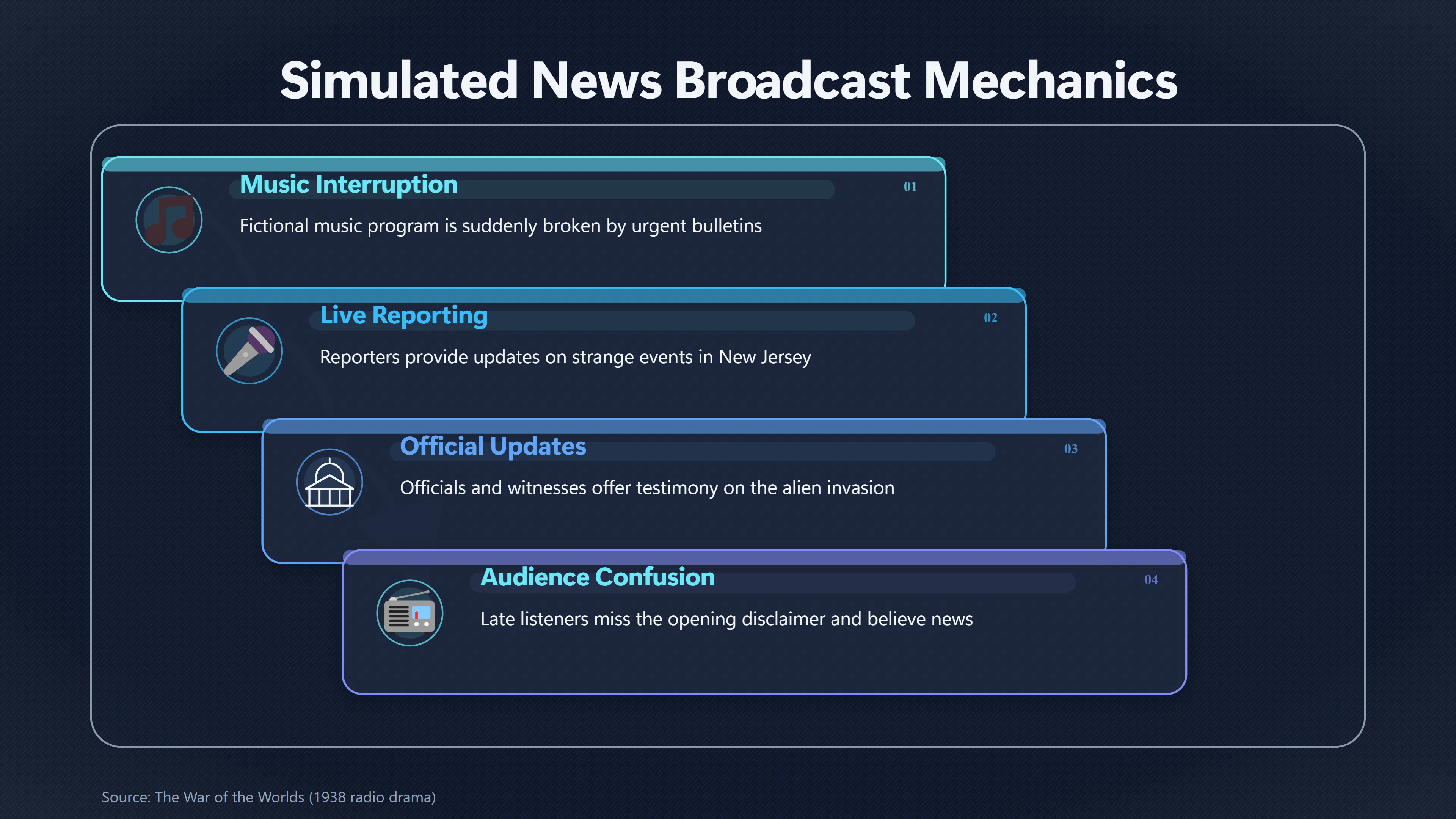
The programme’s unusual structure was central to its effect. Instead of presenting the story as a conventional radio drama with a clear sequence of scenes, the adaptation interrupted a fictional music programme with urgent “news bulletins” describing strange events in New Jersey. Reporters, officials and witnesses appeared to provide live updates as the imaginary invasion developed.[Wellesnet | The Orson Welles Resource]wellesnet.comthe war of the worlds radio scriptThe Orson Welles Resource'The War of the Worlds' radio script from October 30, 1938October 9, 2013…
The production relied on techniques that audiences already associated with serious radio journalism. In the late 1930s, radio had become a trusted source for breaking information, especially during moments of crisis. The realistic presentation style borrowed the authority of news broadcasting while applying it to science fiction. The result was not simply a story about aliens; it was a performance designed to feel like an unfolding event.[OUP Academic]academic.oup.comOUP AcademicRadio and the Intelligent Listener: The War of the Worlds Panic | Radio's Civic Ambition: American Broadcasting and Democracy…
One important factor was that some listeners joined the programme after it had already begun. The introduction identified the broadcast as a dramatic adaptation, but people who tuned in later could hear only the fictional emergency reports. The popularity of the rival Chase and Sanborn Hour also contributed to the confusion because some listeners switched channels during that programme and missed the opening explanation.[National Geographic]nationalgeographic.comwar of the worlds behind the panicNational Geographic'War of the Worlds': Behind the 1938 Radio Show Panic | National Geographic…
The broadcast therefore exploited a specific historical moment: radio was both entertainment and a trusted public information system. The audience was not merely reacting to a frightening story; some were responding to a format that resembled the emergency communications they expected during a real crisis.[OUP Academic]academic.oup.comOUP AcademicRadio and the Intelligent Listener: The War of the Worlds Panic | Radio's Civic Ambition: American Broadcasting and Democracy…
Claims of public panic examined
What people believed happened
Contemporary newspaper reports described dramatic scenes: frightened listeners calling police stations, leaving their homes, or preparing to escape the supposed invasion. These accounts created the enduring image of a country gripped by alien panic. A widely repeated version of the story suggested that millions of people accepted the Martian invasion as fact.[Princeton Alumni Weekly]princeton.eduAlumni Weekly Professor Hadley Cantril Studied Hysteria After ‘War of the Worlds’ | Princeton Alumni WeeklyPrinceton Alumni WeeklyProfessor Hadley Cantril Studied Hysteria After ‘War of the Worlds’ | Princeton Alumni WeeklySeptember 24, 2021
The first major academic study of the reaction, psychologist Hadley Cantril’s The Invasion from Mars (1940), estimated that around six million people heard the programme, that 1.7 million believed it was a news report, and that 1.2 million experienced fear or disturbance. Cantril’s work became the foundation for the traditional account of a major public panic.[Wikipedia]WikipediaThe War of the Worlds (1938 radio dramaThe War of the Worlds (1938 radio drama
However, later historians have challenged the scale and interpretation of those findings. Researchers Michael Socolow and A. Brad Schwartz have argued that the evidence does not support the idea of a nationwide outbreak of mass hysteria. Schwartz’s examination of listener responses and contemporary records found that many reactions involved confusion, curiosity, anger or concern rather than a belief that Earth was actually being invaded.[A. Brad Schwartz]abradschwartz.comA. Brad Schwartz BROADCAST HYSTERIA | A. Brad SchwartzA. Brad Schwartz BROADCAST HYSTERIA | A. Brad Schwartz
Why the panic story became so powerful
The legend of the broadcast panic was shaped partly by the reaction that followed the programme. Newspapers highlighted examples of frightened listeners and criticised radio’s growing influence, helping turn the event into a wider debate about whether broadcasters had too much power. The controversy was not only about aliens; it was about trust, technology and the responsibility of mass media.[The New Yorker]newyorker.comWhile the event is remembered for creating mass hysteria, researcher A. Brad Schwartz argues it was exaggerated by the newspapers to unde…
Some historians argue that newspapers had reasons to emphasise the idea of widespread panic because radio was becoming a major competitor for public attention. By portraying radio audiences as easily misled, critics could question the reliability of the newer medium. The debate reflected broader 1930s concerns about propaganda, persuasion and whether citizens could critically evaluate powerful forms of communication.[OUP Academic]academic.oup.comOUP AcademicRadio and the Intelligent Listener: The War of the Worlds Panic | Radio's Civic Ambition: American Broadcasting and Democracy…
This does not mean nobody was frightened. Some listeners genuinely misunderstood the programme, and the realistic presentation produced real moments of anxiety. The historical correction is that isolated cases of confusion should not automatically be treated as proof of a national psychological collapse.[A. Brad Schwartz]abradschwartz.comA. Brad Schwartz BROADCAST HYSTERIA | A. Brad SchwartzA. Brad Schwartz BROADCAST HYSTERIA | A. Brad Schwartz
Legacy for UFO culture
The importance of the 1938 broadcast extends beyond the question of how many people panicked. It became a cultural example of how fictional alien scenarios could shape expectations about extraterrestrial encounters. By making a Martian invasion sound like a current event, the programme demonstrated that science fiction could influence the emotional and interpretive frameworks people used when thinking about unknown phenomena.[OUP Academic]academic.oup.comOUP AcademicRadio and the Intelligent Listener: The War of the Worlds Panic | Radio's Civic Ambition: American Broadcasting and Democracy…
This became especially significant as UFO culture developed after the Second World War. Reports of unexplained objects in the sky were often interpreted through ideas already familiar from science fiction: advanced visitors from other worlds, mysterious technology and possible threats from beyond Earth. The 1938 broadcast did not create belief in UFOs, but it showed how strongly fictional representations of aliens could affect public imagination.[Princeton University]princeton.eduPrinceton UniversityHistory Ph.D. student Schwartz: ‘War of the Worlds’ still resonates 80 years laterOctober 15, 2018…
The broadcast also remains a key case study in the boundary between fiction and reality. Its lesson is not simply that audiences can be fooled. Instead, it reveals a more complex relationship between storytelling, technology and belief: realistic fiction can borrow the authority of real-world communication systems, while audiences interpret unfamiliar possibilities through stories they already know.[A. Brad Schwartz]abradschwartz.comA. Brad Schwartz BROADCAST HYSTERIA | A. Brad SchwartzA. Brad Schwartz BROADCAST HYSTERIA | A. Brad Schwartz
For UFO culture and science fiction, the 1938 War of the Worlds adaptation became a landmark because it showed the social power of an imagined alien encounter. The Martians never arrived, but the broadcast proved that a carefully constructed fictional arrival from space could produce a very real conversation about fear, trust and humanity’s place in the universe.[Princeton University]princeton.eduPrinceton UniversityHistory Ph.D. student Schwartz: ‘War of the Worlds’ still resonates 80 years laterOctober 15, 2018…
Amazon book picks
Further Reading
Books and field guides related to When Martians Hit the Radio Waves. Use these as the next step if you want deeper reading beyond the article.
Broadcast Hysteria: Orson Welles's War of the Worlds and the...
On the evening of October 30, 1938, radio listeners across the United States heard a startling report of a meteor strike in the New Jerse...
The War of the Worlds
The War of the Worlds (1898), by H. G. Wells, is an early science fiction novel which describes an invasion of England by aliens from Mar...
The War of the Worlds: From H. G. Wells to Orson Welles, Jeff...
First published in 1897, H.G. Wells's alien invasion narrative The War of the Worlds was a landmark work of science fiction and one that...

The Martians Are Coming!: The True Story of Orson Welles' 193...
First published 2011.
eBay marketplace picks
Marketplace Samples
Live-tested eBay searches with available results related to this page.
Selected fromalien invasion poster oneBay.co.uk.


Endnotes
1.
Source: Wikipedia
Title: The War of the Worlds (1938 radio drama)
Link:https://en.wikipedia.org/wiki/The_War_of_the_Worlds_%281938_radio_drama%29
2.
Source: wellesnet.com
Title: the war of the worlds radio script
Link:https://wellesnet.com/the-war-of-the-worlds-radio-script/
Source snippet
The Orson Welles Resource'The War of the Worlds' radio script from October 30, 1938October 9, 2013...
Published: October 30, 1938
3.
Source: academic.oup.com
Link:https://academic.oup.com/book/3693/chapter-abstract/145077697
Source snippet
OUP AcademicRadio and the Intelligent Listener: The War of the Worlds Panic | Radio's Civic Ambition: American Broadcasting and Democracy...
4.
Source: paw.princeton.edu
Link:https://paw.princeton.edu/article/professor-hadley-cantril-studied-hysteria-after-[war-worlds
Source snippet
Princeton Alumni WeeklyProfessor Hadley Cantril Studied Hysteria After ‘War of the Worlds’ | Princeton Alumni WeeklySeptember 24, 2021...
Published: September 24, 2021
5.
Source: princeton.edu
Link:https://www.princeton.edu/news/2018/10/15/history-phd-student-schwartz-war-worlds-still-resonates-80-years-later
Source snippet
Princeton UniversityHistory Ph.D. student Schwartz: ‘War of the Worlds’ still resonates 80 years laterOctober 15, 2018...
Published: October 15, 2018
6.
Source: space.com
Link:https://www.space.com/42287-war-of-the-worlds-broadcast-alien-invasion-reaction.html
7.
Source: wellesnet.com
Title: National Archives: The FCC and ‘The War of the Worlds’ radio broadcast
Link:https://wellesnet.com/national-archives-the-fcc-and-the-war-of-the-worlds-radio-broadcast/
8.
Source: wellesnet.com
Title: the aftermath orson welles the war of the worlds halloween press conference 1938
Link:https://wellesnet.com/the-aftermath-orson-welles-the-war-of-the-worlds-halloween-press-conference-1938/
9.
Source: war-of-the-worlds.org
Link:https://www.war-of-the-worlds.org/Radio/Newspapers/Oct31/FCC.html
10.
Source: war-of-the-worlds.org
Link:https://www.war-of-the-worlds.org/Radio/Original.shtml
11.
Source: abradschwartz.com
Title: A. Brad Schwartz BROADCAST HYSTERIA | A. Brad Schwartz
Link:https://abradschwartz.com/broadcast-hysteria/
12.
Source: nationalgeographic.com
Title: war of the worlds behind the panic
Link:https://www.nationalgeographic.com/science/article/war-of-the-worlds-behind-the-panic
Source snippet
National Geographic'War of the Worlds': Behind the 1938 Radio Show Panic | National Geographic...
13.
Source: newyorker.com
Link:https://www.newyorker.com/magazine/2017/09/04/the-fake-news-fallacy
Source snippet
While the event is remembered for creating mass hysteria, researcher A. Brad Schwartz argues it was exaggerated by the newspapers to unde...
14.
Source: entertainment.howstuffworks.com
Title: war of the worlds
Link:https://entertainment.howstuffworks.com/arts/literature/war-of-the-worlds.htm
15.
Source: theory-practice.sydney.edu.au
Title: the invasion from mars a study in the psychology of panic 1940 by hadley cantril
Link:https://theory-practice.sydney.edu.au/2018/11/the-invasion-from-mars-a-study-in-the-psychology-of-panic-1940-by-hadley-cantril/
16.
Source: radiolab.org
Title: War of the Worlds
Link:https://radiolab.org/podcast/war-worlds/transcript
17.
Source: abcnews.go.com
Link:https://abcnews.go.com/US/80-years-orson-welles-war-worlds-radio-broadcast/story?id=58826359
18.
Source: history.com
Title: inside the war of the worlds broadcast
Link:https://www.history.com/articles/inside-the-war-of-the-worlds-broadcast
19.
Source: pbs.org
Link:https://www.pbs.org/wgbh/americanexperience/films/worlds/
20.
Source: history.com
Title: welles scares nation
Link:https://www.history.com/this-day-in-history/October-30/welles-scares-nation
21.
Source: abradschwartz.com
Link:https://abradschwartz.com/blog/
22.
Source: books.google.com
Title: The Invasion From Mars
Link:https://books.google.com/books/about/The_Invasion_From_Mars.html?id=2c2-k6AvQtQC
23.
Source: jeff560.tripod.com
Link:https://jeff560.tripod.com/script.html
Additional References
24.
Source: youtube.com
Link:https://www.youtube.com/watch?v=jIzfXRAs7G8
Source snippet
1938 War of the Worlds radio panic myth reality Orson Welles Orson Welles' Broadcast That Terrified a Nation: 'War of the Worlds' 1938 Wh...
25.
Source: youtube.com
Title: Was There Really a Mass Panic as a Result of the War of the Worlds Broadcast?
Link:https://www.youtube.com/watch?v=V4uL7gP94rI
Source snippet
Chapter 1 | War of the Worlds | AMERICAN EXPERIENCE | PBS...
26.
Source: youtube.com
Title: Orson Welles: The ‘alien invasion’ that fooled America
Link:https://www.youtube.com/watch?v=BkG70_wa4a8
Source snippet
The War of the Worlds Panic of 1938 — How a Radio Drama Broke Reality...
27.
Source: archives.gov
Link:https://www.archives.gov/publications/prologue/2003/fall/[war-of-worlds
28.
Source: researchgate.net
Link:https://www.researchgate.net/publication/402440894_Critical_Communication_History_Checking_Up_on_The_Invasion_from_Mars_Hadley_Cantril_Paul_Lazarsfeld_and_the_Making_of_a_Misremembered_Classic
29.
Source: publishersweekly.com
Link:https://www.publishersweekly.com/9780809031610
30.
Source: researchgate.net
Link:https://www.researchgate.net/publication/298465677_Checking_Up_on_The_Invasion_from_Mars_Hadley_Cantril_Paul_F_Lazarsfeld_and_the_Making_of_a_Misremembered_Classic
31.
Source: ijoc.org
Link:https://ijoc.org/index.php/ijoc/article/view/2117
32.
Source: orwellsociety.com
Link:https://orwellsociety.com/the-invasion-from-mars-a-study-in-the-psychology-of-panic/
33.
Source: paperzz.com
Link:https://paperzz.com/doc/8145418/the-invasion-from-mars