Within Science fiction alien
How the Xenomorph Redefined Alien Horror
The Xenomorph changed alien design by presenting a creature with its own biology, instincts and unsettling evolutionary logic.
On this page
- Giger's biomechanical creature design
- Alien biology and behaviour
- Influence on later extraterrestrials
Page outline Jump by section
Introduction
The Xenomorph changed science fiction alien design by making the extraterrestrial less like a visitor from another world and more like a disturbing form of life with its own evolutionary logic. First appearing in Ridley Scott’s Alien (1979), the creature combined H.R. Giger’s biomechanical artwork with ideas from horror, biology and industrial design to create an alien that felt neither human nor simply monstrous. Its influence came not only from its appearance, but from the way its body suggested a complete ecosystem: a predator with reproduction, adaptation, instincts and a relationship to its environment.[National Science and Media Museum blog]blog.scienceandmediamuseum.org.ukNational Science and Media Museum blogDesigning Fear in Alien: The Art of Giger's Xenomorph – National Science and Media Museum blogSepte…
Before the Xenomorph, many science fiction aliens were designed around recognisable categories: humanoids, invaders, mutants or symbolic representations of social fears. The Xenomorph pushed alien design towards something more biologically alien, helping redefine how audiences imagined non-human life in fiction. It became a key turning point in the evolution of extraterrestrial horror, where the fear came from confronting a creature that did not share human values, emotions or physical assumptions.
Giger’s biomechanical creature design
A body that looked neither machine nor animal
The Xenomorph’s most important innovation was its visual contradiction. H.R. Giger’s design fused organic and mechanical forms, creating what became known as a biomechanical aesthetic. Instead of showing an alien with obvious eyes, expressions or human-like features, Giger created a creature dominated by an elongated skull, smooth black surfaces, skeletal structures and industrial-looking textures. The result suggested a life form that had evolved along a completely different path from Earth organisms.[National Science and Media Museum blog]blog.scienceandmediamuseum.org.ukNational Science and Media Museum blogDesigning Fear in Alien: The Art of Giger's Xenomorph – National Science and Media Museum blogSepte…
Ridley Scott was drawn to Giger’s earlier artwork Necronom IV (1976), which provided the foundation for the final creature. Giger’s illustration already contained many of the characteristics that defined the film version: an extended head, mechanical-looking anatomy and a mixture of elegance and menace. Scott saw that the design could achieve something unusual in science fiction: a creature that was frightening precisely because it did not fit familiar categories of animal, machine or humanoid.[VICE]vice.comHow H.R. Giger Invented Sci-Fi's Most Terrifying MonsterHow H.R. Giger Invented Sci-Fi's Most Terrifying MonsterOctober 16, 2016…
This approach changed the purpose of alien appearance. Earlier creatures often communicated their nature immediately through visual symbols: a Martian might look strange because it had tentacles, unusual skin or an oversized brain. The Xenomorph instead withheld information. Its smooth exoskeleton and hidden facial features created uncertainty, making viewers study its shape without fully understanding what they were seeing. The creature’s design created fear through ambiguity rather than simple recognition.
Horror through physical presence
The practical construction of the Xenomorph was also central to its impact. The creature was not simply an illustration translated onto a screen; it was built as a physical performer-driven design. The suit, movement and camera work gave the alien weight and unpredictability, allowing it to appear as a living organism rather than an animated effect. Creature performers and effects artists later continued this tradition, arguing that physical creatures create a distinctive relationship between actor, camera and audience.[Vanity Fair]vanityfair.comKnown for his dedication, Woodruff often endured significant discomfort while in the suit, such as being unable to take lunch breaks, go…
The decision to avoid a clearly visible face was especially significant. Human audiences often read emotion through eyes and expressions, but the Xenomorph removed those familiar signals. This made the creature difficult to interpret psychologically. It did not appear angry, frightened or curious in human terms; it simply acted according to survival and reproduction. That absence of readable emotion became one of its defining horror elements.
Alien biology and behaviour
The Xenomorph as an evolutionary nightmare
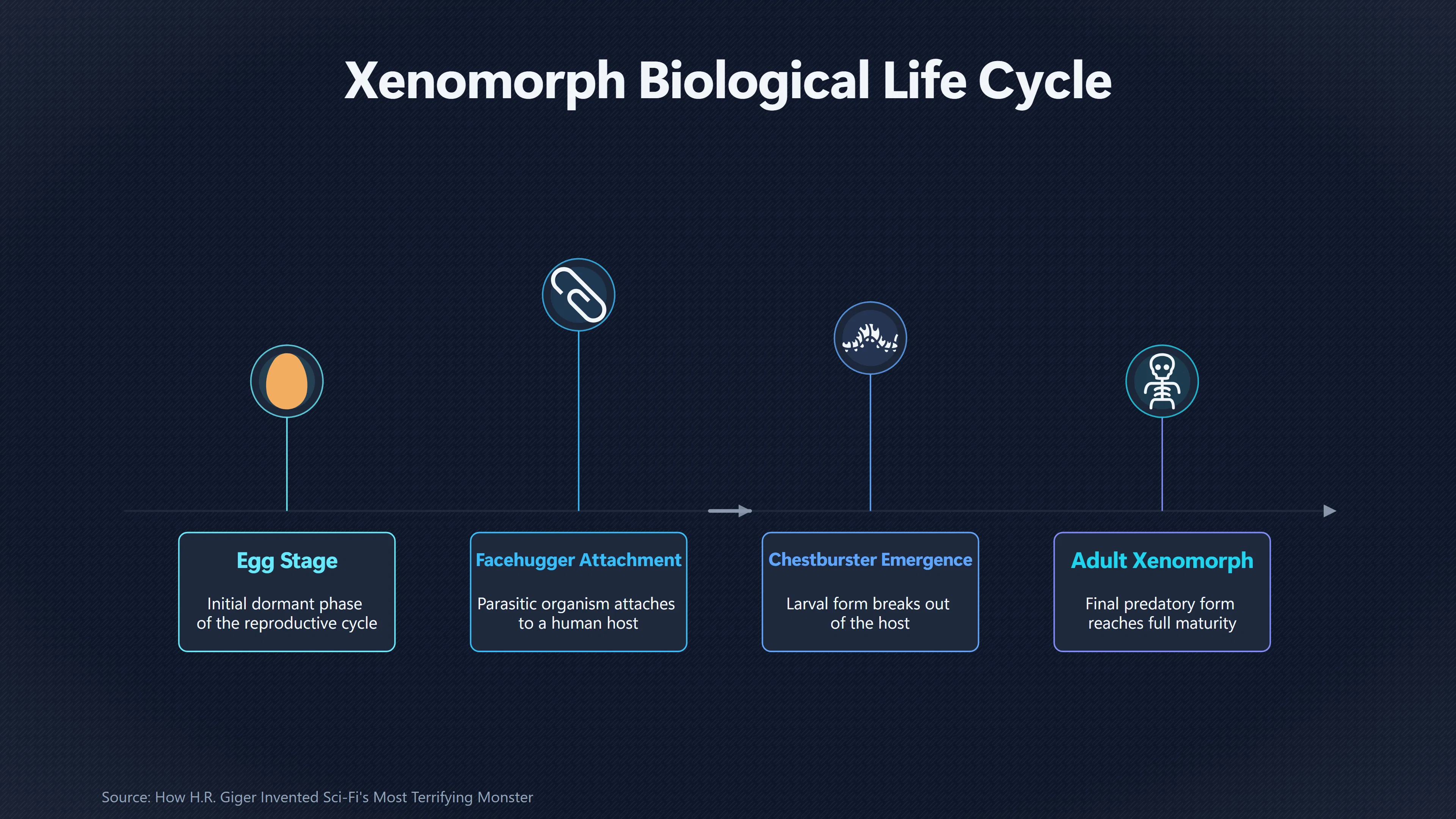
The Xenomorph became influential because it was designed less as a monster and more as a species. In Alien, the creature’s terror comes from the suggestion that it has a complete biological system. The egg, facehugger, chestburster and adult forms present a life cycle that is disturbing but internally consistent. Rather than appearing as a random supernatural threat, the alien behaves like an organism adapted for survival.
Its reproductive process is particularly important to its horror identity. The facehugger stage turns human bodies into part of the creature’s development, creating a violation of familiar biological boundaries. The result is not simply an attack by a predator; it is an encounter with a life form whose evolutionary strategy conflicts completely with human expectations.
The creature’s acid-like blood, protective outer structure and predatory behaviour further reinforced the idea of an organism optimised for survival. The famous description of the Xenomorph as the “perfect organism” in the film reflects this theme: the alien is frightening because it represents biological efficiency without morality or empathy.
From monster to ecosystem
Later entries in the franchise expanded the idea that the Xenomorph was shaped by biology rather than fantasy. Different versions of the creature introduced variations connected to hosts, environments and artificial experimentation, reinforcing the idea that the species could adapt rather than remain a fixed monster design. Recent interpretations have continued exploring the creature as part of a wider ecosystem, emphasising its role as a predator rather than only a cinematic villain.[GamesRadar+]gamesradar.comShowrunner Noah Hawley, while preserving H.R. Giger’s recognizable silhouette, subtly redesigns the alien with functional and biological…
This focus on adaptation influenced later science fiction. Many modern extraterrestrials are no longer designed simply as strange-looking beings. Instead, creators often ask evolutionary questions: How would the creature move? How would it reproduce? What environment shaped it? What biological pressures produced its abilities? The Xenomorph helped make these questions central to alien design.

Influence on later extraterrestrials
Moving beyond humanoid aliens
The Xenomorph’s greatest legacy was changing expectations about what an alien could be. Science fiction had long relied on humanoid creatures because actors could portray them easily and audiences could relate to their faces and behaviour. The Xenomorph demonstrated that an alien could be compelling without human resemblance or understandable motivations.
Its influence can be seen across film, games and visual media, where extraterrestrial creatures increasingly became stranger, more animalistic and less dependent on human anatomy. Designers began using unfamiliar body plans, unusual life cycles and ecological relationships to create believable fictional species.
The creature also strengthened the connection between UFO culture and science fiction imagination. While the Xenomorph was entirely fictional, it became part of the wider cultural language used to imagine what an unknown extraterrestrial life form might represent. Unlike the familiar “grey alien” image associated with UFO folklore, the Xenomorph represented a different possibility: not a mysterious visitor seeking communication, but an alien life form whose biology itself was the source of fear.
Why the design remains influential
The Xenomorph endured because it solved a difficult creative problem: making something truly alien while still allowing audiences to understand its danger. It was recognisable as a living creature but unfamiliar enough to suggest an entirely different evolutionary history.
Its importance lies in that balance. Giger’s design introduced a new visual language for extraterrestrials, while the creature’s behaviour introduced a new narrative model in which alien life was not a reflection of humanity but a separate biological force. The Xenomorph transformed alien horror from a question of appearance into a question of existence: what might life become when it evolves under completely different rules?[National Science and Media Museum blog]blog.scienceandmediamuseum.org.ukNational Science and Media Museum blogDesigning Fear in Alien: The Art of Giger's Xenomorph – National Science and Media Museum blogSepte…
Amazon book picks
Further Reading
Books and field guides related to How the Xenomorph Redefined Alien Horror. Use these as the next step if you want deeper reading beyond the article.
The Science Of Aliens
If extraterrestrials ever landed on Earth, they would find us extremely strange. Their first intimation of our existence might well be a...
H. R. Giger's Alien
First published 1979. Subjects: Alien (Motion picture), Cinematography, Special effects, Fantasy in art, Swiss Painting.
Alien - the Archive
Alien is a science fiction milestone and one of the most thrilling, terrifying, and beautiful film franchises of all time. Alien: The Arc...
eBay marketplace picks
Marketplace Samples
Live-tested eBay searches with available results related to this page.
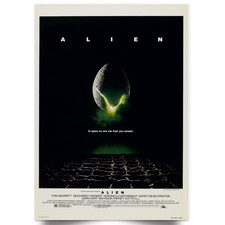
Selected fromAlien movie poster oneBay.co.uk.
Endnotes
1.
Source: vice.com
Title: How H.R. Giger Invented Sci-Fi’s Most Terrifying Monster
Link:https://www.vice.com/en/article/taschen-monograph-the-magnum-opus-of-hr-giger/
Source snippet
How H.R. Giger Invented Sci-Fi's Most Terrifying MonsterOctober 16, 2016...
Published: October 16, 2016
2.
Source: gamesradar.com
Link:https://www.gamesradar.com/entertainment/horror-shows/alien-earth-team-says-the-new-shows-xenomorph-is-an-animal-in-an-ecosystem-with-other-predatory-creatures-and-explains-the-subtle-design-differences/
Source snippet
Showrunner Noah Hawley, while preserving H.R. Giger’s recognizable silhouette, subtly redesigns the alien with functional and biological...
3.
Source: blog.scienceandmediamuseum.org.uk
Link:https://blog.scienceandmediamuseum.org.uk/designing-fear-in-alien-the-art-of-gigers-xenomorph/
Source snippet
National Science and Media Museum blogDesigning Fear in Alien: The Art of Giger's Xenomorph – National Science and Media Museum blogSepte...
4.
Source: vanityfair.com
Link:https://www.vanityfair.com/hollywood/2017/05/alien-xenomorph-actor
Source snippet
Known for his dedication, Woodruff often endured significant discomfort while in the suit, such as being unable to take lunch breaks, go...
5.
Source: simonandschuster.com.au
Title: Giger’s Alien | Book by H
Link:https://www.simonandschuster.com.au/books/Gigers-Alien/H-R-Giger/9781835416570
Source snippet
R. Giger | Official Publisher Page | Simon & Schuster AUSeptember 1, 2026 — Image: Giger's Alien Image: Giger's Alien GIGER'S ALIEN Illus...
Published: September 1, 2026
6.
Source: avpcentral.com
Title: alien 1979
Link:https://www.avpcentral.com/alien-1979
7.
Source: framerated.co.uk
Title: alien 1979
Link:https://www.framerated.co.uk/alien-1979/
8.
Source: deepfocusreview.com
Link:https://www.deepfocusreview.com/definitives/alien/
9.
Source: hrgiger.com
Link:https://www.hrgiger.com/alien.htm
11.
Source: hrgigermuseum.com
Link:https://www.hrgigermuseum.com/about
Additional References
12.
Source: penguinrandomhouse.com
Title: Giger’s Alien by H.R
Link:https://www.penguinrandomhouse.com/books/828014/gigers-alien-by-h-r-giger/
Source snippet
Giger: 9781835416570 | PenguinRandomHouse.com: BooksSeptember 1, 2026 — Image: Giger's Alien by H.R. Giger Image Best Seller GIGER'S ALIE...
Published: September 1, 2026
13.
Source: youtube.com
Link:https://www.youtube.com/watch?v=LjX2gg6JNfU
Source snippet
The Impossible Build: How They Made the Alien Suit...
14.
Source: wired.com
Title: How H.R
Link:https://www.wired.com/2016/09/h-r-giger-made-aliens-monster-beautiful-terrifying
Source snippet
Giger Made Alien's Monster Beautiful and TerrifyingThe 1979 film "Alien" featured a groundbreaking monster, the Xenomorph, designed by Sw...
15.
Source: researchgate.net
Link:https://www.researchgate.net/publication/376669505_Science_fiction_The_biology_of_the_alien_in_Alien
16.
Source: youtube.com
Title: The Impossible Build: How They Made the Alien Suit
Link:https://www.youtube.com/watch?v=hGWwnlR3_-Q
Source snippet
The Evolution Of The Xenomorph (Animated)...
17.
Source: youtube.com
Title: Alien: The Origins Of Giger’s Xenomorph
Link:https://www.youtube.com/watch?v=fuOtTH_31Fk
Source snippet
The Architecture of Fear: Giger's Biomechanical Legacy...
18.
Source: avpcentral.com
Title: Drone Xenomorph: Behavior, Biology & Warrior Differences | Av P Central
Link:https://www.avpcentral.com/drone-xenomorph
19.
Source: avpcentral.com
Title: Xenomorph Motivations: What Do The Xenomorphs Want? | Av P Central
Link:https://www.avpcentral.com/xenomorph-motivations-what-xenomorphs-want
20.
Source: avpcentral.com
Title: Xenomorph Anatomy: Exploring The Biology Of Aliens | Av P Central
Link:https://www.avpcentral.com/xenomorph-anatomy-and-biology-explored
21.
Source: avpcentral.com
Title: DN A Reflex: How Xenomorphs Inherit Host Traits | Av P Central
Link:https://www.avpcentral.com/dna-reflex-explained