Within UFO imagery
Why Flying Saucers Became UFO Icons
The flying saucer became a visual symbol of the unknown by combining futuristic technology, mystery and unfamiliar movement.
On this page
- From reports to visual symbol
- Shapes that suggest unknown technology
- Design influence across science fiction
Page outline Jump by section
Introduction
The flying saucer became a UFO icon because its design offered a simple visual answer to a difficult imaginative problem: how to show technology that appears advanced, but is still completely unfamiliar. The disc-shaped craft combined the smoothness of futuristic engineering with the mystery of an object that did not behave like ordinary aircraft. Its circular body, silent arrival and unusual movement made it a powerful symbol of the unknown in science fiction, where it could represent invasion, discovery, communication or a challenge to human understanding.[HISTORY TV Nederland]history.comTV Nederland Kenneth ArnoldHISTORY TV NederlandKenneth Arnold - UFO, 1947 & Flying Saucer | HISTORYFebruary 22, 2010…
The importance of the saucer shape was not that it proved anything about unidentified objects in the sky. Rather, it created a shared visual language. Once the image entered newspapers, magazines, films and artwork after the 1947 flying saucer reports, audiences quickly learned to associate a hovering disc with extraterrestrial technology. That connection became one of the strongest examples of science fiction imagery shaping how people imagine the unknown.[HISTORY TV Nederland]history.comTV Nederland Kenneth ArnoldHISTORY TV NederlandKenneth Arnold - UFO, 1947 & Flying Saucer | HISTORYFebruary 22, 2010…
From reports to visual symbol
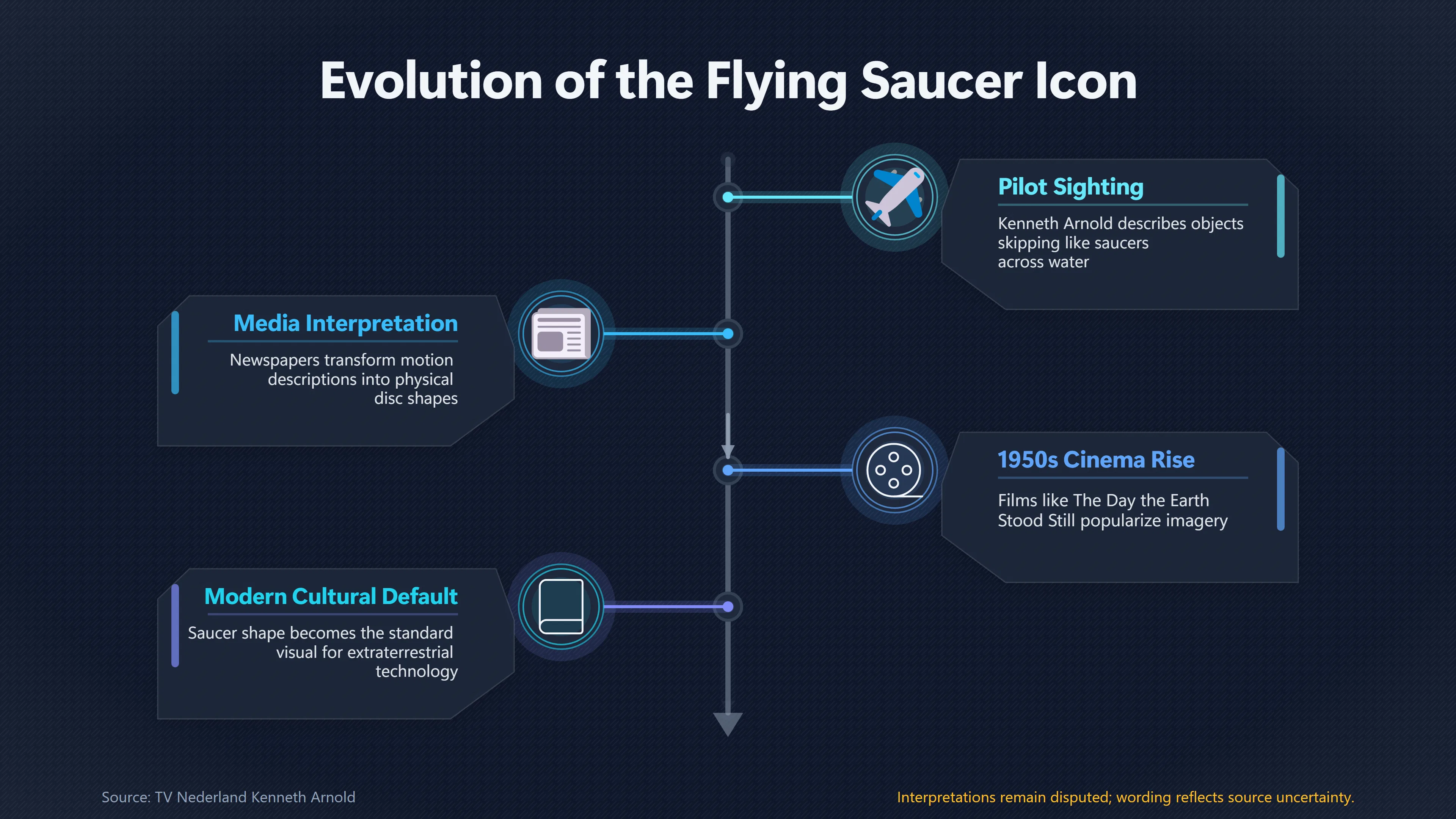
The modern flying saucer image developed through a mixture of observation, media interpretation and artistic adaptation. In 1947, pilot Kenneth Arnold reported seeing unusual objects near Mount Rainier and described their movement as similar to a saucer skipping across water. Newspapers transformed this description of motion into the idea that the objects themselves were saucer-shaped, helping popularise the phrase “flying saucer”.[HISTORY TV Nederland]history.comTV Nederland Kenneth ArnoldHISTORY TV NederlandKenneth Arnold - UFO, 1947 & Flying Saucer | HISTORYFebruary 22, 2010…
This shift from movement to shape was crucial. A technical description of an unknown aircraft would have been difficult for the public to visualise, but a familiar object such as a saucer provided an immediate mental picture. The design was memorable because it looked both simple and impossible: a flat disc seemed too unconventional to be a normal aircraft, yet too structured to be a natural phenomenon.
Science fiction artists and filmmakers then reinforced the image. The saucer fitted naturally into a period fascinated by rockets, atomic energy and emerging aerospace technology. Unlike traditional rockets, which suggested a human-built machine travelling along a known path, the saucer appeared capable of hovering, changing direction and arriving without warning. These imagined abilities gave the shape symbolic power: it represented a technology beyond human control or comprehension.
The association became stronger as UFO reports, pulp science fiction and cinema influenced one another. By the 1950s, “flying saucer” was no longer just a description of a reported object; it had become a visual category for alien machines in popular culture. The Smithsonian notes that the term eventually carried the same extraterrestrial associations later attached to the broader word “UFO”.[Smithsonian Magazine]smithsonianmag.comOpen source on smithsonianmag.com.
Shapes that suggest unknown technology
The saucer’s design worked because its geometry communicated several ideas at once. A circular craft has no obvious front or back, making it difficult to understand how it moves. This challenged conventional expectations about aircraft, which usually have wings, tails or visible propulsion systems. In science fiction, that absence became part of the mystery.
The smooth surface of the saucer also suggested a level of technology beyond visible machinery. Designers often removed familiar details such as engines, rivets or mechanical parts, replacing them with polished metal, glowing lights and seamless curves. The result was a machine that looked advanced precisely because it concealed how it worked.
This design language appeared clearly in films of the 1950s. In The Day the Earth Stood Still (1951), a flying saucer lands in Washington, DC, presenting an alien spacecraft as a dramatic public event rather than simply a distant object. The craft’s clean, controlled appearance supported the film’s themes of technological superiority, uncertainty and humanity’s reaction to a visitor from beyond Earth.[The New Yorker]newyorker.comThe New Yorker The Day the Earth Stood Still | The New YorkerThe New YorkerThe Day the Earth Stood Still | The New YorkerOctober 13, 2011…
The same design could also carry different meanings depending on how filmmakers used it. A dark, threatening saucer approaching a city could symbolise invasion and vulnerability, reflecting Cold War fears about surprise attacks and unfamiliar weapons. A luminous or carefully presented craft could instead represent contact, curiosity and the possibility of communication. The shape remained the same, but its emotional meaning changed through lighting, scale, sound and narrative context.
Design influence across science fiction
Once established, the flying saucer became a reusable visual tool across science fiction. Its greatest strength was flexibility: a single silhouette could suggest danger, wonder or mystery without requiring a long explanation. Viewers immediately understood that a saucer was not an ordinary vehicle; it belonged to a different technological world.
Later films expanded the meaning of the spacecraft while keeping elements of the classic design language. Close Encounters of the Third Kind (1977), for example, moved away from the purely threatening UFO and emphasised spectacle, light and communication. The spacecraft became less like an attacking machine and more like a symbol of an encounter with something beyond ordinary human experience.[The New Yorker]newyorker.comThe New Yorker The Day the Earth Stood Still | The New YorkerThe New YorkerThe Day the Earth Stood Still | The New YorkerOctober 13, 2011…
The design also influenced artwork beyond cinema. Illustrators, magazine publishers and advertising designers repeatedly used discs, domes and glowing circular forms because audiences had already learned their meaning. The saucer became a shortcut for ideas about alien intelligence, future technology and humanity’s place in the universe.
However, the popularity of the shape also created a tension. Because science fiction repeatedly used the saucer as the default alien spacecraft, the image began to influence expectations about UFO reports themselves. The Smithsonian’s analysis of UFO culture highlights how decades of popular representation helped make extraterrestrial explanations the default association for mysterious objects in the sky.[Smithsonian Magazine]smithsonianmag.comOpen source on smithsonianmag.com.
The flying saucer therefore became an icon not because the shape was scientifically established, but because it was visually effective. Its design balanced familiarity and strangeness: simple enough to recognise instantly, but unusual enough to suggest technology beyond human experience. That combination allowed the saucer to become one of science fiction’s most enduring symbols of the unknown.
Amazon book picks
Further Reading
Books and field guides related to Why Flying Saucers Became UFO Icons. Use these as the next step if you want deeper reading beyond the article.
UFO Drawings from the National Archives
Originally set up after a request from Winston Churchill, the Ministry of Defence?s UFO Desk ran for over 60 years, collating mysterious...
The UFO Book: Encyclopedia of the Extraterrestrial
The UFO Book includes a historical overview of UFO phenomenon, an overview of its terminology roots, and in- depth information regarding...
Science Fiction of the 20th Century: An Illustrated History
Newly reprinted and redesigned, this special edition is vividly illustrated with images of film posters, magazines, and books. From dime...
The Art of the Pulps: An Illustrated History
Experts in the ten major Pulp genres, from action Pulps to spicy Pulps and more, chart for the first time the complete history of Pulp ma...
eBay marketplace picks
Marketplace Samples
Live-tested eBay searches with available results related to this page.
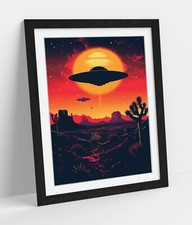
Selected fromflying saucer print oneBay.co.uk.


Endnotes
1.
Source: history.com
Title: TV Nederland Kenneth Arnold
Link:https://www.history.com/articles/kenneth-arnold
Source snippet
HISTORY TV NederlandKenneth Arnold - UFO, 1947 & Flying Saucer | HISTORYFebruary 22, 2010...
Published: February 22, 2010
2.
Source: history.com
Title: UF Os and Alien Invasions in Film
Link:https://www.history.com/articles/ufos-and-alien-invasions-in-film
3.
Source: smithsonianmag.com
Link:https://www.smithsonianmag.com/air-space-magazine/ufos-uapswhatever-we-call-them-why-do-we-assume-mysterious-flying-objects-are-extraterrestrial-180978374/
4.
Source: newyorker.com
Title: The New Yorker The Day the Earth Stood Still | The New Yorker
Link:https://www.newyorker.com/goings-on-about-town/movies/the-day-the-earth-stood-still
Source snippet
The New YorkerThe Day the Earth Stood Still | The New YorkerOctober 13, 2011...
Published: October 13, 2011
5.
Source: smithsonianmag.com
Title: Half a century after “Close Encounters of the Third Kind,” the directo
Link:https://www.smithsonianmag.com/history/whats-behind-steven-spielbergs-lifelong-obsession-with-flying-saucers-and-extraterrestrial-visitors-180988903/
Source snippet
The Alien Inspiration Behind Steven Spielberg's 'Disclosure Day'June 11, 2026 — History | June 11, 2026 WHAT’S BEHIND STEVEN SPIELBERG’S...
Published: June 11, 2026
6.
Source: smithsonianmag.com
Title: Fragments of Famed ‘UFO’ Discovered in Archives of London Museum
Link:https://www.smithsonianmag.com/smart-news/fragments-famed-ufo-discovered-archives-london-museum-180968198/
7.
Source: smithsonianmag.com
Title: How UFO Reports Change With the Technology of the Times
Link:https://www.smithsonianmag.com/history/how-ufo-reports-change-with-technology-times-180968011/
8.
Source: smithsonianmag.com
Title: in 1947 high altitude balloon crash landed roswell aliens never left 180963917
Link:https://www.smithsonianmag.com/smithsonian-institution/in-1947-high-altitude-balloon-crash-landed-roswell-aliens-never-left-180963917/
9.
Source: smithsonianmag.com
Title: Roswell, “The Genesis Story of U.S. UFOs”
Link:https://www.smithsonianmag.com/air-space-magazine/roswell-the-genesis-story-of-us-ufos-140945396/
10.
Source: smithsonianmag.com
Title: Crop Circles: The Art of the Hoax
Link:https://www.smithsonianmag.com/arts-culture/crop-circles-the-art-of-the-hoax-2524283/?page=1
11.
Source: tcm.com
Title: The Day the Earth Stood Still
Link:https://www.tcm.com/articles/145423/the-day-the-earth-stood-still
12.
Source: ultimatepopculture.fandom.com
Title: Flying saucer
Link:https://ultimatepopculture.fandom.com/wiki/Flying_saucer
Additional References
13.
Source: skyatnightmagazine.com
Title: Why are we so obsessed with UFOs?
Link:https://www.skyatnightmagazine.com/space-science/why-are-we-so-obssessed-with-ufos
Source snippet
A history of flying saucers and why they continue to fascinate us | BBC Sky at Night MagazineMay 11, 2026 — EARLY UNEXPLAINED [SIGHTINGS]({{ 'sightings/' | relative_url }}) C...
Published: May 11, 2026
14.
Source: skyatnightmagazine.com
Title: A history of flying saucers and UFOs | BBC Sky at Night Magazine
Link:https://www.skyatnightmagazine.com/space-science/flying-saucers-ufo-history
Source snippet
No, I come at this from that very perspective. I make it very clear from the start, I'm not...
15.
Source: d23.com
Title: 20th century fox spooktacular 1950s the day the earth stood still
Link:https://d23.com/20th-century-fox-spooktacular-1950s-the-day-the-earth-stood-still/
Source snippet
20th Century Fox "Spooktacular" – 1950s: The Day the Earth Stood Still - D23...
16.
Source: tandfonline.com
Link:https://www.tandfonline.com/doi/full/10.1080/10509208.2023.2278388
Source snippet
Full article: Robert Wise’s The Day the Earth Stood Still (1951) is Not an Alien Invasion Film: A Re-Evaluation of the Filmic EvidenceNov...
17.
Source: airandspace.si.edu
Title: 1947 year flying saucer
Link:https://airandspace.si.edu/stories/editorial/1947-year-flying-saucer
Source snippet
Smithsonian Air and Space Museum1947: Year of the Flying Saucer | National Air and Space Museum...
18.
Source: youtube.com
Link:https://www.youtube.com/watch?v=jqJzZ-V5Jv8
Source snippet
Kenneth Arnold and the First UFOs - Jimmy Akin's Mysterious World...
19.
Source: youtube.com
Title: Kenneth Arnold and the First UFOs
Link:https://www.youtube.com/watch?v=qdXNAOxs6mo
Source snippet
The UFO Deluge of July 4th, 1947 | Part 1: Omens...
20.
Source: youtube.com
Title: Earth vs The Flying Saucers Revealed!
Link:https://www.youtube.com/watch?v=Z7ll_PjC8Is
Source snippet
The Day the Earth Stood Still (1951): 15 Weird Facts You Didn't Know...
21.
Source: scribd.com
Link:https://www.scribd.com/document/346785335/A-Flying-Saucer
22.
Source: si.edu
Link:https://www.si.edu/object/siris_sil_812873