Within Early science fiction
When Fiction Inspired Spaceflight
Imagined spacecraft encouraged some readers and organisations to pursue serious ideas about rockets and space exploration.
On this page
- Readers becoming space advocates
- Science fiction and engineering ambition
- Legacy in real exploration
Page outline Jump by section
Introduction
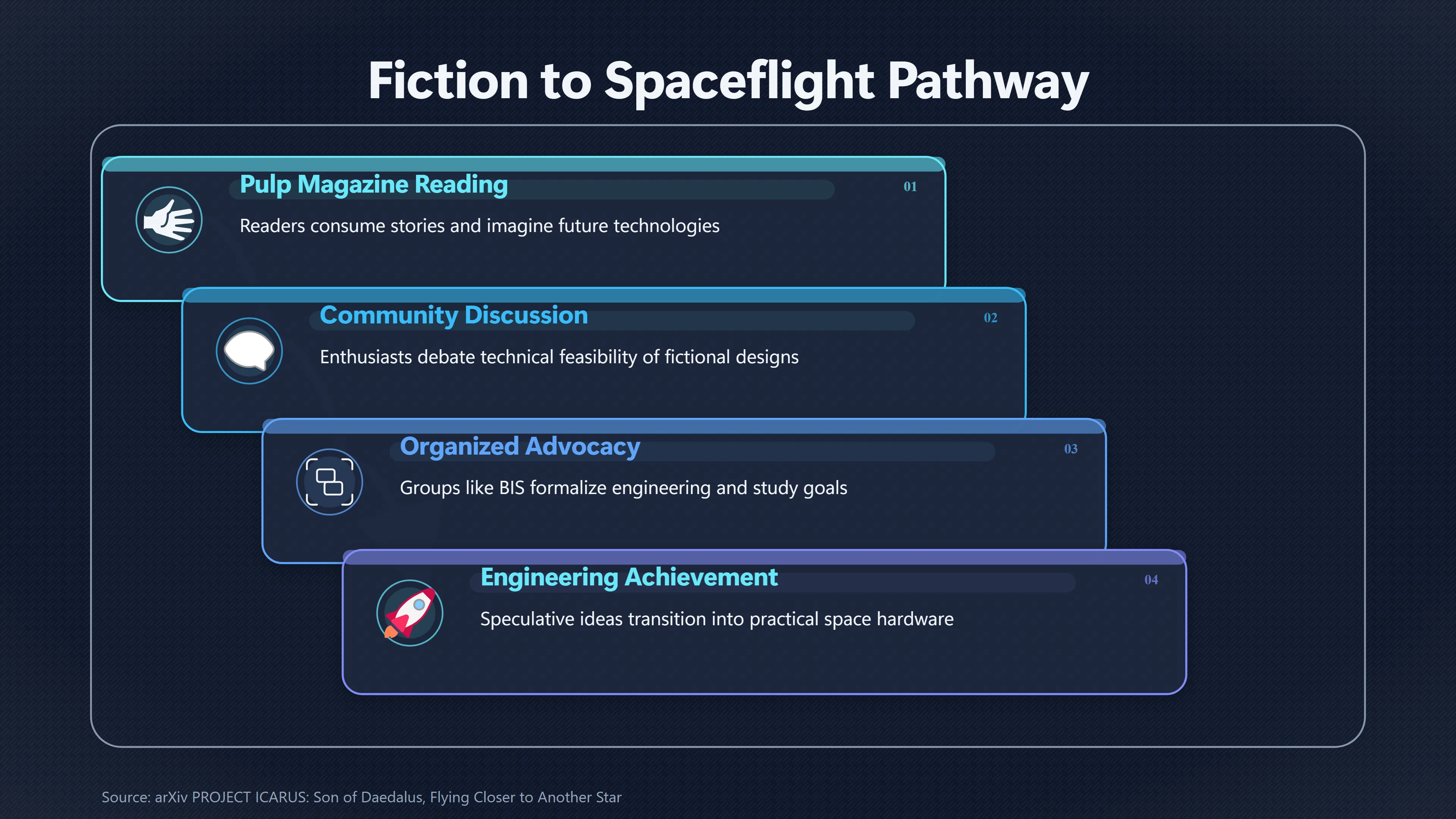
Science fiction spacecraft did more than provide images of imaginary vehicles; they helped create a community of people who wanted to make space travel a real engineering achievement. For many early readers, rockets, starships and lunar vehicles were not simply fictional props. They were possible futures that encouraged study, amateur experimentation, scientific careers and organised space advocacy. The strongest evidence for this influence appears not in claims that fiction directly invented rockets, but in the way fictional spacecraft gave enthusiasts a vision worth pursuing.[The British Interplanetary Society]bis-space.comThe British Interplanetary Society History of the BISThe British Interplanetary SocietyHistory of the BIS - The British Interplanetary Society…
From pulp magazines to technical societies, imagined spacecraft helped transform spaceflight from a distant fantasy into a practical goal. Groups such as the British Interplanetary Society (BIS), founded in 1933 by space enthusiasts, brought together people who combined scientific discussion with the imaginative ambitions popularised by science fiction.[The British Interplanetary Society]bis-space.comThe British Interplanetary Society History of the BISThe British Interplanetary SocietyHistory of the BIS - The British Interplanetary Society… The result was a two-way relationship: engineers and scientists made spacecraft possible, while fictional spacecraft helped motivate the people who would later design, build and advocate for them.
Readers becoming space advocates
Fiction turned curiosity into organised action
Early science fiction magazines created audiences who did not merely consume stories but actively discussed how their imagined futures might become reality. Publications such as Hugo Gernsback’s Amazing Stories encouraged readers to think about technology as something humans could develop rather than something reserved for fantasy. This helped create a culture of amateur science, correspondence groups and technical clubs centred on rockets and space exploration.[Reddit]reddit.comThese classic sci-fi magazines dated 1926-1948 were tucked in a sale that focused on antique English Bibles. Reported by Rare Book Hub.Ju…
The British Interplanetary Society is one of the clearest examples of this transition from imagination to organised effort. Its founders were inspired by the possibility of interplanetary travel and worked on concepts for rockets, lunar missions and future space systems before such projects were technically achievable. The society later developed detailed studies of spacecraft concepts, showing how enthusiasm generated by speculative ideas could become structured engineering discussion.[The British Interplanetary Society]bis-space.comThe British Interplanetary Society History of the BISThe British Interplanetary SocietyHistory of the BIS - The British Interplanetary Society…
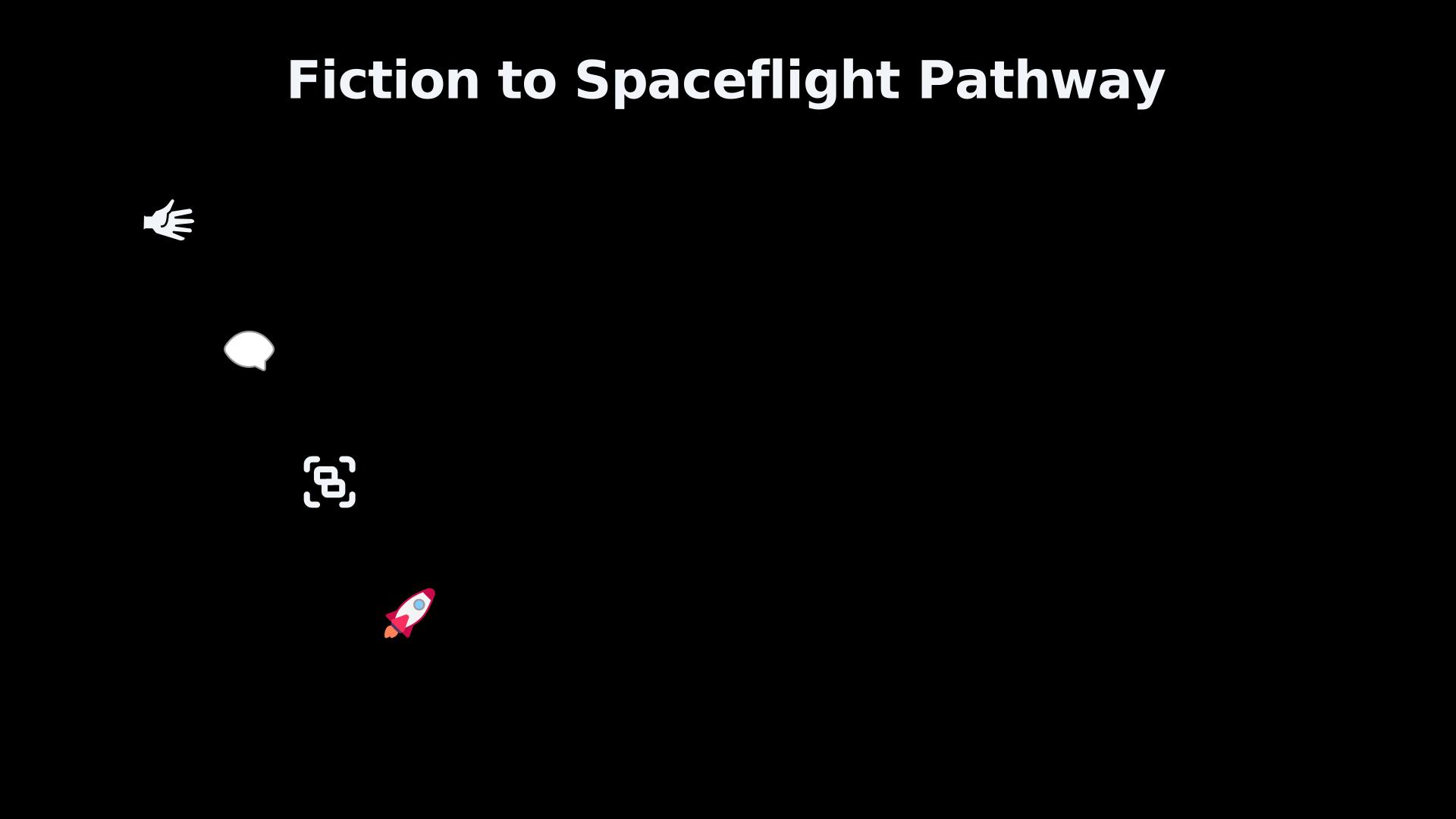
Science fiction also shaped the ambitions of individuals who entered space-related fields. A 2022 study examining UK astronomy communities found a strong connection between science fiction interest and scientific career choices: 93% of surveyed UK astronomers reported an interest in science fiction, and 69% said it had influenced their life or career choices. The study does not show that fiction alone created these careers, but it provides evidence that imaginative spacecraft and future-oriented stories formed part of the cultural environment that encouraged people towards astronomy and space science.[arXiv]arxiv.orgOpen source on arxiv.org.
Arthur C. Clarke as a model of the fiction-to-space pathway
The career of Arthur C. Clarke illustrates how science fiction enthusiasm could develop into serious technical involvement. As a young man, Clarke joined the British Interplanetary Society, contributed to its publications and combined his interest in astronautics with writing science fiction.[The Arthur C Clarke Foundation]clarkefoundation.orgThe Arthur C Clarke Foundation Arthur C ClarkeThe Arthur C Clarke FoundationArthur C Clarke - The Arthur C Clarke Foundation…
Clarke’s later work demonstrates the productive overlap between imagined spacecraft and engineering ambition. His 1945 proposal for using geostationary satellites as communication relays was a technical idea rather than a fictional spacecraft design, but it emerged from the same future-oriented mindset that connected science fiction with astronautics.[Orbital Today]orbitaltoday.comOrbital Today The British Interplanetary Society: Britain’s Space DreamersOrbital TodayThe British Interplanetary Society: Britain’s Space Dreamers - Orbital TodayMay 19, 2026… His example became influential because it showed that imagining future space systems could help people identify problems worth solving.
Science fiction and engineering ambition
Imagined spacecraft created targets for designers
Fictional spacecraft often influenced space enthusiasts by providing a concrete picture of what exploration might look like. A rocket travelling to another world, a lunar vehicle or a spacecraft carrying humans across the Solar System gave engineers and enthusiasts a target beyond immediate technology. The value was not that fictional designs were accurate blueprints; many were physically unrealistic. Their importance was that they encouraged people to ask engineering questions: How could a vehicle survive space? How could humans travel farther? What systems would be required?
The BIS demonstrates this process through its long history of speculative engineering. Before actual human spaceflight, members developed concepts for lunar exploration, space stations and interplanetary missions. These ideas occupied a middle ground between science fiction and engineering: they were imaginative enough to explore distant possibilities but technical enough to test whether those possibilities could eventually be approached.[The British Interplanetary Society]bis-space.comThe British Interplanetary Society History of the BISThe British Interplanetary SocietyHistory of the BIS - The British Interplanetary Society…

From rocket stories to real spacecraft studies
The influence of science fiction was especially visible among early space enthusiasts because the boundary between reader, amateur engineer and professional scientist was often flexible. Before governments established large space programmes, many advocates were working outside formal aerospace institutions. Science fiction gave these communities a shared language for discussing destinations, spacecraft designs and human futures in space.
This did not mean engineers copied fictional ships directly. Real spacecraft were constrained by propulsion, materials, economics and physics. Instead, fiction helped define the questions that engineers wanted to answer. A story about a spacecraft travelling to Mars might not provide a workable design, but it could inspire research into propulsion, life support or mission planning.
This distinction is important in understanding the relationship between UFO culture and science fiction as well. The same visual imagination that produced alien spacecraft also encouraged some readers to investigate the real possibilities of space technology. Fictional vehicles influenced expectations and ambitions, even when they did not predict actual spacecraft shapes.
Legacy in real exploration
The lasting role of the space imagination
The legacy of fictional spacecraft can be seen in continuing space advocacy. Organisations such as the British Interplanetary Society still describe their mission as connecting imagination with practical space exploration, bringing together enthusiasts, researchers and professionals interested in future missions.[The British Interplanetary Society]bis-space.comThe British Interplanetary Society Join the BISThe British Interplanetary SocietyJoin the BIS - The British Interplanetary Society…
Later generations of space enthusiasts inherited a similar pattern. Children inspired by fictional rockets, starships and alien worlds often became engineers, scientists or advocates who worked on real missions. The connection is especially visible in fields where long-term ambition matters: human exploration, interplanetary travel and concepts for reaching beyond the Solar System.
One example is Project Daedalus, a 1970s BIS study that investigated the possibility of sending an unmanned probe to another star. The concept was not a fictional spacecraft from a novel, but it reflected the same willingness to explore ambitious futures that science fiction had helped popularise. Later researchers continued developing related ideas through projects such as Project Icarus.[arXiv]arxiv.orgarXiv PROJECT ICARUS: Son of Daedalus, Flying Closer to Another StarPROJECT ICARUS: Son of Daedalus, Flying Closer to Another StarMay 20, 2010…
What fiction changed — and what it did not
Science fiction spacecraft did not cause the space age by themselves. Rocket development depended on advances in physics, engineering, government investment and industrial capability. However, fictional spacecraft changed the cultural environment in which those developments occurred.
They made space travel imaginable to large audiences, encouraged people to join technical communities and helped future engineers see exploration as a realistic human project rather than an abstract dream. The most important influence of science fiction spacecraft was therefore motivational: they gave generations of enthusiasts a picture of where technology could go, and some of those enthusiasts later helped build the path towards getting there.[The British Interplanetary Society]bis-space.comThe British Interplanetary Society History of the BISThe British Interplanetary SocietyHistory of the BIS - The British Interplanetary Society…
Amazon book picks
Further Reading
Books and field guides related to When Fiction Inspired Spaceflight. Use these as the next step if you want deeper reading beyond the article.
The History of Science Fiction
This book is the definitive critical history of science fiction. The 2006 first edition of this work traced the development of the genre...
The Dreams Our Stuff Is Made Of: How Science Fiction Conquere...
A popular insider offers a fascinating history of science fiction filled with provocative critiques, tidbits, and insights that reveal mu...
The Rocket and the Reich: Peenemünde and the Coming of the Ba...
WINNER OF THE DEXTER PRIZE OF THE SOCIETY FOR THE HISTORY OF TECHNOLOGY Launched by the Third Reich in late 1944, the first ballistic mis...

Astounding: John W. Campbell, Isaac Asimov, Robert A. Heinlei...
First published 2018. Subjects: Science fiction, History and criticism, Science fiction, history and criticism, American Science fiction,...
eBay marketplace picks
Marketplace Samples
Live-tested eBay searches with available results related to this page.
Selected fromspace collectible oneBay.co.uk.
Endnotes
1.
Source: arxiv.org
Link:https://arxiv.org/abs/2208.05825
2.
Source: reddit.com
Link:https://www.reddit.com/r/sciencefiction/comments/1v98roi/nearly_200_issues_of_amazing_stories_science/
Source snippet
These classic sci-fi magazines dated 1926-1948 were tucked in a sale that focused on antique English Bibles. Reported by Rare Book Hub.Ju...
3.
Source: arxiv.org
Title: arXiv PROJECT ICARUS: Son of Daedalus, Flying Closer to Another Star
Link:https://arxiv.org/abs/1005.3833
Source snippet
PROJECT ICARUS: Son of Daedalus, Flying Closer to Another StarMay 20, 2010...
Published: May 20, 2010
4.
Source: space.com
Link:https://www.space.com/space-exploration/2-seconds-that-changed-the-world-the-1st-liquid-fueled-rocket-launched-100-years-ago-today
5.
Source: reddit.com
Link:https://www.reddit.com/r/todayilearned/comments/e19i29/til_that_the_famous_science_fiction_novel_the_war/
6.
Source: bis-space.com
Title: The British Interplanetary Society History of the BIS
Link:https://www.bis-space.com/bis-history/
Source snippet
The British Interplanetary SocietyHistory of the BIS - The British Interplanetary Society...
7.
Source: clarkefoundation.org
Title: The Arthur C Clarke Foundation Arthur C Clarke
Link:https://clarkefoundation.org/arthur-c-clarke-biography/
Source snippet
The Arthur C Clarke FoundationArthur C Clarke - The Arthur C Clarke Foundation...
8.
Source: orbitaltoday.com
Title: Orbital Today The British Interplanetary Society: Britain’s Space Dreamers
Link:https://orbitaltoday.com/2026/05/19/the-british-interplanetary-society-britains-space-dreamers/
Source snippet
Orbital TodayThe British Interplanetary Society: Britain’s Space Dreamers - Orbital TodayMay 19, 2026...
Published: May 19, 2026
9.
Source: bis-space.com
Title: The British Interplanetary Society Join the BIS
Link:https://www.bis-space.com/
Source snippet
The British Interplanetary SocietyJoin the BIS - The British Interplanetary Society...
10.
Source: bis-space.com
Title: The British Interplanetary Society Who We Are
Link:https://www.bis-space.com/about/
Source snippet
The British Interplanetary SocietyWho We Are - The British Interplanetary Society...
11.
Source: bis-space.com
Title: From Amazing Stories to the BIS: 100 Years of “Scientifiction”
Link:https://www.bis-space.com/from-amazing-stories-to-the-bis-100-years-of-scientifiction/
12.
Source: bis-space.com
Title: Spaceships of the mind
Link:https://www.bis-space.com/spaceships-of-the-mind-the-bis-explained/
13.
Source: biography.com
Title: Arthur C. Clarke
Link:https://www.biography.com/authors-writers/arthur-c-clarke
14.
Source: bis-space.com
Title: Front Page
Link:https://www.bis-space.com/front-page/
15.
Source: bis-space.com
Link:https://www.bis-space.com/publications/
16.
Source: bis-space.com
Title: What We Do
Link:https://www.bis-space.com/what-we-do/
17.
Source: bis-space.com
Title: The Sir Arthur Clarke Awards
Link:https://www.bis-space.com/what-we-do/honours-and-awards/arthurs-nominations/
18.
Source: bis-space.com
Title: Sir Arthur Clarke Awards
Link:https://www.bis-space.com/what-we-do/honours-and-awards/arthurs/
19.
Source: clarkeinstitute.org
Link:https://clarkeinstitute.org/arthur-c-clarke/
20.
Source: fiawol.org.uk
Link:https://www.fiawol.org.uk/fanstuff/then%20archive/BIS.htm
21.
Source: cs.cmu.edu
Link:https://www.cs.cmu.edu/~earthware/Clarke.html
22.
Source: iafastro.org
Title: the british interplanetary society
Link:https://www.iafastro.org/membership/all-members/the-british-interplanetary-society.html
23.
Source: pulpmags.org
Title: amazing stories
Link:https://www.pulpmags.org/content/info/amazing-stories.html
Additional References
24.
Source: amazingstories.com
Link:https://amazingstories.com/2026/06/amazing-stories-the-100th-anniversary-issue-2/
Source snippet
His daughter is seeking assistance with funeral and memorial costs. Amazing Stories has contributed support and has also made arrangement...
25.
Source: youtube.com
Title: Science Fiction that became Reality: Robert Goddard
Link:https://www.youtube.com/watch?v=jKDOf3n6QzE
Source snippet
This video is relevant because Imagination to Reality- An Audio History of the BIS details how the British Interplanetary Society was for...
26.
Source: youtube.com
Link:https://www.youtube.com/watch?v=jZgdzHwCsGA
Source snippet
PSW 2532 Robert Goddard and the Invention of the Liquid Fueled Rocket...
27.
Source: youtube.com
Link:https://www.youtube.com/watch?v=zAJCzRsJzzs
Source snippet
Science Fiction that became Reality: Robert Goddard...
28.
Source: nasa.gov
Link:https://www.nasa.gov/history/SP-4219/Chapter13.html
29.
Source: nasa.gov
Title: 55 Years Ago: Star Trek Debuts, Begins an Enduring Relationship with NASA
Link:https://www.nasa.gov/history/55-years-ago-star-trek-debuts-begins-an-enduring-relationship-with-nasa/
30.
Source: nationalgeographic.com
Link:https://www.nationalgeographic.com/history/article/goddard-first-liquid-rocket
31.
Source: sciencenewzealand.org
Link:https://sciencenewzealand.org/
32.
Source: facebook.com
Link:https://www.facebook.com/TheWorldsofDavidDarling/posts/born-on-this-date-jun-25-in-1894-the-romanian-german-space-pioneer-hermann-obert/1195378882390998/
33.
Source: sciencedaily.com
Link:https://www.sciencedaily.com/