Within The cultural impact
How Flying Saucers Became Alien Icons
The flying saucer changed from a reported sighting description into a global symbol for alien encounters, mystery and imagined technology.
On this page
- Arnold's sighting and the saucer label
- From spacecraft idea to cultural symbol
- Why the disc shape endured
Page outline Jump by section
Introduction
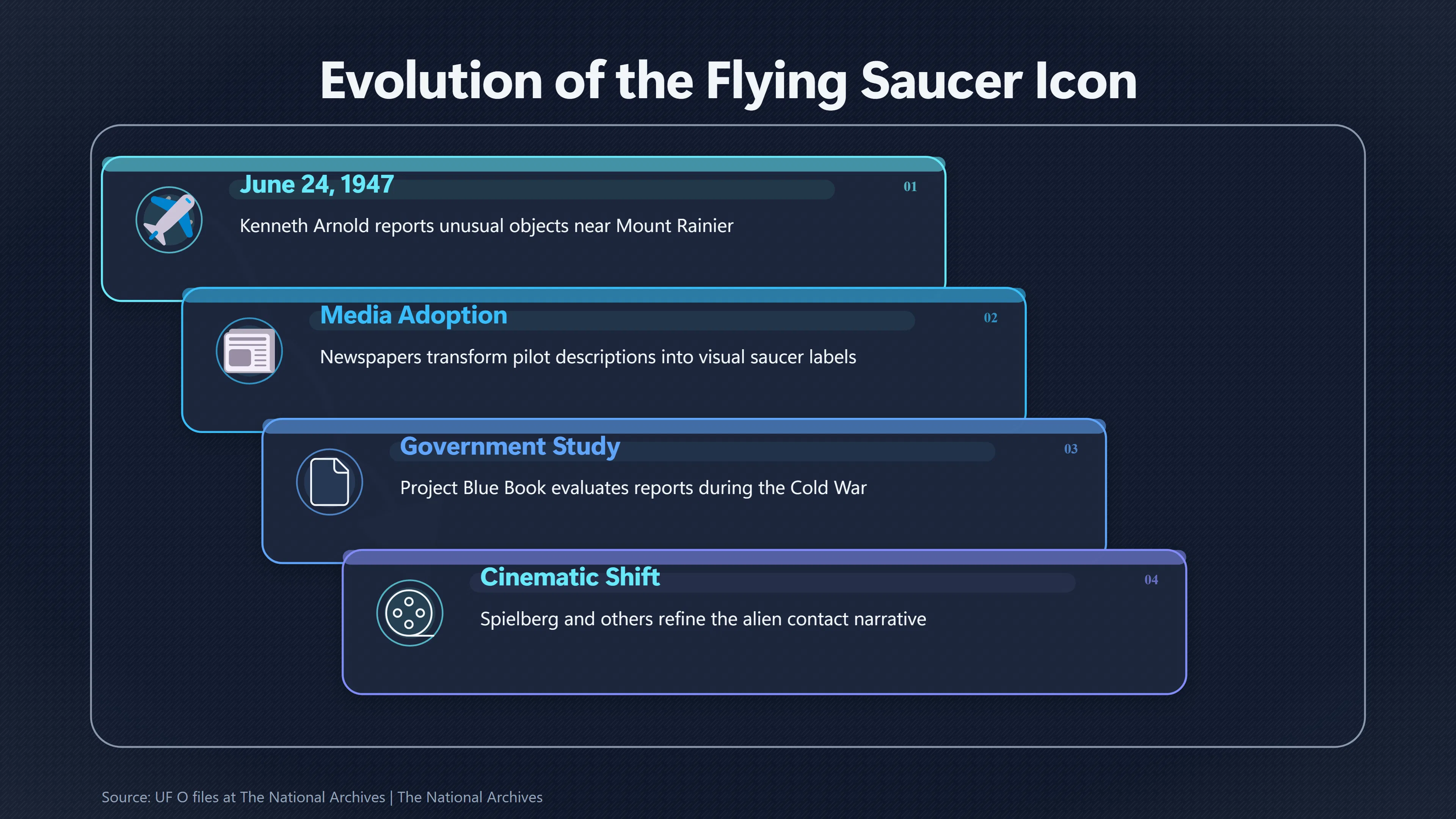
The flying saucer became the defining visual symbol of alien visitation not because it was a proven description of an extraterrestrial craft, but because a media-created image transformed an ambiguous sighting into a universal icon. Within a few years of Kenneth Arnold’s 1947 report of unusual objects near Mount Rainier, the “flying saucer” had moved from a newspaper phrase into a visual language for unknown technology, visitors from space and the mysteries of the modern universe.[Smithsonian Air and Space Museum]airandspace.si.edu1947 year flying saucerSmithsonian Air and Space Museum1947: Year of the Flying Saucer | National Air and Space MuseumJune 24, 2022…
The transformation worked because the saucer shape was simple, memorable and adaptable. A disc hovering above the ground could be drawn in a newspaper illustration, built as a film prop, printed on a paperback cover or recognised instantly in advertising and popular culture. Over time, the flying saucer stopped meaning only “an unexplained object in the sky” and became shorthand for “alien technology” itself.
Arnold’s sighting and the saucer label
How a description became a global image
The modern flying saucer symbol began with pilot Kenneth Arnold’s sighting on 24 June 1947. Arnold reported seeing several unusual objects while flying near Mount Rainier in Washington State. The exact nature of what he observed remains debated, but the cultural impact came from how the event was described and reported. The Smithsonian’s National Air and Space Museum notes that Arnold’s account introduced the phrase “flying saucer” into widespread public vocabulary, although later reporting shaped how the phrase was understood.[Smithsonian Air and Space Museum]airandspace.si.edu1947 year flying saucerSmithsonian Air and Space Museum1947: Year of the Flying Saucer | National Air and Space MuseumJune 24, 2022…
The important change was not simply that people reported strange objects. Unidentified aerial reports had existed before 1947, but Arnold’s case supplied a powerful visual label. The word “saucer” suggested a specific form: a smooth, rounded craft unlike conventional aircraft. Newspapers and broadcasters repeated the term, allowing the shape to become attached to the wider idea of unidentified flying objects.[Smithsonian Air and Space Museum]airandspace.si.edu1947 year flying saucerSmithsonian Air and Space Museum1947: Year of the Flying Saucer | National Air and Space MuseumJune 24, 2022…
This was a case where language created imagery. The phrase “flying saucer” encouraged artists, filmmakers and illustrators to produce a recognisable object even when eyewitness descriptions varied. The symbol became more stable than the original reports that inspired it.
From unidentified object to extraterrestrial visitor
The flying saucer’s meaning also changed because the post-war period was already filled with fascination and anxiety about advanced technology. The late 1940s and 1950s brought jet aircraft, missiles, nuclear weapons and the beginning of the Space Age. A mysterious craft in the sky could therefore be imagined as either a secret weapon or a visitor from another world.[media.nationalarchives.gov.uk]media.nationalarchives.gov.ukUF O files at The National Archives | The National ArchivesUFO files at The National Archives | The National ArchivesMay 1, 2018…
Government investigations contributed to the symbol’s connection with alien technology. The US Air Force created programmes including Project Sign, Project Grudge and later Project Blue Book to collect and evaluate UFO reports during the Cold War. Although these investigations did not establish evidence of extraterrestrial spacecraft, their existence kept flying saucers in public discussion and reinforced the association between strange aerial objects and questions about life beyond Earth.[National Archives]archives.govOpen source on archives.gov.
From spacecraft idea to cultural symbol
Why science fiction adopted the saucer
Science fiction did not simply copy the flying saucer image; it gave the shape a narrative purpose. The saucer represented a form of technology that looked advanced but understandable. Unlike a rocket, which clearly belonged to human engineering, a smooth disc hovering silently suggested a civilisation with unfamiliar abilities.
Early films quickly established the saucer as an alien vehicle. In The Day the Earth Stood Still (1951), an alien visitor arrives in a polished flying saucer in Washington, DC, using the craft as a symbol of a civilisation whose technology exceeds humanity’s own. The film used the object not only as a spectacle but as a way to explore fears about nuclear conflict and humanity’s future.[The New Yorker]newyorker.comThe New Yorker The Day the Earth Stood Still | The New YorkerThe New YorkerThe Day the Earth Stood Still | The New YorkerOctober 13, 2011…
Other 1950s science fiction films used the same shape differently. In invasion stories, flying saucers became symbols of threat, reflecting Cold War fears of attack from an unknown power. In more optimistic stories, the same design suggested discovery, communication and the possibility that humanity was part of a larger cosmic community.[AP News]apnews.comAP News Hollywood's narrative on UFOs and ETs reaches back many decadesFrom classic films like The Day the Earth Stood Still to blockbusters such as E.T. and Close Encounters of the Third Kind, cinemati…
This flexibility helped the saucer survive. It could represent danger, wonder, progress or uncertainty depending on the story around it.
The saucer became a visual shortcut for “aliens”
By the middle of the twentieth century, the flying saucer had become one of the fastest ways to communicate an extraterrestrial theme. A single circular craft with lights or a beam could tell audiences that an alien encounter was about to happen without requiring explanation.
This visual efficiency mattered in mass culture. Posters, magazine illustrations, toys and television programmes repeatedly used the saucer because it was immediately recognisable. The image functioned almost like a symbol or logo: simple enough to reproduce, but carrying a large set of meanings about exploration, mystery and the unknown.
The symbol also influenced how people imagined possible alien technology. Instead of thinking about many possible spacecraft designs, popular culture repeatedly returned to the same disc-shaped craft. The fictional image became a template through which later sightings and stories were interpreted.
Why the disc shape endured
A shape built for imagination
The flying saucer remained powerful because the disc shape suggested both familiarity and strangeness. A circle is a basic human shape, but a floating metallic disc appeared unlike any ordinary vehicle. It looked engineered while avoiding comparison with existing machines.
The design also solved a storytelling problem. Science fiction needed a vehicle that audiences could understand instantly but still perceive as advanced. The saucer provided that balance: it was simple enough to recognise and unusual enough to feel alien.
Its lack of visible conventional features strengthened the mystery. Rockets had engines, wings and fuel systems that audiences could associate with human technology. The saucer often appeared seamless and silent, implying abilities such as anti-gravity, advanced propulsion or materials beyond current science.
The symbol outlived the original reports
The flying saucer eventually became independent from UFO investigations. The term UFO technically refers to an unidentified object, not necessarily an alien spacecraft, and later official terminology attempted to separate observation from assumptions about origin. Edward Ruppelt, who led Project Blue Book, promoted the term “Unidentified Flying Object” partly because “flying saucer” already carried an extraterrestrial implication.[media.nationalarchives.gov.uk]media.nationalarchives.gov.ukUF O files at The National Archives | The National ArchivesUFO files at The National Archives | The National ArchivesMay 1, 2018…
However, popular culture had already fixed the connection. For many audiences, “UFO” and “flying saucer” became closely linked even though the scientific meaning of an unidentified object was broader.
Later films continued to reshape the image. Steven Spielberg’s Close Encounters of the Third Kind (1977) moved away from purely hostile invasion imagery and presented alien contact as a profound human experience. Its elaborate alien craft design expanded the possibilities of UFO imagery, but the idea of the mysterious object arriving from the sky remained rooted in the earlier saucer tradition.[Wikipedia]WikipediaClose Encounters of the Third KindClose Encounters of the Third Kind
The flying saucer endured because it became more than a spacecraft design. It became a cultural symbol for humanity looking upward and imagining what might come from beyond Earth. The transformation from reported sighting to alien icon shows how science fiction can turn uncertain events into lasting images that shape how societies picture the unknown.
Amazon book picks
Further Reading
Books and field guides related to How Flying Saucers Became Alien Icons. Use these as the next step if you want deeper reading beyond the article.
The Report on Unidentified Flying Objects
The Report on Unidentified Flying Objects, written by Captain Edward Ruppelt in 1956, was the first serious, unbiased account written abo...
Watch the Skies! A Chronicle of the Flying Saucer Myth
Narrates the belief in alien visitors to the earth since the 1940s, when their spacecraft began to be described consistently as saucer sh...
Flying Saucers: A Modern Myth of Things Seen in the Skies
Unidentified flying objects viewed by the eminent contemporary psychoanalyst as projections of the unconscious, with analogues in legends...
The Coming of the Saucers
This is the story that started The Modern UFO Era. On June 24,1947 Kenneth Arnold, a respected businessman and pilot, was searching Mt. R...
eBay marketplace picks
Marketplace Samples
Live-tested eBay searches with available results related to this page.
Selected fromUFO metal sign oneBay.co.uk.


Endnotes
1.
Source: archives.gov
Link:https://www.archives.gov/news/articles/project-blue-book-50th-anniversary
2.
Source: media.nationalarchives.gov.uk
Title: UF O files at The National Archives | The National Archives
Link:https://media.nationalarchives.gov.uk/index.php/ufo-files-national-archives/
Source snippet
UFO files at The National Archives | The National ArchivesMay 1, 2018...
Published: May 1, 2018
3.
Source: prologue.blogs.archives.gov
Link:https://prologue.blogs.archives.gov/2019/12/19/saucers-over-washington-the-history-of-project-blue-book/
4.
Source: Wikipedia
Title: Close Encounters of the [Third Kind]({{ ‘third-kind/’ | relative_url }})
Link:https://en.wikipedia.org/wiki/Close_Encounters_of_the_Third_Kind
5.
Source: archives.gov
Link:https://www.archives.gov/research/topics/uaps/rg-collections
6.
Source: visit.archives.gov
Title: gov50 Years Ago: Government Stops Investigating UFOs | National Archives Museum
Link:https://visit.archives.gov/whats-on/explore-exhibits/50-years-ago-government-stops-investigating-ufos
7.
Source: archives.gov
Title: 50 Years Ago: Government stops investigating UFOs | National Archives
Link:https://www.archives.gov/press/press-releases/2020/nr20-19
8.
Source: media.nationalarchives.gov.uk
Title: nationalarchives.gov.uk The Cold War and UFOs | The National Archives
Link:https://media.nationalarchives.gov.uk/index.php/cold-war-ufos/
9.
Source: archives.gov
Title: Do Records Show Proof of UFOs? | National Archives
Link:https://www.archives.gov/news/articles/do-records-show-proof-of-ufos
10.
Source: time.com
Title: close encounters of the third kind 1977
Link:https://time.com/5015537/close-encounters-of-the-third-kind-1977/
11.
Source: prologue.blogs.archives.gov
Title: flying saucers popular mechanics and the national archives
Link:https://prologue.blogs.archives.gov/2013/07/08/flying-saucers-popular-mechanics-and-the-national-archives/
12.
Source: nationalarchives.gov.uk
Link:https://www.nationalarchives.gov.uk/help-with-your-research/research-guides/ufos/
13.
Source: airandspace.si.edu
Title: 1947 year flying saucer
Link:https://airandspace.si.edu/stories/editorial/1947-year-flying-saucer
Source snippet
Smithsonian Air and Space Museum1947: Year of the Flying Saucer | National Air and Space MuseumJune 24, 2022...
Published: June 24, 2022
14.
Source: newyorker.com
Title: The New Yorker The Day the Earth Stood Still | The New Yorker
Link:https://www.newyorker.com/goings-on-about-town/movies/the-day-the-earth-stood-still
Source snippet
The New YorkerThe Day the Earth Stood Still | The New YorkerOctober 13, 2011...
Published: October 13, 2011
15.
Source: apnews.com
Title: AP News Hollywood’s narrative on UFOs and ETs reaches back many decades
Link:https://apnews.com/article/b529dafa810051226842b49523fdab77
Source snippet
From classic films like *The Day the Earth Stood Still* to blockbusters such as *E.T.* and *Close Encounters of the Third Kind*, cinemati...
16.
Source: airandspace.si.edu
Link:https://airandspace.si.edu/air-and-space-quarterly/issue-18/hollywood-close-encounters-model
17.
Source: encyclopedia.com
Title: Close Encounters Of The Third Kind | Encyclopedia.com
Link:https://www.encyclopedia.com/literature-and-arts/performing-arts/film-and-television/close-encounters-third-kind
18.
Source: airandspace.si.edu
Title: study flying saucer sightings
Link:https://airandspace.si.edu/stories/editorial/study-flying-saucer-sightings
19.
Source: si.edu
Title: Museum Unveils Declassified Roswell Artifact | Smithsonian Institution
Link:https://www.si.edu/object/yt_JkFjUhLONms
20.
Source: airandspace.si.edu
Title: museum unveils declassified roswell artifact
Link:https://airandspace.si.edu/stories/editorial/museum-unveils-declassified-roswell-artifact
21.
Source: airandspace.si.edu
Title: reports ufos 1947 roswell incident
Link:https://airandspace.si.edu/stories/editorial/reports-ufos-1947-roswell-incident
22.
Source: tcm.com
Title: Close Encounters Of The Third Kind
Link:https://www.tcm.com/articles/18629/close-encounters-of-the-third-kind-close-encounters-of-the-third-kind
23.
Source: criterion.com
Title: Close Encounters of the Third Kind | Current | The Criterion Collection
Link:https://www.criterion.com/current/posts/877-close-encounters-of-the-third-kind
24.
Source: rottentomatoes.com
Title: Close Encounters of the Third Kind | Rotten Tomatoes
Link:https://www.rottentomatoes.com/m/close_encounters_of_the_third_kind
25.
Source: culture.fandom.com
Title: Close Encounters of the Third Kind
Link:https://culture.fandom.com/wiki/Close_Encounters_of_the_Third_Kind
26.
Source: websites.umich.edu
Link:https://websites.umich.edu/~engb415/film/Earth.html
27.
Source: ultimatepopculture.fandom.com
Title: Flying saucer
Link:https://ultimatepopculture.fandom.com/wiki/Flying_saucer
Additional References
28.
Source: theguardian.com
Link:https://www.theguardian.com/film/2010/oct/21/day-earth-stood-still-wise
Source snippet
The GuardianThe Day the Earth Stood Still: No 20 best sci-fi and fantasy film of all time | Science fiction and fantasy films | The Guardian...
29.
Source: smithsonianmag.com
Title: The Alien Inspiration Behind Steven Spielberg’s ‘Disclosure Day’
Link:https://www.smithsonianmag.com/history/whats-behind-steven-spielbergs-lifelong-obsession-with-flying-saucers-and-extraterrestrial-visitors-180988903/
Source snippet
Morning. America’s most famous UFO case began just after a spring storm swept across the high plains outside Roswell, New Mexico. Rancher...
30.
Source: youtube.com
Link:https://www.youtube.com/watch?v=l5evk6lvo9Y
Source snippet
This curated collection documents the historical origin and evolution of the "flying saucer" icon, examining how media reporting, popular...
31.
Source: youtube.com
Link:https://www.youtube.com/watch?v=01sVLTO8xmo
Source snippet
The UFO Deluge of July 4th, 1947 | Part 1: Omens (Before the Storm)...
Published: June 1947
32.
Source: youtube.com
Link:https://www.youtube.com/watch?v=sSY6NB6m2PU
Source snippet
History of UFO and alien encounters | Prof. Greg Eghigian...
33.
Source: youtube.com
Title: History of UFO and alien encounters | Prof. Greg Eghigian
Link:https://www.youtube.com/watch?v=XAqOUoUIJWA
Source snippet
No Limits: The Legend of Alexander Weygers...
34.
Source: sonypictures.com
Link:https://www.sonypictures.com/movies/closeencountersofthethirdkind
35.
Source: psupress.org
Link:https://www.psupress.org/books/titles/978-0-271-03342-6.html
36.
Source: ebsco.com
Link:https://www.ebsco.com/research-starters/film/day-earth-stood-still-film
37.
Source: tandfonline.com
Link:https://www.tandfonline.com/doi/full/10.1080/14794012.2014.928032