Within UFO Fiction Exchange
Science fiction alien
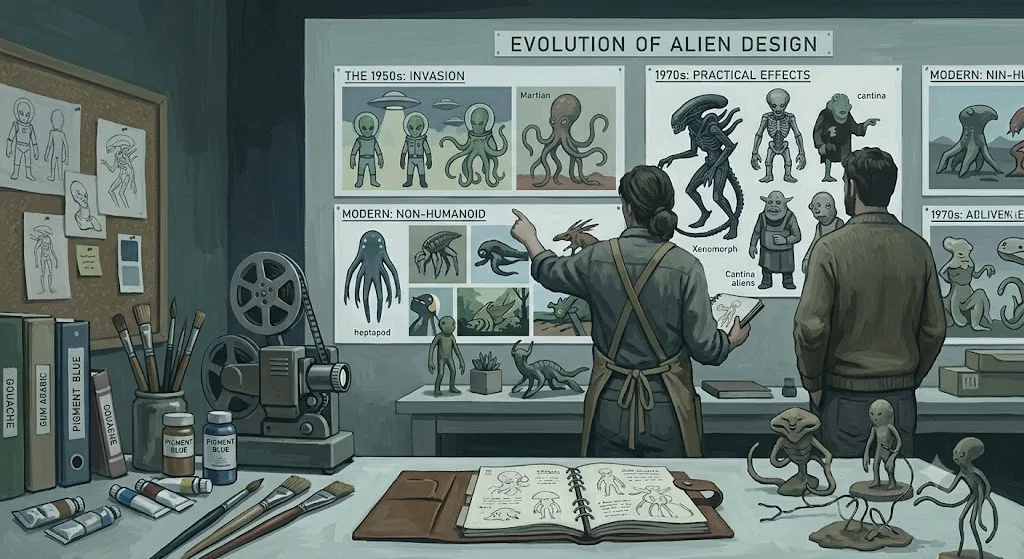
Science fiction alien design has evolved from simple representations of “the unknown” into one of the most inventive areas of visual storytelling. Early aliens were often distorted versions of humans or familiar Earth creatures, reflecting fears about invasion, evolution and social difference.
Page outline Jump by section
Introduction
Science fiction alien design has evolved from simple representations of “the unknown” into one of the most inventive areas of visual storytelling. Early aliens were often distorted versions of humans or familiar Earth creatures, reflecting fears about invasion, evolution and social difference. Over time, filmmakers, writers and designers moved towards more biologically unusual, culturally complex and sometimes deliberately incomprehensible beings. This shift changed how audiences imagined extraterrestrial life and helped shape the wider relationship between UFO culture and science fiction: the creatures seen in films and books often became templates through which people interpreted ideas about real alien possibilities.[University of Memphis Digital Commons]digitalcommons.memphis.eduUniversity of Memphis Digital CommonsAlien Evolutions: Darwinian Influence on the History and Transformation of the Anglo-American Scienc…
The history of alien design is therefore not only a record of changing special effects. It is also a history of changing assumptions about what an alien should represent. From tentacled invaders and little green beings to biomechanical predators and non-humanoid intelligences, each era’s designs reveal contemporary ideas about science, technology, humanity and the possibility of life beyond Earth.
From monsters and Martians to imagined species
Early aliens reflected human fears
The earliest science fiction aliens were usually built around recognisable forms. Writers and artists often made extraterrestrials strange by exaggerating familiar animals or human features rather than attempting to imagine completely different forms of life. This approach allowed aliens to function symbolically: they could represent invasion, social anxiety, technological change or the fear of humanity becoming obsolete. Research into early science fiction aliens has highlighted how evolutionary theory and ideas about the “other” influenced the creation of alien creatures as beings that were recognisably connected to life on Earth while also representing difference.[University of Memphis Digital Commons]digitalcommons.memphis.eduUniversity of Memphis Digital CommonsAlien Evolutions: Darwinian Influence on the History and Transformation of the Anglo-American Scienc…
H. G. Wells’s Martians in The War of the Worlds (1898) established a major influence on later alien imagery. Wells described creatures that were radically different from humans, with large brains, tentacles and fragile bodies adapted for their own environment. Later adaptations transformed these ideas visually, but the underlying concept remained influential: an alien did not need to resemble a person to be intelligent or threatening.
The 1953 film adaptation of The War of the Worlds demonstrated how cinema created a new visual language for extraterrestrials. Production designer Albert Nozaki created Martians with a single large eye, long arms and suction-cup fingers, combining familiar biological references with an unsettling sense of otherness. The design reflected the period’s fascination with technology, mutation and invasion while also taking advantage of colour film and practical effects.[Turner Classic Movies]tcm.comthe war of the worlds 1953 the war of the worlds b 1953Turner Classic MoviesThe War of the Worlds (1953) - The War of the Worlds (1953)December 7, 2007…

The 1950s and 1960s: the rise of recognisable alien types
The mid-twentieth century produced some of the most enduring alien stereotypes. Science fiction films of the era frequently used aliens to explore Cold War fears, including invasion, ideological conflict and uncontrolled technological power. Many designs focused on making aliens visually memorable rather than biologically realistic.
The “little green men” and “grey alien” traditions emerged from a mixture of science fiction art, popular media and UFO culture. Although these images were not based on verified extraterrestrial evidence, repeated appearances in magazines, films and television helped establish them as cultural symbols. The relationship between UFO reports and science fiction became circular: fictional designs influenced how people pictured possible visitors, while reports of strange encounters were often described using existing fictional imagery.
Television also expanded alien design beyond simple monsters. Series such as Star Trek used aliens as a way to explore social differences, creating species with distinctive appearances, cultures and political identities. Many of these designs remained partly humanoid because actors needed to portray emotional characters and because human audiences naturally interpret faces and bodies as signs of personality. This practical limitation became a defining tension in alien design: the more alien a creature became, the harder it could be to communicate with viewers.
Practical effects changed what aliens could become
The development of advanced makeup, puppetry and animatronics in the 1970s transformed alien design. Instead of relying mainly on costumes and masks, designers could create creatures with unusual anatomy, realistic movement and convincing physical presence.
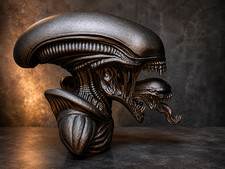
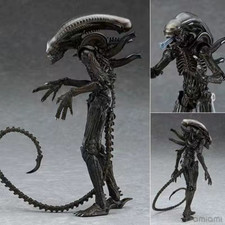
The 1979 film Alien marked a major turning point. Swiss artist H. R. Giger designed the Xenomorph using a biomechanical style that blended organic forms with mechanical imagery. The creature’s elongated head, hidden mouth, skeletal appearance and unfamiliar anatomy created an alien that was not simply a monster wearing an alien costume but a creature with its own disturbing logic. Giger’s work became influential because it suggested an extraterrestrial life form shaped by an entirely different evolutionary pathway.[WIRED]wired.comHow H.RGiger Made Alien's Monster Beautiful and TerrifyingSeptember 14, 2016 — The 1979 film "Alien" featured a groundbreaking monster, the Xeno…
The importance of the Xenomorph was not only its appearance but also its behaviour. Earlier aliens were often invaders with understandable motives. The Xenomorph represented something more difficult to categorise: a life form existing outside human morality. Its design supported the film’s themes of vulnerability, survival and humanity’s inability to control unfamiliar ecosystems.

Alien design became more biological and diverse
Star Wars and the expansion of alien societies
While Alien pushed alien design towards horror and biological difference, Star Wars expanded the idea of aliens as part of a wider civilisation. Instead of presenting extraterrestrials mainly as threats, it created a galaxy filled with species, cultures and personalities.
The cantina sequence in Star Wars: Episode IV – A New Hope (1977) became especially important because it presented numerous alien species with different body shapes, textures and visual identities. The production combined masks, puppets, makeup and practical effects to create a sense of a populated universe rather than a single encounter with the unknown. The franchise continued developing this approach by combining practical creature work with later digital techniques.[StarWars.com]starwars.comThe Moviemaking Magic of Star Wars: Creatures & Aliens | StarWars.comMay 15, 2018…
This represented a major change in science fiction design. Aliens were no longer only symbols of danger; they became characters capable of humour, friendship, conflict and ordinary life. The question shifted from “what would attack humanity from space?” to “what kinds of societies might exist beyond Earth?”
The influence of biology and evolution
As scientific knowledge expanded, some designers became increasingly interested in creating aliens that appeared adapted to different environments. Instead of giving aliens human faces and bodies by default, creators began considering questions such as: What kind of senses would a creature develop? How would it move? What environment would shape its body?
However, realistic alien design faces a fundamental challenge. Human creators can only imagine from their own experiences, so many fictional aliens remain combinations of familiar animals, humans and machines. Recent discussions among scientists and designers have noted that Hollywood often balances scientific plausibility against storytelling needs, because completely unfamiliar creatures can be difficult for audiences to understand.[Financial Times]ft.comFinancial Times Can Hollywood ever get aliens right?While science fiction and cinematic storytelling often collide, Hollywood typically resorts to humanoid depictions of aliens due to human…
The digital era: aliens beyond physical limits
Computer-generated imagery (CGI) expanded the range of possible alien designs by allowing filmmakers to create creatures that would have been impossible or impractical with traditional effects. Digital tools made it easier to design complex movement, unusual body structures and large-scale alien environments.
Films such as Avatar combined digital character creation with detailed world-building to present an alien ecosystem rather than isolated creatures. Other films deliberately moved away from familiar humanoid forms. Arrival (2016), for example, used the heptapods to explore communication with an intelligence that does not think or appear like humans. The creatures’ circular written language and unusual bodies made alienness part of the story’s central idea rather than simply a visual effect.
Modern alien design often focuses less on creating a frightening appearance and more on creating a believable existence. Designers increasingly consider anatomy, behaviour, communication and ecological relationships. The most memorable aliens are often those where the audience can sense a complete way of life behind the design.

Why alien designs keep changing
Alien design evolves because science fiction reflects changing ideas about humanity’s place in the universe. During periods of political tension, aliens often became symbols of invasion or hidden threats. As audiences became more familiar with space science and planetary exploration, designers increasingly explored questions of evolution, intelligence and communication.
The connection with UFO culture remains important because fictional imagery influences public expectations. The classic flying saucer, humanoid visitor and grey alien became cultural references partly because science fiction repeatedly presented them. At the same time, filmmakers and writers continue to challenge these familiar images by creating aliens that are stranger, less human and more connected to ideas from biology and astronomy.
The evolution of science fiction alien design therefore represents a movement from simple visual shorthand towards complex speculation. Each generation’s aliens reveal not only what people imagine life beyond Earth might look like, but also how they understand themselves, their fears and their hopes for contact with the unknown.
Amazon book picks
Further Reading
Books and field guides related to Science fiction alien. Use these as the next step if you want deeper reading beyond the article.
Aliens and Alien Societies: A Writer's Guide to Creating Extr...
A thoughtful, clear and utterly fascinating reference, this book is absolutely vital to writers who want to put extraterrestrial life-for...
The Science Fiction Encyclopedia
Nearly two thousand illustrated entries covering science-fiction authors, editors, critics, magazines, anthologies, comics, illustrators,...
The Encyclopedia of Science Fiction
Encompassing 4,360 entries that provide critical insight and biographical and bibliographical data, an updated edition of a popular scien...

The Visual Encyclopedia of Science Fiction
First published 1977. Subjects: Science fiction, Encyclopedias, Science-fiction, Dictionnaires anglais, Thèmes, motifs.
eBay marketplace picks
Marketplace Samples
Live-tested eBay searches with available results related to this page.
Selected fromalien figure collectible oneBay.co.uk.
Endnotes
1.
Source: digitalcommons.memphis.edu
Link:https://digitalcommons.memphis.edu/etd/778/
Source snippet
University of Memphis Digital CommonsAlien Evolutions: Darwinian Influence on the History and Transformation of the Anglo-American Scienc...
2.
Source: wired.com
Title: How H.R
Link:https://www.wired.com/2016/09/h-r-giger-made-aliens-monster-beautiful-terrifying
Source snippet
Giger Made Alien's Monster Beautiful and TerrifyingSeptember 14, 2016 — The 1979 film "Alien" featured a groundbreaking monster, the Xeno...
Published: September 14, 2016
3.
Source: starwars.com
Link:https://www.starwars.com/news/unmasking-the-moviemaking-magic-of-star-wars-creatures-and-aliens
Source snippet
The Moviemaking Magic of Star Wars: Creatures & Aliens | StarWars.comMay 15, 2018...
Published: May 15, 2018
4.
Source: starwars.com
Title: Creature Department Creations from Star Wars: The Force Awakens | Star Wars.com
Link:https://www.starwars.com/news/star-wars-the-force-awakens-creature-department
Source snippet
Creature Department Creations from Star Wars: The Force Awakens | StarWars.comDecember 18, 2025 — CHEWBACCA AND OTHER CREATURE DEPARTMENT...
Published: December 18, 2025
5.
Source: tcm.com
Title: the war of the worlds 1953 the war of the worlds b 1953
Link:https://www.tcm.com/articles/188880/the-war-of-the-worlds-1953-the-war-of-the-worlds-b-1953
Source snippet
Turner Classic MoviesThe War of the Worlds (1953) - The War of the Worlds</B> (1953)December 7, 2007...
Published: December 7, 2007
6.
Source: ft.com
Title: Financial Times Can Hollywood ever get aliens right?
Link:https://www.ft.com/content/a5b68862-74e6-45f9-a365-d8774e201c16
Source snippet
While science fiction and cinematic storytelling often collide, Hollywood typically resorts to humanoid depictions of aliens due to human...
7.
Source: reviewallmonsters.wordpress.com
Title: the war of the worlds 1953
Link:https://reviewallmonsters.wordpress.com/2026/05/31/the-war-of-the-worlds-1953/
Source snippet
War of the Worlds (1953) | REVIEW ALL MONSTERSMay 31, 2026 — THE WAR OF THE WORLDS (1953) May 31, 2026 Matt Image The fifties explosion o...
Published: May 31, 2026
8.
Source: goldenageflicks.co.uk
Title: the war of the worlds 1953
Link:https://www.goldenageflicks.co.uk/post/the-war-of-the-worlds-1953
9.
Source: deepfocusreview.com
Link:https://www.deepfocusreview.com/definitives/aliens/
10.
Source: bbfc.co.uk
Title: the war of the worlds 1953
Link:https://www.bbfc.co.uk/case-studies/the-war-of-the-worlds-1953
11.
Source: rottentomatoes.com
Title: The War of the Worlds | Rotten Tomatoes
Link:https://www.rottentomatoes.com/m/the_war_of_the_worlds
12.
Source: horror.fandom.com
Title: The War of the Worlds (1953)
Link:https://horror.fandom.com/wiki/The_War_of_the_Worlds_%281953%29
Additional References
13.
Source: youtube.com
Title: How Alien Life Could Evolve Like Prehistoric Earth | Full Documentary Movie
Link:https://www.youtube.com/watch?v=RuRav5ZURdc
Source snippet
This selection provides videos addressing how alien design in science fiction has evolved over time—from early archetypes and non-humanoi...
14.
Source: youtube.com
Link:https://www.youtube.com/watch?v=8JgjxHvDQB0
Source snippet
How Alien Life Could Evolve Like Prehistoric Earth | Full Documentary Movie...
15.
Source: arxiv.org
Title: arXiv Imagining the Alien: Human Projections and Cognitive Limitations
Link:https://arxiv.org/abs/2602.07284
16.
Source: researchgate.net
Link:https://www.researchgate.net/publication/376669505_Science_fiction_The_biology_of_the_alien_in_Alien
17.
Source: eap-iea.org
Link:https://eap-iea.org/index.php/eap/article/view/197
18.
Source: bloomsbury.com
Link:https://www.bloomsbury.com/uk/immortal-monster-9780313306679/
19.
Source: goat.com
Link:https://www.goat.com/editorial/sci-fi-fashion
20.
Source: youtube.com
Title: The perfect alien design that Hollywood CAN’T copy
Link:https://www.youtube.com/watch?v=vB0j_uNwa3Q
Source snippet
Visual themes of Giger's ALIEN creature design...
21.
Source: vbn.aau.dk
Link:https://vbn.aau.dk/da/publications/the-perfect-organism-the-intruder-of-the-alien-films-as-a-bio-fic/
22.
Source: youtube.com
Title: Non-Humanoid Aliens | Designing Aliens
Link:https://www.youtube.com/watch?v=Wk1k_sfWI0E
Source snippet
Alien (1979) — Secrets That Connect to Alien Earth...