Within Television s role
When UFO Shows Reflected Cold War Fears
Cold War UFO programmes used alien threats to explore invasion fears, military power, technology, and public uncertainty.
On this page
- Alien threats and social anxiety
- Military responses on television
- Technology and secrecy themes
Page outline Jump by section
Introduction
UFO television transformed Cold War fears by turning anxieties about invasion, military technology, surveillance and secrecy into recurring science-fiction stories. From the late 1950s through the 1970s, television audiences encountered alien threats that reflected real concerns about nuclear conflict, the space race and the possibility that advanced technology could escape human control. These programmes did not simply present extraterrestrials as monsters from another world; they used UFOs as symbols for uncertainty about who controlled powerful new technologies and whether governments could protect ordinary people.

The connection between UFO stories and Cold War culture was especially visible in programmes such as The Twilight Zone, The Outer Limits and Gerry and Sylvia Anderson’s UFO. Each used alien encounters differently: some focused on paranoia and social distrust, while others imagined organised military responses to extraterrestrial threats. Together, they helped shape the modern UFO television tradition by linking the unknown in the sky with fears about security and power on Earth.[EW.com]ew.comEnter another dimension!The 30 best "Twilight Zone" episodes, rankedApril 22, 2023 — Entertainment Weekly (EW) has compiled a list ranking the 30 best episodes o…
Alien threats and social anxiety
Aliens became symbols of invasion fears
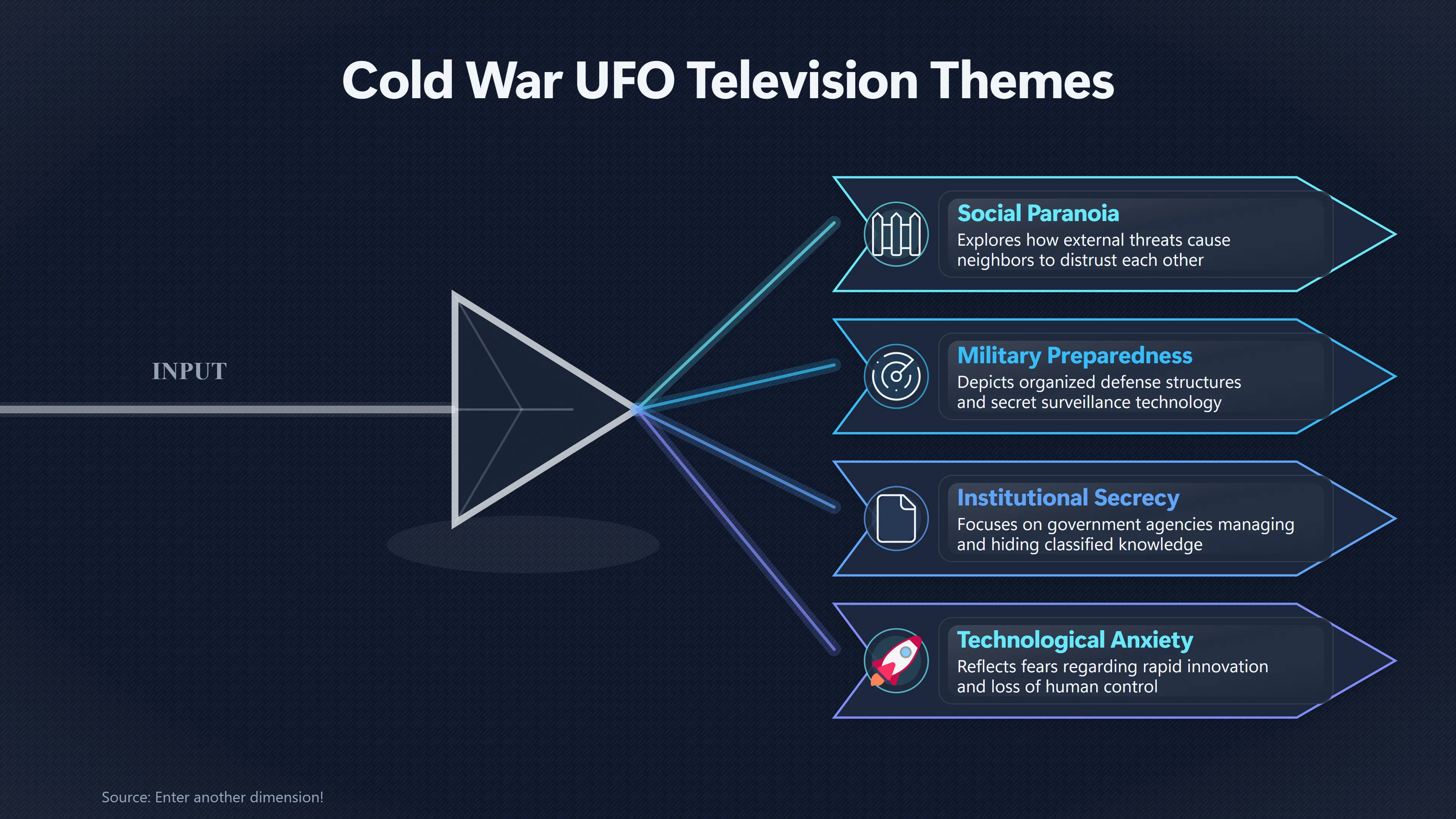
Early UFO television emerged during a period when many viewers were already accustomed to thinking about hidden enemies, surprise attacks and technological competition. The Cold War created a sense that danger could arrive without warning, whether through nuclear missiles, espionage or new military inventions. UFO fiction adapted these concerns by replacing human opponents with alien forces that represented an even more unpredictable threat.
Anthology programmes were particularly effective at exploring these fears because they could present a different social dilemma each week. The Twilight Zone, which ran from 1959 to 1964, frequently used science-fiction settings to examine contemporary worries. Its famous episode “The Monsters Are Due on Maple Street” did not centre on aliens attacking humanity directly; instead, it showed how the suspicion of an outside threat could cause neighbours to turn against one another. The story reflected Cold War concerns about paranoia, conformity and the dangers of fear-driven reactions.[EW.com]ew.comEnter another dimension!The 30 best "Twilight Zone" episodes, rankedApril 22, 2023 — Entertainment Weekly (EW) has compiled a list ranking the 30 best episodes o…
UFO television therefore often made the alien threat less about extraterrestrials themselves and more about human responses. A mysterious craft in the sky created questions that mirrored Cold War debates: Should governments reveal information? Should citizens trust official explanations? How much power should authorities have when facing an unknown danger?
The unknown became a test of public trust
This uncertainty was central to UFO storytelling because unidentified objects existed between science and speculation. Real-world UFO investigations, including the US Air Force’s Project Blue Book, added to public fascination by acknowledging reports while also attempting to explain many sightings through conventional causes. Project Blue Book investigated thousands of reports between 1952 and 1969, a period when UFO concerns were closely connected to fears about Soviet technology and national security.[HISTORY TV Nederland]history.comTV Nederland Project Blue BookHISTORY TV NederlandProject Blue Book - Alien, Definition & Files | HISTORYFebruary 22, 2010…
Television transformed this ambiguity into drama. Instead of treating UFOs only as evidence of alien visitors, many programmes explored the tension between what officials said and what ordinary people believed they saw. This created a lasting narrative pattern: the UFO as a mystery was often less important than the struggle over who had the authority to define the truth.
Military responses on television
UFO turned aliens into a defence problem
A major shift in UFO television came with the British series UFO (1970–1971), created by Gerry and Sylvia Anderson. Rather than focusing mainly on civilian encounters, the programme imagined an organised military response to extraterrestrial danger. Its central organisation, SHADO (Supreme Headquarters Alien Defence Organisation), was a secret international defence agency created to protect Earth from alien attacks.[Fanderson]fanderson.org.ukFanderson UFOUFO - Fanderson…
The series reflected Cold War ideas about preparedness and deterrence. Its fictional governments responded to UFOs in the same way Cold War states responded to strategic threats: through intelligence gathering, early warning systems, advanced weapons and secrecy. SHADO operated with hidden facilities, surveillance technology and specialised spacecraft, presenting alien defence as an extension of modern military planning.[Wikipedia]WikipediaUFO (British TV seriesUFO (British TV series
This approach changed the meaning of the UFO on screen. Instead of being only a mysterious object that challenged science, it became a strategic problem requiring command structures and technological solutions. The alien invasion scenario allowed television writers to explore questions already familiar from Cold War politics: Could technology keep humanity safe? Could secret organisations be trusted? Would preparation prevent catastrophe or create new risks?
Television mirrored real military uncertainty
The military focus of UFO programmes was closely connected to the real relationship between UFO reports and national security agencies. During the early Cold War, officials considered whether some sightings might involve foreign aircraft or new weapons technology rather than extraterrestrial visitors. Project Blue Book existed partly because unidentified objects raised questions about air defence and intelligence.[HISTORY TV Nederland]history.comTV Nederland Project Blue BookHISTORY TV NederlandProject Blue Book - Alien, Definition & Files | HISTORYFebruary 22, 2010…
Later television productions continued to revisit this connection. The drama series Project Blue Book (2019–2020), although a modern interpretation rather than a documentary account, used the historical Air Force investigation as a setting for stories about UFOs, government secrecy and Cold War uncertainty.[HISTORY TV Nederland]history.comTV Nederland Watch Project Blue Book Full Episodes, Video & More | HISTORYHISTORY TV NederlandWatch Project Blue Book Full Episodes, Video & More | HISTORY…
The repeated use of military investigators, secret files and restricted information in UFO television helped establish a familiar cultural image: the UFO mystery was not only about visitors from space but also about institutions attempting to manage knowledge.
Technology and secrecy themes
Advanced machines reflected fears about human control
Cold War UFO television often presented technology as both humanity’s protection and a source of anxiety. Rockets, satellites, computers and weapons systems were transforming everyday ideas about what was possible. The Space Age created excitement about exploration, but it also raised concerns about surveillance, military competition and the consequences of rapid technological change.
In UFO, futuristic equipment such as tracking systems, spacecraft and interception vehicles represented confidence in scientific progress while also suggesting that humanity needed increasingly complex systems to survive. The programme’s technological imagination reflected the same contradiction found in Cold War society: innovation promised security, yet every new capability could also become a new danger.[Fanderson]fanderson.org.ukFanderson UFOUFO - Fanderson…
Other science-fiction television used aliens to question whether technological advancement automatically meant progress. The threat from outer space often exposed weaknesses in human institutions rather than simply demonstrating alien power. A civilisation capable of reaching Earth forced characters to confront whether their own governments, scientists and militaries were prepared for unprecedented challenges.
Secrecy became part of the UFO formula
One of the most influential ideas developed by Cold War UFO television was that important information might be hidden from the public. Secret agencies, classified research and unexplained events became recurring features because they matched real concerns about government secrecy during the nuclear age.
This theme later became central to programmes such as The X-Files, but its roots were visible in earlier UFO stories. The combination of alien mystery and institutional secrecy created a powerful television structure: viewers were invited to investigate alongside characters who suspected that official explanations were incomplete. The result was a shift from simple invasion stories towards narratives about evidence, trust and hidden knowledge.
Why Cold War UFO television still shapes the genre
Cold War UFO programmes established many of the ideas that continue to define alien stories on television. They connected extraterrestrial encounters with human concerns rather than treating aliens as purely imaginary creatures. The UFO became a way to discuss military power, scientific uncertainty and the relationship between governments and citizens.
The most important transformation was that UFO television moved the subject from simple speculation about life beyond Earth into a broader discussion about fear and responsibility. Alien threats worked because they reflected familiar human worries: invasion, technological competition and uncertainty about who controlled dangerous knowledge.
By turning Cold War anxieties into science-fiction narratives, television created a lasting framework for UFO storytelling. Later series would change the style, moving from military defence stories to investigations, conspiracies and personal encounters, but the central question remained the same: when faced with something unknown, how should humanity respond?
Amazon book picks
Further Reading
Books and field guides related to When UFO Shows Reflected Cold War Fears. Use these as the next step if you want deeper reading beyond the article.
The Close Encounters Man: How One Man Made the World Believe...
Meet the astronomer who invented the concept of "Close Encounters" with aliens, inspired a classic sci-fi film, and made a nation want to...
Saucers, Spooks and Kooks: UFO Disinformation in the Age of A...
From flying saucer crashes to underground alien bases, a number of modern mythologies have come into being since the advent of the UFO er...
Monsters of the Week: The Complete Critical Companion to The...
The complete critical companion to The X-Files, covering every episode and both films and featuring interviews with screenwriters and sta...
Cold War, Cool Medium: Television, McCarthyism, and American...
Conventional wisdom holds that television was coconspirator in the repressions of Cold War America, but Doherty argues that it was throug...
eBay marketplace picks
Marketplace Samples
Live-tested eBay searches with available results related to this page.
Selected fromalien invasion poster oneBay.co.uk.
Endnotes
1.
Source: ew.com
Title: Enter another dimension!
Link:https://ew.com/tv/best-twilight-zone-episodes-ranked/
Source snippet
The 30 best "Twilight Zone" episodes, rankedApril 22, 2023 — Entertainment Weekly (EW) has compiled a list ranking the 30 best episodes o...
Published: April 22, 2023
2.
Source: history.com
Title: TV Nederland Project Blue Book
Link:https://www.history.com/articles/project-blue-book
Source snippet
HISTORY TV NederlandProject Blue Book - Alien, Definition & Files | HISTORYFebruary 22, 2010...
Published: February 22, 2010
3.
Source: Wikipedia
Title: UFO (British TV series)
Link:https://en.wikipedia.org/wiki/UFO_%28British_TV_series%29
4.
Source: history.com
Title: TV Nederland Watch Project Blue Book Full Episodes, Video & More | HISTORY
Link:https://www.history.com/shows/project-blue-book
Source snippet
HISTORY TV NederlandWatch Project Blue Book Full Episodes, Video & More | HISTORY...
5.
Source: space.com
Title: the best sci fi tv shows of the 1960s
Link:https://www.space.com/entertainment/the-best-sci-fi-tv-shows-of-the-1960s
6.
Source: history.com
Title: project blue book set production design
Link:https://www.history.com/articles/project-blue-book-set-production-design
7.
Source: history.com
Title: u s air force closes the book on ufos 45 years ago
Link:https://www.history.com/articles/u-s-air-force-closes-the-book-on-ufos-45-years-ago
8.
Source: fanderson.org.uk
Title: Fanderson UFO
Link:https://fanderson.org.uk/productions/ufo/
Source snippet
UFO - Fanderson...
9.
Source: justwatch.com
Link:https://www.justwatch.com/uk/tv-series/ufo
Source snippet
UFO - watch tv series streaming onlineJune 23, 2026 — UFO (1970) Image: JustWatch Icon63% Image: ImDB Logo7.9 (4.6k) 12 Age rating 48min...
Published: June 23, 2026
10.
Source: watch.plex.tv
Link:https://watch.plex.tv/en-GB/show/ufo
Source snippet
to Watch UFO (1970) TV Show Online - PlexJuly 15, 2025 — IMAGEUFO 12 1970 50mAction, Science Fiction 7.9 88%7.8 Add to Watchlist In 1980...
Published: July 15, 2025
11.
Source: televisionheaven.co.uk
Title: The Outer Limits | Television Heaven
Link:https://televisionheaven.co.uk/reviews/the-outer-limits
12.
Source: tvguide.com
Title: Project Blue Book
Link:https://www.tvguide.com/tvshows/project-blue-book/1000568062/
13.
Source: rottentomatoes.com
Title: Project Blue Book | Rotten Tomatoes
Link:https://www.rottentomatoes.com/tv/project_blue_book
14.
Source: twilightzonecoldwar.wordpress.com
Title: the monsters are due on maple street
Link:https://twilightzonecoldwar.wordpress.com/the-monsters-are-due-on-maple-street/
15.
Source: salon.com
Title: “The Outer Limits”
Link:https://www.salon.com/2002/04/09/outer_limits/
16.
Source: tvinsider.com
Title: Project Blue Book
Link:https://www.tvinsider.com/show/project-blue-book/
17.
Source: gerryanderson.fandom.com
Link:https://gerryanderson.fandom.com/wiki/UFO
18.
Source: theouterlimits.fandom.com
Title: The Outer Limits
Link:https://theouterlimits.fandom.com/wiki/The_Outer_Limits
19.
Source: thetvdb.com
Title: The Twilight Zone
Link:https://www.thetvdb.com/series/the-twilight-zone/allseasons/official
20.
Source: play.google.com
Title: Twilight Zone
Link:https://play.google.com/store/tv/show/Twilight_Zone?cdid=tvseason-kW-FOOKrjN80pfhcH4a0Jw&gdid=tvepisode-IwzHIXuIJsk&hl=en_GB&id=dKIvvpZT9Lc
21.
Source: encyclopedia.com
Title: outer limits
Link:https://www.encyclopedia.com/media/encyclopedias-almanacs-transcripts-and-maps/outer-limits
22.
Source: tzone.the-croc.com
Link:https://tzone.the-croc.com/tzeplist/monsters.html
23.
Source: twilightzone.fandom.com
Title: The Monsters Are Due on Maple Street
Link:https://twilightzone.fandom.com/wiki/The_Monsters_Are_Due_on_Maple_Street
Additional References
24.
Source: forbes.com
Title: ‘Do Not Attempt To Adjust The Picture
Link:https://www.forbes.com/sites/jimclash/2025/08/07/do-not-attempt-to-adjust-the-picture-we-are-controlling-transmission/
Source snippet
We Are Controlling Transmission’August 7, 2025 — ‘DO NOT ATTEMPT TO ADJUST THE PICTURE. WE ARE CONTROLLING TRANSMISSION’ The 1960s not on...
Published: August 7, 2025
25.
Source: youtube.com
Link:https://www.youtube.com/watch?v=atdLkJHxx-c
Source snippet
You'll NEVER Look at UFO the SAME Way Again...
26.
Source: youtube.com
Link:https://www.youtube.com/watch?v=bSUogcLHvkg
Source snippet
The Twilight Zone's Most Chilling Social Commentary | The Monsters Are Due on Maple Street...
27.
Source: tandfonline.com
Link:https://www.tandfonline.com/doi/abs/10.1080/01956051.2010.482950
28.
Source: paramountpressexpress.com
Link:https://www.paramountpressexpress.com/paramount-plus/releases/?view=50604
29.
Source: tvencyclopedia.org
Link:https://www.tvencyclopedia.org/tv-encyclopedia-14/science-fiction-programs
30.
Source: the-twilight-zone-archive.vercel.app
Link:https://the-twilight-zone-archive.vercel.app/
31.
Source: openlibrary.org
Link:https://openlibrary.org/books/OL26266461M/The_twilight_zone_the_monsters_are_due_on_Maple_Street
32.
Source: tvencyclopedia.org
Link:https://www.tvencyclopedia.org/tv-encyclopedia-17/twilight-zone-the
33.
Source: tvencyclopedia.org
Link:https://www.tvencyclopedia.org/tvencyclopedia1/twilightzone