Within Secret technology themes
When Alien Engines Rewrite Human Physics
Alien propulsion ideas in fiction imagine machines that challenge current physics and reveal the gap between discovery and understanding.
On this page
- Fictional propulsion breakthroughs
- Technology gaps between civilisations
- Science limits in alien stories
Page outline Jump by section
Introduction
Alien propulsion systems are among science fiction’s clearest ways of showing the gap between human engineering and imagined extraterrestrial knowledge. From warp drives that reshape spacetime to engines that bypass ordinary ideas of distance, fictional alien machines often do not simply make spacecraft faster; they change the rules that limit human travel. These stories use propulsion as a mechanism for asking a deeper question: what happens when a civilisation encounters a technology it can observe but cannot yet understand?
The central idea is not merely speed. Human spacecraft are constrained by energy, materials, acceleration limits and the speed of light, while alien propulsion in fiction often removes one or more of those barriers. The resulting technology gap becomes a narrative device: advanced species appear almost magical because their methods operate beyond the scientific framework available to humanity. Theoretical physics has explored some of these concepts, such as the Alcubierre warp drive, but they remain mathematical possibilities rather than practical engineering solutions.[arXiv]arxiv.orgarXiv The warp drive: hyper-fast travel within general relativityThe warp drive: hyper-fast travel within general relativitySeptember 5, 2000…
Fictional propulsion breakthroughs
Alien propulsion in science fiction usually works by solving a problem that has defeated human technology. Conventional rockets carry fuel and push against expelled mass, but fictional alien engines often alter the relationship between the spacecraft and the surrounding universe itself.
Warp drives and the manipulation of spacetime
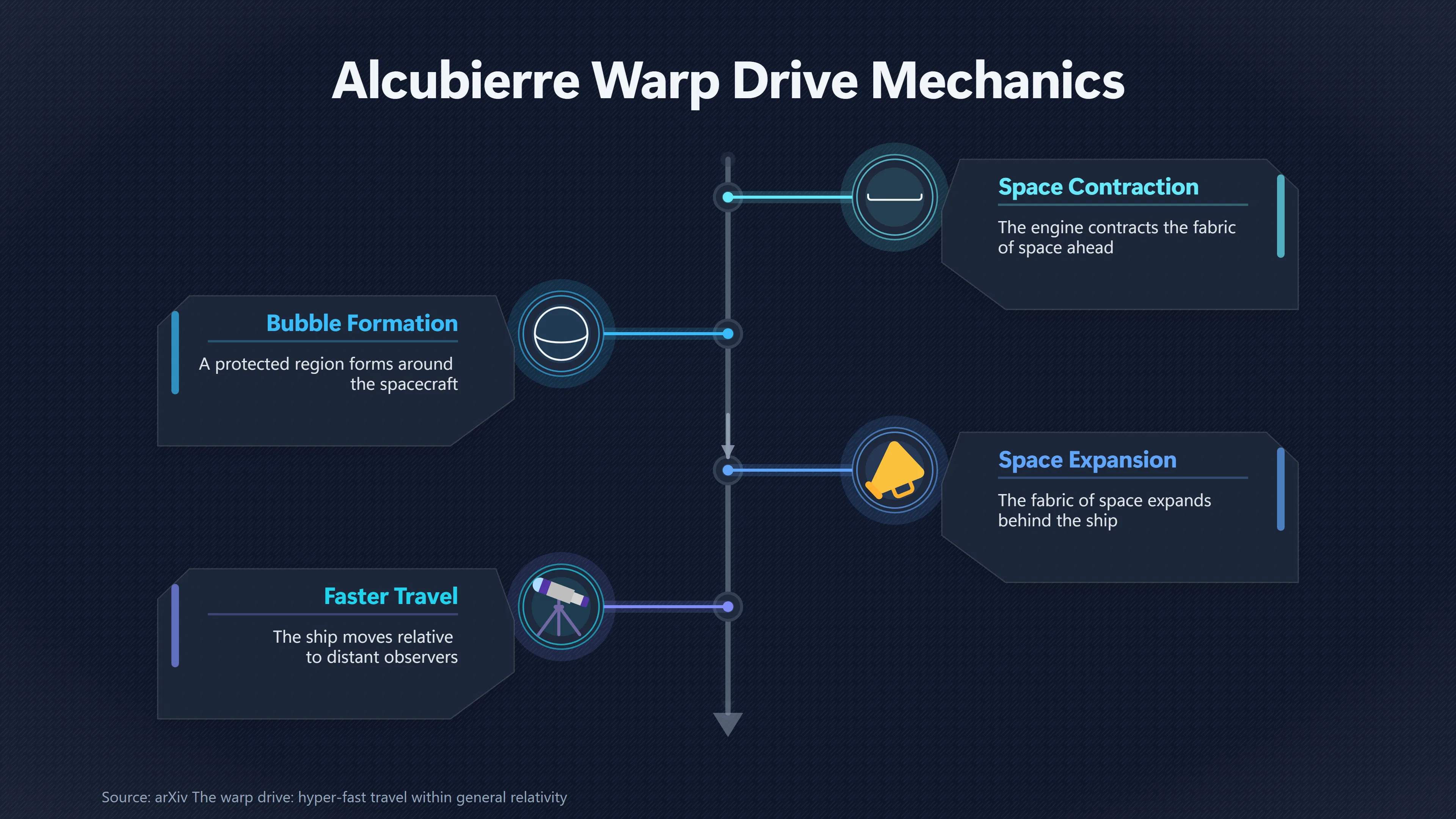
The most influential example is the warp drive popularised by Star Trek’s USS Enterprise. Instead of accelerating a ship through space faster than light, a warp system is imagined as changing spacetime around the vessel. The spacecraft remains inside a protected region while space contracts ahead and expands behind it. This approach inspired physicist Miguel Alcubierre’s 1994 theoretical model, which showed that general relativity equations could describe a “warp bubble” moving faster than light relative to distant observers, although the concept required exotic forms of matter or energy that have not been demonstrated.[arXiv]arxiv.orgarXiv The warp drive: hyper-fast travel within general relativityThe warp drive: hyper-fast travel within general relativitySeptember 5, 2000…
The importance of the warp drive idea is that it transforms a physics barrier into an engineering challenge. Human spacecraft cannot simply accelerate to faster-than-light speeds because relativity prevents objects with mass from reaching the speed of light. A fictional alien civilisation therefore needs a different mechanism: not moving faster through space, but changing the space being travelled through.[Live Science]livescience.comLive ScienceWhat would happen if you moved at the speed of light? | Live ScienceFebruary 15, 2024…
Hyperspace, jump drives and alternate routes through the universe
Other fictional propulsion systems avoid the speed problem by proposing that aliens understand hidden structures of reality. In stories such as Star Wars, Battlestar Galactica and many space-operatic settings, ships enter alternate dimensions or shortcuts that reduce interstellar distances.
These concepts are less closely tied to established physics than warp-drive models, but they serve a similar storytelling function. The alien civilisation does not merely possess a better engine; it possesses a different understanding of the universe. The technology gap is therefore intellectual as much as mechanical.
The Epstein drive and the edge of human plausibility
Some science fiction takes a different approach by improving propulsion without breaking known physics. The fictional Epstein drive from The Expanse imagines an extremely efficient fusion-based engine capable of sustained high acceleration. Unlike faster-than-light systems, it keeps the challenge of human biology central: passengers must survive acceleration forces, and spacecraft design must account for the effects of continuous thrust. This reflects a more realistic concern in space travel: even a powerful engine may be limited by what human bodies can endure.[WIRED]wired.comThe Physics of Accelerating Spacecraft in The ExpanseCharacters use magnetic boots or float when not subjected to acceleration. This relates to physics, particularly in the Epstein drive seq…
Technology gaps between civilisations
Alien propulsion stories often portray technological progress as uneven rather than simply advanced or primitive. A younger civilisation may understand the effects of an alien engine without understanding its underlying principles. This creates a recurring science-fiction theme: discovery does not guarantee comprehension.
A human observer might see an alien craft crossing enormous distances instantly, hovering without visible exhaust or ignoring conventional flight limits. The mystery is not only how the machine works but what scientific ideas the creators have mastered that humans have not yet discovered.
Reverse engineering the impossible machine
The reverse-engineering storyline appears frequently because propulsion technology represents the ultimate technological prize. A civilisation that controls interstellar travel has solved problems involving energy generation, materials science, navigation and long-duration survival.
However, fiction often highlights the difficulty of copying such systems. A recovered alien engine may be like a modern computer placed in front of an ancient civilisation: its functions may be visible, but the supporting knowledge required to recreate it may be missing. This idea connects with a broader science-fiction theme often associated with Arthur C. Clarke’s observation that sufficiently advanced technology can appear indistinguishable from magic.
Real investigations of alleged unidentified aerial phenomena have not produced confirmed evidence of extraterrestrial propulsion systems. Official reviews have found no verified proof that governments possess recovered alien craft or working extraterrestrial technology, leaving the most dramatic propulsion claims within the realm of speculation and fiction.[The New Yorker]newyorker.comThe New Yorker What's the Deal with U.F.O.s?Originally dismissed as fantasy, interest in aliens has grown due to official disclosures and congressional hearings, prompting scientist…
The alien advantage is often knowledge, not hardware
Many stories suggest that the greatest difference between humans and advanced species is not the possession of a machine but the scientific understanding behind it. An alien engine may depend on discoveries about gravity, quantum physics or dimensions that humans have not achieved.
This changes the meaning of “advanced technology”. A more advanced civilisation is not necessarily one that builds larger engines; it may be one that has discovered entirely new ways of interacting with physical reality. Alien propulsion therefore becomes a symbol of a civilisation’s accumulated knowledge.
Science limits in alien stories
The strongest alien propulsion stories work because they balance imagination with real physical constraints. They do not simply remove every obstacle; they explore what would happen if one fundamental limitation were overcome.
The human body remains the hardest passenger problem
Even if a spacecraft could achieve extraordinary speeds, humans would still face biological limits. Acceleration produces forces that can damage the body by preventing normal blood circulation and stressing organs. A vehicle travelling at extreme speeds would need a way to protect its occupants from acceleration effects, radiation and long-duration isolation.[Live Science]livescience.comLive ScienceWhat would happen if you moved at the speed of light? | Live ScienceFebruary 15, 2024…
Science fiction frequently solves this problem with artificial gravity, inertial dampeners or protective fields. These devices reveal another technological gap: an alien civilisation capable of interstellar travel may also have solved the biological consequences of that travel.

Energy requirements expose the scale of the challenge
Propulsion is ultimately an energy problem. Reaching nearby stars with conventional technology already requires enormous resources, and faster-than-light concepts introduce additional theoretical difficulties. Warp-drive models have been studied because they offer a possible route around ordinary speed limits, but they also raise questions about energy conditions, stability and whether such spacetime distortions could exist physically.[arXiv]arxiv.orgarXiv Warp drive basicsarXiv Warp drive basics
This tension gives alien propulsion stories their dramatic power. The imagined engine is impressive precisely because it represents problems humanity has not solved.
Fictional engines reveal the boundary of current understanding
Alien propulsion is valuable in science fiction because it marks the boundary between known science and speculation. Concepts such as warp drives have encouraged physicists to examine the possibilities and limits of relativity, even when the technologies themselves remain far beyond current capabilities. NASA research programmes and theoretical studies have examined advanced propulsion ideas as ways to explore these boundaries, but no experimental system has demonstrated faster-than-light travel.[NASA Technical Reports Server]ntrs.nasa.govTechnical Reports Server SearchNASA Technical Reports ServerSearch - NASA Technical Reports Server (NTRS)…
The lasting appeal of alien engines comes from this uncertainty. They represent not just faster spacecraft, but the possibility that another civilisation might have discovered principles that transform humanity’s understanding of travel itself. In UFO-related science fiction, propulsion technology becomes the clearest symbol of the distance between what humans can build today and what an older, more advanced civilisation might imagine.
Amazon book picks
Further Reading
Books and field guides related to When Alien Engines Rewrite Human Physics. Use these as the next step if you want deeper reading beyond the article.
2001 A Space Odyssey
A breakthrough into the twenty-first century, this novel and movie puts the man of today into the credible environment of tomorrow, when...
The Physics of Star Trek
Introduces physics as it analyzes the science behind "Star Trek," explaining the intricacies of warp speed and showing the difference bet...
Física de lo imposible / Physics of the Impossible
¿Hasta qué punto los ingenios de la ciencia ficción que hoy consideramos imposibles pueden ser habituales en el futuro? Teletransporte, m...
The Elegant Universe
NATIONAL BESTSELLER Finalist for the Pulitzer Prize A new edition of the iconic bestseller that introduced legions to modern physics and...
eBay marketplace picks
Marketplace Samples
Live-tested eBay searches with available results related to this page.
Selected fromalien enamel pin oneBay.co.uk.

Current eBay listing
Alien - 40th Anniversary Limited Edition Enamel Pin Badge NEW


Current eBay listing
Alien Face Head Metal Enamel Pin Badge Area 51 UFO Silver and Black

Endnotes
1.
Source: arxiv.org
Title: arXiv The warp drive: hyper-fast travel within general relativity
Link:https://arxiv.org/abs/gr-qc/0009013
Source snippet
The warp drive: hyper-fast travel within general relativitySeptember 5, 2000...
Published: September 5, 2000
2.
Source: arxiv.org
Title: arXiv Warp drive basics
Link:https://arxiv.org/abs/2103.05610
3.
Source: wired.com
Title: The Physics of Accelerating Spacecraft in The Expanse
Link:https://www.wired.com/story/the-physics-of-accelerating-spacecraft-in-the-expanse
Source snippet
Characters use magnetic boots or float when not subjected to acceleration. This relates to physics, particularly in the Epstein drive seq...
4.
Source: arxiv.org
Title: arXiv Introducing Physical Warp Drives
Link:https://arxiv.org/abs/2102.06824
5.
Source: ntrs.nasa.gov
Title: Technical Reports Server Search
Link:https://ntrs.nasa.gov/search?q=alcubierre
Source snippet
NASA Technical Reports ServerSearch - NASA Technical Reports Server (NTRS)...
6.
Source: ntrs.nasa.gov
Title: Technical Reports Server Warp Field Mechanics 101
Link:https://ntrs.nasa.gov/search.jsp?R=20110015936&hterms=warp
Source snippet
NASA Technical Reports ServerWarp Field Mechanics 101 - NASA Technical Reports Server (NTRS)...
7.
Source: discovery.com
Title: The New Warp Drive Idea Isn’t Very Warpy | Discovery
Link:https://www.discovery.com/space/the-new-warp-drive-idea-isn-t-very-warpy
8.
Source: wired.com
Title: warp drive plausible
Link:https://www.wired.com/2012/09/warp-drive-plausible/
9.
Source: ntrs.nasa.gov
Link:https://ntrs.nasa.gov/archive/nasa/casi.ntrs.nasa.gov/20110015936.pdf
10.
Source: ntrs.nasa.gov
Link:https://ntrs.nasa.gov/search?page=%7B%22from%22%3A0%2C%22size%22%3A25%7D&q=%22Warp+field%22
11.
Source: livescience.com
Link:https://www.livescience.com/space/cosmology/what-would-happen-if-you-moved-at-the-speed-of-light
Source snippet
Live ScienceWhat would happen if you moved at the speed of light? | Live ScienceFebruary 15, 2024...
Published: February 15, 2024
12.
Source: livescience.com
Link:https://www.livescience.com/33747-science-fiction-fact-faster-light-travel.html
13.
Source: newyorker.com
Title: The New Yorker What’s the Deal with U.F.O.s?
Link:https://www.newyorker.com/culture/annals-of-inquiry/whats-the-deal-with-ufos
Source snippet
Originally dismissed as fantasy, interest in aliens has grown due to official disclosures and congressional hearings, prompting scientist...
14.
Source: popularmechanics.com
Title: Warp Drive
Link:https://www.popularmechanics.com/science/a32449240/nasa-warp-drive-space-time/
15.
Source: livescience.com
Title: Science Fact or Fiction? The Plausibility of 10 Sci-Fi Concepts | Live Science
Link:https://www.livescience.com/39825-reality-of-sci-fi-concepts.html
16.
Source: labs.engineering.asu.edu
Title: warp drive
Link:https://labs.engineering.asu.edu/trek-demo/research/warp-drive/
17.
Source: en.wikipedia-on-ipfs.org
Title: Warp drive
Link:https://en.wikipedia-on-ipfs.org/wiki/Warp_drive
18.
Source: ebsco.com
Link:https://www.ebsco.com/research-starters/engineering/warp-drive
19.
Source: future.fandom.com
Title: Warp Drive
Link:https://future.fandom.com/wiki/Warp_Drive
Additional References
20.
Source: sciencefocus.com
Link:https://www.sciencefocus.com/space/beyond-the-speed-of-light
Source snippet
February 7, 2026 — BEYOND THE SPEED OF LIGHT: THE STRANGE PARTICLE THAT COULD RESHAPE THE LAWS OF THE UNIVERSE As much as we want to tell...
Published: February 7, 2026
21.
Source: youtube.com
Title: Faster than Light Speed? The Physics of the Warp Drive
Link:https://www.youtube.com/watch?v=iUydeMpN8Fc
Source snippet
Post-Alcubierre Warp-Drives | Daniel Davis...
22.
Source: youtube.com
Title: The truth about Warp Drive with Miguel Alcubierre
Link:https://www.youtube.com/watch?v=auKzuyHkuZA
Source snippet
Faster than Light Speed? The Physics of the Warp Drive - Elias Most - 01/24/2025...
23.
Source: newspaceeconomy.ca
Link:https://newspaceeconomy.ca/2024/09/19/a-journey-through-imaginary-rockets-propulsion-systems-in-science-fiction/
24.
Source: sciencetimes.com
Link:https://www.sciencetimes.com/articles/61148/20260116/faster-light-travel-how-warp-drive-physics-relativity-challenge-limits-space-travel.htm
25.
Source: orbitcodex.com
Link:https://orbitcodex.com/knowledge-base/warp-drive
26.
Source: thingsiknownothingabout.com
Link:https://thingsiknownothingabout.com/blog/e41-sci-fi-space/
27.
Source: everything.explained.today
Link:https://everything.explained.today/Warp_drive/
28.
Source: nationalgeographic.com
Link:https://www.nationalgeographic.com/science/article/warp-drive-science-fiction-physics
29.
Source: youtube.com
Title: Post-Alcubierre Warp-Drives | Daniel Davis
Link:https://www.youtube.com/watch?v=0tGU2pSLtwI
Source snippet
The Absolute Limit of Human Travel Through Space...