Within Future encounters
The Signal That Was Not Alien
The BLC1 signal candidate shows why possible alien detections require careful testing before being accepted as evidence of technology beyond Earth.
On this page
- The discovery of the BLC 1 candidate
- How researchers tested the signal
- Lessons for future contact claims
Page outline Jump by section
Introduction
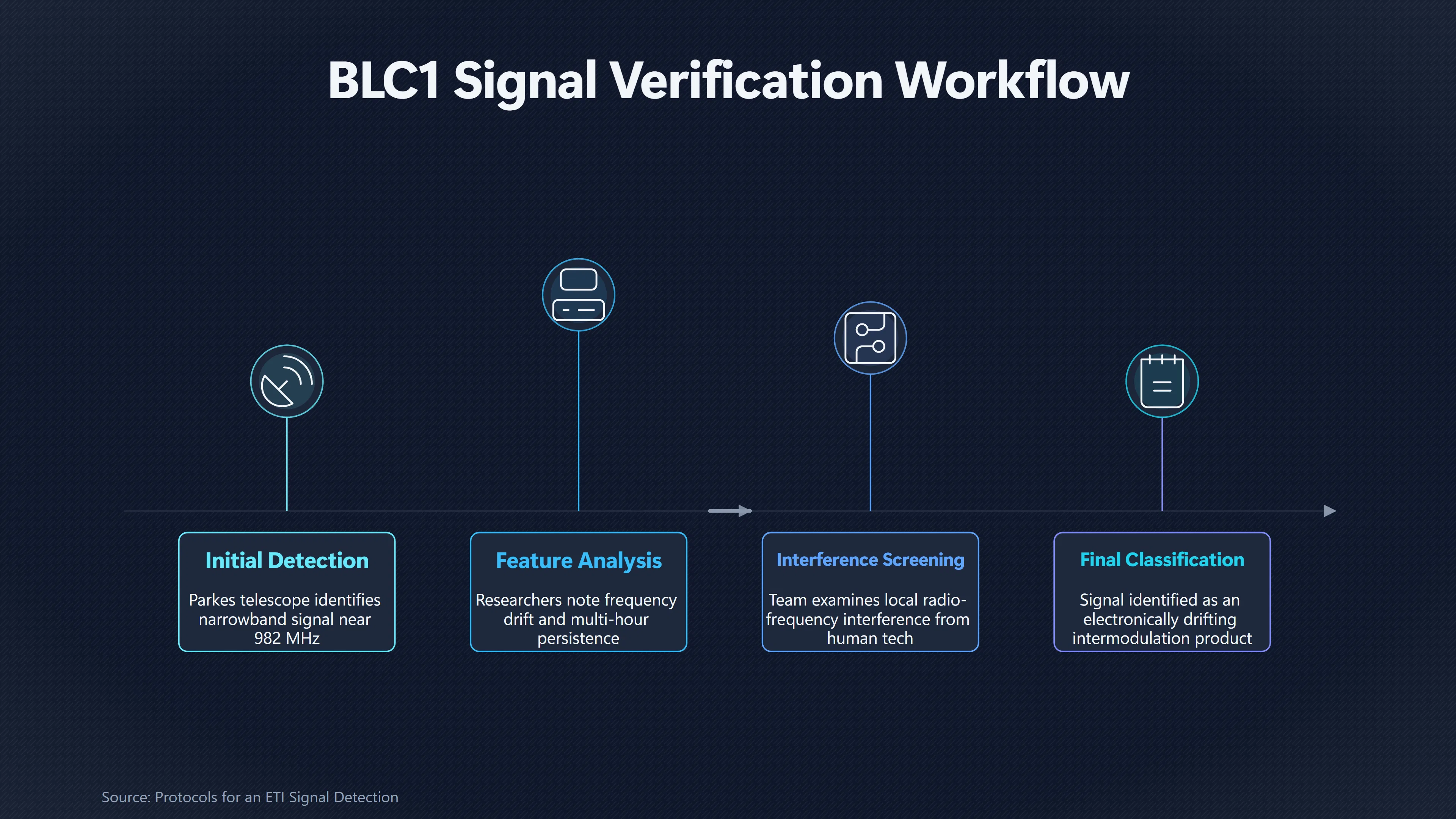
The BLC1 signal became one of the clearest modern examples of why a possible alien detection must be treated as a scientific investigation rather than an announcement. Detected during observations of Proxima Centauri by the Breakthrough Listen project, BLC1 initially appeared interesting because it had several features expected of a possible technosignature: it was narrowband, showed frequency drift, persisted for hours, and appeared only during observations pointed towards the star system. Later analysis showed that it was not a transmission from another civilisation, but a complex form of human-generated radio interference.[Nature]nature.comA radio technosignature search towards Proxima Centauri resulting in a signal of interest | Nature AstronomyOctober 25, 2021…
The importance of BLC1 is therefore not that it represented a failed alien discovery. Instead, it demonstrated how future searches for extraterrestrial technology must separate a promising signal from a verified discovery. In the context of UFO and science-fiction ideas about first contact, BLC1 provides a realistic model of what an actual detection process may look like: uncertainty, testing, competing explanations, and the need for evidence strong enough to survive detailed scrutiny.[Nature]nature.comAnalysis of the Breakthrough Listen signal of interest blc1 with a technosignature verification framework | Nature Astronomy…
The discovery of the BLC1 candidate
BLC1 was identified in data collected in April 2019 by the Breakthrough Listen project while using the Parkes “Murriyang” radio telescope in Australia to observe Proxima Centauri, the closest star system to the Sun. The signal appeared near 982 MHz and was unusually narrow in frequency. Researchers classified it as a “signal of interest” because its characteristics matched some expectations for an artificial transmission rather than a natural astrophysical source.[Nature]nature.comA radio technosignature search towards Proxima Centauri resulting in a signal of interest | Nature AstronomyOctober 25, 2021…
Several features made BLC1 stand out:
- A narrowband signal: Natural astronomical radio sources usually produce broader emissions, while a very narrow signal can be a sign of technology.
- Frequency drift: The signal changed frequency over time, a behaviour that could occur if a transmitter were moving relative to the observer, such as a spacecraft or a planet-based transmitter affected by rotation.
- Persistence: The signal remained detectable across multiple observations rather than appearing as a brief burst.
- Target association: It appeared during observations directed towards Proxima Centauri and was not immediately visible in the same way during off-target observations.[Nature]nature.comA radio technosignature search towards Proxima Centauri resulting in a signal of interest | Nature AstronomyOctober 25, 2021…
These characteristics explain why BLC1 attracted attention. A convincing technosignature would not necessarily look like a dramatic message or an obvious “alien broadcast”; it could initially appear as a small, ambiguous pattern buried in astronomical data. This is similar to many science-fiction portrayals of first contact through signals rather than physical visitors, but BLC1 showed the difference between a compelling clue and confirmed evidence.
The initial excitement also demonstrated a challenge for modern SETI (the Search for Extraterrestrial Intelligence): the same properties that make a signal scientifically interesting can also be produced by human technology. A signal being consistent with an artificial origin does not automatically mean it is extraterrestrial.
How researchers tested the signal
The investigation of BLC1 focused on eliminating possible explanations one by one. Researchers applied a verification framework designed to determine whether a signal of interest could genuinely originate beyond Earth or whether it was caused by local interference.[Nature]nature.comAnalysis of the Breakthrough Listen signal of interest blc1 with a technosignature verification framework | Nature Astronomy…
A major part of the analysis involved examining radio-frequency interference (RFI), the unwanted signals produced by human technology. The researchers found that BLC1 was an electronically drifting intermodulation product: a signal artifact created when multiple sources of radio interference interacted through electronic systems. In simpler terms, the telescope had detected a complicated by-product of local technology that happened to resemble the kind of signal scientists were searching for.[Nature]nature.comAnalysis of the Breakthrough Listen signal of interest blc1 with a technosignature verification framework | Nature Astronomy…
The team compared BLC1 against other observations and looked for patterns that would reveal a terrestrial origin. Their analysis found similar interference structures at related frequencies, showing that the signal’s unusual behaviour could be explained without requiring an extraterrestrial transmitter.[Nature]nature.comAnalysis of the Breakthrough Listen signal of interest blc1 with a technosignature verification framework | Nature Astronomy…
The verification process highlighted several important checks for future technosignature investigations:
- Instrument testing: Researchers must confirm that the telescope and associated equipment are functioning correctly.
- Off-target observations: A genuine distant source should behave differently from local interference when the telescope changes direction.
- Radio environment analysis: Scientists must examine whether nearby human activity could create a false signal.
- Independent follow-up: A promising detection requires repeated observation and confirmation before any claim of discovery.[Nature]nature.comAnalysis of the Breakthrough Listen signal of interest blc1 with a technosignature verification framework | Nature Astronomy…
This process reflects a key difference between science fiction and scientific practice. In fictional first-contact stories, a strange signal often becomes meaningful immediately. In real research, the first question is not “Who sent it?” but “What natural or human-made explanations must be ruled out first?”
Lessons for future contact claims
BLC1 changed how researchers think about the path from detection to discovery. Rather than being remembered only as a false alarm, it became a practical test case for building stronger verification methods. The Breakthrough Listen team described the investigation as a reason to develop more systematic procedures for evaluating future signals of interest.[Nature]nature.comAnalysis of the Breakthrough Listen signal of interest blc1 with a technosignature verification framework | Nature Astronomy…
The case shows that a future confirmed detection of alien technology may not arrive with immediate certainty. A genuine signal could initially look very similar to interference, equipment problems, satellites, or other human sources. The challenge will be demonstrating that the signal cannot reasonably be explained by Earth-based causes.
This is especially important because humanity’s radio environment is becoming increasingly crowded. Modern communication systems create a background of signals that can imitate some features scientists expect from distant technology. BLC1 showed that advanced searches require not only sensitive telescopes but also detailed knowledge of terrestrial interference.
For science-fiction storytelling, the lesson is equally significant. Future encounter narratives increasingly focus on decoding messages, evaluating evidence, and deciding when a discovery is trustworthy. BLC1 provides a realistic example of the uncertainty behind such stories: the dramatic moment is not finding a strange signal, but proving what that signal actually represents.
The final result was a false alarm, but it was a scientifically valuable one. BLC1 demonstrated that careful scepticism is not an obstacle to discovering extraterrestrial life; it is the method that would make such a discovery credible if it ever occurs.[Nature]nature.comAnalysis of the Breakthrough Listen signal of interest blc1 with a technosignature verification framework | Nature Astronomy…
Amazon book picks
Further Reading
Books and field guides related to The Signal That Was Not Alien. Use these as the next step if you want deeper reading beyond the article.
The Little Book of Aliens
“With wit and brio, Frank separates current nonsense about aliens from the serious and fascinating search for extraterrestrial life.” —Ca...
The Eerie Silence: Renewing Our Search for Alien Intelligence
"Refreshing . . . A penetrating analysis of the assumptions that underlie SETI and the entire enterprise of searching for life beyond Ear...
Contact
Rating: 4.0/5 from 21 Google Books ratings
In the year 1999 a multinational team of astronauts sets out to discover the secrets of the universe.
Extraterrestrial: The First Sign of Intelligent Life Beyond E...
'VISIONARY' Stephen Greenblatt 'So interesting... I recommend [Extraterrestrial] to people who have any interest in this extraordinary su...
eBay marketplace picks
Marketplace Samples
Live-tested eBay searches with available results related to this page.
Selected fromspace poster oneBay.co.uk.



Endnotes
1.
Source: nature.com
Link:https://www.nature.com/articles/s41550-021-01479-w
Source snippet
A radio technosignature search towards Proxima Centauri resulting in a signal of interest | Nature AstronomyOctober 25, 2021...
Published: October 25, 2021
2.
Source: nature.com
Link:https://www.nature.com/articles/s41550-021-01508-8
Source snippet
Analysis of the Breakthrough Listen signal of interest blc1 with a technosignature verification framework | Nature Astronomy...
3.
Source: seti.org
Title: Protocols for an ETI Signal Detection
Link:https://www.seti.org/research/seti-101/protocols-for-an-eti-signal-detection/
Source snippet
June 1, 2026 — DECLARATION OF PRINCIPLES CONCERNING THE CONDUCT OF THE SEARCH FOR EXTRATERRESTRIAL INTELLIGENCE JUNE 2026 UPDATE PREAMBLE...
Published: June 1, 2026
4.
Source: seti.org
Title: What was that signal from Proxima Centauri?
Link:https://www.seti.org/what-was-signal-proxima-centauri
5.
Source: nature.com
Title: Mysterious ‘alien beacon’ was false alarm | Nature
Link:https://www.nature.com/articles/d41586-021-02931-7
6.
Source: seti.org
Title: Did Proxima Centauri Just Call to Say Hello? Not Really!
Link:https://www.seti.org/did-proxima-centauri-just-call-say-hello-not-really
7.
Source: nature.com
Link:https://www.nature.com/natastron/articles?page=4&searchType=journalSearch&sort=PubDate&year=2021
8.
Source: nature.com
Link:https://www.nature.com/natastron/research-articles?page=2&searchType=journalSearch&sort=PubDate&year=2021
Additional References
9.
Source: par.nsf.gov
Link:https://par.nsf.gov/biblio/10313859-analysis-breakthrough-listen-signal-interest-blc1-technosignature-verification-framework
Source snippet
of the Breakthrough Listen signal of interest blc1 with a technosignature verification framework | NSF Public Access RepositoryNovember 1...
10.
Source: sciencefocus.com
Title: Yet Credit: KTSDESIGN/SCIENCE PHOTO LIBRARY via Getty Dr Alastair Gunn Publ
Link:https://www.sciencefocus.com/space/these-two-signals-are-closest-to-alien-contact
Source snippet
These two signals are the closest we've come to alien contact | BBC Science Focus MagazineJune 21, 2026 — THESE TWO SIGNALS ARE THE CLOSE...
Published: June 21, 2026
11.
Source: researchgate.net
Title: These data contained a narrowband signal with characteristics broadly cons
Link:https://www.researchgate.net/publication/356159013_Analysis_of_the_Breakthrough_Listen_signal_of_interest_blc1_with_a_technosignature_verification_framework
Source snippet
(PDF) Analysis of the Breakthrough Listen signal of interest blc1 with a technosignature verification frameworkNovember 11, 2021 — On 201...
Published: November 11, 2021
12.
Source: newspaceeconomy.ca
Link:https://newspaceeconomy.ca/2026/03/25/breakthrough-listen-humanitys-most-ambitious-search-for-extraterrestrial-intelligence/
Source snippet
The open-data philosophy was a deliberate choice tied to Milner’s stated goal of applying Silicon Valley-style co...
13.
Source: youtube.com
Title: Did we really detect a signal from Proxima Centauri? Maybe (not)!
Link:https://www.youtube.com/watch?v=HZrlY7d8fMI
Source snippet
BLC1 Breakthrough Listen Proxima Centauri signal SETI Alien Signal My BLC1 Story Prof Simon - Science Filmmaker...
14.
Source: youtube.com
Title: SETI Signal From Proxima Centauri Detected Last Year Finally Explained
Link:https://www.youtube.com/watch?v=m515z9Yh3DY
Source snippet
Analysis of Intriguing Signal by Breakthrough Listen...
15.
Source: youtube.com
Title: Breakthrough Listen Candidate 1: Alien Technology or not?
Link:https://www.youtube.com/watch?v=E_Bhg5on5us
Source snippet
SETI Signal From Proxima Centauri Detected Last Year Finally Explained...
16.
Source: youtube.com
Title: BLC1 the Proxima Centauri SETI Candidate with Jason Wright
Link:https://www.youtube.com/watch?v=-OO7JZ14sZM
Source snippet
Breakthrough Listen Candidate 1: Alien Technology or not?...
17.
Source: youtube.com
Title: Analysis of Intriguing Signal by Breakthrough Listen
Link:https://www.youtube.com/watch?v=Pd4-me6ZSC4
Source snippet
Did we really detect a signal from Proxima Centauri? Maybe (not)...
18.
Source: communities.springernature.com
Title: the blc1 signal is not alien but it is a huge leap forward for seti
Link:https://communities.springernature.com/posts/the-blc1-signal-is-not-alien-but-it-is-a-huge-leap-forward-for-seti