Within Science fiction
The Satellite Idea That Connected Earth
Arthur C.
On this page
- Clarke's orbital communication proposal
- From concept to satellite networks
- Lessons from accurate predictions
Page outline Jump by section
Introduction
The significance of Clarke’s satellite vision lies in how it transformed a space-age idea into a practical communications model. The geostationary orbit he promoted became the foundation for many international telephone, television and data networks, helping create the global connectivity that later generations would take for granted. The story shows how science fiction can influence technology not by predicting exact devices, but by identifying possibilities before the engineering tools exist to realise them.[Clarke Foundation]clarkefoundation.orgClarke Foundation AboutClarke FoundationAbout - The Arthur C Clarke Foundation…
Clarke’s orbital communication proposal
The satellite idea that connected Earth
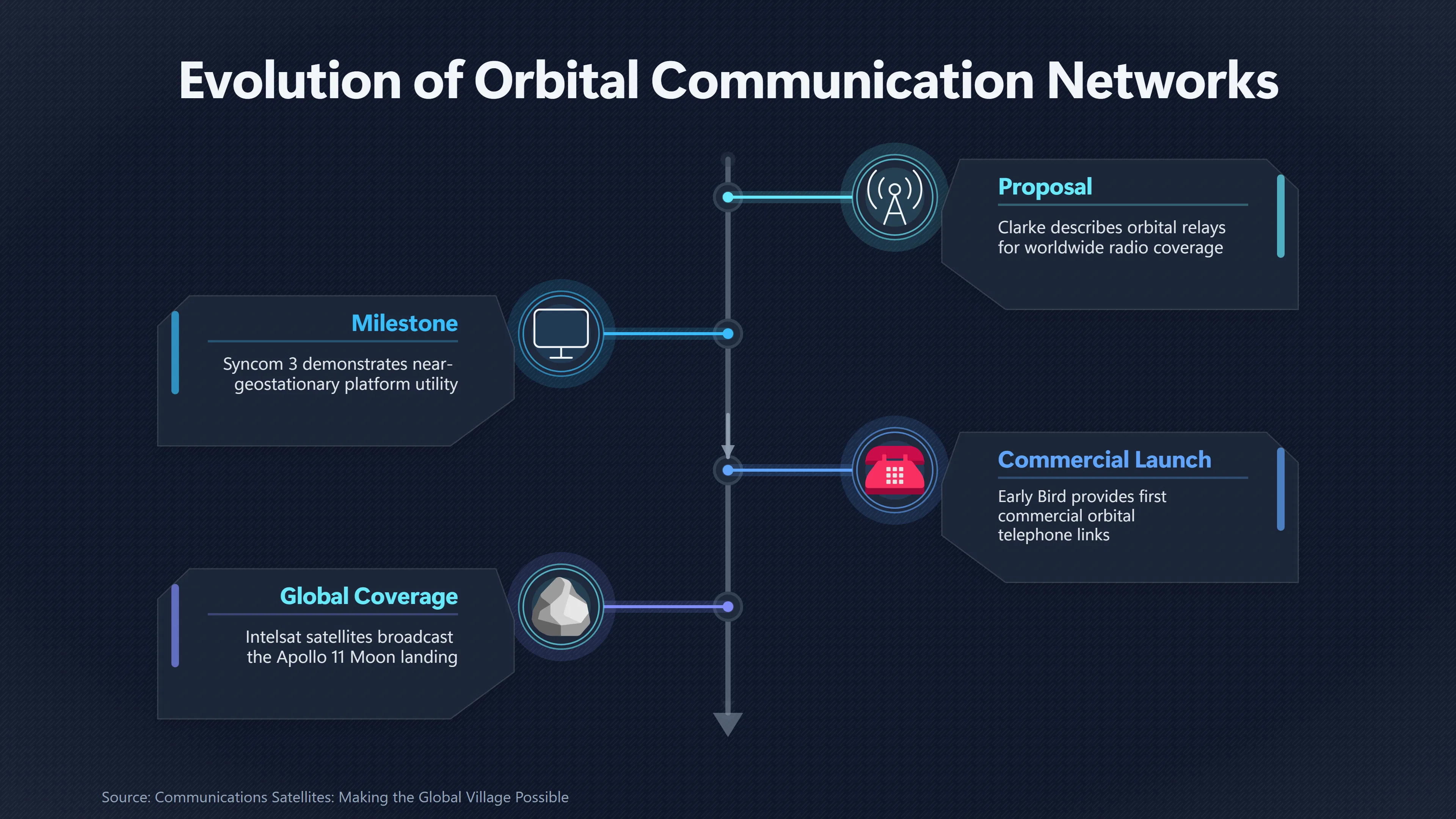
In his 1945 paper “Extra-Terrestrial Relays – Can Rocket Stations Give World-wide Radio Coverage?”, published in Wireless World, Arthur C. Clarke proposed using satellites in geostationary orbit as communication relay stations. A geostationary satellite travels around Earth at the same rate that Earth rotates, making it appear fixed above one point on the planet. This allows ground antennas to remain pointed at the same location instead of constantly tracking a moving spacecraft.[Clarke Foundation]clarkefoundation.orgClarke Foundation Arthur C ClarkeClarke FoundationArthur C Clarke - The Arthur C Clarke Foundation…
Clarke’s proposal addressed a practical communications problem: long-distance signals weaken as they travel around Earth’s curved surface. A high-altitude relay could receive a signal from one location, amplify it, and transmit it onward to another part of the world. In effect, the satellite would act as a bridge between distant regions that could not easily communicate through conventional radio systems.[NASA]nasa.govCommunications Satellites: Making the Global Village PossibleCommunications Satellites: Making the Global Village Possible - NASA…
The idea was ambitious because the necessary technology was not yet available. In 1945, rockets capable of launching useful satellites did not exist, electronics were too limited for compact spacecraft systems, and no artificial object had reached orbit. Clarke’s contribution was not the invention of a satellite in isolation, but the recognition that orbital mechanics and communications engineering could eventually combine into a global network.[Clarke Foundation]clarkefoundation.orgClarke Foundation Arthur C ClarkeClarke FoundationArthur C Clarke - The Arthur C Clarke Foundation…
Although Clarke is often described as the inventor of the communications satellite, the history is more nuanced. Earlier thinkers had discussed geostationary orbits, but Clarke was among the first to clearly connect that orbit with worldwide telecommunications. Later engineers, including researchers at Bell Laboratories, independently developed related concepts as satellite technology became realistic.[Wikipedia]WikipediaArthur C. ClarkeArthur C. Clarke
From concept to satellite networks
The engineering path from theory to orbit
The transition from Clarke’s proposal to operational satellites required several stages of experimentation. Early communication satellites demonstrated that signals could be transmitted through space, but many early spacecraft moved around Earth rather than remaining fixed above one region. The breakthrough came with satellites designed for geosynchronous and geostationary operation.[NASA]nasa.govCommunications Satellites: Making the Global Village PossibleCommunications Satellites: Making the Global Village Possible - NASA…
One important milestone was Syncom 3, launched in 1964. It helped demonstrate the usefulness of a near-geostationary communication platform and was used to transmit coverage of the 1964 Tokyo Olympic Games to the United States. This marked a practical step towards the type of global communications system Clarke had envisioned.[Clarke Foundation]clarkefoundation.orgClarke Foundation Arthur C ClarkeClarke FoundationArthur C Clarke - The Arthur C Clarke Foundation…
The following year, Intelsat I (Early Bird) became the first commercial communications satellite. Launched in 1965, it provided telephone and television links between North America and Europe from geosynchronous orbit. The satellite could support hundreds of voice circuits or television transmission, demonstrating that orbital communication was not merely an experiment but a viable international service.[IEEE Communications Society]comsoc.orgOpen source on comsoc.org.
NASA’s historical account of communications satellites highlights how systems such as Early Bird and later Intelsat satellites gradually transformed space technology into a global communications network. By 1969, Intelsat satellites provided worldwide coverage, allowing major international events, including the Apollo 11 Moon landing, to be watched by audiences around the planet.[NASA]nasa.govCommunications Satellites: Making the Global Village PossibleCommunications Satellites: Making the Global Village Possible - NASA…
The result was a new form of global infrastructure. Satellite links supported international telephone calls, television broadcasts, maritime communication, weather services and later digital data networks. Clarke’s original vision of orbital relays became part of the hidden architecture behind everyday communication.[Clarke Foundation]clarkefoundation.orgClarke Foundation OverviewClarke FoundationOverview - The Arthur C Clarke Foundation…
Why Clarke’s prediction was unusually accurate
A prediction about infrastructure, not gadgets
Many science fiction predictions focus on visible objects: futuristic vehicles, robots or handheld devices. Clarke’s satellite idea was different because it predicted a system. He imagined not just a machine in space, but a network connecting people on Earth. That distinction helped the idea remain relevant even as the technology changed.
The satellites built after Clarke’s proposal did not exactly match every detail of his original design. Clarke initially imagined large, manned space stations acting as communication relays, while real systems used unmanned spacecraft with advanced electronics. The underlying principle, however, remained remarkably close: place relay stations in a stable orbit to enable worldwide communication.[NASA]nasa.govCommunications Satellites: Making the Global Village PossibleCommunications Satellites: Making the Global Village Possible - NASA…
This is why Clarke’s example is often used when discussing the relationship between science fiction and technological innovation. His work did not predict a mysterious breakthrough from an unknown civilisation, but it demonstrated a similar imaginative process: considering what capabilities a highly advanced society might need and then asking whether physics allows those capabilities to exist.
The lasting impact on global communication
Modern communication systems are more diverse than Clarke’s original satellite network. Fibre-optic cables carry much of today’s international internet traffic, and newer satellite systems use different orbital approaches, including large constellations of lower-orbit spacecraft. However, geostationary satellites remain important for broadcasting, remote connectivity and specialised communication services.[arXiv]arxiv.orgSatellite Communications in the New Space Era: A Survey and Future ChallengesFebruary 20, 2020…
The enduring lesson from Clarke’s satellite vision is that technological imagination can influence engineering when it is grounded in scientific principles. His proposal succeeded because it identified a real challenge — communicating across a curved planet — and offered a physically possible solution before the necessary technology had matured.[Clarke Foundation]clarkefoundation.orgClarke Foundation Arthur C ClarkeClarke FoundationArthur C Clarke - The Arthur C Clarke Foundation…
In the broader relationship between UFO ideas and science fiction, Clarke’s satellites represent a more grounded form of “advanced technology” thinking. Instead of imagining impossible alien machinery, his work showed how humans can use speculation to design practical systems that once seemed almost as extraordinary as science fiction itself.
Amazon book picks
Further Reading
Books and field guides related to The Satellite Idea That Connected Earth. Use these as the next step if you want deeper reading beyond the article.
The Right Stuff
Rating: 4.5/5 from 8 Google Books ratings
The first Americans in space--Yeager, Conrad, Grissom, and Glenn--battle the Russians for control of the heavens and put their lives on t...
A Brief History of Time
Rating: 4.0/5 from 7 Google Books ratings
#1 NEW YORK TIMES BESTSELLER A landmark volume in science writing by one of the great minds of our time, Stephen Hawking’s book explores...

The High Frontier: Human Colonies in Space
First published 1976. Subjects: Space colonies, Colonies spatiales, Buitenaards leven, Ruimtekolonies, Ruimtevaart.
eBay marketplace picks
Marketplace Samples
Live-tested eBay searches with available results related to this page.
Selected fromscience poster oneBay.co.uk.



Endnotes
1.
Source: nasa.gov
Title: Communications Satellites: Making the Global Village Possible
Link:https://www.nasa.gov/history/communications-satellites/
Source snippet
Communications Satellites: Making the Global Village Possible - NASA...
2.
Source: Wikipedia
Title: Arthur C. Clarke
Link:https://en.wikipedia.org/wiki/Arthur_C._Clarke
3.
Source: arxiv.org
Link:https://arxiv.org/abs/2002.08811
Source snippet
Satellite Communications in the New Space Era: A Survey and Future ChallengesFebruary 20, 2020...
Published: February 20, 2020
4.
Source: arxiv.org
Link:https://arxiv.org/abs/2101.08051
5.
Source: spectrum.ieee.org
Title: this is what broadband satellite communication looked like in 1965
Link:https://spectrum.ieee.org/this-is-what-broadband-satellite-communication-looked-like-in-1965
6.
Source: nasa.gov
Title: Telstar Opened Era of Global Satellite Television
Link:https://www.nasa.gov/history/telstar-opened-era-of-global-satellite-television/
7.
Source: spectrum.ieee.org
Title: audio transcript interview with arthur c clarke
Link:https://spectrum.ieee.org/audio-transcript-interview-with-arthur-c-clarke
8.
Source: spectrum.ieee.org
Title: final thoughts from sir arthur c clarke 19172008
Link:https://spectrum.ieee.org/final-thoughts-from-sir-arthur-c-clarke-19172008
9.
Source: technav.ieee.org
Title: geosynchronous satellites
Link:https://technav.ieee.org/topic/geosynchronous-satellites/
10.
Source: www3.nasa.gov
Link:https://www3.nasa.gov/specials/timeline/topics.html
11.
Source: clarkefoundation.org
Title: Clarke Foundation Arthur C Clarke
Link:https://clarkefoundation.org/arthur-c-clarke-biography/
Source snippet
Clarke FoundationArthur C Clarke - The Arthur C Clarke Foundation...
12.
Source: clarkefoundation.org
Title: Clarke Foundation About
Link:https://clarkefoundation.org/about/
Source snippet
Clarke FoundationAbout - The Arthur C Clarke Foundation...
13.
Source: clarkefoundation.org
Title: Clarke Foundation Overview
Link:https://clarkefoundation.org/overview/
Source snippet
Clarke FoundationOverview - The Arthur C Clarke Foundation...
14.
Source: coseti.org
Title: Extra-Terrestrial Relays
Link:https://www.coseti.org/clarke_1.htm
Source snippet
Extra-Terrestrial Relays...
15.
Source: comsoc.org
Link:https://www.comsoc.org/node/19396
16.
Source: lcdcompendium.com
Title: Arthur C
Link:https://lcdcompendium.com/arthur-c-clarke/
Source snippet
Clarke - LCD CompendiumMay 29, 2026 — GEOSTATIONARY COMMUNICATIONS SATELLITE Arthur C. Clarke helped make the idea of using geostationary...
Published: May 29, 2026
17.
Source: comsoc.org
Link:https://www.comsoc.org/node/19071
18.
Source: clarkeinstitute.org
Link:https://clarkeinstitute.org/arthur-c-clarke/
Additional References
19.
Source: youtube.com
Link:https://www.youtube.com/watch?v=YwELr8ir9qM
Source snippet
Interview with author/futurist Arthur C. Clarke, from an AT&T-MIT Conference, 1976...
20.
Source: youtube.com
Link:https://www.youtube.com/watch?v=D1vQ_cB0f4w
Source snippet
1968: The Whole World in a Box | Towards Tomorrow | BBC Archive...
21.
Source: youtube.com
Link:https://www.youtube.com/watch?v=c-i4sDAGyXQ
Source snippet
Arthur C. Clarke's Predictions for Space: What Did He Get Right?...
22.
Source: youtube.com
Title: Arthur C. Clarke’s Predictions for Space: What Did He Get Right?
Link:https://www.youtube.com/watch?v=8mMv_-E9OWs
Source snippet
Sir Arthur C Clarke: 90th Birthday Reflections...
23.
Source: clarkeinstitute.org
Link:https://clarkeinstitute.org/arthur-c-clarke/bibliography/
24.
Source: fantlab.ru
Link:https://fantlab.ru/article389
25.
Source: airandspace.si.edu
Link:https://airandspace.si.edu/collection-objects/model-communications-satellite-intelsat-i/nasm_A19750767000
26.
Source: sciencemuseum.org.uk
Link:https://www.sciencemuseum.org.uk/objects-and-stories/telstar-intelsat-and-first-global-satellite-broadcast
27.
Source: researchgate.net
Link:https://www.researchgate.net/publication/3003555_The_geostationary_orbit_and_satellite_communications_Concepts_older_than_commonly_supposed
28.
Source: sciencedirect.com
Title: Extra-Terrestrial Relays: Can Rocket Stations Give World-wide Radio Coverage?
Link:https://www.sciencedirect.com/science/article/pii/B9781483227160500062