Within UFO culture
How Sci Fi Magazines Shaped UFO Fans
Science fiction magazines supplied many of the ideas and images that helped early UFO communities develop.
On this page
- Magazine fandom before organised UFO groups
- Alien worlds and future technology ideas
- Shared language between fiction and reports
Page outline Jump by section
Introduction
Science fiction magazines did more than entertain readers with stories about distant planets and alien civilisations: they created a shared imaginative vocabulary that helped early UFO communities form. Before organised UFO groups existed, science-fiction readers were already discussing extraterrestrial life, advanced spacecraft, future technologies and possible encounters with non-human intelligence through magazines, letters columns and fan clubs. When reports of “flying saucers” entered public discussion in the late 1940s, many people interpreted them through ideas that pulp science fiction had circulated for decades.[Hollis Archives]hollisarchives.lib.harvard.eduHollis ArchivesScience fiction fanzines and prozines, 1939-1971 - HOLLIS for Archival Discovery…

The connection was not that science fiction magazines caused belief in UFOs. Rather, they provided a ready-made cultural framework: readers already understood the possibility of visitors from other worlds, imagined technologies beyond human capability and communities built around speculation. Publications such as Amazing Stories and later UFO-focused magazines helped transform isolated curiosity into organised discussion networks.[Wikipedia]WikipediaAmazing StoriesAmazing Stories
Magazine fandom before organised UFO groups
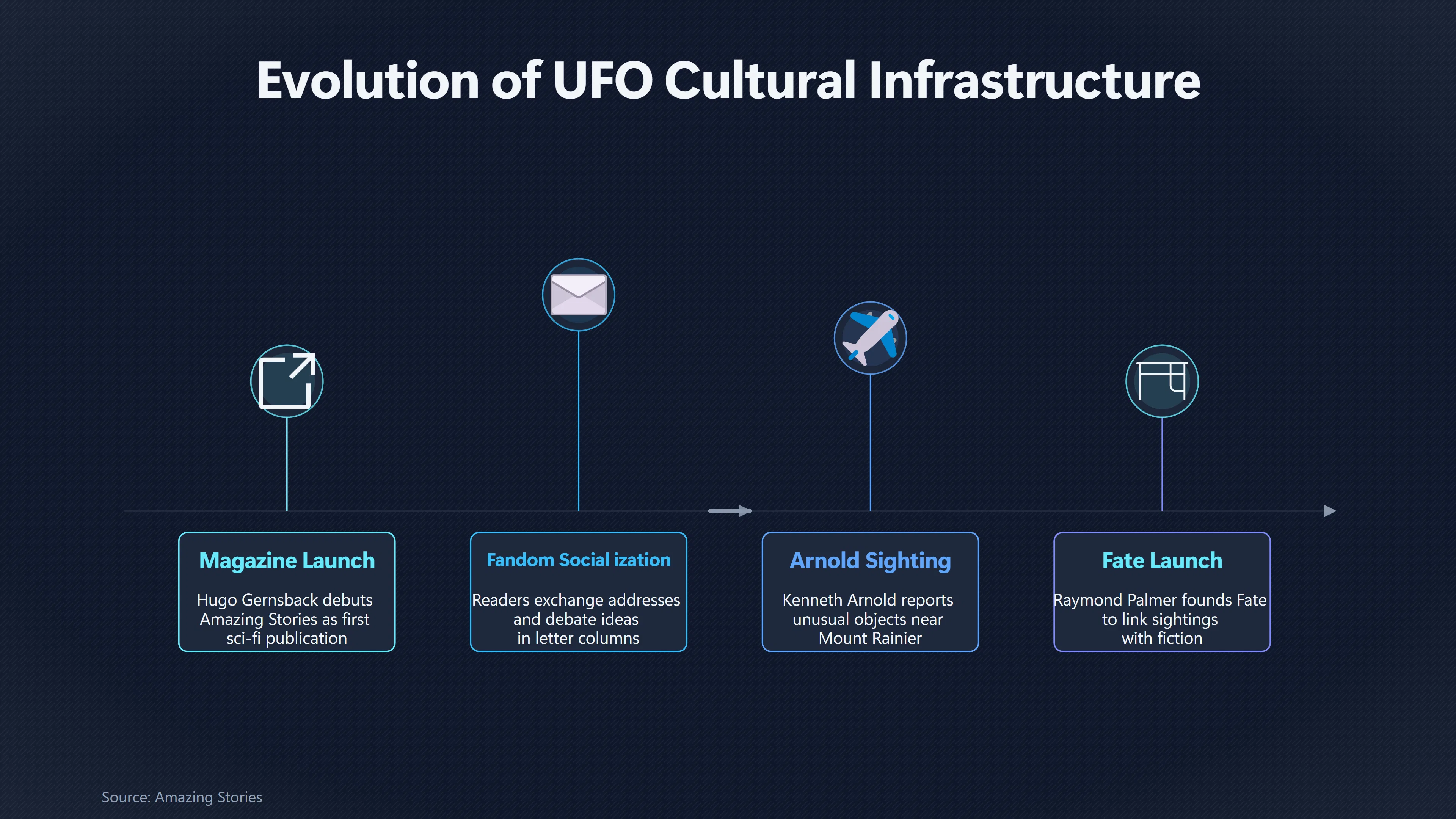
The roots of UFO communities can be traced partly to the social structures created by early science-fiction publishing. In the 1920s and 1930s, magazines were not simply collections of stories; they were meeting places in print. Readers wrote letters to editors, debated scientific ideas and exchanged addresses with other enthusiasts. These exchanges helped create clubs, amateur publications and conventions before UFO organisations became established.[Hollis Archives]hollisarchives.lib.harvard.eduHollis ArchivesScience fiction fanzines and prozines, 1939-1971 - HOLLIS for Archival Discovery…
The most important early example was Amazing Stories, launched in 1926 by Hugo Gernsback and widely recognised as the first magazine devoted exclusively to science fiction. Its mixture of speculative fiction, scientific discussion and reader correspondence helped define science-fiction fandom as an active community rather than a passive audience.[Wikipedia]WikipediaAmazing StoriesAmazing Stories
From fan letters to shared communities
The letter columns of science-fiction magazines created habits that later appeared in UFO culture:
- Readers formed identity around shared interests. Fans saw themselves as part of a community interested in future worlds, space exploration and unknown possibilities.
- Speculation became a social activity. Discussions about alien life or future technology moved beyond private imagination into clubs and correspondence networks.
- Amateur publishing became normal. Science-fiction fans produced fanzines, newsletters and local publications, creating a model later used by UFO researchers and enthusiasts.[Hollis Archives]hollisarchives.lib.harvard.eduHollis ArchivesScience fiction fanzines and prozines, 1939-1971 - HOLLIS for Archival Discovery…
This background mattered because early UFO interest emerged into a world where thousands of readers already had experience discussing extraordinary ideas through print culture. The UFO community did not begin from nothing; it inherited communication methods from science-fiction fandom.
Alien worlds and future technology ideas
Science-fiction magazines supplied many of the images that shaped how people imagined extraterrestrial visitors. Before UFO reports became widespread, pulp stories regularly featured intelligent alien species, interplanetary travel, artificial machines and advanced civilisations. These ideas created a mental landscape in which unusual objects in the sky could be interpreted as possible spacecraft rather than simply unknown aircraft or natural phenomena.
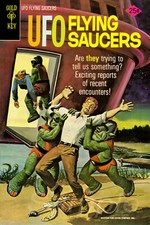
The visual language was especially influential. Colourful magazine covers often showed sleek spacecraft, strange planets and encounters between humans and alien beings. While these illustrations were fictional, they established recognisable symbols that later became closely associated with UFO culture: flying discs, visitors from space and technologically superior civilisations.
The relationship became particularly visible through editors and writers who moved between science fiction and UFO publishing. Raymond A. Palmer, editor of Amazing Stories, promoted speculative material that blurred the boundary between fiction, mystery and claimed fact. His magazine’s controversial “Shaver Mystery” stories in the 1940s presented accounts of hidden ancient civilisations and advanced technologies as if they might describe real events, creating intense reader responses. Historians of science fiction have identified this period as an important precursor to later UFO-oriented publishing.[Amazing Stories]amazingstories.comAmazing Stories The Art of the Shaver MysteryAmazing StoriesThe Art of the Shaver Mystery - Amazing StoriesFebruary 15, 2013…
The influence was complicated. Many science-fiction fans rejected the Shaver material as sensational, arguing that it damaged the reputation of the genre. Yet the controversy demonstrated the power of magazines to gather communities around extraordinary claims and to encourage readers to investigate mysteries together.[Pulp Magazines Project]pulpmags.orgPulp Magazines Project Amazing StoriesPulp Magazines Project Amazing Stories
How magazines connected fiction with UFO reports
When pilot Kenneth Arnold reported seeing unusual objects near Mount Rainier in 1947, the public response occurred in a culture already familiar with space travel and extraterrestrial stories. Arnold’s report helped popularise the term “flying saucer”, and newspapers rapidly spread the idea. The interpretation of these objects was influenced by existing science-fiction imagery of advanced craft visiting Earth.[Smithsonian Air and Space Museum]airandspace.si.edu1947 year flying saucerSmithsonian Air and Space Museum1947: Year of the Flying Saucer | National Air and Space Museum…
Magazine publishers quickly recognised the cultural moment. Palmer and Curtis Fuller founded Fate in 1948, combining UFO reports with wider discussions of unexplained phenomena. Its first issue featured Kenneth Arnold’s account of his sighting, linking the new flying-saucer discussion directly to the publishing networks that had grown around science fiction.[FATE Magazine]fatemag.comFATE Magazine About | FATE MagazineFATE Magazine About | FATE Magazine
This transition shows how UFO culture developed its own language by adapting science-fiction ideas:
- “Visitors from space” became a common explanation for unexplained sightings.
- Advanced technology became a way to describe objects that appeared beyond human capability.
- Alien contact narratives provided a structure for interpreting reports of encounters.
The result was a shared vocabulary between fictional stories and real-world claims. A person reading a science-fiction magazine and a person reading a UFO report could recognise the same basic ideas: mysterious craft, distant civilisations and contact between humanity and an unknown intelligence.
The boundary between imagination and investigation
The influence of science-fiction magazines on UFO communities remains debated because the relationship worked in both directions. Some enthusiasts argued that fiction merely prepared people to recognise a genuine phenomenon. Critics argued that fictional images shaped expectations and encouraged people to interpret ambiguous events through familiar stories.
The strongest historical evidence supports a middle position: science fiction did not create UFO interest, but it provided the cultural tools through which UFO reports were discussed. Magazines offered communities, vocabulary and visual references that made extraterrestrial explanations easier to imagine.
By the time formal UFO organisations appeared in the 1950s and 1960s, many participants were already experienced science-fiction readers. They brought with them habits developed through fandom: collecting information, debating theories, attending meetings and publishing their own material. Later UFO groups therefore inherited not only ideas from science fiction, but also the community practices that magazines had helped build.[Hollis Archives]hollisarchives.lib.harvard.eduHollis ArchivesScience fiction fanzines and prozines, 1939-1971 - HOLLIS for Archival Discovery…
Science-fiction magazines were therefore less a source of UFO belief than a social infrastructure for thinking about the unknown. They created the audiences, images and conversations that allowed UFO culture to become a recognisable community.
Amazon book picks
Further Reading
Books and field guides related to How Sci Fi Magazines Shaped UFO Fans. Use these as the next step if you want deeper reading beyond the article.
The History of the Science-fiction Magazine
This is the first of three volumes that chart the history of the science fiction magazine from the earliest days to the present. This fir...
Science-Fiction: The Gernsback Years
Complementing Science-Fiction: The Early Years, which surveys science-fiction published in book form from its beginnings through 1930, th...
The Dreams Our Stuff Is Made Of: How Science Fiction Conquere...
A popular insider offers a fascinating history of science fiction filled with provocative critiques, tidbits, and insights that reveal mu...
eBay marketplace picks
Marketplace Samples
Live-tested eBay searches with available results related to this page.
Selected fromufo poster oneBay.co.uk.


Endnotes
1.
Source: Wikipedia
Title: Amazing Stories
Link:https://en.wikipedia.org/wiki/Amazing_Stories
2.
Source: Wikipedia
Title: Fate (magazine)
Link:https://en.wikipedia.org/wiki/Fate_%28magazine%29
3.
Source: ultimatepopculture.fandom.com
Title: Science fiction fandom
Link:https://ultimatepopculture.fandom.com/wiki/Science_fiction_fandom
4.
Source: youtube.com
Title: The Shaver Mystery: Science Fiction’s first controversy
Link:https://www.youtube.com/watch?v=1CB0xOwVcSE
Source snippet
Amazing Stories & The Shaver Mystery | The Dark Histories Podcast...
5.
Source: youtube.com
Title: Amazing Stories & The Shaver Mystery | The Dark Histories Podcast
Link:https://www.youtube.com/watch?v=0x2WaWhHn58
Source snippet
Rationality, Science Fiction, and UFOs...
6.
Source: hollisarchives.lib.harvard.edu
Link:https://hollisarchives.lib.harvard.edu/catalog/hou02207
Source snippet
Hollis ArchivesScience fiction fanzines and prozines, 1939-1971 - HOLLIS for Archival Discovery...
7.
Source: airandspace.si.edu
Title: 1947 year flying saucer
Link:https://airandspace.si.edu/stories/editorial/1947-year-flying-saucer
Source snippet
Smithsonian Air and Space Museum1947: Year of [the Flying Saucer]({{ 'the-flying-saucer/' | relative_url }}) | National Air and Space Museum...
8.
Source: fatemag.com
Title: FATE Magazine About | FATE Magazine
Link:https://www.fatemag.com/about
9.
Source: amazingstories.com
Title: Amazing Stories The Art of the Shaver Mystery
Link:https://amazingstories.com/2013/02/the-art-of-the-shaver-mystery/
Source snippet
Amazing StoriesThe Art of the Shaver Mystery - Amazing StoriesFebruary 15, 2013...
Published: February 15, 2013
10.
Source: pulpmags.org
Title: Pulp Magazines Project Amazing Stories
Link:https://www.pulpmags.org/content/info/amazing-stories.html
11.
Source: iapsop.com
Title: Fate Magazine (Palmer) [IAPSOP]
Link:https://iapsop.com/archive/materials/fate_magazine/
Source snippet
The World's Mysteries Explored. Tue Stories of the strange and Unknown Other titles: Fate Magazine 1948 Quarterly, 1948-4...
12.
Source: fatemag.com
Title: the birth of fate
Link:https://www.fatemag.com/post/the-birth-of-fate
13.
Source: spaceagedesign.org
Title: Science Fiction
Link:https://spaceagedesign.org/science-fiction
14.
Source: pulpandoldmagazines.wordpress.com
Title: amazing stories
Link:https://pulpandoldmagazines.wordpress.com/2018/09/09/amazing-stories/
15.
Source: history.com
Title: Kenneth Arnold
Link:https://www.history.com/articles/kenneth-arnold
16.
Source: encyclopedia.com
Link:https://www.encyclopedia.com/media/encyclopedias-almanacs-transcripts-and-maps/amazing-stories
17.
Source: nhinewsnetwork.com
Link:https://nhinewsnetwork.com/newsletters/fate-magazine/
18.
Source: wonderclub.com
Link:https://wonderclub.com/magazines/magazine_history.php?magazine=amazing-stories
19.
Source: worldradiohistory.com
Link:https://www.worldradiohistory.com/Amazing-Stories.htm
20.
Source: pulpmags.org
Link:https://www.pulpmags.org/content/info/astounding-stories.html
21.
Source: pulpmags.org
Title: planet stories
Link:https://www.pulpmags.org/content/info/planet-stories.html
22.
Source: olps.co.za
Title: Fate Magazine
Link:https://www.olps.co.za/kiwix/content/wikipedia_en_all_maxi_2024-01/A/Fate_Magazine
23.
Source: philsp.com
Link:https://www.philsp.com/mags/amazing_stories.html
24.
Source: fatemag.com
Link:https://www.fatemag.com/
25.
Source: thelivingmoon.com
Title: Kenneth Arnold
Link:https://thelivingmoon.com/49ufo_files/03files2/1945_Ray_Palmer.html
Additional References
26.
Source: youtube.com
Link:https://www.youtube.com/watch?v=jqJzZ-V5Jv8
Source snippet
This collection highlights how pulp science fiction magazines, editor Ray Palmer's Amazing Stories, and early fandom subcultures provided...
27.
Source: fanlore.org
Title: Science fiction fandom forme
Link:https://www.fanlore.org/wiki/Science_Fiction_Fandom
Source snippet
Science Fiction Fandom - FanloreMay 25, 2026 — SCIENCE FICTION FANDOM Jump to navigation Jump to search Synonyms: | SFF See also: | Fando...
Published: May 25, 2026
28.
Source: encyclopedia.com
Title: astounding science fiction
Link:https://www.encyclopedia.com/media/encyclopedias-almanacs-transcripts-and-maps/astounding-science-fiction
Source snippet
4, 2026 — ASTOUNDING SCIENCE FICTION views 2,618,589 updated ASTOUNDING SCIENCE FICTION Spanning three incarnations since 1930, this is p...
29.
Source: pulpfest.com
Title: the shaver mystery
Link:https://pulpfest.com/2026/05/20/the-shaver-mystery/
Source snippet
May 20, 2026 — THE SHAVER MYSTERY Mike Chomko May 20, 2026 5 min read ImagePulpFest 2026 will celebrate the centennials of Amazin...
Published: May 20, 2026
30.
Source: youtube.com
Title: Science Fiction’s Influence on UFO Pop Culture
Link:https://www.youtube.com/watch?v=cGtPAOJSTEo
Source snippet
1947: The Kenneth [Arnold Sighting]({{ 'arnold-sighting/' | relative_url }}) | Weird History Ep. #5...
31.
Source: bygonely.com
Link:https://www.bygonely.com/sci-fi-pulp-covers/
32.
Source: bibliotecapleyades.net
Link:https://www.bibliotecapleyades.net/bb/palmer.htm
33.
Source: fanac.org
Link:https://fanac.org/Fan_Histories/Then/
34.
Source: kirkusreviews.com
Link:https://www.kirkusreviews.com/news-and-features/articles/john-campbell-jr-astounding-magazine-and-start-gol/
35.
Source: kirkusreviews.com
Title: Astounding Facts About the Early Days of Science Fiction | Kirkus Reviews
Link:https://www.kirkusreviews.com/news-and-features/articles/astounding-facts-about-early-days-science-fiction/