Within J Allen Hynek
How Early UFO Reports Were Classified
Hynek's early role in Project Sign shows how UFO reports were first approached as identification problems requiring scientific review.
On this page
- Hynek's role as scientific adviser
- Sorting observations from explanations
- The origins of systematic UFO review
Page outline Jump by section
Introduction
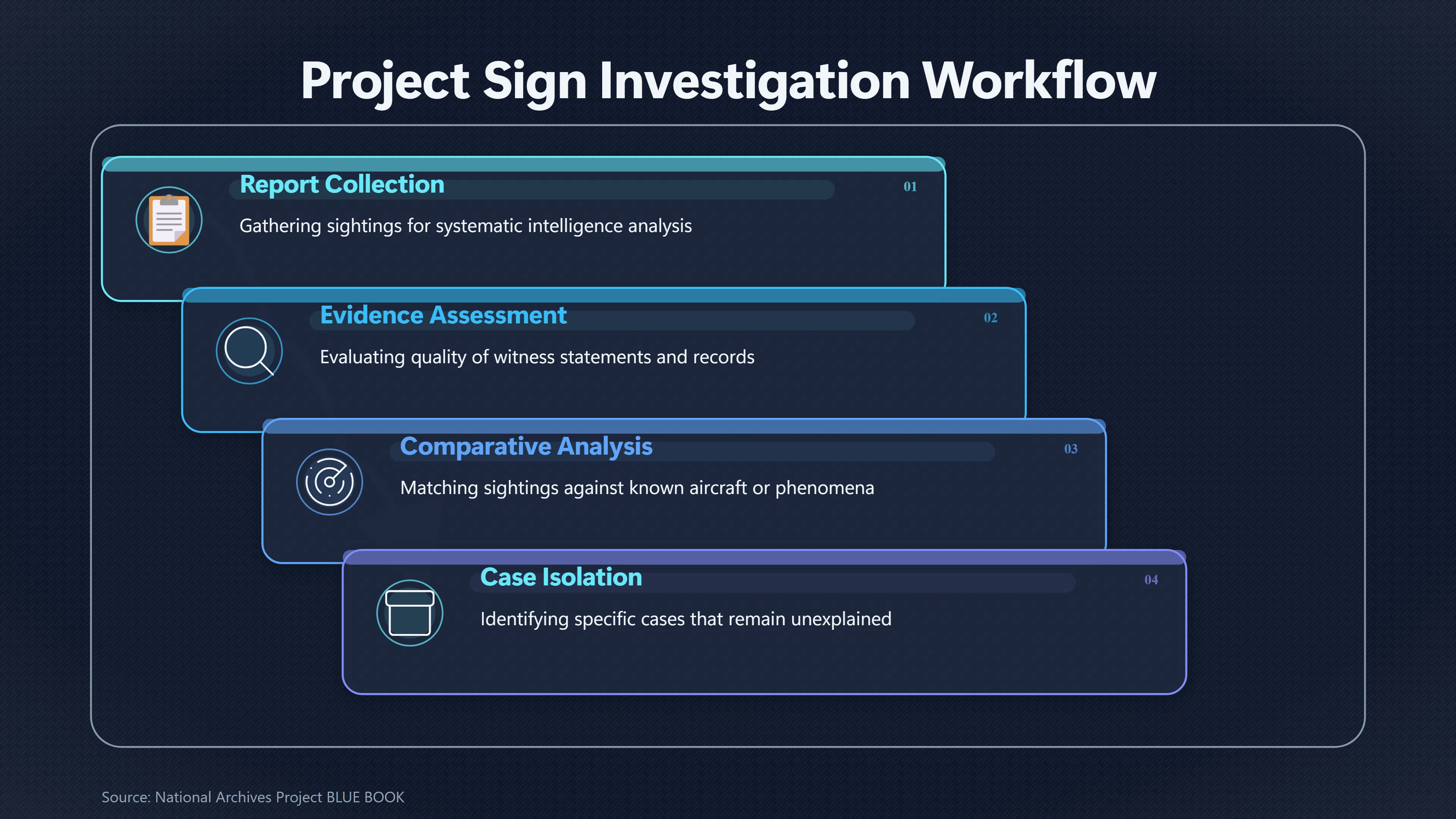
Project Sign was the first organised United States Air Force attempt to examine reports of mysterious aerial objects using a process closer to intelligence analysis than public speculation. Operating from Wright-Patterson Air Force Base in 1948 and early 1949, the project treated sightings as identification problems: collect the report, compare it with known aircraft or natural phenomena, assess the quality of the evidence, and isolate the cases that remained unexplained.[National Archives]archives.govNational Archives Project BLUE BOOKNational ArchivesProject BLUE BOOK - Unidentified Flying Objects | National ArchivesJune 25, 2024…
J. Allen Hynek’s early role in Project Sign was central to this approach. Before he became associated with “close encounters” and the later links between UFO terminology and science fiction, Hynek was an astronomer asked to help determine whether unusual reports could be explained by stars, planets, meteors, or other conventional causes. His work helped establish a pattern that would shape later UFO investigations: classify what was observed before attempting to explain what it meant.[HISTORY]history.comj allen hynek ufos project blue bookMeet J. Allen Hynek, the Astronomer Who First Classified UFO 'Close Encounters' | HISTORYNovember 19, 2018…
Hynek’s role as scientific adviser
Turning sightings into scientific questions
When the Air Force created Project Sign in response to the wave of “flying saucer” reports after 1947, it did not begin with a settled explanation. The military interest was practical: determine whether the reports represented misidentified ordinary objects, foreign technology, a security concern, or something else. The project’s formal purpose was to collect, evaluate, and distribute information about sightings considered potentially relevant to national security.[National Archives]archives.govOpen source on archives.gov.
Hynek, then director of Ohio State University’s McMillin Observatory, was brought in as an astronomical consultant. His task was narrower than later popular accounts often suggest. He was not initially leading a search for extraterrestrial explanations; he was helping investigators test whether astronomical events could account for reported sightings. Bright planets, meteors, stars near the horizon, and unusual atmospheric effects were among the possibilities he examined.[HISTORY]history.comj allen hynek ufos project blue bookMeet J. Allen Hynek, the Astronomer Who First Classified UFO 'Close Encounters' | HISTORYNovember 19, 2018…
This early assignment reflected a conventional scientific instinct: unusual observations should first be compared against known phenomena. A strange light in the sky was not automatically a new discovery; it was an observation requiring classification. That distinction became one of the most important features of Hynek’s later thinking.
The 1948 case review process
Project Sign gathered hundreds of reports during its short existence. The surviving records show an attempt to organise cases according to evidence quality and possible explanations rather than treating every report equally. The project’s later report examined roughly 200-plus cases, including incidents investigated through witness statements, military records, and technical assessments.[HISTORY]history.comj allen hynek ufos project blue bookMeet J. Allen Hynek, the Astronomer Who First Classified UFO 'Close Encounters' | HISTORYNovember 19, 2018…
Hynek’s contribution was especially important in separating different layers of uncertainty. A witness might accurately describe what they saw while still misidentifying the cause. For example, a bright object moving across the sky could be a planet observed under unusual conditions, an aircraft seen from an unusual angle, or a genuine unidentified event. The classification problem was therefore not simply “true or false”; it was a question of how much confidence investigators could place in each interpretation.
Sorting observations from explanations
Why identification came before interpretation
Early UFO investigation operated on a principle familiar to astronomy and aviation: observations require careful filtering. Investigators needed to distinguish between the reported appearance of an object and the physical reality behind it.
Project Sign’s working categories reflected this approach. Reports were examined for possible matches with:
- Astronomical objects, including planets, stars, meteors, and other celestial events.
- Human-made technology, such as aircraft, balloons, rockets, and experimental vehicles.
- Environmental effects, including optical illusions and atmospheric phenomena.
- Insufficient evidence, where available information did not allow a reliable explanation.
Hynek’s astronomical analysis became one part of this broader review system. His importance was not that he identified a particular type of UFO, but that he helped establish a method for deciding which reports deserved further attention.[HISTORY]history.comj allen hynek ufos project blue bookMeet J. Allen Hynek, the Astronomer Who First Classified UFO 'Close Encounters' | HISTORYNovember 19, 2018…
This distinction later became significant in both UFO research and science fiction. The idea of a “classified unknown” — an observation that remained unresolved after ordinary explanations had been tested — created narrative space for stories about discovery, contact, and investigation rather than only invasion or conflict.
The unresolved remainder
One of the lasting controversies surrounding Project Sign concerns the reports that resisted easy explanation. Popular accounts often focus on the claim that an internal document known as the “Estimate of the Situation” supported an extraterrestrial interpretation, but the original document has not survived in public archives, and details about its conclusions remain debated.[Disclosure Archives]disclosurearchives.comOpen source on disclosurearchives.com.
What is better documented is that Project Sign’s final assessment did not produce a definitive answer. The Air Force later stated that available evidence neither proved nor disproved the existence of unknown objects, leaving a category of unresolved cases rather than a confirmed explanation.[National Archives]archives.govOpen source on archives.gov.
This uncertainty was important for Hynek’s later career. The early classification work showed him that most reports could be approached through conventional science, but it also convinced him that some cases required better data rather than automatic dismissal.

The origins of systematic UFO review
From Project Sign to later classification systems
Project Sign created the foundation for a longer sequence of official investigations. It was followed by Project Grudge in 1949 and then Project Blue Book from 1952 to 1969, with Hynek continuing as a scientific consultant during the later programme. The accumulated archive eventually contained thousands of investigated reports, forming the largest government record of UFO investigations in the United States.[National Archives]archives.govNational Archives Project BLUE BOOKNational ArchivesProject BLUE BOOK - Unidentified Flying Objects | National ArchivesJune 25, 2024…
The significance of Project Sign was therefore not that it solved the UFO question. Its lasting contribution was procedural: it introduced a structured way to handle reports that occupied the boundary between ordinary explanation and genuine uncertainty.
That method influenced Hynek’s later classification work. Decades afterwards, when he developed categories such as nocturnal lights, daylight discs, radar-visual cases, and close encounters, he continued the same basic idea first applied during Project Sign: describe the observation carefully before making claims about its origin.
Why Project Sign mattered for science fiction culture
Project Sign’s early classification work helped create the conceptual bridge between government investigation and fictional storytelling. Science fiction had long imagined alien visitors, strange aircraft, and encounters with unknown intelligences, but official attempts to categorise sightings gave these ideas a new vocabulary of investigation.
The language of “unidentified” became culturally powerful because it suggested a middle ground between certainty and disbelief. A report could be unexplained without being automatically accepted as extraterrestrial. That tension — the careful study of an anomaly without knowing its final meaning — became one of the foundations for later UFO-inspired science fiction, including stories focused on communication, observation, and first contact rather than simple alien threats.
Project Sign’s early work remains important because it shows the moment when UFO reports moved from scattered anecdotes into a formal classification problem. Hynek’s role in that transition helped define the approach that would later shape both UFO research and the fictional imagination surrounding encounters with the unknown.[HISTORY]history.comj allen hynek ufos project blue bookMeet J. Allen Hynek, the Astronomer Who First Classified UFO 'Close Encounters' | HISTORYNovember 19, 2018…
Amazon book picks
Further Reading
Books and field guides related to How Early UFO Reports Were Classified. Use these as the next step if you want deeper reading beyond the article.
The UFO Experience: A Scientific Inquiry
Cited by the New York Review of Books as "the best brief for visitation," this classic study presents an analysis of UFO reports and conc...
The Report on Unidentified Flying Objects
The Report on Unidentified Flying Objects, written by Captain Edward Ruppelt in 1956, was the first serious, unbiased account written abo...
UFOs: Generals, Pilots, and Government Officials Go on the Re...
NEW YORK TIMES BESTSELLER • Impeccably researched, this riveting journalistic investigation separates fact from fiction, and documents th...
Area 51: An Uncensored History of America's Top Secret Milita...
The explosive, untold story of the Cold War's biggest secret from the bestselling author of NUCLEAR WAR: A SCENARIO 'An extraordinary boo...
eBay marketplace picks
Marketplace Samples
Live-tested eBay searches with available results related to this page.
Selected fromufo poster oneBay.co.uk.



Endnotes
1.
Source: archives.gov
Title: National Archives Project BLUE BOOK
Link:https://www.archives.gov/research/military/air-force/ufos
Source snippet
National ArchivesProject BLUE BOOK - Unidentified Flying Objects | National ArchivesJune 25, 2024...
Published: June 25, 2024
2.
Source: archives.gov
Link:https://www.archives.gov/news/articles/project-blue-book-50th-anniversary
3.
Source: history.com
Title: [j allen hynek]({{ ‘j-allen-hynek/’ | relative_url }}) ufos project blue book
Link:https://www.history.com/articles/j-allen-hynek-ufos-project-blue-book
Source snippet
Meet J. Allen Hynek, the Astronomer Who First Classified UFO 'Close Encounters' | HISTORYNovember 19, 2018...
Published: November 19, 2018
4.
Source: archives.gov
Link:https://www.archives.gov/research/topics/uaps/presidential-libraries
Source snippet
Library Holdings | National ArchivesJanuary 30, 2026 — RECORDS RELATED TO UNIDENTIFIED FLYING OBJECTS (UFOS) AND UNIDENTIFIED ANOMALOUS P...
Published: January 30, 2026
5.
Source: archives.gov
Link:https://www.archives.gov/research/topics/uaps/rg-collections
6.
Source: archives.gov
Title: 50 Years Ago: Government stops investigating UFOs | National Archives
Link:https://www.archives.gov/press/press-releases/2020/nr20-19
7.
Source: archives.gov
Title: Do Records Show Proof of UFOs? | National Archives
Link:https://www.archives.gov/news/articles/do-records-show-proof-of-ufos
8.
Source: everything.explained.today
Link:https://everything.explained.today/J._Allen_Hynek/
9.
Source: disclosurearchives.com
Link:https://disclosurearchives.com/project-sign
10.
Source: media.nationalarchives.gov.uk
Title: nationalarchives.gov.uk The Cold War and UFOs | The National Archives
Link:https://media.nationalarchives.gov.uk/index.php/cold-war-ufos/
11.
Source: media.nationalarchives.gov.uk
Link:https://media.nationalarchives.gov.uk/index.php/ufo-files-national-archives/
12.
Source: nationalarchives.gov.uk
Link:https://www.nationalarchives.gov.uk/help-with-your-research/research-guides/ufos/
13.
Source: declassified.ca
Title: J. Allen Hynek
Link:https://declassified.ca/key-figures-in-ufology/j-allen-hynek/
14.
Source: nhinewsnetwork.com
Link:https://nhinewsnetwork.com/biographies/j-allen-hynek/
15.
Source: cufos.org
Title: Project Blue Book
Link:https://cufos.org/resources/project-blue-book/
16.
Source: daviddarling.info
Link:https://www.daviddarling.info/encyclopedia/S/Sign.html
17.
Source: military-history.fandom.com
Title: Estimate of the Situation
Link:https://military-history.fandom.com/wiki/Estimate_of_the_Situation
18.
Source: project1947.com
Link:https://www.project1947.com/fig/1948a.htm
Additional References
19.
Source: youtube.com
Link:https://www.youtube.com/watch?v=7LYqfZ70yGY
Source snippet
Dr Aaron J. French: The Magic of Technology: Rudolf Steiner's Rosicrucianism and the UFO Phenomenon...
20.
Source: biography.com
Title: j allen hynek project blue book
Link:https://www.biography.com/scientists/a71083752/j-allen-hynek-project-blue-book
Source snippet
Allen Hynek and Project Blue Book: UFO Secrets RevealedApril 21, 2026 — His research over the next 12 years culminated in his appointment...
Published: April 21, 2026
21.
Source: youtube.com
Title: NTK/15 — Estimate of the Situation — 06-05-22
Link:https://www.youtube.com/watch?v=W8k8yl5yLGk
Source snippet
This list contains discussions on the official Air Force Project Sign investigations, J. Allen Hynek's early astronomical evaluation of s...
22.
Source: youtube.com
Link:https://www.youtube.com/watch?v=fReIz1gU-nI
Source snippet
UFOs and The Military Elite - The BEST [UFO Documentary]({{ 'documentary-debates/' | relative_url }}) 2020...
23.
Source: youtube.com
Title: UFOs and The Military Elite
Link:https://www.youtube.com/watch?v=4zAnv9aiPyw
Source snippet
Edward R. Murrow Presents "The Case for [the Flying Saucer]({{ 'the-flying-saucer/' | relative_url }})"...
24.
Source: commons.wikimedia.org
Title: Commons File:Project Sign report.pdf
Link:https://commons.wikimedia.org/wiki/File%3AProject_Sign_report.pdf
Source snippet
Wikimedia CommonsFile:Project Sign report.pdf - Wikimedia Commons...
25.
Source: uap-files.org
Title: It summarizes
Link:https://uap-files.org/documento/4e191615a53faf81
Source snippet
USAF Project SIGN file (1948) — Air Materiel Command (AMC) | Declassified UFO/UAP File · UAP ArchivesJuly 10, 2026 — USAF PROJECT SIGN FI...
Published: July 10, 2026
26.
Source: archania.org
Title: j allen hynek
Link:https://archania.org/p/individuals/scientists/astronomers/j-allen-hynek
Source snippet
Allen HynekMay 25, 2026 — Hynek’s Northwestern work included image-intensifier and image-orthicon telescope projects. These devices ampli...
Published: May 25, 2026
27.
Source: youtube.com
Title: Edward R. Murrow Presents “The Case for the Flying Saucer”
Link:https://www.youtube.com/watch?v=hVvz8ebUeSk
Source snippet
NTK/15 — Estimate of the Situation — 06-05-22...
28.
Source: en-academic.com
Link:https://en-academic.com/dic.nsf/enwiki/1177185