Within Future encounters
How Arrival Changed Alien Communication Stories
Arrival explores why understanding an alien language may be harder than reaching another world, turning translation into a test of human assumptions.
On this page
- The heptapod language and its unusual structure
- Translation as the central first contact problem
- Why the film reshaped alien encounter fiction
Page outline Jump by section
Introduction
Arrival changed the way many modern science fiction stories imagine alien contact by making language the central challenge rather than a background detail. The 2016 film, directed by Denis Villeneuve and adapted from Ted Chiang’s 1998 novella “Story of Your Life”, asks a deceptively difficult question: if humanity encountered an intelligent species from another world, could we actually understand each other? The film’s answer is that reaching another planet may be easier than bridging the gap between two completely different ways of thinking.[Wikipedia]WikipediaArrival (filmArrival (film
Instead of presenting first contact as a battle over territory or technology, Arrival presents communication itself as the unknown frontier. Linguist Louise Banks must determine what the heptapods mean, how their symbols work, and whether human assumptions about language are preventing understanding. This focus helped reshape alien encounter fiction by treating translation, interpretation and cognitive differences as the main dramatic conflict.[Jessica Coon]jessica.lingspace.orgJessica Coon -Arrival: Linguistic fieldwork on the big screenJessica CoonNovember 16, 2016…
The heptapod language and its unusual structure
The alien language in Arrival is designed around the idea that a truly non-human intelligence might not organise information in the same way humans do. The heptapods have two forms of communication: a spoken language and a written system known as Heptapod B. The written language is the film’s most distinctive invention: circular, ink-like symbols called logograms that appear as complete forms rather than sequences of letters written one after another.[Wikipedia]WikipediaHeptapod languagesHeptapod languages
This structure creates the first major communication barrier. Human languages usually rely on sequence. A sentence begins, continues and ends. Even writing systems that use symbols generally depend on a reader moving through information in a particular order. The heptapod writing system challenges this assumption by presenting meaning as a whole pattern, suggesting a species whose understanding of events does not depend on the same linear progression humans experience.[guez.org]guez.orgArrival: The Language of the Heptapods | A.L.I LABOJune 19, 2026…
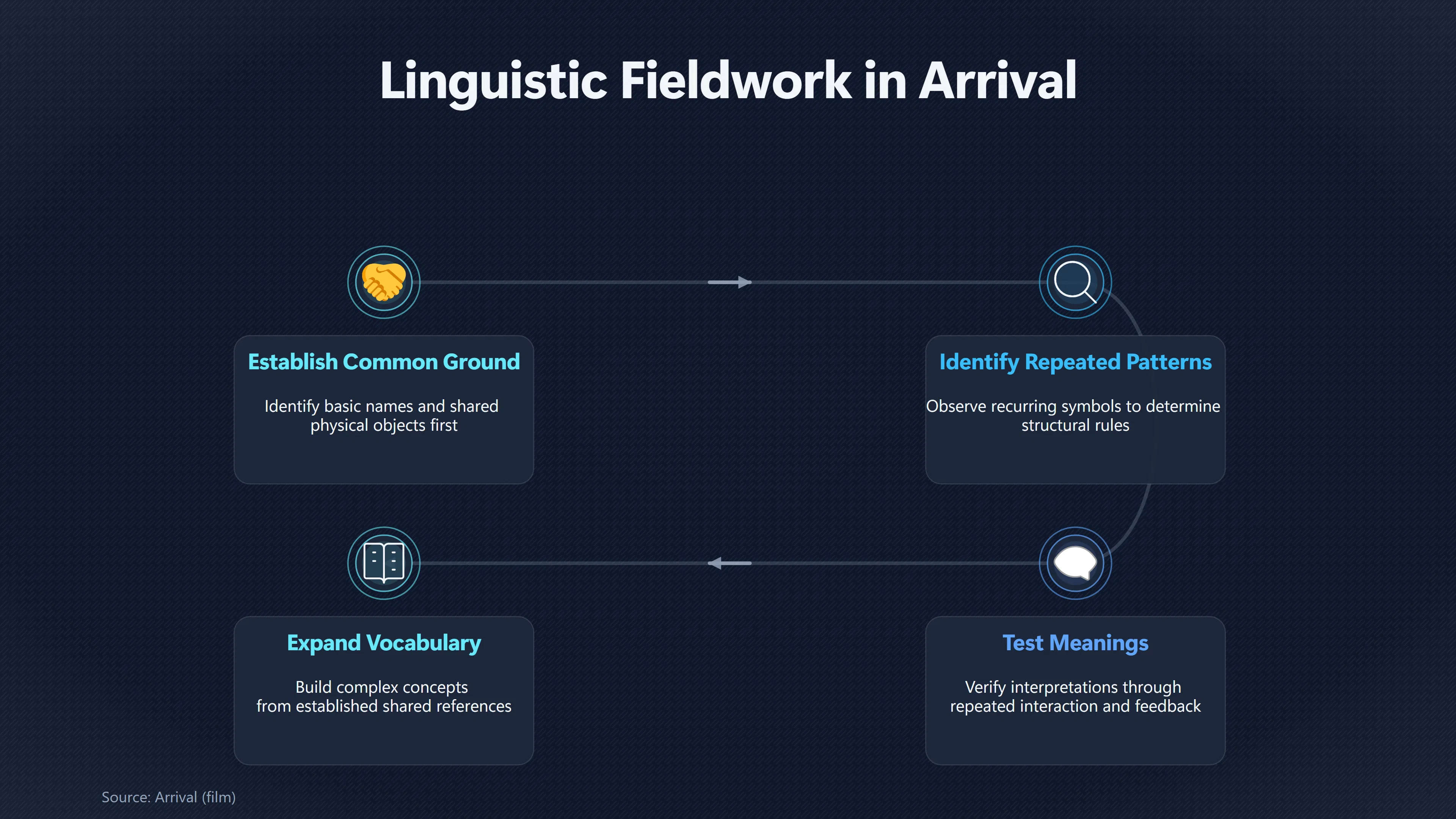
The design is not simply visual decoration. The filmmakers worked with linguists and language specialists to make the process of discovery resemble real linguistic fieldwork: identifying repeated patterns, testing meanings, building shared references and gradually expanding vocabulary. Jessica Coon, a linguist from McGill University who advised the production, noted that the film’s approach reflected genuine questions about how researchers study unfamiliar languages, even though an alien language remains purely speculative.[Jessica Coon]jessica.lingspace.orgJessica Coon -Arrival: Linguistic fieldwork on the big screenJessica CoonNovember 16, 2016…
A memorable example is Louise’s early method of communication. Rather than assuming she can immediately decode alien speech, she begins with basic concepts and shared experiences. She uses names, objects and actions to establish connections between signs and meanings. This reflects a real principle in language documentation: communication begins by building common ground before attempting complex ideas.[The Independent]independent.co.ukOpen source on independent.co.uk.
Translation as the central first contact problem
Most alien stories treat language as a problem solved after the dramatic encounter has already begun. Arrival reverses that formula. The encounter itself cannot progress until communication is possible. The central mystery is not simply “what do the aliens want?” but “how can humans know what the aliens mean?”
This creates a realistic problem of interpretation. A single word may carry multiple meanings depending on cultural assumptions. In the film, the translation of the heptapods’ message becomes politically dangerous because humans interpret unfamiliar terms through fear. A word translated as “weapon” could imply a threat, but it could also refer to a tool, technology or something valuable. The difficulty is not translating symbols mechanically; it is understanding intention.[English Language TESOL]english-language-tesol.swansea.ac.uklanguage at the movies arrival denis villeneuve 2016English Language TESOLLanguage at the Movies: Arrival (Denis Villeneuve, 2016) – English Language, Applied Linguistics, and TESOL BlogMay…
The film also highlights that communication failures can happen between humans as well as between species. Different governments respond to the alien arrival with suspicion and competing interpretations, showing that the challenge of first contact is partly linguistic and partly social. Even before humanity understands the visitors, humans struggle to communicate with each other about how to respond.[The New Yorker]newyorker.comThe New Yorker The Consuming Fervor of "ArrivalThe New Yorker The Consuming Fervor of "Arrival
This emphasis separates Arrival from many earlier UFO and science fiction narratives. Classic alien stories often assume that advanced beings would either immediately understand humans or communicate through simple universal ideas such as mathematics. Arrival instead explores the possibility that intelligence does not guarantee compatibility. A civilisation may be highly advanced technologically while still being extremely difficult to interpret.

Language, thought and the question of changing perception
The most speculative idea in Arrival is that learning the heptapod language changes Louise’s perception of reality. The story draws on linguistic relativity, the idea that language can influence how people think and organise experience. The film presents an extreme version of this concept: by learning a language built around a different understanding of time, Louise begins to experience time differently herself.[OUP Academic]academic.oup.comOpen source on oup.com.
Real linguistics is more cautious. Modern research generally supports weaker versions of linguistic relativity: languages can influence attention, memory or habitual ways of categorising experience, but there is no established evidence that learning a language can completely transform human perception in the way shown in the film. Scholars discussing Arrival often describe this as a powerful science-fiction extension of real linguistic questions rather than a literal scientific prediction.[OUP Academic]academic.oup.comOpen source on oup.com.
This tension is part of why the film became influential. It uses a genuine academic debate as the foundation for a larger philosophical question: if another intelligence experienced reality differently, would humans even recognise its way of thinking? The heptapod language becomes more than a communication system; it becomes a bridge between different models of existence.
Why the film reshaped alien encounter fiction
Arrival influenced later science fiction by shifting attention away from the physical appearance of aliens and towards the problem of understanding alien minds. The heptapods are memorable not because they represent a familiar idea of extraterrestrial life, but because they resist easy interpretation. They are not simply humans with unusual bodies; they represent the possibility of an intelligence built around completely different assumptions.[TIME]time.comReview: Arrival , Grand and Somber, Asks Universal QuestionsReview: Arrival , Grand and Somber, Asks Universal Questions
The film’s impact can be seen in how modern first-contact stories increasingly focus on communication, uncertainty and interpretation. Rather than asking only whether aliens would be friendly or hostile, newer narratives explore questions such as whether humans could recognise alien intelligence, whether translation is ever neutral, and whether contact would require changing our own assumptions first.
By making a linguist the central figure in a global alien event, Arrival also changed the role of expertise in science fiction. The person most important to humanity’s survival is not a soldier or engineer but someone trained to listen carefully, identify patterns and accept that human perspectives may not be universal.[Jessica Coon]jessica.lingspace.orgJessica Coon -Arrival: Linguistic fieldwork on the big screenJessica CoonNovember 16, 2016…
Within UFO-related science fiction, this remains one of the most important shifts in imagining future encounters. The greatest challenge of meeting another civilisation may not be travelling across space, detecting a spacecraft or surviving an attack. It may be discovering whether two minds from different worlds can create a shared meaning at all.

Amazon book picks
Further Reading
Books and field guides related to How Arrival Changed Alien Communication Stories. Use these as the next step if you want deeper reading beyond the article.
Contact
Rating: 4.0/5 from 21 Google Books ratings
In the year 1999 a multinational team of astronauts sets out to discover the secrets of the universe.
The Left Hand of Darkness
Rating: 4.0/5 from 13 Google Books ratings
50TH ANNIVERSARY EDITION—WITH A NEW INTRODUCTION BY DAVID MITCHELL AND A NEW AFTERWORD BY CHARLIE JANE ANDERS Ursula K. Le Guin’s groundb...
The Language Instinct
In this exhilarating book, Steven Pinker asserts that language should not be seen as a cultural artefact that we learn in the way we lear...
eBay marketplace picks
Marketplace Samples
Live-tested eBay searches with available results related to this page.
Selected fromalien sticker oneBay.co.uk.




Endnotes
1.
Source: Wikipedia
Title: Arrival (film)
Link:https://en.wikipedia.org/wiki/Arrival_%28film%29
2.
Source: Wikipedia
Title: Story of Your Life
Link:https://en.wikipedia.org/wiki/Story_of_Your_Life
3.
Source: Wikipedia
Title: Heptapod languages
Link:https://en.wikipedia.org/wiki/Heptapod_languages
4.
Source: guez.org
Link:https://www.guez.org/ali/labo/?lang=en&post=arrival-langage-heptapodes-logogrammes
Source snippet
Arrival: The Language of the Heptapods | A.L.I LABOJune 19, 2026...
Published: June 19, 2026
5.
Source: mcgill.ca
Title: Mc Gill University Mc Gill linguist helped on upcoming movie Arrival | Newsroom
Link:https://www.mcgill.ca/newsroom/node/26307
Source snippet
McGill UniversityMcGill linguist helped on upcoming movie Arrival | Newsroom - McGill University...
6.
Source: english-language-tesol.swansea.ac.uk
Title: language at the movies arrival denis villeneuve 2016
Link:https://english-language-tesol.swansea.ac.uk/2017/05/01/language-at-the-movies-arrival-denis-villeneuve-2016/
Source snippet
English Language TESOLLanguage at the Movies: Arrival (Denis Villeneuve, 2016) – English Language, Applied Linguistics, and TESOL BlogMay...
7.
Source: academic.oup.com
Link:https://academic.oup.com/book/31973/chapter-abstract/267717021
8.
Source: time.com
Title: Review:Arrival, Grand and Somber, Asks Universal Questions
Link:https://time.com/4566458/arrival-review-amy-adams/
9.
Source: youtube.com
Link:https://www.youtube.com/watch?v=lC9X5mDZBjs
Source snippet
The Linguistics of Arrival...
10.
Source: jessica.lingspace.org
Title: Jessica Coon -Arrival: Linguistic fieldwork on the big screen
Link:https://jessica.lingspace.org/arrival/
Source snippet
Jessica CoonNovember 16, 2016...
Published: November 16, 2016
11.
Source: independent.co.uk
Link:https://www.independent.co.uk/arts-entertainment/films/features/arrival-jessica-coon-linguist-amy-adams-donald-trump-language-a7640106.html
12.
Source: newyorker.com
Title: The New Yorker The Consuming Fervor of “Arrival”
Link:https://www.newyorker.com/magazine/2016/11/14/the-consuming-fervor-of-arrival
13.
Source: cinematheque.qc.ca
Link:https://www.cinematheque.qc.ca/en/cinema/arrival/
14.
Source: noslangues-ourlanguages.gc.ca
Link:https://www.noslangues-ourlanguages.gc.ca/en/blogue-blog/jessica-coon-etoile-superstar-eng
15.
Source: newyorker.com
Title: Ted Chiang’s Soulful Science Fiction | The New Yorker
Link:https://www.newyorker.com/culture/persons-of-interest/ted-chiangs-soulful-science-fiction
16.
Source: gradesaver.com
Link:https://www.gradesaver.com/arrival-2016-film/wikipedia/introduction
17.
Source: jessica.lingspace.org
Link:https://jessica.lingspace.org/
18.
Source: paramountpictures.com
Link:https://www.paramountpictures.com/movies/arrival
Additional References
19.
Source: wired.com
Link:https://www.wired.com/story/arrival-science-fact-fiction
Source snippet
The protagonist, linguist Louise Banks, works to understand the heptapods' strange circular written language and whale-like spoken sounds...
20.
Source: youtube.com
Link:https://www.youtube.com/watch?v=me9uliPVqeU
Source snippet
Arrival linguistics alien communication Jessica Coon Jessica Coon: Linguistics of Arrival. What an Alien Writing System Can Teach Us abou...
21.
Source: youtube.com
Title: Can language change the way you think? The science of Arrival
Link:https://www.youtube.com/watch?v=lIPi3OiaG3I
Source snippet
Reading Your Future: A brief analysis of Heptapod B ("nonlinear orthography" from the film Arrival)...
22.
Source: youtube.com
Title: The Linguistics of Arrival: Aliens, Fieldwork and Universal Grammar
Link:https://www.youtube.com/watch?v=W51G0aUPSm4
Source snippet
Can language change the way you think? The science of Arrival...
23.
Source: engadget.com
Title: Dissecting the alien language in ‘Arrival’
Link:https://www.engadget.com/2016-11-14-dissecting-the-alien-language-in-arrival.html
Source snippet
Dissecting the alien language in 'Arrival'...
24.
Source: utoronto.ca
Link:https://www.utoronto.ca/news/communicating-aliens-u-t-linguists-talk-facts-behind-film-arrival
25.
Source: linguistics.princeton.edu
Link:https://linguistics.princeton.edu/events/2017/linguistics-[arrival-aliens
26.
Source: bfi.org.uk
Link:https://www.bfi.org.uk/bfi-funded-productions/arrival
27.
Source: ciol.org.uk
Link:https://www.ciol.org.uk/civicrm/event/info?id=193&reset=1
28.
Source: researchgate.net
Link:https://www.researchgate.net/publication/346354665_The_linguistics_of_Arrival_Heptapods_field_linguistics_and_Universal_GrammarHeptapods_field_linguistics_and_Universal_Grammar