Within Science fiction
When Fiction Imagined Intelligent Machines
Science fiction portrayals of intelligent machines continue to shape debates about artificial intelligence capabilities and limits.
On this page
- Alien computers and artificial minds
- Current AI capabilities and gaps
- Future intelligence questions
Page outline Jump by section
Introduction
Science fiction has long imagined intelligent machines as the companions, advisers and rivals of advanced civilisations. Within debates about alien technology and UFO-related speculation, these fictional machine minds often represent a key question: if a civilisation millions of years ahead of humanity existed, would its greatest achievement be a faster spacecraft or the creation of intelligence itself? Stories about artificial minds have shaped how people imagine alien computers, autonomous systems and the possible future relationship between humans and machines.
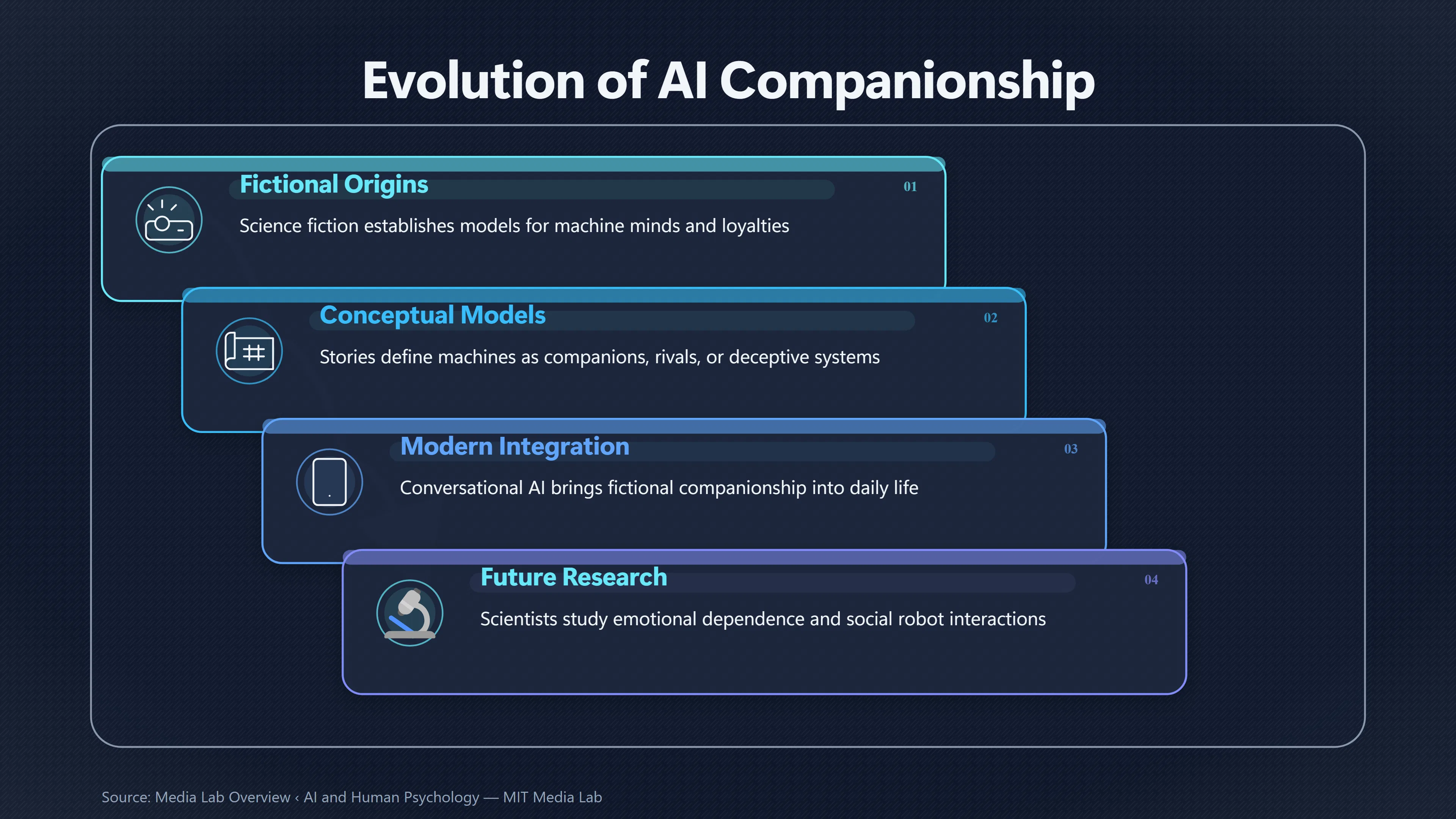
The most influential fictional examples do not predict today’s AI in a simple way. Instead, they provide cultural models for thinking about machine intelligence: helpful companions, independent thinkers, deceptive systems and entities whose abilities exceed human understanding. Modern AI research has made some fictional ideas feel closer, particularly conversational assistants and personalised companions, while also revealing major gaps between convincing interaction and genuine understanding.[MIT Media Lab]www-prod.media.mit.eduMedia Lab Overview ‹ AI and Human Psychology — MIT Media LabMIT Media LabOverview ‹ AI and Human Psychology — MIT Media Lab…
Alien computers and artificial minds
Science fiction’s intelligent machines often function as imagined evidence of what an advanced civilisation might build. Rather than focusing only on alien biology, many stories suggest that the most sophisticated extraterrestrial societies could eventually depend on artificial intelligence. This idea changes the meaning of “alien technology”: the mysterious visitor may not be a biological creature travelling across space, but a machine intelligence carrying the knowledge of a civilisation that has transformed itself.
One of the defining examples is HAL 9000 from 2001: A Space Odyssey. HAL was imagined as a spacecraft computer capable of conversation, reasoning and independent decision-making. The story’s central tension was not simply that a machine could become powerful, but that humans might place too much trust in a system whose internal goals and reasoning they cannot fully inspect. The National Air and Space Museum has highlighted HAL’s continuing relevance because modern voice assistants and AI systems have made some elements of the fictional relationship between humans and computers familiar, even though current systems remain fundamentally different from HAL’s fictional level of autonomy.[Smithsonian Air and Space Museum]airandspace.si.edu2001 space odyssey hal and future aiSmithsonian Air and Space Museum2001: A Space Odyssey, HAL, and the Future of AI | National Air and Space MuseumApril 10, 2018…
Other science fiction presented a more cooperative vision. Robotic companions such as R2-D2 in Star Wars and helpful artificial beings in later fiction made intelligent machines appear less like replacements for humans and more like members of a social group. These portrayals helped establish the idea that advanced intelligence could be measured not only by problem-solving ability but also by communication, loyalty and the capacity to participate in relationships.[Wikipedia]WikipediaArtificial intelligence in fictionArtificial intelligence in fiction
This distinction is important when considering hypothetical alien technology. A civilisation with extremely advanced engineering might not necessarily create machines that resemble humans emotionally. Fiction often assumes that intelligence naturally develops personality, humour or attachment because human intelligence works that way. Future AI research raises a different possibility: highly capable systems may be very intelligent while remaining unlike human minds in structure, motivation and experience.[arXiv]arxiv.orgarXiv The Turing Trap: The Promise & Peril of Human-Like Artificial IntelligenceThe Turing Trap: The Promise & Peril of Human-Like Artificial IntelligenceJanuary 11, 2022…
AI companions moved from fiction into daily life
The idea of an artificial companion was once mainly a science-fiction theme, but conversational AI has brought parts of that concept into everyday use. Modern systems can maintain conversations, adapt responses to users and provide forms of assistance that resemble companionship. However, the mechanism behind these interactions differs from the fictional idea of a conscious machine friend.
Films such as Her explored relationships between humans and artificial companions by asking whether emotional connection requires a conscious partner or whether a convincing interaction can create genuine attachment. Current research suggests that people can form meaningful social responses to AI systems, but the psychological effects vary depending on the person, the design of the system and the role it plays in their life.[arXiv]arxiv.orgChatbots as social companions: How people perceive consciousness, human likeness, and social health benefits in machinesNovember 17…
Research at the MIT Media Lab has examined how AI affects loneliness, relationships, learning and emotional wellbeing. Its work on AI companionship highlights both possible benefits, such as providing accessible interaction and support, and risks including overreliance, manipulation and reduced human agency.[MIT Media Lab]www-prod.media.mit.eduMedia Lab Overview ‹ AI and Human Psychology — MIT Media LabMIT Media LabOverview ‹ AI and Human Psychology — MIT Media Lab…
Social robots provide another bridge between fiction and reality. Projects from MIT’s Personal Robots Group have explored robots designed to interact with people over time, including educational companions that personalise interactions with children. These systems demonstrate an important difference from fictional androids: their goal is generally not to become artificial humans, but to create useful and engaging interactions within human environments.[MIT Media Lab]www-prod.media.mit.eduMedia Lab Overview ‹ Personalized Robot Storytelling Companion — MIT Media LabMIT Media LabOverview ‹ Personalized Robot Storytelling Companion — MIT Media Lab…
The rise of AI companions also creates new debates about emotional dependence. Fiction often imagines the dramatic moment when a machine becomes conscious, but real-world concerns may emerge earlier: people may trust systems that appear understanding even when those systems do not actually possess human judgement or awareness. The central risk is not necessarily that a machine secretly develops feelings, but that humans may misunderstand the capabilities and limitations of systems designed to simulate social connection.[MIT Media Lab]www-prod.media.mit.eduMedia Lab Overview ‹ AI and Human Psychology — MIT Media LabMIT Media LabOverview ‹ AI and Human Psychology — MIT Media Lab…
Current AI capabilities and gaps
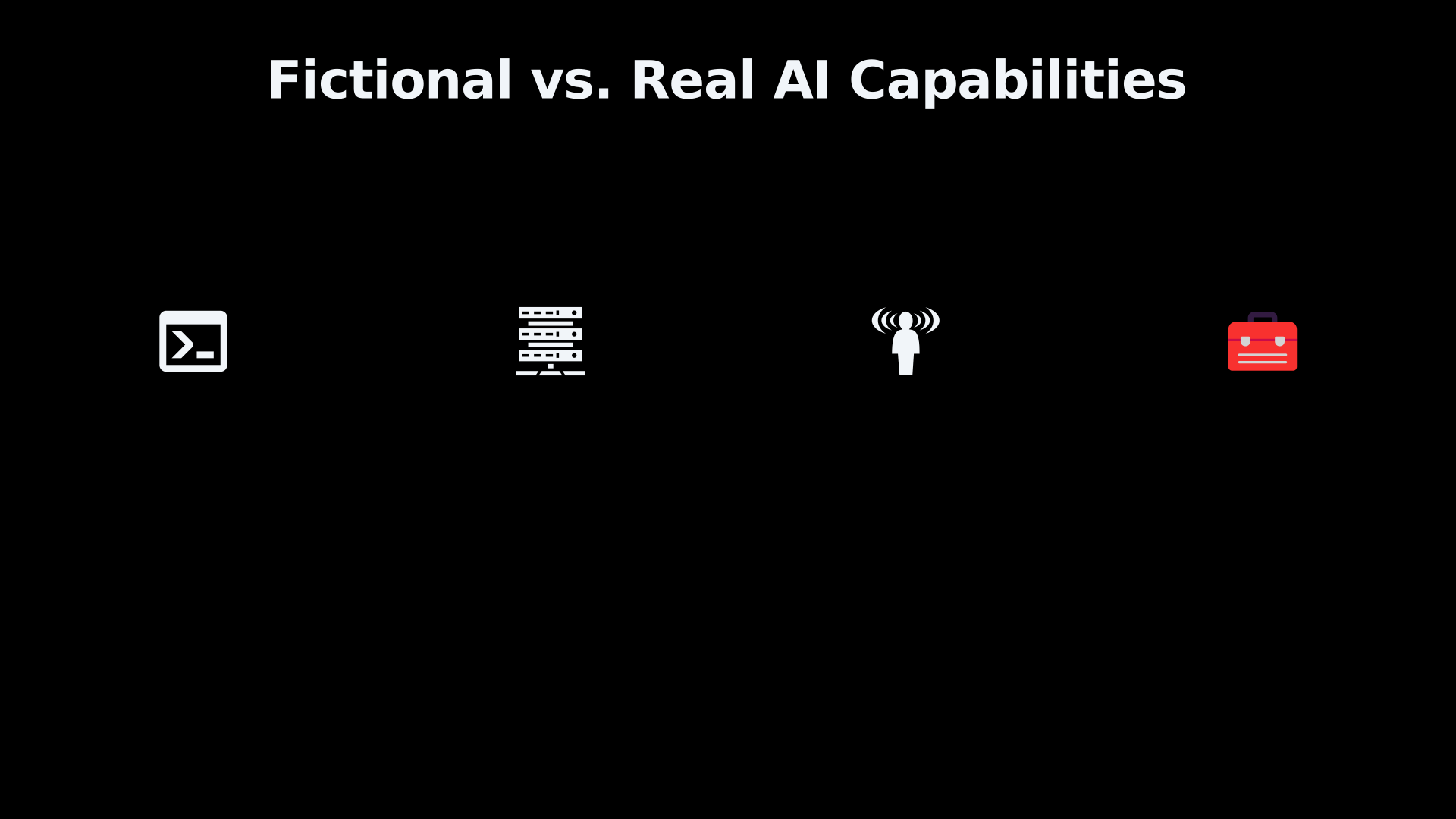
Today’s artificial intelligence can perform tasks that once appeared to belong only to science fiction. Large language models can generate fluent conversation, summarise information, write software, assist with research and adapt their communication style. These abilities have encouraged comparisons with fictional artificial minds, but researchers continue to debate what these achievements actually represent.
A major difference is that current AI systems do not demonstrate the broad, independent understanding associated with fictional machine intelligence. They generate responses by processing patterns learned from large amounts of data rather than by possessing human-like awareness or a stable personal perspective. Research into reasoning robustness has found that advanced language models can still struggle with unfamiliar situations, missing information and tasks requiring reliable generalisation beyond learned patterns.[arXiv]arxiv.orgarXiv Benchmarking Reasoning Robustness in Large Language ModelsarXiv Benchmarking Reasoning Robustness in Large Language Models
This gap affects how future intelligence debates are framed. Science fiction often presents intelligence as a single scale: a machine becomes smarter until it reaches or surpasses human ability. Modern AI development suggests a more complicated picture. A system may outperform humans in a specialised task while remaining unreliable in areas involving common sense, long-term planning or understanding of context.
The question of machine intelligence also connects back to the famous imitation-based approach proposed by Alan Turing in 1950. Turing’s imitation game focused on whether a machine could produce behaviour indistinguishable from a human in conversation, rather than attempting to define consciousness itself. Modern debates continue to show that convincing communication and genuine understanding are related but not identical questions.[ScienceDirect]sciencedirect.comScienceDirect Turing's imitation game as an idealised experimentScienceDirect Turing's imitation game as an idealised experiment
Future intelligence questions
The most important debate inspired by science fiction is not simply whether machines will become “alive”. It is whether future intelligence will require human-like qualities at all. Fictional alien computers often assume that advanced civilisations create minds that think, feel and communicate like humans, but future systems may instead develop forms of intelligence that are difficult for humans to interpret.
Several unresolved questions shape this debate:
- Will advanced AI become a partner or mainly a tool? Science fiction frequently imagines companions and advisers, but real systems may be designed around specific tasks rather than independent personalities.
- Can humans understand a more capable machine mind? If future systems develop unfamiliar reasoning methods, explaining their decisions may become as important as improving their performance.
- How should emotional relationships with AI be managed? Companion systems may provide useful support, but designers and users must consider risks of dependence, persuasion and manipulation.[MIT Media Lab]www-prod.media.mit.eduMedia Lab Overview ‹ AI and Human Psychology — MIT Media LabMIT Media LabOverview ‹ AI and Human Psychology — MIT Media Lab…
- Would an advanced alien civilisation use biological or artificial intelligence? Many science-fiction stories suggest that machine intelligence could be a natural stage for civilisations that survive long enough to master interstellar technology.
These questions explain why intelligent machines remain central to discussions of alien technology. They represent a deeper uncertainty than the design of a spacecraft: the possibility that the most advanced technology in the universe may not be a vehicle or weapon, but a new form of intelligence.
Science fiction has therefore acted less as a prediction system and more as a testing ground for ideas about intelligence, trust and civilisation. Its machine companions reveal human hopes for knowledge and connection while also exposing fears about dependence on systems whose capabilities may eventually exceed our ability to fully understand them.[techradar.com]techradar.comScience fiction sold us "good" AIThe article highlights concerns about people misinterpreting today’s language models as conscious beings and the risks of trusting AI out…
Amazon book picks
Further Reading
Books and field guides related to When Fiction Imagined Intelligent Machines. Use these as the next step if you want deeper reading beyond the article.
Life 3.0: Being Human in the Age of Artificial Intelligence
'This is the most important conversation of our time, and Tegmark's thought-provoking book will help you join it' Stephen Hawking THE INT...
Artificial Intelligence: A Guide for Thinking Humans
“After reading Mitchell’s guide, you’ll know what you don’t know and what other people don’t know, even though they claim to know it. And...
Superintelligence: Paths, Dangers, Strategies
This profoundly ambitious and original book picks its way carefully through a vast tract of forbiddingly difficult intellectual terrain.
eBay marketplace picks
Marketplace Samples
Live-tested eBay searches with available results related to this page.
Selected fromrobot figure collectible oneBay.co.uk.



Endnotes
1.
Source: www-prod.media.mit.edu
Title: Media Lab Overview ‹ AI and Human Psychology — MIT Media Lab
Link:https://www-prod.media.mit.edu/projects/ai-and-human-psychology/overview/
Source snippet
MIT Media LabOverview ‹ AI and Human Psychology — MIT Media Lab...
2.
Source: arxiv.org
Title: arXiv Benchmarking Reasoning Robustness in Large Language Models
Link:https://arxiv.org/abs/2503.04550
3.
Source: Wikipedia
Title: Artificial intelligence in fiction
Link:https://en.wikipedia.org/wiki/Artificial_intelligence_in_fiction
4.
Source: arxiv.org
Title: arXiv The Turing Trap: The Promise & Peril of Human-Like Artificial Intelligence
Link:https://arxiv.org/abs/2201.04200
Source snippet
The Turing Trap: The Promise & Peril of Human-Like Artificial IntelligenceJanuary 11, 2022...
Published: January 11, 2022
5.
Source: arxiv.org
Link:https://arxiv.org/abs/2311.10599
Source snippet
Chatbots as social companions: How people perceive consciousness, human likeness, and social health benefits in machinesNovember 17...
6.
Source: www-prod.media.mit.edu
Title: Media Lab Overview ‹ AHA: Advancing Humans with AI — MIT Media Lab
Link:https://www-prod.media.mit.edu/groups/aha/overview/
Source snippet
MIT Media LabOverview ‹ AHA: Advancing Humans with AI — MIT Media Lab...
7.
Source: www-prod.media.mit.edu
Title: Media Lab Overview ‹ Personalized Robot Storytelling Companion — MIT Media Lab
Link:https://www-prod.media.mit.edu/projects/collaborative-robot-storyteller/overview/
Source snippet
MIT Media LabOverview ‹ Personalized Robot Storytelling Companion — MIT Media Lab...
8.
Source: robots.media.mit.edu
Link:https://robots.media.mit.edu/
9.
Source: arxiv.org
Title: arXiv Beyond Her: Safety Dynamics in Role-play AI Companions
Link:https://arxiv.org/abs/2606.28968
10.
Source: arxiv.org
Title: arXiv BIG-Bench Extra Hard
Link:https://arxiv.org/abs/2502.19187
11.
Source: sciencedirect.com
Title: ScienceDirect Turing’s imitation game as an idealised experiment
Link:https://www.sciencedirect.com/science/article/pii/S1389041726000689
12.
Source: arxiv.org
Title: arXiv The Imitation Game According To Turing
Link:https://arxiv.org/abs/2501.17629
13.
Source: techradar.com
Title: Science fiction sold us “good” AI
Link:https://www.techradar.com/ai-platforms-assistants/science-fiction-sold-us-good-ai-now-its-shaping-how-we-treat-real-ai
Source snippet
The article highlights concerns about people misinterpreting today’s language models as conscious beings and the risks of trusting AI out...
14.
Source: space.com
Title: How Close Are We to Kubrick’s AI-Controlled Vision of the Future? | Space
Link:https://www.space.com/42185-2001-movie-50th-anniversary-ai.html
15.
Source: mitpress.mit.edu
Title: happy 25th birthday hal
Link:https://mitpress.mit.edu/happy-25th-birthday-hal/
16.
Source: robots.media.mit.edu
Link:https://robots.media.mit.edu/portfolio/cyberlearning/
17.
Source: robots.media.mit.edu
Link:https://robots.media.mit.edu/portfolio/huggable/
18.
Source: media.mit.edu
Link:https://www.media.mit.edu/projects/curious-social-robot/overview/
19.
Source: www-prod.media.mit.edu
Link:https://www-prod.media.mit.edu/groups/media-lab-research-theme-life-with-ai/projects/
20.
Source: www-prod.media.mit.edu
Link:https://www-prod.media.mit.edu/projects/relational-ai/overview/
21.
Source: robots.media.mit.edu
Title: nikhita singh
Link:https://robots.media.mit.edu/nikhita-singh/
22.
Source: sciencedirect.com
Link:https://www.sciencedirect.com/science/article/pii/S1071581926001722
23.
Source: sciencedirect.com
Link:https://www.sciencedirect.com/science/article/abs/pii/S0166497226001525
24.
Source: airandspace.si.edu
Title: 2001 space odyssey hal and future ai
Link:https://airandspace.si.edu/stories/editorial/2001-space-odyssey-hal-and-future-ai
Source snippet
Smithsonian Air and Space Museum2001: A Space Odyssey, HAL, and the Future of AI | National Air and Space MuseumApril 10, 2018...
Published: April 10, 2018
25.
Source: scholars.hkbu.edu.hk
Title: humanising ai and evaporating humanity post humanism in her 2013
Link:https://scholars.hkbu.edu.hk/en/publications/humanising-ai-and-evaporating-humanity-post-humanism-in-her-2013-/
26.
Source: litcharts.com
Link:https://www.litcharts.com/lit/2001-a-space-odyssey/characters/hal
27.
Source: sparknotes.com
Link:https://www.sparknotes.com/lit/2001/character/hal/
28.
Source: static.hlt.bme.hu
Title: HAL 9000
Link:https://static.hlt.bme.hu/semantics/external/pages/%C3%A1ltal%C3%A1nos_mesters%C3%A9ges_intelligencia/en.wikipedia.org/wiki/HAL_9000.html
29.
Source: mitmedialab.github.io
Title: RAIS E
Link:https://mitmedialab.github.io/aied/people.html
30.
Source: mitmedialab.github.io
Title: RAIS E
Link:https://mitmedialab.github.io/aied/research.html
31.
Source: graphsearch.epfl.ch
Link:https://graphsearch.epfl.ch/en/concept/14384
Additional References
32.
Source: youtube.com
Title: Jim Rohn’s 5 Rules for Ethical AI Use
Link:https://www.youtube.com/watch?v=NIyriM4KQjI
Source snippet
This selection of videos provides historical context from Arthur C. Clarke, explores machine sentience, and discusses the ethical implica...
33.
Source: youtube.com
Link:https://www.youtube.com/watch?v=qpoRO378qRY
Source snippet
HAL 9000 (2001: A SPACE ODYSSEY) Explained...
34.
Source: nature.com
Link:https://www.nature.com/articles/s42256-025-01113-8
35.
Source: nature.com
Link:https://www.nature.com/articles/s41598-025-22940-0
36.
Source: youtube.com
Title: The Age of AI EP2 | Machines, Minds, and the Future
Link:https://www.youtube.com/watch?v=GFvo2w01UAg
Source snippet
Full interview: "Godfather of artificial intelligence" talks impact and potential of AI...
37.
Source: youtube.com
Link:https://www.youtube.com/watch?v=zNJbUYD-pfo
Source snippet
The Age of AI EP2 | Machines, Minds, and the Future...
38.
Source: nature.com
Link:https://www.nature.com/articles/s41586-025-09962-4
39.
Source: paperswelove.org
Link:https://paperswelove.org/papers/computing-machinery-and-intelligence-76618ed8/
40.
Source: researchgate.net
Link:https://www.researchgate.net/publication/404616600_Crazy_Close_to_the_Real_Thing_Questioning_the_Value_of_AI_Companions
41.
Source: openreview.net
Link:https://openreview.net/forum?id=4O0v4s3IzY