Within Alien invasion versus
When alien technology becomes the threat
Many invasion stories imagine advanced extraterrestrial technology as a test of human survival and decision-making.
On this page
- Power differences between civilisations
- Technology and fear of invasion
- Humanity facing unknown capabilities
Page outline Jump by section
Introduction
Alien invasion stories often turn technological inequality into the central source of fear. The threat is not simply that extraterrestrials might be hostile; it is that a civilisation with capabilities far beyond humanity’s own could make human power, weapons and political systems suddenly irrelevant. In this kind of science fiction, advanced alien technology becomes a test of survival: can a species with limited knowledge and weaker tools make rational decisions when faced with an intelligence it cannot match?
This mechanism has shaped some of the most influential UFO and science-fiction narratives, from H. G. Wells’s The War of the Worlds to modern films such as Independence Day. The stories rarely focus only on weapons. They explore a deeper vulnerability: what happens when humans encounter a civilisation whose science, engineering and strategic abilities appear to place it several evolutionary steps ahead?[Chandigarh Philosophers]chandigarhphilosophers.comWells's The War of the Worlds.: Technological Anxiety in the 19th Century, alien technologies, Comparative Analysis of Technological and…
Power differences between civilisations
The idea of unequal technology is what separates many alien invasion stories from ordinary war fiction. A conflict between human nations usually assumes that both sides understand similar physical limits: weapons, transport, communication and defence systems operate within a shared technological framework. Alien invasion narratives remove that assumption. The opposing force may not simply possess better equipment; it may operate according to an entirely different technological level.
H. G. Wells’s 1898 novel The War of the Worlds established one of the strongest examples of this imbalance. The Martians arrive with machines that Victorian humanity cannot effectively counter, including armoured fighting machines and the heat-ray weapon. The important dramatic point is not only that the Martians are stronger, but that human institutions are unable to understand or respond to the technology quickly enough. The novel uses the experience of helplessness to reverse familiar ideas about invasion and imperial power, placing a technologically weaker society in the position of those historically threatened by expansionist powers.[OUP Academic]academic.oup.comOUP AcademicThe War of the Worlds: Aliens Forever at the Gate | The Oxford Handbook of H. G. Wells | Oxford AcademicApril 29, 2026…
This pattern continued throughout twentieth-century science fiction. Alien technology often represents an extreme version of existing human anxieties about industrial power, military competition and weapons development. During the Cold War, invasion films reflected fears surrounding nuclear weapons and geopolitical rivalry, with alien forces sometimes functioning as a symbolic stand-in for technologically advanced human enemies.[Anchor Publishing]anchor-publishing.comAnchor Publishing The Cold War in Science Fiction: Soviet and AmericanAnchor PublishingThe Cold War in Science Fiction: Soviet and American…February 16, 2015…
The imbalance creates a recurring question: if a civilisation can cross interstellar distances, what other abilities might it possess? In fiction, interstellar travel implies mastery over energy, materials, automation or biology that could make human defences appear primitive. A civilisation capable of reaching Earth may not need to fight a conventional war at all. It might disable communications, ignore existing weapons, or achieve its objectives through methods humans cannot anticipate.
Technology and fear of invasion
Alien invasion fears often come from uncertainty about capability rather than evidence of hostile intent. The unknown technology itself becomes frightening because humans cannot easily judge the limits, purpose or risks of something far beyond their understanding.
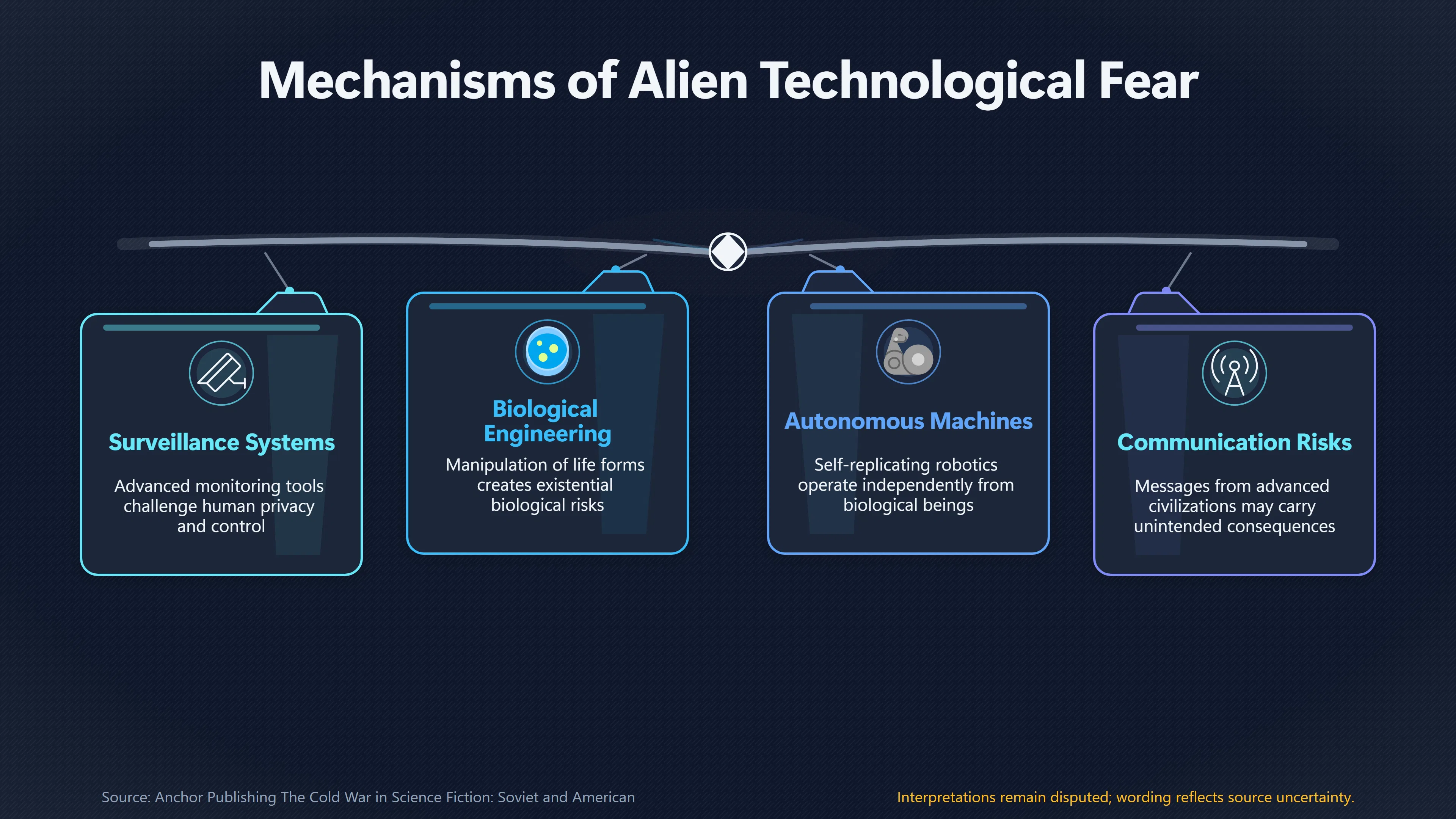
This theme is especially visible in stories involving surveillance, artificial intelligence, biological engineering or autonomous machines. A technologically superior alien society does not need to resemble a human military force. It may use tools that challenge basic assumptions about conflict. Instead of armies and battleships, science fiction imagines microscopic technologies, self-replicating machines, advanced robotics or forms of intelligence that operate independently from biological beings.
The fear is therefore partly about losing control. Humanity’s historical experience shows that technological advantages can reshape power relationships: societies with superior navigation, weapons or industrial capacity have often gained influence over less technologically advanced groups. Alien invasion fiction extends this pattern to a planetary scale, asking what humanity’s position would be if another civilisation viewed Earth as technologically immature.[Chandigarh Philosophers]chandigarhphilosophers.comWells's The War of the Worlds.: Technological Anxiety in the 19th Century, alien technologies, Comparative Analysis of Technological and…
Some science-fiction narratives also explore the possibility that the danger comes from communication itself. In discussions around searching for extraterrestrial intelligence, some researchers have considered whether a message from a much more advanced civilisation could carry risks if humans cannot understand its consequences. Such scenarios remain speculative, but they show how the technology gap can transform peaceful contact into a question of caution and preparedness rather than simple curiosity.[SETI Institute]seti.orgInstitute Scientists say space aliens could hack our planetSETI InstituteScientists say space aliens could hack our planetFebruary 26, 2018…
At the same time, scientific discussions of extraterrestrial intelligence often highlight a major difference between fiction and reality: technological advancement does not automatically imply aggression. The search for extraterrestrial intelligence focuses on detecting possible signs of technology, known as technosignatures, but there is no evidence that advanced civilisations exist or that they would behave like invasion narratives predict.[arXiv]arxiv.orgarXiv Broadband SETI: a New Strategy To Find Nearby Alien CivilizationsBroadband SETI: a New Strategy To Find Nearby Alien CivilizationsMarch 7, 2026…

Humanity facing unknown capabilities
Many invasion stories are ultimately less about aliens than about humanity’s reaction to overwhelming uncertainty. When characters encounter superior technology, the crisis often reveals weaknesses in human decision-making: competition between governments, mistrust, attempts to control information and the temptation to respond with force before understanding the situation.
The Day the Earth Stood Still offers a useful contrast. The alien visitor Klaatu possesses technology far beyond Earth’s, including capabilities represented through his spacecraft and robotic companion Gort, but the story’s tension comes from human fear and misunderstanding rather than an immediate attack. The film shows how a technological gap can create panic even when the visitor’s intentions are not purely hostile.[HISTORY]history.comUFOs and Alien Invasions in FilmUFOs and Alien Invasions in Film - Meaning, Hollywood, List | HISTORYApril 9, 2010…
Later invasion films often return to the same dilemma from a more militarised perspective. In Independence Day (1996), humanity initially appears powerless against alien ships protected by advanced systems. The conflict is resolved not by matching alien technology directly, but by finding an unexpected weakness. This reflects a common science-fiction idea: when technology is unequal, survival depends less on possessing the strongest tools and more on adaptation, cooperation and understanding the opponent.[AP News]apnews.comAP News Hollywood's narrative on UFOs and ETs reaches back many decadesInterest in extraterrestrial life surged after the 1947 Roswell incident, which spurred both governmental secrecy and a new wave of alien…
The imbalance also shapes how audiences imagine first contact. A civilisation capable of travelling between stars would likely possess knowledge and engineering abilities that could transform human society. That possibility creates both hope and fear: advanced technology could represent scientific progress, but it could also expose humanity’s vulnerability if contact occurred under unequal conditions.
Ultimately, alien technology imbalance works as a science-fiction mechanism because it turns the unknown into a mirror for human concerns. The alien threat is rarely only about machines or weapons. It is about power: who controls knowledge, who sets the rules of interaction, and whether a less advanced civilisation can respond wisely when confronted by capabilities it cannot yet comprehend.
Amazon book picks
Further Reading
Books and field guides related to When alien technology becomes the threat. Use these as the next step if you want deeper reading beyond the article.
The War of the Worlds
The War of the Worlds (1898), by H. G. Wells, is an early science fiction novel which describes an invasion of England by aliens from Mar...
Contact
Rating: 4.0/5 from 21 Google Books ratings
In the year 1999 a multinational team of astronauts sets out to discover the secrets of the universe.
The Three-Body Problem
The inspiration for the Netflix series 3 Body Problem! WINNER OF THE HUGO AWARD FOR BEST NOVEL Over 1 million copies sold in North Americ...
The Road
Rating: 3.5/5 from 8 Google Books ratings
In a novel set in an indefinite, futuristic, post-apocalyptic world, a father and his young son make their way through the ruins of a dev...
eBay marketplace picks
Marketplace Samples
Live-tested eBay searches with available results related to this page.
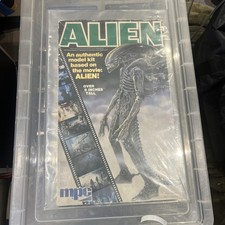
Selected fromalien model oneBay.co.uk.

Endnotes
1.
Source: academic.oup.com
Link:https://academic.oup.com/edited-volume/62696/chapter-abstract/562075070
Source snippet
OUP AcademicThe War of the Worlds: Aliens Forever at the Gate | The Oxford Handbook of H. G. Wells | Oxford AcademicApril 29, 2026...
Published: April 29, 2026
2.
Source: anchor-publishing.com
Title: Anchor Publishing The Cold War in Science Fiction: Soviet and American
Link:https://www.anchor-publishing.com/document/287375
Source snippet
Anchor PublishingThe Cold War in Science Fiction: Soviet and American...February 16, 2015...
Published: February 16, 2015
3.
Source: m.anchor-publishing.com
Title: Anchor Publishing The Cold War in Science Fiction: Soviet and American
Link:https://m.anchor-publishing.com/document/287375
4.
Source: seti.org
Title: Institute Scientists say space aliens could hack our planet
Link:https://www.seti.org/scientists-say-space-aliens-could-hack-our-planet
Source snippet
SETI InstituteScientists say space aliens could hack our planetFebruary 26, 2018...
Published: February 26, 2018
5.
Source: arxiv.org
Title: arXiv Broadband SETI: a New Strategy To Find Nearby [Alien Civilizations]({{ ‘alien-civilizations/’ | relative_url }})
Link:https://arxiv.org/abs/2603.07333
Source snippet
Broadband SETI: a New Strategy To Find Nearby Alien CivilizationsMarch 7, 2026...
Published: March 7, 2026
6.
Source: history.com
Title: UFOs and Alien Invasions in Film
Link:https://www.history.com/articles/ufos-and-alien-invasions-in-film
Source snippet
UFOs and Alien Invasions in Film - Meaning, Hollywood, List | HISTORYApril 9, 2010...
Published: April 9, 2010
7.
Source: seti.org
Title: institute looks for signs of technology in interstellar visitor 3iatlas
Link:https://www.seti.org/news/seti-institute-looks-for-signs-of-technology-in-interstellar-visitor-3iatlas/
8.
Source: seti.org
Title: Can ET Detect Us?
Link:https://www.seti.org/press-release/can-et-detect-us
9.
Source: seti.org
Title: Can ET Detect Us?
Link:https://www.seti.org/news/can-et-detect-us/
10.
Source: academic.oup.com
Link:https://academic.oup.com/mississippi-scholarship-online/book/51370/chapter-abstract/417739682
11.
Source: academic.oup.com
Link:https://academic.oup.com/edinburgh-scholarship-online/book/19171/chapter-abstract/177636966
12.
Source: academic.oup.com
Link:https://academic.oup.com/edinburgh-scholarship-online/book/19171/chapter/177636966
13.
Source: seti.org
Link:https://www.seti.org/research/seti-101/fermi-paradox/
14.
Source: shapes.inc
Link:https://shapes.inc/fandom/independence-day/deep-dive
15.
Source: chandigarhphilosophers.com
Link:https://www.chandigarhphilosophers.com/index.php/ijmrp/article/view/190
Source snippet
Wells's The War of the Worlds.: Technological Anxiety in the 19th Century, alien technologies, Comparative Analysis of Technological and...
16.
Source: Wikipedia
Title: Alien invasion
Link:https://en.wikipedia.org/wiki/Alien_invasion
17.
Source: apnews.com
Title: AP News Hollywood’s narrative on UFOs and ETs reaches back many decades
Link:https://apnews.com/article/b529dafa810051226842b49523fdab77
Source snippet
Interest in [extraterrestrial life]({{ 'extraterrestrial-life/' | relative_url }}) surged after the 1947 Roswell incident, which spurred both governmental secrecy and a new wave of alien...
18.
Source: plotexplained.com
Title: independence day
Link:https://www.plotexplained.com/movie/independence-day
19.
Source: davisreviews.com
Title: independence day 1996
Link:https://www.davisreviews.com/post/independence-day-1996
20.
Source: deepfocusreview.com
Title: independence day
Link:https://www.deepfocusreview.com/reviews/independence-day/
21.
Source: historynewsnetwork.org
Title: Ronald Reagan and the Day the Earth Stood Still — History News Network
Link:https://www.historynewsnetwork.org/article/ronald-reagan-and-the-day-the-earth-stood-still
22.
Source: oocities.org
Title: The War of the Worlds
Link:https://www.oocities.org/timessquare/galaxy/3773/waroftheworlds/martians/tech.html
23.
Source: journals.ala.org
Link:https://journals.ala.org/index.php/rusq/article/view/7273/9956
24.
Source: en.wikipedia-on-ipfs.org
Title: Alien invasion
Link:https://en.wikipedia-on-ipfs.org/wiki/Alien_invasion
25.
Source: roger-russell.com
Link:https://www.roger-russell.com/war/war.htm
Additional References
26.
Source: youtube.com
Title: Liu Cixin – The Dark Forest | Books in Bytes Podcast
Link:https://www.youtube.com/watch?v=VTRbfp4C1Ko
Source snippet
This selection explores the theme of technological imbalance in science fiction and real-world astrobiology, highlighting H.G. Wells's pi...
27.
Source: youtube.com
Title: The War of the Worlds: The Novel That Changed Science Fiction Forever
Link:https://www.youtube.com/watch?v=d6leAYIVKHc
Source snippet
How The Martians Invaded Earth | War Of The Worlds Lore...
28.
Source: youtube.com
Title: The Dark Forest Theory: Why We Should Stop Searching for Aliens
Link:https://www.youtube.com/watch?v=KGaLE-DQEzg
Source snippet
Stephen Hawking's Stark Warning for Humans to Leave Earth...
29.
Source: youtube.com
Title: How The Martians Invaded Earth | War Of The Worlds Lore
Link:https://www.youtube.com/watch?v=3CRV6IRZ–I
Source snippet
The Dark Forest Theory: Why We Should Stop Searching for Aliens...
30.
Source: youtube.com
Title: Stephen Hawking’s Stark Warning for Humans to Leave Earth
Link:https://www.youtube.com/watch?v=AoR2lWyngFk
Source snippet
Liu Cixin – The Dark Forest | Books in Bytes Podcast...
31.
Source: mdpi.com
Link:https://www.mdpi.com/2076-0787/10/4/107
Source snippet
Robert Wise’s The Day the Earth Stood Still (1951) and Interplanetary Emissary Klaatu Are Not Anti-Atomic: A Reassessment of the Film...
32.
Source: philarchive.org
Link:https://philarchive.org/rec/TURTRC
33.
Source: cambridge.org
Link:https://www.cambridge.org/core/journals/international-journal-of-astrobiology/article/abs/are-transmissions-to-space-dangerous/A85A96440C1D8E25780D8937D3E3A7D0
34.
Source: doi.org
Link:https://doi.org/10.3847/1538-4357/ae4c38
35.
Source: tandfonline.com
Link:https://www.tandfonline.com/doi/abs/10.1080/01956051.2010.482950