Within Alien civilizations
Why Fiction Imagines Wise Alien Civilisations
Stories of helpful extraterrestrial civilisations explore hopes that contact could bring knowledge, ethics and technological progress.
On this page
- Ancient and advanced alien societies
- Human hopes about first contact
- Links to real SETI questions
Page outline Jump by section
Introduction
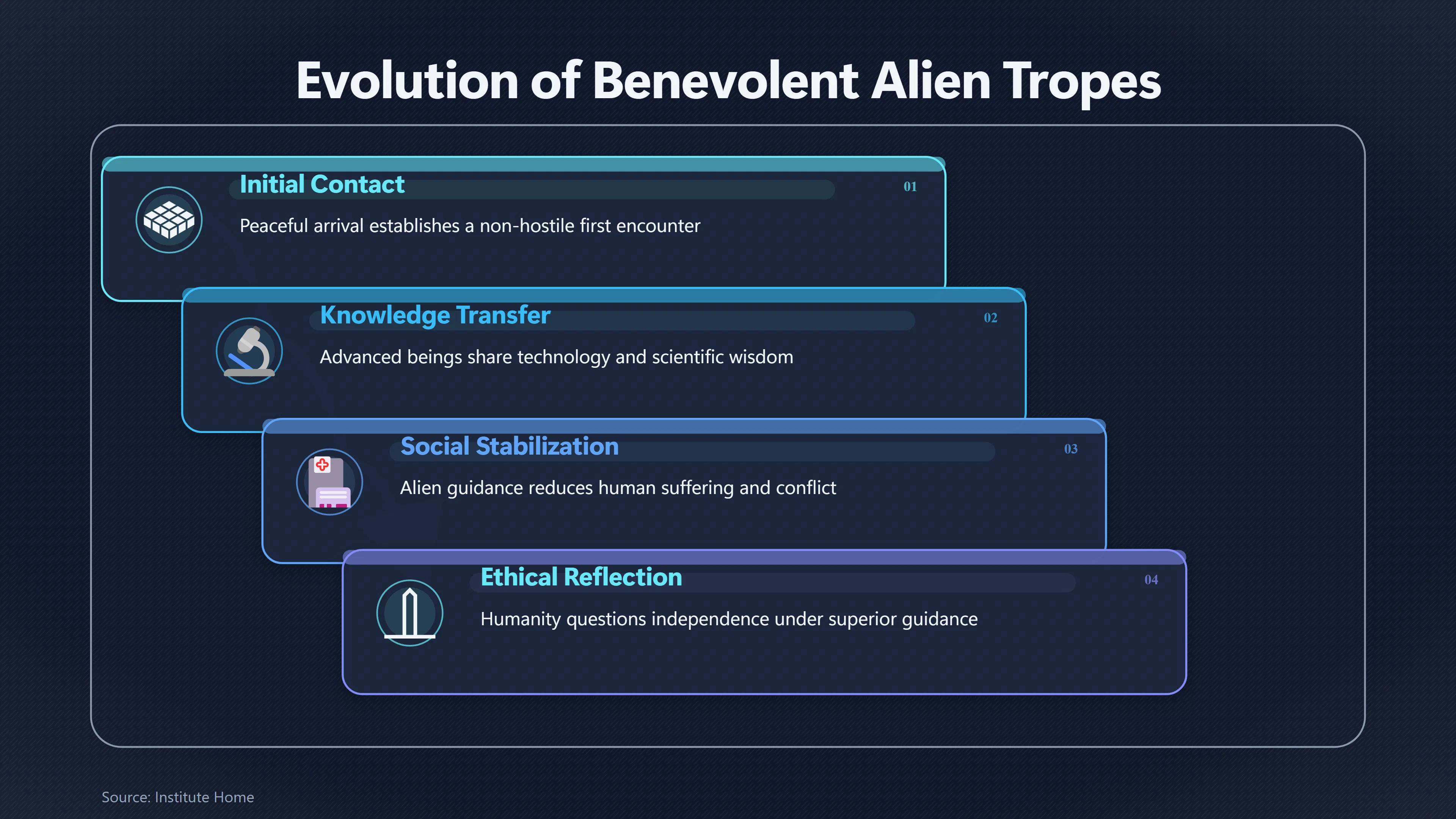
Benevolent alien civilisations are one of science fiction’s most enduring ways of imagining first contact: not as an invasion, but as an encounter with beings who have solved problems humanity still struggles with. These stories portray advanced extraterrestrials as teachers, guardians, diplomats or ethical examples whose knowledge could transform human society. The appeal lies in a powerful question: if another civilisation had survived for thousands or millions of years longer than ours, might it have developed not only greater technology but also greater wisdom?
Within science fiction’s wider relationship with UFO ideas, helpful aliens represent a hopeful alternative to stories of hostile visitors. They shape public imagination about what contact might mean, while also influencing real discussions in astronomy and the Search for Extraterrestrial Intelligence (SETI), where scientists consider what kinds of advanced civilisations might exist and how they might communicate.[SETI Institute]seti.orgInstitute HomeSETI InstituteHome…
Ancient and advanced alien societies
Many fictional advanced civilisations are imagined as ancient because technological progress creates a huge gap between a young species like humanity and a civilisation that began exploring space millions of years earlier. This “time advantage” allows writers to explore aliens who are not merely more powerful than humans, but fundamentally different in their priorities, ethics and understanding of existence.
A classic example is Arthur C. Clarke’s Childhood’s End (1953), where the mysterious Overlords arrive peacefully and appear to create a better world by ending war, reducing suffering and helping humanity achieve a period of stability. The story uses the idea of a superior civilisation as both a dream and a warning: advanced beings may genuinely improve human life while still raising difficult questions about independence, cultural identity and whether humanity should accept guidance from a more powerful species.[Penguin Random House]penguinrandomhouse.comchildhoods end by arthur c clarkePenguin Random HouseChildhood's End by Arthur C. Clarke: 9780345444059 | PenguinRandomHouse.com: BooksJuly 3, 2001…
This tension is central to many “wise alien” stories. The alien civilisation may possess technologies that seem miraculous, but the important difference is often portrayed as social rather than mechanical. Writers imagine that a truly advanced species might have overcome problems that remain unresolved on Earth, such as violence, resource scarcity or environmental destruction.
Another influential example is the civilisation-building tradition found in works such as The Culture series, where highly advanced societies use artificial intelligence and abundant resources to create post-scarcity worlds. These fictional societies are less interested in conquest than in questions about responsibility: when a civilisation becomes powerful enough to influence others, does it have a duty to intervene?
The “ancient alien mentor” idea therefore works as a mirror for human ambitions. Fiction often asks whether technological advancement naturally leads to moral progress, or whether intelligence and wisdom must be developed separately.
Why humans imagine helpful first contact
The idea of benevolent aliens reflects hopes about humanity’s own future. Contact with an older civilisation is often imagined as a shortcut around our current limitations: aliens could reveal new energy sources, medical discoveries, scientific knowledge or ways of organising society. These stories transform extraterrestrials into symbols of possibility.
A recurring mechanism in these narratives is the “cosmic teacher” role. Humanity is depicted as a young civilisation still learning how to manage its technology responsibly, while extraterrestrials represent a possible future stage of development. The appeal is similar to traditional stories about mentors or explorers who return with knowledge from beyond familiar boundaries, but science fiction places that relationship on a planetary scale.
Films such as The Day the Earth Stood Still use alien visitors to examine whether humanity is mature enough to survive its own inventions. Rather than simply presenting aliens as superior creatures, these stories turn the encounter into a test of human behaviour.
The most optimistic versions suggest that contact would expand humanity’s moral imagination. An alien civilisation might force people to think beyond national competition, short-term interests and Earth-based divisions. The alien becomes a way of asking what kind of civilisation humans would want to become.
However, many science fiction works complicate this optimism. A civilisation advanced enough to guide humanity may also have values humans do not fully understand. In Childhood’s End, the apparent generosity of the Overlords raises questions about whether improvement imposed from outside is the same as progress chosen freely.[Penguin Random House]penguinrandomhouse.comchildhoods end by arthur c clarkePenguin Random HouseChildhood's End by Arthur C. Clarke: 9780345444059 | PenguinRandomHouse.com: BooksJuly 3, 2001…

From fictional wisdom to real SETI questions
Real SETI research does not assume that extraterrestrial civilisations would be benevolent, hostile or similar to humans. Instead, researchers focus on whether technological civilisations might leave detectable signs of their existence, known as technosignatures. The SETI Institute studies possible evidence of intelligent life through radio observations, optical searches and other astronomical methods.[SETI Institute]seti.orgInstitute ResearchSETI InstituteResearch…
Science fiction’s advanced civilisations have influenced some of the questions scientists ask. One example is the idea that an extremely old civilisation might operate on scales far beyond current human technology. The Kardashev Scale, proposed by astronomer Nikolai Kardashev in 1964, classifies hypothetical civilisations by their ability to use energy, ranging from planetary-scale to stellar and galactic-scale capabilities. Although speculative, it has become a common framework for discussing possible advanced societies.[ScienceDirect]sciencedirect.comScienceDirect Project SETIProject SETI - an overview | ScienceDirect Topics…
Concepts such as Dyson spheres — hypothetical structures that could capture large amounts of energy from a star — also connect fictional ideas of advanced engineering with scientific attempts to imagine detectable signs of distant civilisations. Researchers have explored whether such large-scale technological activity could create observable signals, although no confirmed evidence of such structures has been found.[YouTube]youtube.comA WISE search for large extraterrestrial civilizations: a complementary approach to traditional SETI - YouTubeNovember 12, 2013…
The connection between fiction and SETI is not that stories predict what aliens will be like. Instead, fiction provides mental models for possibilities. It encourages scientists and the public to consider that an extraterrestrial civilisation may not resemble human societies, human politics or even human concepts of progress.
The unresolved question: would advanced aliens help us?
The most interesting feature of benevolent alien stories is that they rarely answer the question of whether advanced beings would actually help humanity. They explore the consequences of different assumptions.
If an older civilisation contacted Earth, it might choose to share knowledge, remain distant, observe without interference or communicate only when humanity reached a certain level of development. Science fiction uses these possibilities to examine a problem that also appears in real discussions of extraterrestrial intelligence: advanced technology does not automatically reveal a civilisation’s motives.
Some fictional societies are benevolent because they have learned cooperation over immense periods of time. Others are cautious because they recognise that younger civilisations may misuse powerful knowledge. This distinction gives the genre depth: the most compelling alien mentors are not simply perfect beings who arrive with answers, but civilisations that create new ethical questions for humanity.
The lasting appeal of wise alien civilisations comes from their ability to combine wonder with self-reflection. They represent the possibility that intelligence elsewhere in the universe could have developed into something more peaceful, more sustainable and more thoughtful — while reminding readers that becoming a better civilisation is a challenge humanity must ultimately face itself.

Amazon book picks
Further Reading
Books and field guides related to Why Fiction Imagines Wise Alien Civilisations. Use these as the next step if you want deeper reading beyond the article.
Childhood's End
Arthur C. Clarke's classic in which he ponders humanity's future and possible evolution When the silent spacecraft arrived and took the l...
Contact
Rating: 4.0/5 from 21 Google Books ratings
In the year 1999 a multinational team of astronauts sets out to discover the secrets of the universe.
The Left Hand Of Darkness
Winter is an Earth-like planet with two major differences: conditions are semi artic even at the warmest time of the year, and the inhabi...
eBay marketplace picks
Marketplace Samples
Live-tested eBay searches with available results related to this page.
Selected fromalien poster oneBay.co.uk.

Current eBay listing
Alien Vintage Classic Movie Poster Art Print Gift - A0 A1 A2 A3 A4
Current eBay listing
Alien 1979 Classic Movie- Canvas - Framed or Poster Available
Endnotes
1.
Source: seti.org
Title: Institute Home
Link:https://www.seti.org/
Source snippet
SETI InstituteHome...
2.
Source: seti.org
Title: Institute Research
Link:https://www.seti.org/research
Source snippet
SETI InstituteResearch...
3.
Source: sciencedirect.com
Title: ScienceDirect Project SETI
Link:https://www.sciencedirect.com/topics/earth-and-planetary-sciences/project-seti
Source snippet
Project SETI - an overview | ScienceDirect Topics...
4.
Source: youtube.com
Link:https://www.youtube.com/watch?v=fI8rYMuLNeA
Source snippet
A WISE search for large extraterrestrial civilizations: a complementary approach to traditional SETI - YouTubeNovember 12, 2013...
Published: November 12, 2013
5.
Source: archive.seti.org
Link:https://archive.seti.org/press-release/seti-institute-employs-seti-ellipsoid-technique-searching-signals-distant-civilizations
Source snippet
Institute Employs SETI Ellipsoid Technique for Searching for Signals from Distant CivilizationsFebruary 12, 2024 — SETI INSTITUTE EMPLOYS...
Published: February 12, 2024
6.
Source: space.com
Title: The Kardashev scale: Classifying [alien civilizations]({{ ‘alien-civilizations/’ | relative_url }}) | Space
Link:https://www.space.com/kardashev-scale
7.
Source: seti.org
Link:https://www.seti.org/about/
8.
Source: meetings.seti.org
Link:https://meetings.seti.org/
9.
Source: youtube.com
Title: Benevolent Aliens
Link:https://www.youtube.com/watch?v=xWcEXBikPgw
Source snippet
Exploring Alien Civilizations | Isaac Arthur...
10.
Source: youtube.com
Title: Exploring Alien Civilizations | Isaac Arthur
Link:https://www.youtube.com/watch?v=pcEwHyvwQWA
Source snippet
Childhood's End Explained: A Deep Dive into Arthur C. Clarke's Sci-Fi Classic...
11.
Source: youtube.com
Title: Childhood’s End Explained: A Deep Dive into Arthur C. Clarke’s Sci-Fi Classic
Link:https://www.youtube.com/watch?v=6QQ5EA8wDr0
Source snippet
The Most DISTURBING Alien Reveal in Science Fiction...
12.
Source: youtube.com
Title: The Most DISTURBING Alien Reveal in Science Fiction
Link:https://www.youtube.com/watch?v=3dzk4c1Rqe4
Source snippet
First Contact...
13.
Source: youtube.com
Title: First Contact
Link:https://www.youtube.com/watch?v=igZi4iyJiq0
14.
Source: penguinrandomhouse.com
Title: childhoods end by arthur c clarke
Link:https://www.penguinrandomhouse.com/books/28158/childhoods-end-by-arthur-c-clarke/
Source snippet
Penguin Random HouseChildhood's End by Arthur C. Clarke: 9780345444059 | PenguinRandomHouse.com: BooksJuly 3, 2001...
Published: July 3, 2001
15.
Source: foliosociety.com
Title: Childhood’s End | The Folio Society Fiction
Link:https://www.foliosociety.com/uk/childhood-s-end
Source snippet
Clarke CHILDHOOD’S END £60 Illustrated By Grace Aldrich Foreword By Arthur C. Clarke Arthur C. Clarke’s seminal sci-fi novel Childhood’s...
16.
Source: penguinrandomhouseretail.com
Title: Childhood’s End (Syfy TV Tie-in) | Penguin Random House Retail
Link:https://www.penguinrandomhouseretail.com/book/?isbn=9781101967034
17.
Source: penguinrandomhouselibrary.com
Title: Childhood’s End
Link:https://penguinrandomhouselibrary.com/book/?isbn=9780345444059
18.
Source: kardashev.fandom.com
Link:https://kardashev.fandom.com/wiki/SETI
Additional References
19.
Source: sciencefocus.com
Link:https://www.sciencefocus.com/space/first-human-contact
Source snippet
May 23, 2026 — HERE’S HOW ALIENS WILL ACTUALLY MAKE FIRST CONTACT WITH HUMANITY The head scientist in the international Search for Extrat...
Published: May 23, 2026
20.
Source: newyorker.com
Link:https://www.newyorker.com/science/elements/intelligent-ways-to-search-for-extraterrestrials
Source snippet
These hypothetical megastructures, first speculated by Freeman Dyson in 1960, could theoretically encircle a star, harnessing its energy...
21.
Source: ebsco.com
Link:https://www.ebsco.com/research-starters/literature-and-writing/childhoods-end-analysis-major-characters
22.
Source: si.edu
Link:https://www.si.edu/object/childhoods-end-arthur-c-clarke%3Asiris_sil_1078444
23.
Source: kardashevscale.com
Link:https://kardashevscale.com/
24.
Source: kardashevinstitute.org
Link:https://kardashevinstitute.org/about/mission/
25.
Source: iaaseti.org
Link:https://iaaseti.org/en/protocols/
26.
Source: enotes.com
Link:https://www.enotes.com/topics/arthur-c-clarke/criticism/clarke-arthur/bruce-beatie-essay-date-spring-1989
27.
Source: syfy.com
Title: Contact, SETI, and the science of searching for alien life
Link:https://www.syfy.com/syfy-wire/contact-seti-and-the-science-of-searching-for-alien-life
28.
Source: openlibrary.org
Title: Childhood’s End by Arthur C. Clarke | Open Library
Link:https://openlibrary.org/books/OL10684179M/Childhood%27s_End