Within Alien contact stories
What Alien Contact Reveals About Humans
Alien encounters often challenge ideas about intelligence, civilisation and what makes humanity unique in the universe.
On this page
- Aliens as mirrors of human concerns
- Different ideas of intelligence
- Transformation after cosmic encounters
Page outline Jump by section
Introduction
Alien contact stories reveal as much about humanity as they do about imagined extraterrestrial beings. Rather than simply asking whether humans could survive meeting another civilisation, these narratives ask a deeper question: what parts of being human would remain meaningful if intelligence existed in forms unlike our own? Across science fiction, the alien visitor has become a tool for examining identity, language, culture, prejudice and the assumptions humans make about their own uniqueness. Scholars of science fiction have described alien encounters as stories of “Self” and “Other”, where humanity measures itself by confronting a being that does not fit familiar categories.[ScholarWorks]scholarworks.uno.eduScholar Works"Self and Other in SF: Alien Encounters" by Carl D. MalmgrenScholar Works"Self and Other in SF: Alien Encounters" by Carl D. Malmgren
The most influential contact stories therefore move beyond invasion. They imagine encounters where the challenge is understanding rather than defeating the alien. In Close Encounters of the Third Kind, The Left Hand of Darkness and Arrival, contact changes human self-perception because the alien presence exposes limits in human thinking.[The Criterion Collection]criterion.comThe Criterion CollectionClose Encounters of the Third Kind | Current | The Criterion CollectionNovember 12, 1990… These stories suggest that the most significant consequence of meeting another intelligence might not be technological advancement or danger, but a transformation in how humanity defines itself.
Aliens as mirrors of human concerns
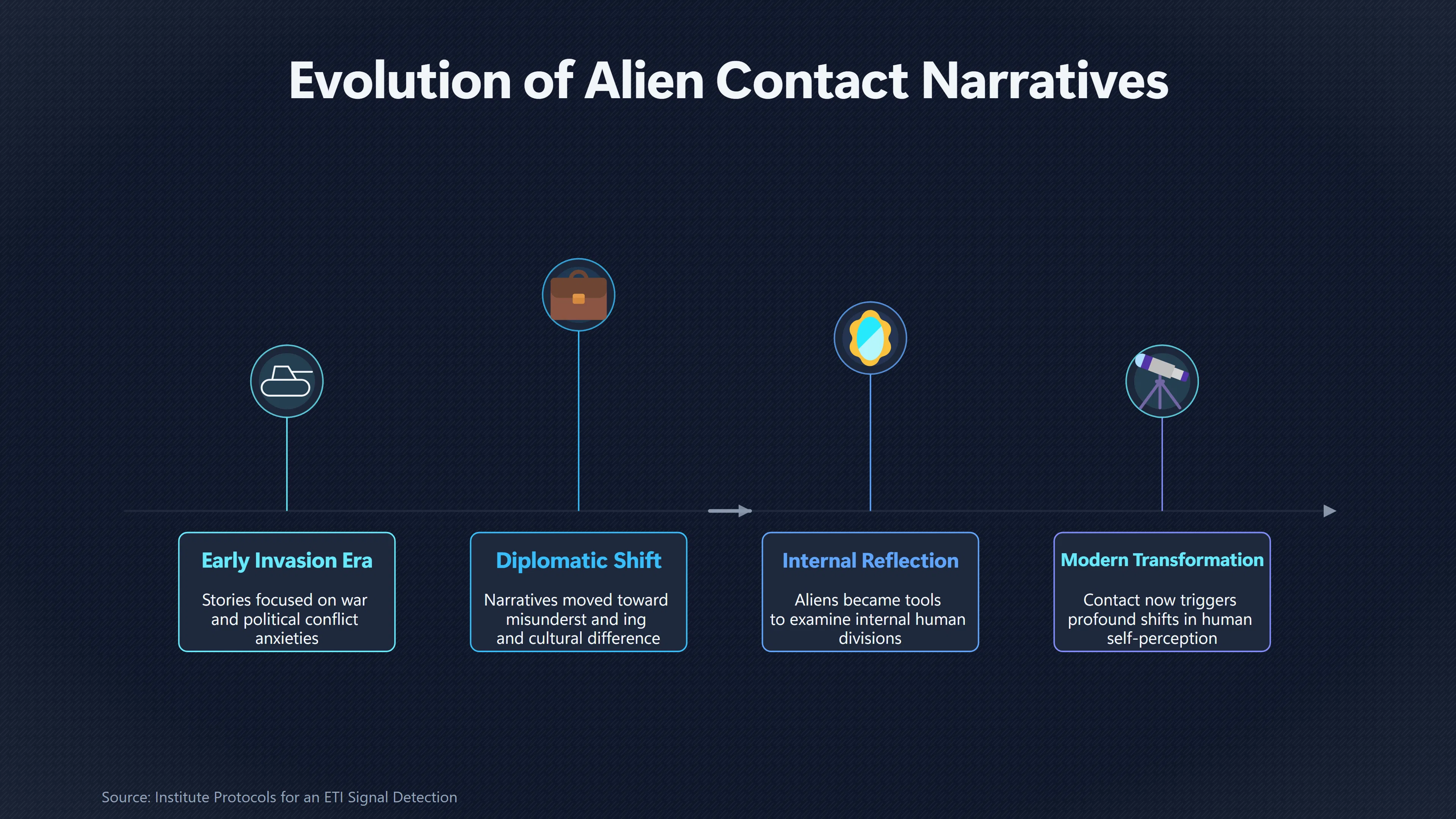
Alien contact fiction often uses extraterrestrials as mirrors: their differences reveal ideas, fears and inequalities already present in human societies. The alien is rarely just a biological creature from another planet. It represents a challenge to human categories of normality, civilisation and intelligence.
This pattern can be seen in the development of first-contact science fiction. Earlier invasion narratives frequently reflected anxieties about war and political conflict, but later contact stories shifted attention towards misunderstanding, diplomacy and cultural difference. The alien became less a symbol of external danger and more a way to examine internal human divisions.[AP News]apnews.comAP News Hollywood's narrative on UFOs and ETs reaches back many decadesFrom classic films like The Day the Earth Stood Still to blockbusters such as E.T. and Close Encounters of the Third Kind, cinemati…
Contact exposes human assumptions
A recurring theme is that humans often assume their own values are universal. Alien encounters challenge this by presenting beings whose communication systems, social structures or moral frameworks operate differently.
Ursula K. Le Guin’s novel The Left Hand of Darkness is one of the clearest examples. The story sends a human ambassador to the planet Winter, where inhabitants have a form of gender identity that differs radically from human assumptions. The alien society forces the protagonist to reconsider ideas about gender, politics and relationships that he initially treats as natural.[Penguin Random House Higher Education]penguinrandomhousehighereducation.comOpen source on penguinrandomhousehighereducation.com.
The importance of this approach is not that fictional aliens provide simple answers about humanity. Instead, they create distance. By making human behaviour appear unfamiliar, science fiction allows readers to examine customs and beliefs that are normally invisible because they feel ordinary.
Different ideas of intelligence
Alien contact stories also question whether intelligence must look human. They challenge the idea that advanced thinking must involve human-like bodies, emotions or communication methods.
One of the strongest examples is Arrival, based on Ted Chiang’s short story “Story of Your Life”. The narrative centres on a linguist attempting to understand an alien language after mysterious spacecraft arrive on Earth. The story treats communication as a profound encounter between different ways of experiencing reality rather than as a technical code-breaking exercise.[GQ]gq.comHow an Unfilmable Story Turned Into the Year's Best Sci-Fi MovieThe adaptation maintains the complexity of Chiang's work, even including elements like the Sapir-Whorf hypothesis. Screenwriter Eric Heis…
The aliens in Arrival are important because they do not behave like humans with unusual appearances. Their intelligence is expressed through a fundamentally different relationship with language and time. The story asks whether humans would even recognise another form of intelligence if it did not think in familiar ways.
This question connects fictional contact stories with real scientific discussions about extraterrestrial intelligence. The Search for Extraterrestrial Intelligence (SETI) focuses on finding evidence of technological activity beyond Earth, but researchers also recognise that a confirmed discovery would create social and philosophical questions about humanity’s place in the universe. Modern SETI protocols include not only scientific verification but also communication, ethical and societal considerations.[SETI Institute]seti.orgInstitute Protocols for an ETI Signal DetectionSETI InstituteProtocols for an ETI Signal DetectionJune 1, 2026…
The difficulty is that humans naturally interpret unknown intelligence through human experience. Imagined aliens often inherit human concerns because writers and audiences have no alternative reference point. This limitation is itself part of the subject: alien stories reveal both curiosity about the unknown and the boundaries of human imagination.[arXiv]arxiv.orgarXiv Imagining the Alien: Human Projections and Cognitive LimitationsImagining the Alien: Human Projections and Cognitive LimitationsFebruary 7, 2026…

When contact changes the human individual
Many alien contact narratives focus not on humanity as a whole but on individuals whose identities are transformed by encountering something beyond ordinary experience.
Steven Spielberg’s Close Encounters of the Third Kind presents contact as a personal transformation. The protagonist Roy Neary’s encounter with a UFO disrupts his previous life and creates an overwhelming need to understand what he has experienced. Rather than depicting contact as a military event, the film presents it as a psychological and emotional turning point.[Science on Screen]scienceonscreen.orgScience on Screen Close Encounters of the Third Kind — Science on ScreenScience on Screen Close Encounters of the Third Kind — Science on Screen
The film’s famous communication sequence also changes the meaning of first contact. The exchange is not based on weapons or political negotiation but on music, symbols and shared curiosity. The aliens’ arrival forces humans to reconsider whether communication itself might be the defining feature of intelligence.[BFI]bfi.org.ukwhy i love close encounters third kindwhy i love close encounters third kind
This pattern appears repeatedly in contact fiction: the human characters who encounter aliens often become outsiders within their own societies. Their experience separates them from people who have not shared it, creating questions about belief, knowledge and belonging.
Transformation after cosmic encounters
The deepest impact of alien contact stories is often a change in perspective. Humanity does not necessarily become stronger because aliens arrive; it becomes more aware of its own limitations.
From human exceptionalism to cosmic humility
Many contact narratives challenge the assumption that humans occupy a privileged position in the universe. The arrival of another civilisation forces characters to reconsider whether human intelligence, morality and culture are unique or simply one possible outcome among many.
This theme appears in stories such as Carl Sagan’s Contact, where communication with extraterrestrial intelligence becomes a scientific and philosophical encounter rather than a battle. The central question is not whether humans can defeat aliens but whether they are prepared to engage with knowledge that exceeds their current understanding.
Real-world discussions about possible extraterrestrial detection reflect similar concerns. Scientific organisations preparing for a potential discovery of intelligent life emphasise careful verification and global communication because such an event would have implications far beyond astronomy.[SETI Institute]seti.orgInstitute Humanity's Plan for First Contact: Who Speaks for EarthInstitute Humanity's Plan for First Contact: Who Speaks for Earth
Contact as a test of cooperation
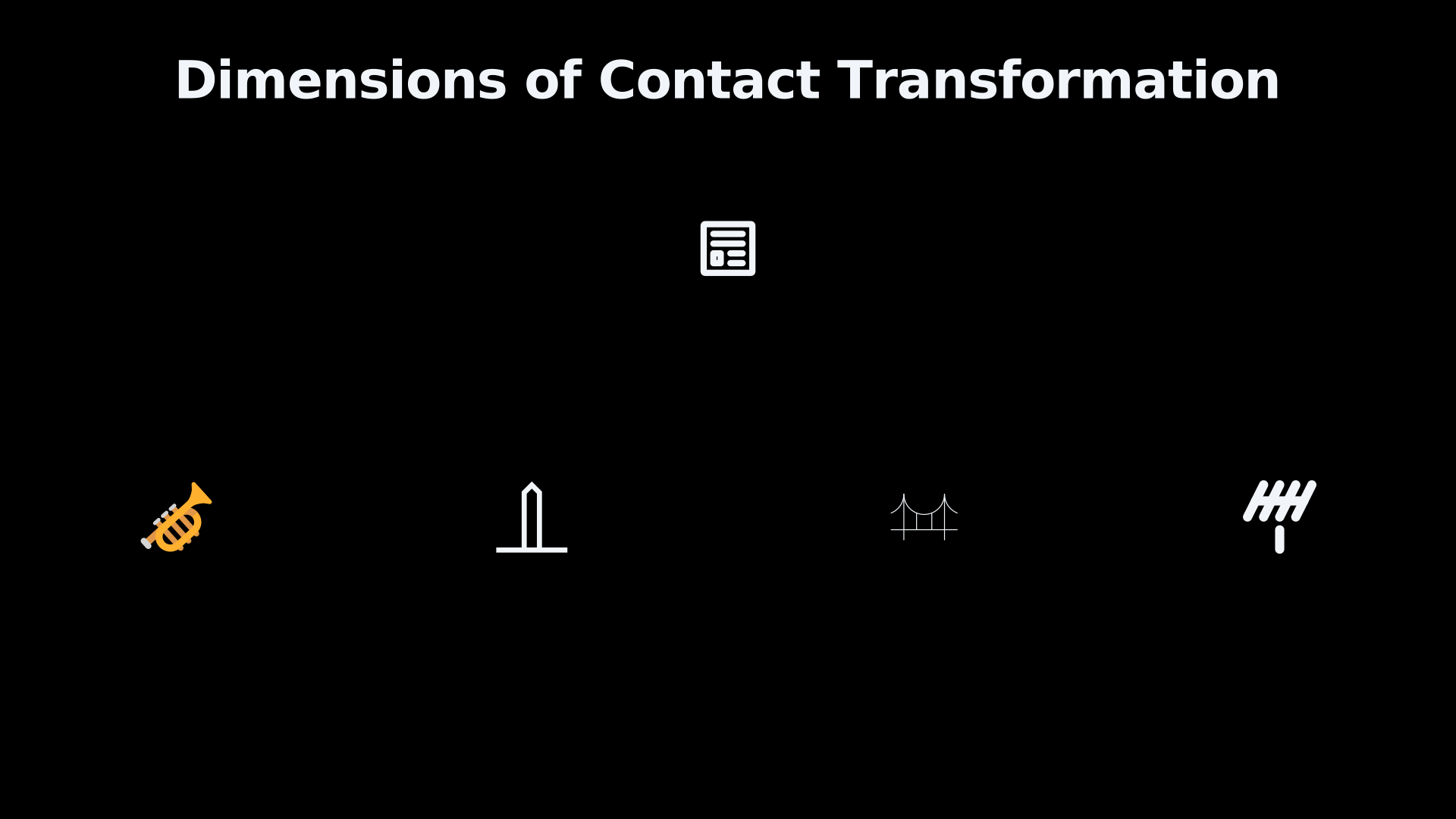
Alien stories also examine whether humanity can overcome internal divisions when faced with a larger cosmic perspective. A common tension is that humans may struggle to respond collectively because political competition, mistrust and cultural differences do not disappear simply because another intelligence appears.
This makes contact fiction a form of social criticism. The alien often reveals human problems rather than causing them. In The Day the Earth Stood Still, for example, the extraterrestrial visitor’s message reflects concerns about humanity’s use of destructive technology and its inability to manage conflict. The story uses an outside perspective to question whether humans are mature enough to participate in a wider community of civilisations.[AP News]apnews.comAP News Hollywood's narrative on UFOs and ETs reaches back many decadesFrom classic films like The Day the Earth Stood Still to blockbusters such as E.T. and Close Encounters of the Third Kind, cinemati…
Why alien contact stories remain powerful
Alien contact narratives endure because they turn the unknown into a question about identity. The alien is valuable not only because it represents life beyond Earth, but because it creates a comparison point for understanding life on Earth.
These stories repeatedly return to three questions: Can humans communicate with something genuinely different? Can intelligence exist without resembling humanity? And would contact make humans more united, or would it expose existing divisions?
The most thoughtful contact stories do not present aliens as simple threats or saviours. They use extraterrestrial encounters to examine the boundaries of human knowledge and the assumptions behind human civilisation. In this sense, the alien visitor is less a character from another world than a device for seeing our own world differently.
Amazon book picks
Further Reading
Books and field guides related to What Alien Contact Reveals About Humans. Use these as the next step if you want deeper reading beyond the article.
The Left Hand of Darkness
Rating: 4.0/5 from 13 Google Books ratings
50TH ANNIVERSARY EDITION—WITH A NEW INTRODUCTION BY DAVID MITCHELL AND A NEW AFTERWORD BY CHARLIE JANE ANDERS Ursula K. Le Guin’s groundb...
Contact
Rating: 4.0/5 from 21 Google Books ratings
In the year 1999 a multinational team of astronauts sets out to discover the secrets of the universe.
The Science Fiction Handbook
Rating: 4.0/5 from 5 Google Books ratings
The Science Fiction Handbook offers a comprehensive and accessible survey of one of the literary world's most fascinating genres. Include...
The Road to Science Fiction: From here to forever
Now in Paperback The Road to Science Fiction is a six-volume anthology that covers the development of this genre from its earliest protot...
eBay marketplace picks
Marketplace Samples
Live-tested eBay searches with available results related to this page.
Selected fromscience fiction poster oneBay.co.uk.


Endnotes
1.
Source: criterion.com
Link:https://www.criterion.com/current/posts/877-close-encounters-of-the-third-kind
Source snippet
The Criterion CollectionClose Encounters of the Third Kind | Current | The Criterion CollectionNovember 12, 1990...
Published: November 12, 1990
2.
Source: seti.org
Title: Institute Protocols for an ETI Signal Detection
Link:https://www.seti.org/research/seti-101/protocols-for-an-eti-signal-detection/
Source snippet
SETI InstituteProtocols for an ETI Signal DetectionJune 1, 2026...
Published: June 1, 2026
3.
Source: arxiv.org
Title: arXiv Imagining the Alien: Human Projections and Cognitive Limitations
Link:https://arxiv.org/abs/2602.07284
Source snippet
Imagining the Alien: Human Projections and Cognitive LimitationsFebruary 7, 2026...
Published: February 7, 2026
4.
Source: bfi.org.uk
Title: why i love close encounters third kind
Link:https://www.bfi.org.uk/features/why-i-love-close-encounters-third-kind
5.
Source: seti.org
Title: Institute Humanity’s Plan for First Contact: Who Speaks for Earth
Link:https://www.seti.org/news/humanitys-plan-for-first-contact/
6.
Source: seti.org
Title: Beyond Disclosure Day: The Real-World Protocols
Link:https://www.seti.org/news/beyond-disclosure-day/
7.
Source: seti.org
Title: What Happens Next If We Find Proof of Space Aliens?
Link:https://www.seti.org/what-happens-next-if-we-find-proof-space-aliens
8.
Source: seti.org
Link:https://www.seti.org/research/seti-101/
9.
Source: seti.org
Link:https://www.seti.org/what-happens-if-we-find-signal
10.
Source: scholarworks.uno.edu
Title: Scholar Works”Self and Other in SF: Alien Encounters” by Carl D. Malmgren
Link:https://scholarworks.uno.edu/engl_facpubs/28/
11.
Source: penguinrandomhousehighereducation.com
Link:https://penguinrandomhousehighereducation.com/book/?isbn=9781101665398
12.
Source: apnews.com
Title: AP News Hollywood’s narrative on UFOs and ETs reaches back many decades
Link:https://apnews.com/article/b529dafa810051226842b49523fdab77
Source snippet
From classic films like *The Day the Earth Stood Still* to blockbusters such as *E.T.* and *Close Encounters of the Third Kind*, cinemati...
13.
Source: gq.com
Title: How an Unfilmable Story Turned Into the Year’s Best Sci-Fi Movie
Link:https://www.gq.com/story/arrival-film-adapted-from-story-of-your-life
Source snippet
The adaptation maintains the complexity of Chiang's work, even including elements like the Sapir-Whorf hypothesis. Screenwriter Eric Heis...
14.
Source: scienceonscreen.org
Title: Science on Screen Close Encounters of the Third Kind — Science on Screen
Link:https://scienceonscreen.org/films/close-encounters-of-the-third-kind
15.
Source: iaaseti.org
Link:https://iaaseti.org/en/protocols/
16.
Source: czasopisma.uwm.edu.pl
Link:https://czasopisma.uwm.edu.pl/index.php/pj/article/view/10359
17.
Source: bfi.org.uk
Title: spielberg goes sublime close encounters third kind
Link:https://www.bfi.org.uk/features/spielberg-goes-sublime-close-encounters-third-kind
18.
Source: public.websites.umich.edu
Title: close encounters
Link:https://public.websites.umich.edu/~umfandsf/film/films/close_encounters.html
19.
Source: rottentomatoes.com
Title: Close Encounters of the Third Kind | Rotten Tomatoes
Link:https://www.rottentomatoes.com/m/close_encounters_of_the_third_kind
Additional References
20.
Source: newyorker.com
Link:https://www.newyorker.com/culture/persons-of-interest/ted-chiangs-soulful-science-fiction
Source snippet
His breakthrough story, "Story of Your Life," which inspired the film "Arrival," grapples with time, determinism, and acceptance. A lingu...
21.
Source: youtube.com
Link:https://www.youtube.com/watch?v=sZ42jfZrd2E
Source snippet
[Science fiction alien]({{ 'science-fiction-alien/' | relative_url }}) contact human nature video essay Resisting the Fifth: Visions of the Fourth Industrial Revolution in Alien and Alie...
22.
Source: youtube.com
Link:https://www.youtube.com/watch?v=yqtmkqzmlBo
Source snippet
The Left Hand of Darkness by Ursula K. Le Guin (ecology, gender, and what it means to be human)...
23.
Source: researchgate.net
Link:https://www.researchgate.net/publication/397300281_Perception_of_linguistic_identity_in_Ted_Chiang%27s_Story_of_Your_Life_Angele_Schoemann
24.
Source: mediascot.org
Link:https://www.mediascot.org/atmosphere/arrival/extra
25.
Source: theguardian.com
Link:https://www.theguardian.com/p/2kgbq
26.
Source: dergipark.org.tr
Link:https://dergipark.org.tr/tr/pub/cbayarsos/article/1055863
27.
Source: philpapers.org
Link:https://philpapers.org/rec/HERBAO
28.
Source: dergipark.org.tr
Link:https://dergipark.org.tr/en/doi/10.18026/cbayarsos.1055863
29.
Source: theguardian.com
Link:https://www.theguardian.com/books/booksblog/2016/nov/11/ted-chiang-science-fiction-genius-arrival-writer