Within UFO Fiction Exchange
UFO encounter categories
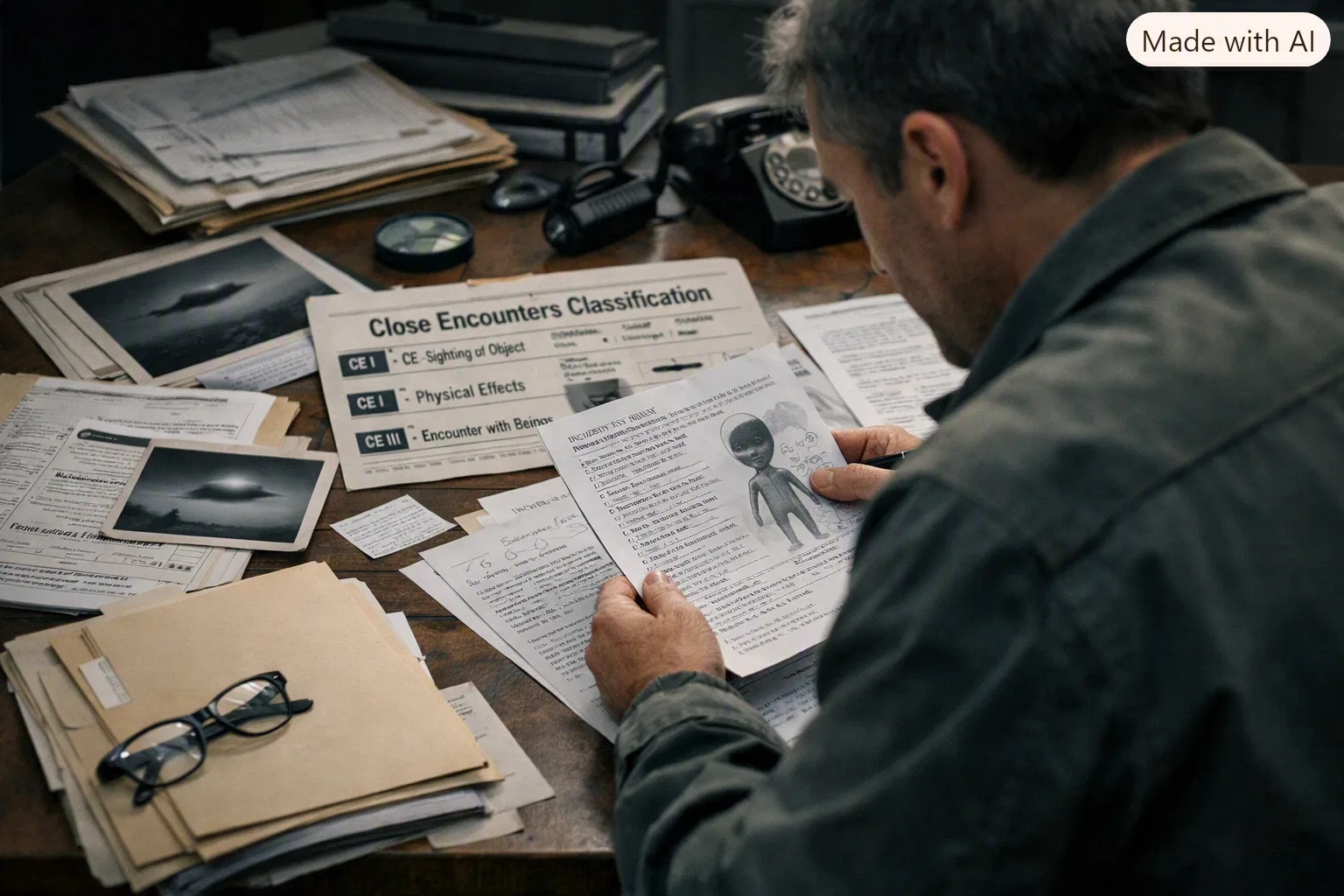
UFO encounter categories are systems for describing reported UFO experiences according to what a witness claims happened, rather than proof of what caused the event. The most influential framework is the “close encounter” scale developed by astronomer J.
Page outline Jump by section
Introduction
The categories do not classify UFOs as extraterrestrial craft; they classify the structure of an encounter report. A “close encounter of the third kind”, for example, means that a witness reports seeing occupants or entities associated with a UFO, not that alien life has been scientifically confirmed. This distinction helped the terminology move from UFO research into films, novels and television, where encounter types became narrative tools for exploring fear, curiosity, communication and the possibility of contact with other intelligences.[HowStuffWorks Science]science.howstuffworks.comHow Stuff Works Science UFO Classification | How Stuff WorksHow Stuff Works Science UFO Classification | How Stuff Works
How Hynek’s encounter scale changed UFO language
From sightings to interaction
J. Allen Hynek developed his close encounter categories while working as a scientific consultant on United States Air Force UFO investigations and later refined them in his 1972 book The UFO Experience: A Scientific Inquiry. His aim was not to prove a particular explanation for UFO reports but to create a more consistent way of describing unusual observations.[Exopaedia]exopaedia.orgHynek, Joseph AllenExopaedia:: Hynek, Joseph Allen…
The original system began with three close encounter categories:
- Close Encounter of the First Kind (CE1): a nearby visual sighting of an unidentified object without reported physical effects.
- Close Encounter of the Second Kind (CE2): a sighting accompanied by claimed physical effects, such as interference with equipment, effects on the environment or traces left at a location.
- Close Encounter of the Third Kind (CE3): a report involving visible entities or occupants connected with the object.[HowStuffWorks Science]science.howstuffworks.comHow Stuff Works Science UFO Classification | How Stuff WorksHow Stuff Works Science UFO Classification | How Stuff Works
The significance of the scale was cultural as much as investigative. Before the phrase became popular, UFO reports were often grouped simply as sightings. Hynek’s categories introduced a way of discussing degrees of reported involvement, allowing researchers, journalists and fictional creators to distinguish between observing a mysterious object and experiencing a claimed encounter with a living presence.[Center for UFO Studies]cufos.orgCenter for UFO Studies Classification SystemsCenter for UFO StudiesClassification Systems - Center for UFO Studies…
What each encounter category means
First kind: seeing an unknown object
A first-kind encounter is the most basic form of close encounter: the witness reports seeing an unusual object at relatively close range but does not report measurable effects. These accounts often involve unusual lights, shapes or movements that the observer cannot immediately identify.
Within UFO culture and science fiction, this category represents the moment of uncertainty before contact. Many stories begin with a distant observation that challenges existing assumptions: a pilot tracking something unknown, a person seeing a strange light over a landscape, or scientists detecting an unexplained object. The dramatic importance comes from ambiguity rather than direct interaction.
Second kind: when the encounter leaves traces
Second-kind encounters add a physical dimension. Witnesses may report effects such as marks on the ground, changes to vegetation, interference with vehicles or electronics, or unusual reactions from animals. These cases attracted particular attention because they appeared to offer something that could be examined beyond personal testimony.[HowStuffWorks Science]science.howstuffworks.comHow Stuff Works Science UFO Classification | How Stuff WorksHow Stuff Works Science UFO Classification | How Stuff Works
A famous example often discussed in UFO literature is the 1951 Lubbock Lights case, where witnesses reported groups of glowing objects over Texas. Although the event generated extensive investigation and debate, it did not produce evidence demonstrating an extraterrestrial cause. Such cases illustrate the central tension of UFO research: a report can be unusual and historically influential while still lacking proof of its interpretation.
For science fiction, second-kind encounters provide a bridge between observation and material evidence. Stories use physical traces as a way to suggest that an unknown visitor has affected the human world, creating questions about technology, biology and the limits of human understanding.
Third kind: reported occupants and the idea of contact
Third-kind encounters involve reports of beings, occupants or entities associated with a UFO. This category became internationally recognised partly through Steven Spielberg’s 1977 film Close Encounters of the Third Kind, which helped transform Hynek’s terminology into a mainstream cultural phrase.[Paranormal Encyclopedia]paranormal-encyclopedia.comParanormal Encyclopedia Close Encounters of the First KindParanormal Encyclopedia Close Encounters of the First Kind
The category is particularly important in science fiction because it moves the story from discovery to relationship. An unidentified object alone raises questions about technology and origin; an occupant introduces questions about language, motives, intelligence and ethics.
Many famous fictional alien-contact narratives follow this structure. They use the encounter with a being to explore whether humanity responds with fear, aggression, cooperation or curiosity. In this sense, the third kind became one of the most influential templates for modern first-contact storytelling.
Later expansions: abductions and communication categories
The original Hynek system stopped at third kind, but later researchers and UFO writers added new categories to describe reports that did not fit easily into the original framework.[Center for UFO Studies]cufos.orgCenter for UFO Studies Classification SystemsCenter for UFO StudiesClassification Systems - Center for UFO Studies…
Fourth kind: alleged abduction experiences
The fourth kind usually refers to reports in which a person claims to have been taken aboard a UFO or removed from their normal environment. These accounts became prominent during the late twentieth century, especially through widely discussed abduction narratives.[Center for UFO Studies]cufos.orgCenter for UFO Studies Classification SystemsCenter for UFO StudiesClassification Systems - Center for UFO Studies…
Abduction stories had a major influence on science fiction because they shifted the focus from public sightings to personal experiences. Instead of a spacecraft appearing over a city, the encounter became intimate and psychological, raising themes of memory, identity, control and the boundary between human experience and external reality.
Researchers and critics have debated these accounts extensively. Supporters argue that some reports contain recurring patterns, while sceptics point to possible explanations involving memory, sleep phenomena, cultural influence and expectations shaped by popular media. The category remains influential primarily as a description of reported experiences rather than as established evidence of alien activity.
Fifth kind: communication and human-initiated contact
The meaning of “fifth kind” is less consistent than the earlier categories. Some versions describe direct communication between humans and alleged non-human intelligences, while others associate the term with human-initiated attempts to establish contact.[HowStuffWorks Science]science.howstuffworks.comHow Stuff Works Science UFO Classification | How Stuff WorksHow Stuff Works Science UFO Classification | How Stuff Works
This category reflects a broader change in both UFO culture and science fiction. Early stories often imagined invasion or accidental discovery, whereas later works increasingly focus on communication: how different forms of intelligence might understand each other and whether contact would be beneficial or dangerous.
Why encounter categories matter in science fiction
UFO encounter categories influenced science fiction by turning different stages of contact into storytelling structures. A first-kind event creates mystery, a second-kind event introduces evidence, a third-kind event creates dialogue, and later categories explore deeper questions about identity and transformation.
The terminology also shaped public expectations. The phrase “close encounter” became associated not only with UFO reports but with a wider cultural idea of meeting something unknown. Science fiction adopted these categories because they provided a ready-made framework for stories about discovery and contact, even when writers changed or challenged the original meanings.
At the same time, the categories reveal the difference between classification and explanation. A system can organise reports by what people describe without resolving whether those experiences result from extraterrestrial visitors, misidentified objects, psychological processes, technological events or other causes. Modern discussions of unidentified aerial phenomena continue this distinction by separating the description of an observation from claims about its origin.[HowStuffWorks Science]science.howstuffworks.comHow Stuff Works Science UFO Classification | How Stuff WorksHow Stuff Works Science UFO Classification | How Stuff Works
The lasting meaning of the encounter scale
UFO encounter categories remain influential because they describe a progression that mirrors one of science fiction’s oldest questions: what happens when humanity meets something genuinely unknown? The movement from sighting to evidence to communication reflects changing ideas about discovery, technology and humanity’s place in the universe.
Although the categories do not provide proof of extraterrestrial contact, they remain valuable cultural tools. They show how UFO reports and science fiction developed a shared language for imagining encounters beyond ordinary human experience, from the first glimpse of a strange object in the sky to the possibility of communication with another form of intelligence.
Amazon book picks
Further Reading
Books and field guides related to UFO encounter categories. Use these as the next step if you want deeper reading beyond the article.
The UFO Experience: A Scientific Inquiry
Cited by the New York Review of Books as "the best brief for visitation," this classic study presents an analysis of UFO reports and conc...
The Hynek UFO Report
The ultimate guide to Project Blue Book by one of the lead astronomers for the US Air Force program to investigate UFO sightings—and feat...
UFOs: Generals, Pilots, and Government Officials Go on the Re...
NEW YORK TIMES BESTSELLER • Impeccably researched, this riveting journalistic investigation separates fact from fiction, and documents th...
UFOs and the National Security State: Chronology of a Coverup...
"The documentation is spectacularly good, the best ever on the UFO subject. And the conclusion is overwhelmingly powerful." —Whitley Stri...
eBay marketplace picks
Marketplace Samples
Live-tested eBay searches with available results related to this page.
Selected fromufo collectible oneBay.co.uk.

Endnotes
1.
Source: exopaedia.org
Title: Hynek, Joseph Allen
Link:https://www.exopaedia.org/Hynek%2C%2BJoseph%2BAllen
Source snippet
Exopaedia:: Hynek, Joseph Allen...
2.
Source: science.howstuffworks.com
Title: How Stuff Works Science UFO Classification | How Stuff Works
Link:https://science.howstuffworks.com/space/aliens-ufos/ufo-classification.htm
3.
Source: paranormal-encyclopedia.com
Title: Paranormal Encyclopedia Close Encounters of the First Kind
Link:https://www.paranormal-encyclopedia.com/u/ufo/close-encounters/first-kind.html
4.
Source: exopaedia.org
Link:https://www.exopaedia.org/Encounters
5.
Source: cufos.org
Title: Center for UFO Studies Classification Systems
Link:https://cufos.org/types-of-ufos/classification-systems/
Source snippet
Center for UFO StudiesClassification Systems - Center for UFO Studies...
6.
Source: cufos.org
Title: Frequently Asked Questions
Link:https://cufos.org/resources/faqs/
Additional References
7.
Source: theoriesofanything.com
Link:https://www.theoriesofanything.com/research/non-human-intelligence-nhi-taxonomy-and-classification-systems
Source snippet
February 28, 2026 — I_1_04 I_1_04 — NON-HUMAN INTELLIGENCE (NHI) TAXONOMY AND CLASSIFICATION SYSTEMS Confidence: 3/5 Section: I Updated...
Published: February 28, 2026
8.
Source: cccpublishing.org
Title: UF O History -Cyberspace – CCC- TImely Manor-TJ Morris Pubishing Book Store
Link:https://cccpublishing.org/uncategorized/ufo-history-cyberspace/
Source snippet
UFO History -Cyberspace – CCC- TImely Manor-TJ Morris Pubishing Book StoreJanuary 25, 2026 — Denzler states that ufology as a field of st...
Published: January 25, 2026
9.
Source: newspaceeconomy.ca
Title: What Is Jacques Vallees UFO Classification Methodology?
Link:https://newspaceeconomy.ca/2025/12/03/what-is-jacques-vallees-ufo-classification-methodology/
Source snippet
New Space EconomyDecember 3, 2025 — EarthEditor’s PicksExtraterrestrial LifeSpace Economy WHAT IS JACQUES VALLEES UFO CLASSIFICATION ME...
Published: December 3, 2025
10.
Source: youtube.com
Title: THE 4TH KIND: Exploring The “Real Footage” Alien Abduction Film
Link:https://www.youtube.com/watch?v=iwIJm47tZyE
Source snippet
Here is a relevant video that explores the original UFO classification framework developed by Dr. J. Allen Hynek and how it inspired scie...
11.
Source: thinkaboutitdocs.com
Title: UF O Classification Systems: Comparing Hynek vs
Link:https://www.thinkaboutitdocs.com/vallees-hynek-original-classification-system/
Source snippet
ValleeJuly 13, 2014 — VALLEE’S & HYNEK’S ORIGINAL CLASSIFICATION SYSTEM...
Published: July 13, 2014
12.
Source: youtube.com
Title: Close Encounters of the Fifth Kind, CE-5 Protocols, ET Contact Method
Link:https://www.youtube.com/watch?v=eOfyhWyxqM8
Source snippet
THE 4TH KIND: Exploring The "Real Footage" Alien Abduction Film...
13.
Source: youtube.com
Title: Ancient Aliens: Project Blue Book Proves UFO Phenomenon
Link:https://www.youtube.com/watch?v=hYYVwXCpgj4
Source snippet
Close Encounters of the Fifth Kind, CE-5 Protocols, ET Contact Method...
14.
Source: arxiv.org
Title: arXiv The New Science of Unidentified Aerospace-Undersea Phenomena (UAP)
Link:https://arxiv.org/abs/2502.06794
15.
Source: youtube.com
Title: What If You Have A Close Encounter Of The Third Kind?
Link:https://www.youtube.com/watch?v=L043-gQmdZA
Source snippet
Ancient Aliens: Project Blue Book Proves UFO Phenomenon...
16.
Source: ufo-database.blogspot.com
Link:https://ufo-database.blogspot.com/2009/03/jacques-vallee-classification-of-ufo.html