Within Military technology
How Alien Stories Reflect Nuclear Anxiety
Alien invasion stories often use advanced enemies to examine humanity's anxiety about nuclear weapons and self-destruction.
On this page
- Atomic weapons and science fiction
- Alien threats after World War Two
- Technology as human vulnerability
Page outline Jump by section
Introduction
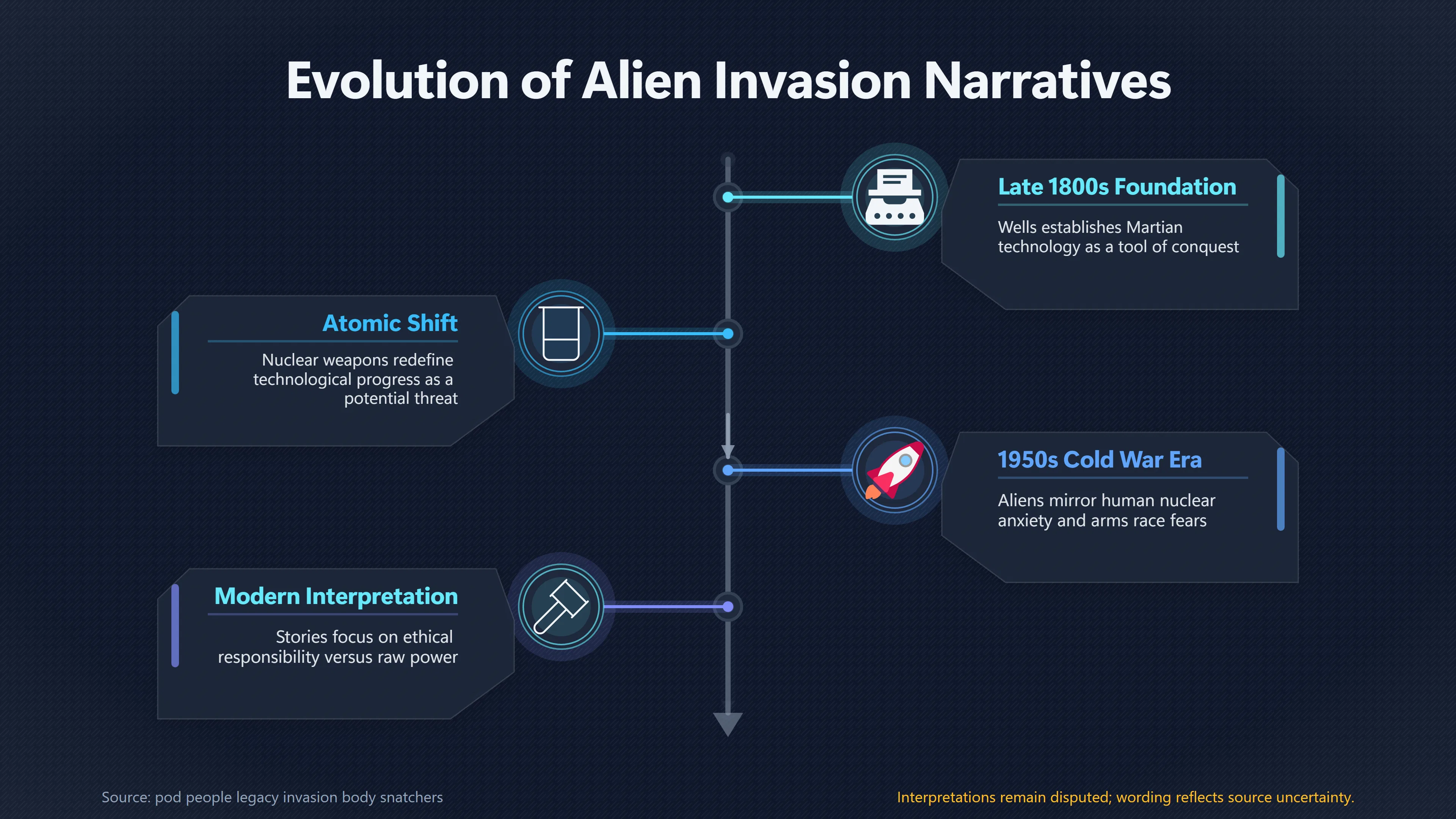
Alien invasion stories became one of science fiction’s most powerful ways to explore nuclear anxiety after the Second World War. The central fear was not only that an advanced extraterrestrial enemy might attack Earth, but that humanity had already created the means to destroy itself. In the atomic age, alien weapons often functioned as mirrors of human technology: they exposed the danger of building ever more powerful machines without developing equal wisdom about when and how to use them. Films and novels from the early Cold War transformed extraterrestrial threats into warnings about escalation, arms races and the vulnerability created by military power.[BFI]bfi.org.uk10 great films about atomic age10 great films about the atomic age | BFIJuly 13, 2023…
The link between UFO imagery and nuclear fears was especially strong from the late 1940s through the 1960s. After Hiroshima and Nagasaki, and during the growth of Cold War nuclear competition, alien stories frequently imagined weapons beyond human control. Sometimes the alien represented a future enemy with superior technology; sometimes it represented humanity’s own destructive impulses projected onto an outsider. These stories did not predict alien attacks so much as use them to ask whether a civilisation capable of reaching the stars could survive its own inventions.[BFI]bfi.org.uk10 great films about atomic age10 great films about the atomic age | BFIJuly 13, 2023…
Atomic weapons and science fiction
The nuclear age changed the meaning of advanced technology in science fiction. Before atomic weapons, powerful machines in speculative stories often represented progress and discovery. After 1945, technological advancement carried a darker possibility: scientific achievement could produce tools capable of ending civilisation. The atomic bomb became a symbol of knowledge moving faster than moral judgement, a theme that alien invasion stories repeatedly adapted.[BFI]bfi.org.uk10 great films about atomic age10 great films about the atomic age | BFIJuly 13, 2023…
Alien invasions were particularly suited to this anxiety because they placed humanity in the position of facing a technologically superior force. The comparison was unsettling: if humans could create nuclear weapons after only a few decades of modern science, what might a civilisation millions of years ahead of Earth possess? The alien enemy became a way to imagine the consequences of unchecked technological competition taken to an extreme.
H. G. Wells’s The War of the Worlds (1898) established many of the foundations of the alien invasion genre before the nuclear era. Its Martian machines overwhelm Earth’s armies through superior technology, reversing the assumptions of imperial power by making humans experience the helplessness often inflicted on technologically weaker societies. Later adaptations shifted this idea into the atomic age, where the question was no longer simply whether humans could defeat invaders, but whether their most advanced weapons would be meaningful at all.[The Criterion Collection]criterion.comThe Criterion CollectionThe War of the Worlds (1953) | The Criterion Collection…
The 1953 film adaptation of The War of the Worlds made this connection explicit through its Cold War setting. The Martians arrive in an era of aircraft, missiles and nuclear weapons, yet human military forces prove ineffective against their technology. Even the use of atomic weapons fails to solve the crisis, reinforcing the idea that humanity’s strongest weapons might not represent true security when confronted by a civilisation with a different technological order.[The Criterion Collection]criterion.comThe Criterion CollectionThe War of the Worlds (1953) | The Criterion Collection…
Alien threats after World War Two
The years after 1945 created a distinctive atmosphere for alien invasion fiction. The world had witnessed the destructive power of nuclear weapons, while the United States and Soviet Union entered an arms race built around the possibility of catastrophic escalation. Science fiction writers and filmmakers responded by imagining external threats that reflected these fears. The alien invasion became a fictional battlefield where questions about deterrence, survival and responsibility could be examined without directly depicting a real-world nuclear conflict.[BFI]bfi.org.uk10 great films about atomic age10 great films about the atomic age | BFIJuly 13, 2023…
One of the most influential examples was The Day the Earth Stood Still. The film presents the arrival of the alien Klaatu and his warning about humanity’s dangerous relationship with atomic power. Rather than simply portraying aliens as attackers, it reverses the usual invasion narrative: the extraterrestrial visitor becomes a judge of human behaviour. The story reflects a period when many people feared that nuclear competition could become a threat not only to individual nations but to civilisation itself.[DOI]doi.orgRobert Wise’s The Day the Earth Stood Still (1951) and Interplanetary Emissary Klaatu Are Not Anti-Atomic: A Reassessment of the Filmi…
However, interpretations of The Day the Earth Stood Still have also been debated. Some critics have treated it as a straightforward anti-nuclear warning, while later analysis has argued that the film’s relationship with atomic technology is more complicated and not simply a rejection of nuclear science. This disagreement shows how alien stories often carried multiple meanings: they could criticise military rivalry while still expressing confidence in scientific progress.[MDPI]mdpi.comRobert Wise’s The Day the Earth Stood Still (1951) and Interplanetary Emissary Klaatu Are Not Anti-Atomic: A Reassessment of the Film…
Another important example is Invasion of the Body Snatchers. Unlike stories focused on cities being destroyed by alien weapons, this film presents invasion as a quiet process of replacement and loss of identity. Its alien threat has often been connected to Cold War fears of infiltration, conformity and political paranoia. Although it is not primarily a nuclear-war story, it belongs to the same period of anxiety in which science fiction used alien scenarios to explore fears created by global conflict and ideological competition.[BFI]bfi.org.ukpod people legacy invasion body snatchersPod people: the legacy of Invasion of the Body Snatchers | BFIOctober 22, 2021…
Technology as human vulnerability
A recurring message in nuclear-era alien stories is that technology does not automatically provide safety. Human societies often assume that superior weapons create control, but alien narratives repeatedly challenge this belief by showing military power becoming unreliable or even dangerous.
In many invasion stories, the problem is not simply that aliens possess stronger weapons. The deeper fear is that humanity responds to uncertainty with the same habits that created nuclear danger: secrecy, competition and escalation. An unknown spacecraft is treated as a military problem before it is understood, reflecting real-world fears that governments might make irreversible decisions under pressure.
This theme appears clearly in stories where nuclear weapons are used as a final defence against extraterrestrial enemies. Such plots often question whether the atomic bomb is a solution or another source of danger. If a weapon powerful enough to destroy cities cannot defeat an alien civilisation, then the story suggests that humanity’s confidence in destructive force may be misplaced.
The appeal of the alien invasion narrative came from this tension. The alien represented the ultimate technological challenge, but the real subject was often human behaviour. Science fiction used extraterrestrial conflict to examine whether societies could manage powerful inventions responsibly. The danger was not only an enemy from the sky; it was the possibility that humanity’s own weapons, fears and decisions could create disaster.
Why nuclear fears remained central to alien stories
Nuclear anxiety continued to shape alien narratives because atomic weapons represented a unique contradiction: they demonstrated extraordinary scientific achievement while creating unprecedented risks. Alien stories captured this contradiction by imagining civilisations that had advanced technologically but failed ethically, or by showing humanity confronted with a force that made its own weapons appear primitive.[BFI]bfi.org.uk10 great films about atomic age10 great films about the atomic age | BFIJuly 13, 2023…
The strongest alien invasion stories therefore work as cautionary tales rather than simple battles between humans and extraterrestrials. They ask whether technological power can be separated from responsibility, whether fear leads to dangerous choices, and whether survival depends more on cooperation than on weapon superiority.
From the Cold War films of the 1950s to later science fiction blockbusters, the nuclear-age alien invasion remains influential because it transforms a cosmic threat into a human question. The alien may arrive from another world, but the anxieties it represents come from Earth: the fear that scientific progress can outrun judgement, and that the greatest danger created by advanced technology may be the way humans choose to use it.

Amazon book picks
Further Reading
Books and field guides related to How Alien Stories Reflect Nuclear Anxiety. Use these as the next step if you want deeper reading beyond the article.
The Making of the Atomic Bomb
Details the making of the atomic bomb. Includes diagrams and pictures documenting people and places.
The Doomsday Machine
Shortlisted for the Andrew Carnegie Medal for Excellence in Nonfiction Finalist for The California Book Award in Nonfiction The San Franc...
Nuclear War: A Scenario
The INSTANT New York Times bestseller Instant Los Angeles Times bestseller Finalist, Dayton Literary Peace Prize One of NPR's Books We Lo...
Command and Control
From famed investigative journalist Eric Schlosser, author of Fast Food Nation, comes Command and Control a ground-breaking account of th...
eBay marketplace picks
Marketplace Samples
Live-tested eBay searches with available results related to this page.
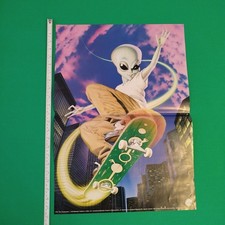
Selected fromalien invasion poster oneBay.co.uk.


Endnotes
1.
Source: criterion.com
Link:https://www.criterion.com/films/29942
Source snippet
The Criterion CollectionThe War of the Worlds (1953) | The Criterion Collection...
2.
Source: doi.org
Link:https://doi.org/10.3390/h10040107
Source snippet
Robert Wise’s The Day the Earth Stood Still (1951) and Interplanetary Emissary Klaatu Are Not Anti-Atomic: A Reassessment of the Filmi...
3.
Source: mdpi.com
Link:https://www.mdpi.com/2076-0787/10/4/107
Source snippet
Robert Wise’s The Day the Earth Stood Still (1951) and Interplanetary Emissary Klaatu Are Not Anti-Atomic: A Reassessment of the Film...
4.
Source: bfi.org.uk
Title: pod people legacy invasion body snatchers
Link:https://www.bfi.org.uk/features/pod-people-legacy-invasion-body-snatchers
Source snippet
Pod people: the legacy of Invasion of the Body Snatchers | BFIOctober 22, 2021...
Published: October 22, 2021
5.
Source: mdpi.com
Link:https://www.mdpi.com/2077-1444/12/7/520
6.
Source: doi.org
Link:https://doi.org/10.14325/mississippi/9781496806277.003.0006
7.
Source: bfi.org.uk
Title: 10 great films about atomic age
Link:https://www.bfi.org.uk/lists/10-great-films-about-atomic-age
Source snippet
10 great films about the atomic age | BFIJuly 13, 2023...
Published: July 13, 2023
8.
Source: bfi.org.uk
Title: 10 great american sci fi films 1950s
Link:https://www.bfi.org.uk/lists/10-great-american-sci-fi-films-1950s
Source snippet
10 great American sci-fi films of the 1950s | BFI...
9.
Source: bfi.org.uk
Title: [invaders from mars]({{ ‘invaders-control/’ | relative_url }}) alien invasion movie
Link:https://www.bfi.org.uk/features/invaders-from-mars-alien-invasion-movie
10.
Source: bfi.org.uk
Title: 10 great films about nuclear apocalypse
Link:https://www.bfi.org.uk/lists/10-great-films-about-nuclear-apocalypse
11.
Source: bfi.org.uk
Title: potted history end world screen
Link:https://www.bfi.org.uk/features/potted-history-end-world-screen
12.
Source: en.wikipedia-on-ipfs.org
Title: Alien invasion
Link:https://en.wikipedia-on-ipfs.org/wiki/Alien_invasion
13.
Source: rottentomatoes.com
Title: Invasion of the Body Snatchers | Rotten Tomatoes
Link:https://www.rottentomatoes.com/m/1010678-invasion_of_the_body_snatchers
Additional References
14.
Source: academic.oup.com
Link:https://academic.oup.com/reference/62339/reference-article-abstract/554201922
Source snippet
OUP AcademicInvasion of the Body Snatchers | Oxford Bibliographies in Cinema and Media Studies | Oxford Academic...
15.
Source: thebulletin.org
Link:https://thebulletin.org/premium/2026-07/introduction-doomsday-and-the-movies/
Source snippet
Introduction: Doomsday and the movies - Bulletin of the Atomic ScientistsJuly 8, 2026 — INTRODUCTION: DOOMSDAY AND THE MOVIES By Dan Drol...
Published: July 8, 2026
16.
Source: youtube.com
Link:https://www.youtube.com/watch?v=yE3TY23HZPM
Source snippet
1950s Flying Saucer, UFO, and Alien Encounter Movies...
17.
Source: youtube.com
Link:https://www.youtube.com/watch?v=mwh-4ThihbE
Source snippet
10 Forgotten 1950s Atomic Horror Films That Predicted Our Worst Fears...
18.
Source: youtube.com
Title: 10 ’50s Atomic Monster Movies Born From Real Nuclear Panic
Link:https://www.youtube.com/watch?v=TjcOJobmShE
Source snippet
This Disturbing 1953 Sci-Fi Film Still Gives People Chills...
19.
Source: youtube.com
Link:https://www.youtube.com/watch?v=_bLMi1nqDQQ
Source snippet
10 '50s Atomic Monster Movies Born From Real Nuclear Panic...
20.
Source: researchgate.net
Link:https://www.researchgate.net/publication/304799529_The_Return_of_the_Pod_People_Remaking_Cultural_Anxieties_in_Invasion_of_the_Body_Snatchers
21.
Source: researchgate.net
Link:https://www.researchgate.net/publication/354906835_Robert_Wise%27s_The_Day_the_Earth_Stood_Still_1951_and_Interplanetary_Emissary_Klaatu_Are_Not_Anti-Atomic_A_Reassessment_of_the_Filmic_Evidence
22.
Source: jpellegrino.com
Link:https://jpellegrino.com/teaching/historyofsf2.html
23.
Source: bloomsbury.com
Link:https://www.bloomsbury.com/uk/invasion-of-the-body-snatchers-9781844575626/