Within Extraterrestrial life
Can humans truly translate aliens?
Arrival presents alien communication as a problem of language, perception and trust rather than a simple translation task.
On this page
- The heptapod communication problem
- Language and changing perspectives
- Trust during first contact
Page outline Jump by section
Introduction
Arrival (2016) presents alien translation as a problem that cannot be solved by a simple dictionary or futuristic translator. The film asks a more difficult question: can humans understand a species whose way of organising meaning may be fundamentally different from our own? Through linguist Louise Banks’ attempt to communicate with the heptapods, Arrival turns first contact into a study of language, perception and trust.[University of Toronto]utoronto.caUniversity of TorontoCommunicating with aliens? U of T linguists talk facts behind the film 'Arrival' | University of TorontoNovember 25…
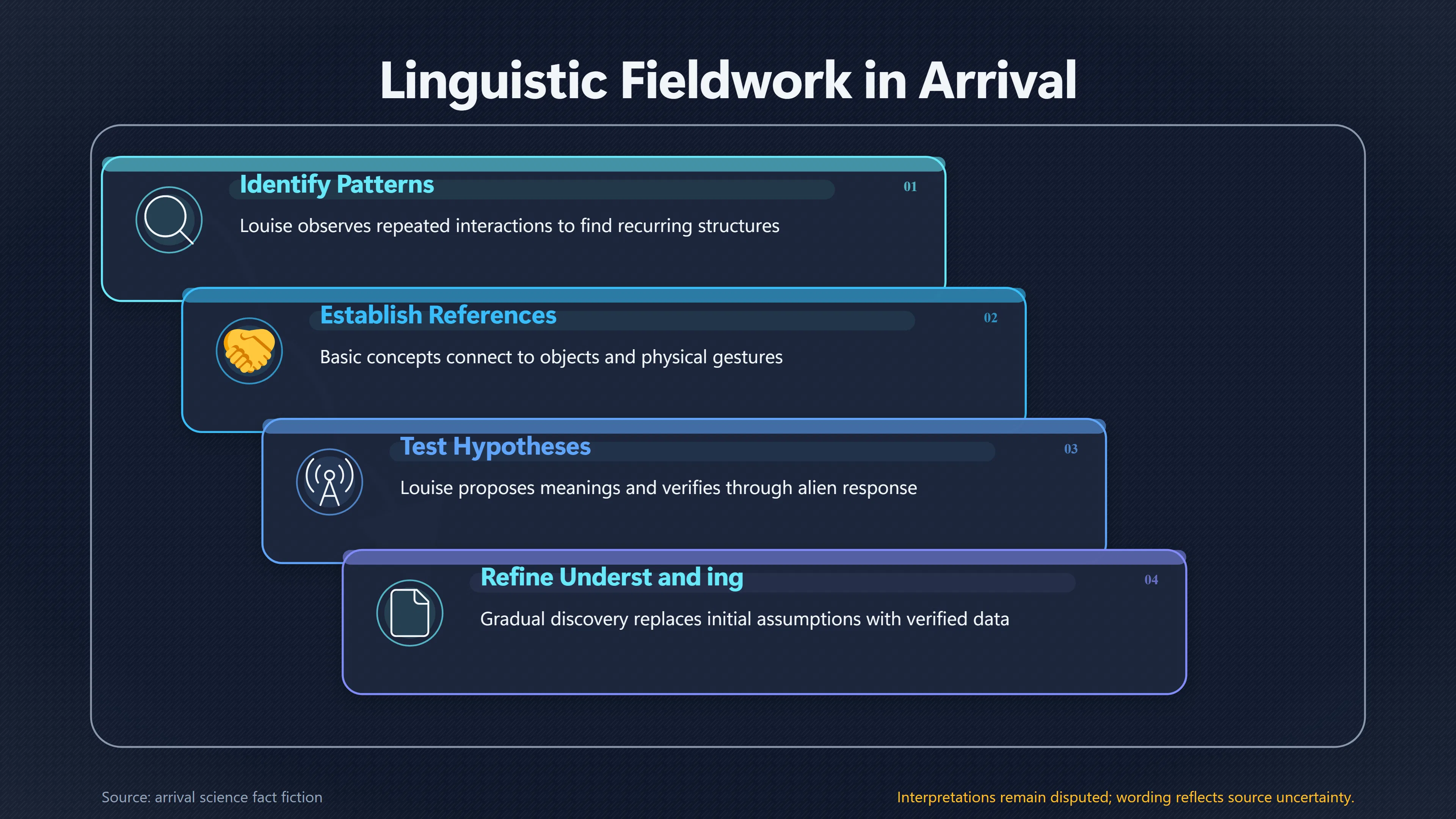
Unlike many science-fiction stories where aliens immediately speak English or rely on universal translation technology, Arrival treats communication as slow investigative work. Louise must identify patterns, establish shared meanings and avoid dangerous assumptions before humanity can even understand why the visitors have arrived. The film’s central idea is that translation is not just replacing words from one language with another; it is building a bridge between different ways of thinking.[WIRED]wired.comarrival science fact fictionThe science of Arrival: what the film got right (and wrong) | WIREDNovember 12, 2016…
The heptapod communication problem
Why alien translation cannot start with words
When the heptapods arrive on Earth, humans face a problem familiar to real linguists studying unknown languages: there is no shared vocabulary, grammar or cultural context. Louise cannot begin by asking what a particular alien sound means because she does not yet know whether the sounds represent objects, actions, ideas or something entirely different.[University of Toronto]utoronto.caUniversity of TorontoCommunicating with aliens? U of T linguists talk facts behind the film 'Arrival' | University of TorontoNovember 25…
The film’s solution is based on a principle from real-world field linguistics: communication begins with establishing basic references. Louise uses objects, gestures and repeated interactions to connect concepts with meanings. Instead of assuming that the aliens think like humans, she treats their language as a system that must be observed and analysed. This reflects how linguists approach undocumented human languages, where researchers must build understanding through careful comparison rather than direct translation.[Jessica Coon]jessica.lingspace.orgJessica Coon -Arrival: Linguistic fieldwork on the big screenJessica Coon…
The heptapods’ written language makes the challenge even greater. Their circular symbols, known as logograms, do not function like ordinary human writing. Rather than arranging letters or words in a simple sequence, the symbols represent complete ideas and are presented as connected circular forms. The film’s design team created hundreds of these symbols and developed rules for how their meanings could be represented visually.[WIRED]wired.comarrivals designers crafted mesmerizing alien alphabetHow Arrival's Designers Crafted a Mesmerizing Alien Alphabet | WIREDNovember 16, 2016…
This design choice supports one of Arrival’s major arguments: a truly alien language might not simply be another version of a human language. It might reflect a different understanding of structure, time and meaning itself.
Language and changing perspectives
The Sapir–Whorf idea in science-fiction form
The most ambitious part of Arrival is its suggestion that learning a new language can change how someone experiences reality. The film draws on the linguistic relativity debate, often associated with the Sapir–Whorf hypothesis, which explores whether the language people use influences how they perceive and organise the world. Modern linguistics generally rejects the strongest version of the idea — that language completely determines thought — but accepts that language can influence attention, categorisation and habitual ways of thinking.[Simply Psychology]simplypsychology.orgSimply Psychology Sapir–Whorf Hypothesis (Linguistic Relativity HypothesisSimply PsychologySapir–Whorf Hypothesis (Linguistic Relativity Hypothesis)May 18, 2026…
In Arrival, this concept is pushed into speculative territory. Louise’s increasing understanding of the heptapods’ written language changes her perception of time itself. The film imagines language not simply as a tool for communication but as a cognitive framework capable of reshaping consciousness.[OUP Academic]academic.oup.comOUP AcademicThe linguistics of Arrival: Heptapods, field linguistics, and Universal Grammar | Language Invention in Linguistics Pedagogy…
This idea connects Arrival to a broader tradition of science fiction that uses alien encounters to question human assumptions. The aliens are not presented as enemies who must be defeated or mysteries that must be solved through technology. Instead, they challenge humanity’s belief that human categories are universal.
Heptapod language as a different model of reality
The heptapods’ language is unusual because their written communication reflects a non-linear view of events. Human writing normally unfolds in a sequence: one word follows another, and one event follows another. The heptapods’ circular symbols suggest a form of communication where the beginning and ending of an idea are understood together.[Engadget]engadget.comDissecting the alien language in 'ArrivalDissecting the alien language in 'Arrival
This makes translation a philosophical problem as much as a technical one. Louise is not only asking, “What does this symbol mean?” She is confronting a deeper question: what happens when the structure of another intelligence’s language does not match the structure of human experience?
The film therefore presents translation as an act of perspective-taking. Understanding another species requires humans to recognise that their own assumptions about meaning, time and communication may be limited.
Trust during first contact
Translation as a way to prevent conflict
A major tension in Arrival comes from the gap between understanding and suspicion. Governments and military leaders are not only trying to decode the heptapods’ language; they are trying to decide whether the aliens are a threat. A misunderstanding could have consequences because words exchanged during first contact are interpreted through fear and uncertainty.[WIRED]wired.comarrival science fact fictionThe science of Arrival: what the film got right (and wrong) | WIREDNovember 12, 2016…
Louise’s approach differs from the more defensive responses around her. She argues that communication must come before conclusions. Her work shows that translation is not merely a technical service provided after a decision has been made; it shapes the decision itself.
The film highlights a real issue in cross-cultural communication: a message cannot be separated from the assumptions of the people receiving it. The same phrase, gesture or symbol can carry different meanings depending on context. Arrival expands this human problem to an encounter between entirely different species.
The importance of patient interpretation
The film’s most realistic contribution is not the idea of instant alien understanding but the opposite: meaningful communication would probably require time. Linguists consulted on Arrival noted that the film’s emphasis on fieldwork, gradual discovery and uncertainty reflects important aspects of real linguistic research.[CIOL]ciol.org.ukOpen source on ciol.org.uk.
Louise does not “crack” the alien language like a code. She learns it through repeated interaction, testing hypotheses and revising her understanding. This makes Arrival unusual among UFO and alien-contact stories because the central achievement is not defeating an alien threat or discovering alien technology. It is learning how to listen.
Why Arrival changed the alien translation question
Before Arrival, many fictional first-contact stories treated translation as a background convenience. Characters might activate a universal translator and move directly to diplomacy or conflict. Denis Villeneuve’s film instead places translation at the centre of the narrative, making language the main technology of first contact.[WIRED]wired.comarrival science fact fictionThe science of Arrival: what the film got right (and wrong) | WIREDNovember 12, 2016…
Its lasting contribution to science fiction is the idea that the greatest barrier between civilisations may not be distance or technology, but interpretation. If humanity ever encountered another intelligent species, the first challenge would not necessarily be asking what aliens want. It would be discovering whether humans and aliens can create enough shared meaning to ask the question at all.
Amazon book picks
Further Reading
Books and field guides related to Can humans truly translate aliens?. Use these as the next step if you want deeper reading beyond the article.
Arrival
"A collection of science fiction short stories, including "Story of Your Life," in which a linguist's insight into the language of alien...
Dawn
One woman is called upon to rebuild the future of humankind after a nuclear war, in this revelatory post-apocalyptic tale from the award-...
Embassytown
From the award-winning author of Perdido Street Station and The City & the City "Richly conceived." The New York Times Book Review Embass...
The Sparrow
"Set in the 21st century - between 20 and 60 years from now - The Sparrow is the story of a charismatic Jesuit priest and talented lingui...
eBay marketplace picks
Marketplace Samples
Live-tested eBay searches with available results related to this page.
Selected fromsci fi poster oneBay.co.uk.


Endnotes
1.
Source: wired.com
Title: arrival science fact fiction
Link:https://www.wired.com/story/arrival-science-fact-fiction/
Source snippet
The science of Arrival: what the film got right (and wrong) | WIREDNovember 12, 2016...
Published: November 12, 2016
2.
Source: academic.oup.com
Link:https://academic.oup.com/book/31973/chapter-abstract/267717021
Source snippet
OUP AcademicThe linguistics of Arrival: Heptapods, field linguistics, and Universal Grammar | Language Invention in Linguistics Pedagogy...
3.
Source: wired.com
Title: arrivals designers crafted mesmerizing alien alphabet
Link:https://www.wired.com/2016/11/arrivals-designers-crafted-mesmerizing-alien-alphabet/
Source snippet
How Arrival's Designers Crafted a Mesmerizing Alien Alphabet | WIREDNovember 16, 2016...
Published: November 16, 2016
6.
Source: engadget.com
Title: Dissecting the alien language in ‘Arrival’
Link:https://www.engadget.com/2016-11-14-dissecting-the-alien-language-in-arrival.html
7.
Source: ciol.org.uk
Link:https://www.ciol.org.uk/civicrm/event/info?id=193&reset=1
8.
Source: wired.com
Title: arrivals designers crafted mesmerizing alien alphabet
Link:https://www.wired.com/gallery/arrivals-designers-crafted-mesmerizing-alien-alphabet/
9.
Source: academic.oup.com
Title: reference article
Link:https://academic.oup.com/reference/62334/reference-article-abstract/554065940?login=false
10.
Source: utoronto.ca
Link:https://www.utoronto.ca/news/communicating-aliens-u-t-linguists-talk-facts-behind-film-arrival
Source snippet
University of TorontoCommunicating with aliens? U of T linguists talk facts behind the film 'Arrival' | University of TorontoNovember 25...
11.
Source: jessica.lingspace.org
Title: Jessica Coon -Arrival: Linguistic fieldwork on the big screen
Link:https://jessica.lingspace.org/arrival/
Source snippet
Jessica Coon...
12.
Source: simplypsychology.org
Title: Simply Psychology Sapir–Whorf Hypothesis (Linguistic Relativity Hypothesis)
Link:https://www.simplypsychology.org/sapir-whorf-hypothesis.html
Source snippet
Simply PsychologySapir–Whorf Hypothesis (Linguistic Relativity Hypothesis)May 18, 2026...
Published: May 18, 2026
13.
Source: psycholinguistics.org
Title: Sapir–Whorf Hypothesis
Link:https://psycholinguistics.org/glossary/term/sapir-whorf-hypothesis
14.
Source: artsci.utoronto.ca
Link:https://www.artsci.utoronto.ca/news/communicating-aliens-u-t-linguists-talk-facts-behind-film-arrival
15.
Source: gradesaver.com
Link:https://www.gradesaver.com/arrival-2016-film/wikipedia/introduction
16.
Source: jessica.lingspace.org
Link:https://jessica.lingspace.org/research/
17.
Source: jessica.lingspace.org
Link:https://jessica.lingspace.org/
18.
Source: tedai-sanfrancisco.ted.com
Title: jessica coon
Link:https://tedai-sanfrancisco.ted.com/speakers/jessica-coon/
Additional References
19.
Source: verywellmind.com
Link:https://www.verywellmind.com/the-sapir-whorf-hypothesis-7565585
Source snippet
Named after Edward Sapir and Benjamin Lee Whorf, the theory suggests that the language we speak affects how we see and understand the wor...
20.
Source: youtube.com
Title: The Alien Language in Arrival EXPLAINED || Heptapod B
Link:https://www.youtube.com/watch?v=HTWOJtEPjDk
Source snippet
Science Behind Arrival: Can language determine the way we think?...
21.
Source: youtube.com
Title: Can language change the way you think? The science of Arrival
Link:https://www.youtube.com/watch?v=lIPi3OiaG3I
Source snippet
Principles of Time, Memory and Language | Arrival...
22.
Source: youtube.com
Title: Principles of Time, Memory and Language | Arrival
Link:https://www.youtube.com/watch?v=S1aztVT4XzU
Source snippet
The Alien Language in Arrival EXPLAINED || Heptapod B...
23.
Source: kpbs.org
Link:https://www.kpbs.org/news/2016/11/11/arrival-authors-approach-to-science-fiction-slow-steady-and-successful
24.
Source: laist.com
Link:https://laist.com/shows/the-frame/arrival-screenwriters-challenge-to-balance-scientific-accuracy-with-a-human-story
25.
Source: independent.co.uk
Link:https://www.independent.co.uk/arts-entertainment/films/features/arrival-jessica-coon-linguist-amy-adams-donald-trump-language-a7640106.html
26.
Source: nofilmschool.com
Link:https://nofilmschool.com/2018/05/story-arrival-eric-heisserer
27.
Source: scribd.com
Link:https://www.scribd.com/document/949479389/Coon-Arrival
28.
Source: latimes.com
Link:https://www.latimes.com/entertainment/movies/la-et-mn-oscars-arrival-sound-editor-sylvain-bellmare-20170224-story.html