Within Flying saucer imagery
How Flying Saucer Toys Shaped Childhood
Flying saucer toys spread alien spacecraft imagery beyond cinema and helped make UFO designs part of everyday childhood culture.
On this page
- Space toys in the 1950 s and 1960 s
- Collecting and preserving saucer toys
- The link between toys and science fiction
Page outline Jump by section
Introduction
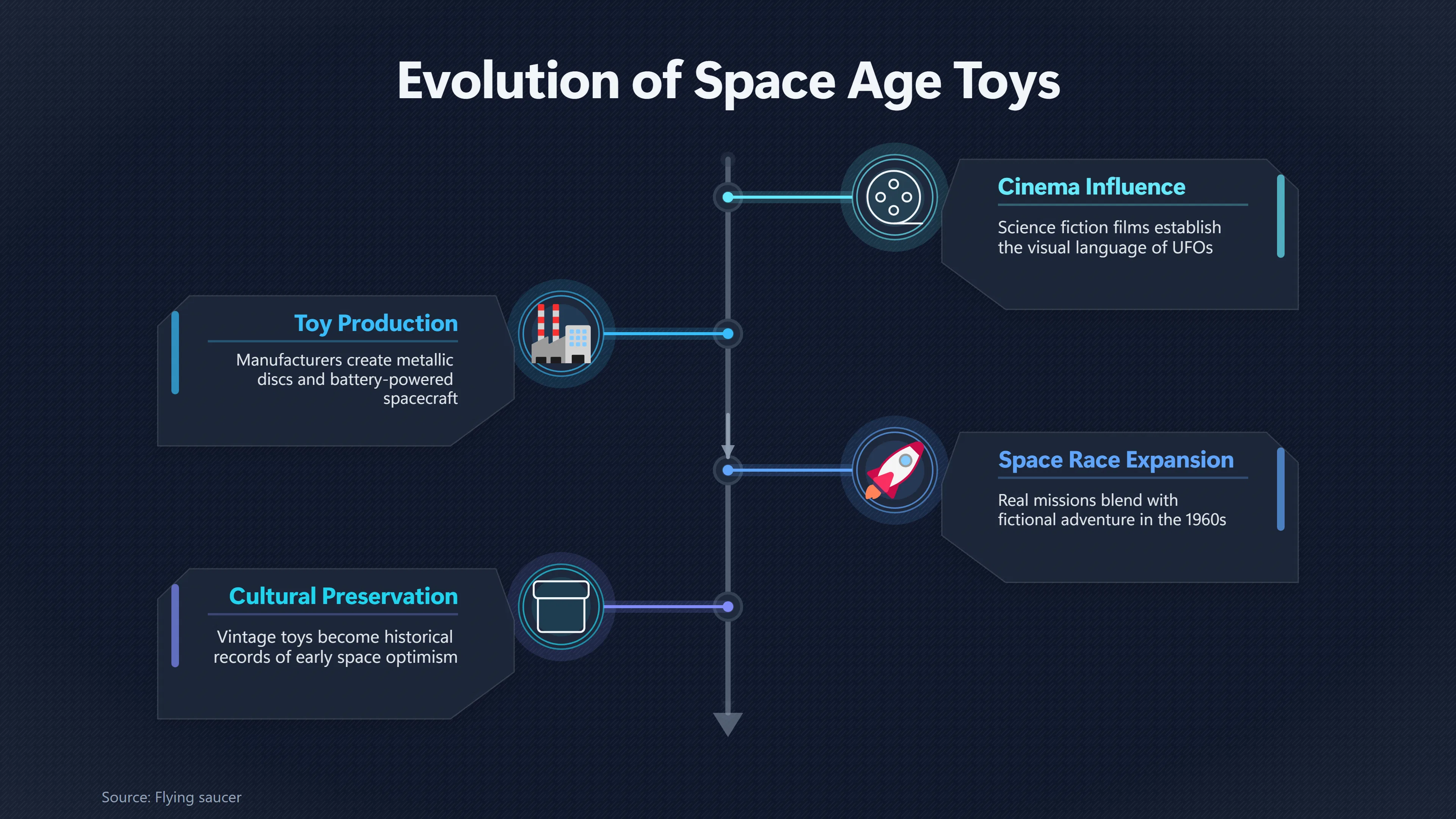
Flying saucer toys helped turn UFO imagery from a screen spectacle into a hands-on part of childhood culture. When children played with small metallic discs, battery-powered spacecraft and futuristic space playsets in the 1950s and 1960s, they were not simply copying films; they were experimenting with ideas about exploration, alien worlds and advanced technology. Toys gave the flying saucer a new role: instead of appearing only as a mysterious object arriving from the sky, it became something children could hold, launch, collect and use to create their own science-fiction stories.
The spread of saucer toys followed the wider popularity of UFO imagery in post-war popular culture. Manufacturers used the recognisable disc shape because it immediately communicated “space age” excitement, while children supplied the missing stories themselves. Collections of vintage space toys show how manufacturers, especially in Japan and the United States, produced a wide variety of robots, rockets and flying saucers during the decades when public fascination with space exploration was at its height.[House on the Hill Museum]houseonthehillmuseum.co.ukrobots space toysHouse on the Hill MuseumRobots & Space Toysthe favourite toy of the 1950's was the Robot. and the 1960's. Japanese manufacturers produced…
Space toys in the 1950s and 1960s
The flying saucer became a successful toy subject because it sat between two powerful childhood ideas: adventure and the unknown. A rocket suggested a human mission with a clear destination, but a saucer suggested something stranger — a visitor, a discovery or a machine with technology beyond ordinary experience. This made it especially useful for imaginative play connected to science fiction.
From cinema screens to toy rooms
The toy industry quickly absorbed the visual language created by science-fiction films and illustrations. During the 1950s, disc-shaped spacecraft appeared alongside other futuristic toys as manufacturers responded to public interest in UFO reports, space travel and alien stories. Flying saucers became part of a wider group of “space age” playthings that included robots, rockets and experimental vehicles.[Wikipedia]WikipediaFlying saucerFlying saucer
Japanese tin-toy manufacturers became particularly important in this period. Companies produced brightly coloured, often battery-operated spacecraft with spinning mechanisms, lights and moving parts. These toys were designed less as accurate models of possible spacecraft and more as objects of wonder: a child could imagine that the saucer hovered, travelled between planets or carried unknown visitors. Collectors and museum displays of mid-century toys show the variety of saucer designs produced during this era, from simple tin discs to more elaborate futuristic vehicles.[House on the Hill Museum]houseonthehillmuseum.co.ukrobots space toysHouse on the Hill MuseumRobots & Space Toysthe favourite toy of the 1950's was the Robot. and the 1960's. Japanese manufacturers produced…
The 1960s space race expanded the appeal of these toys. As real spacecraft missions became regular news events, children encountered a mixture of genuine exploration and fictional adventure. Space toys such as Mattel’s Major Matt Mason range encouraged imaginative play around astronauts, lunar bases and alien encounters, showing how toy makers blended real space achievements with science-fiction ideas.[Space]space.comCelebrating its 60th anniversary, the Major Matt Mason series—featuring 6-inch astronaut action figures, moon bases, and alien allies—ori… Although not every space toy focused specifically on saucers, these products shared the same cultural environment in which flying saucers represented the possibilities of life beyond Earth and future technology.
Why saucers worked so well as children’s objects
The flying saucer’s simple shape gave it unusual flexibility. A child did not need detailed instructions to understand what it represented. A circular craft with a dome, flashing lights or unusual colours could become a friendly exploration vehicle one day and an alien invasion machine the next.
This openness was central to imaginative play. Unlike a realistic vehicle that might have a fixed purpose, a saucer could support many different stories. It could land on an invented planet, rescue astronauts, carry alien characters or become a mysterious object discovered in a backyard. The same qualities that made the saucer effective in science-fiction films — its unfamiliar design and sense of mystery — also made it valuable as a toy.
Collecting and preserving saucer toys
Today, flying saucer toys are valued not only as nostalgic objects but also as evidence of how science fiction entered everyday life. Collectors preserve examples of the period because they reveal the visual language of the early space age: chrome finishes, imagined control panels, alien motifs and optimistic visions of future technology.[Vintage Spacetoys]vintagespacetoys.comVintage Spacetoys AboutVintage SpacetoysAbout - Vintage Spacetoys26 Apr 2021 — filled with flying saucers from the 1950s and 1960s ・ battery operated space to…
What collectors look for
Vintage saucer toys are often judged by features that show their original design and cultural setting:
- Mechanical features: Battery operation, spinning parts, lights and sound effects demonstrate how manufacturers tried to make imagined technology feel real.
- Packaging and artwork: Boxes and advertisements often reveal the stories attached to the toy, showing alien planets, astronauts and futuristic cities.
- Manufacturing origin: Japanese tin toys from the 1950s and 1960s are especially significant because Japan became a major producer of futuristic toys during the period.[House on the Hill Museum]houseonthehillmuseum.co.ukrobots space toysHouse on the Hill MuseumRobots & Space Toysthe favourite toy of the 1950's was the Robot. and the 1960's. Japanese manufacturers produced…
- Condition and completeness: Original parts, working mechanisms and preserved packaging can greatly affect collector interest.
The collecting community has also helped keep less-famous designs visible. Many saucer toys were not linked to major film franchises, meaning their survival often depends on enthusiasts who document, repair and display them. Specialist collections of vintage space toys focus heavily on battery-operated saucers, robots, ships and rockets from the mid-century period.[Vintage Spacetoys]vintagespacetoys.comVintage Spacetoys AboutVintage SpacetoysAbout - Vintage Spacetoys26 Apr 2021 — filled with flying saucers from the 1950s and 1960s ・ battery operated space to…
From discarded toys to cultural artefacts
The changing status of saucer toys reflects a broader shift in how society views childhood objects. Toys once considered ordinary consumer goods can later become historical records of a particular moment. A 1950s saucer toy captures the optimism and uncertainty of the early space age: excitement about exploration existed alongside fascination with alien possibilities and unknown technologies.
Preserved examples also show that UFO imagery was not limited to films or television. The flying saucer became a household symbol, appearing in toy boxes, department stores and children’s bedrooms. Its influence came partly from repetition: the more often children encountered the shape in play, the more familiar and meaningful the image became.
The link between toys and science fiction
Flying saucer toys strengthened the relationship between UFO imagery and science fiction by allowing children to participate in the worlds they saw on screen. A film could present an alien craft as a dramatic arrival, but a toy transformed that craft into something interactive. Children became creators of their own science-fiction scenarios rather than only viewers.
This distinction matters because popular culture is shaped not just by media producers but also by audiences. Toys provided a bridge between professional storytelling and personal imagination. A child using a saucer toy could recreate a favourite film scene, invent a new alien civilisation or imagine a future in which space travel was ordinary.
The relationship worked in both directions. Science fiction gave toy makers a ready-made visual vocabulary, while toys helped preserve and spread that vocabulary among new generations. The flying saucer remained recognisable because it appeared repeatedly across different forms of culture: films, television, advertisements, games and physical objects that children could own.[Wikipedia]WikipediaFlying saucerFlying saucer
Ultimately, saucer toys mattered because they changed the meaning of the UFO image. The flying saucer was no longer only a mysterious object in the sky. In children’s hands, it became a tool for curiosity, storytelling and exploration — a small model of the larger science-fiction dream that humanity might one day encounter worlds beyond Earth.
Amazon book picks
Further Reading
Books and field guides related to How Flying Saucer Toys Shaped Childhood. Use these as the next step if you want deeper reading beyond the article.

The Visual Encyclopedia of Science Fiction
First published 1977. Subjects: Science fiction, Encyclopedias, Science-fiction, Dictionnaires anglais, Thèmes, motifs.
How to Fabricate Damn Near Anything
" ... takes readers through the basics of making parts from metal, plastic, or composites. When building custom cars or motorcycles, fabr...
The Big Book of Maker Skills (Popular Science)
Makers, get ready. This is your ultimate, must-have, tip-packed guide for taking your DIY projects to the next level—from basic wood- and...
The Encyclopedia of Science Fiction
Encompassing 4,360 entries that provide critical insight and biographical and bibliographical data, an updated edition of a popular scien...
eBay marketplace picks
Marketplace Samples
Live-tested eBay searches with available results related to this page.
Selected fromufo collectible oneBay.co.uk.
Endnotes
1.
Source: Wikipedia
Title: Flying saucer
Link:https://en.wikipedia.org/wiki/Flying_saucer
2.
Source: space.com
Link:https://www.space.com/entertainment/space-movies-shows/move-over-he-man-mattels-major-matt-mason-space-toys-could-still-be-blasting-off-for-hollywood
Source snippet
Celebrating its 60th anniversary, the Major Matt Mason series—featuring 6-inch astronaut action figures, moon bases, and alien allies—ori...
3.
Source: youtube.com
Link:https://www.youtube.com/watch?v=EK_2F3wNCvc
Source snippet
Space Giant Flying Saucer mint in Original Box Masudaya Japan 1960's...
4.
Source: youtube.com
Link:https://www.youtube.com/watch?v=jTPp0Akrv4E
Source snippet
STAR TEAM Star Hawk Flying Saucer Spaceship Zeroid Ideal Toys Zeroids Robots 1977 Space Toy...
5.
Source: houseonthehillmuseum.co.uk
Title: robots space toys
Link:https://houseonthehillmuseum.co.uk/opening-times-prices/robots-space-toys/
Source snippet
House on the Hill MuseumRobots & Space Toysthe favourite toy of the 1950's was the Robot. and the 1960's. Japanese manufacturers produced...
6.
Source: vintagespacetoys.com
Title: Vintage Spacetoys About
Link:https://vintagespacetoys.com/about/
Source snippet
Vintage SpacetoysAbout - Vintage Spacetoys26 Apr 2021 — filled with flying saucers from the 1950`s and 1960`s ・ battery operated space to...
7.
Source: uk.pinterest.com
Title: space toy flying saucers
Link:https://uk.pinterest.com/zapwow/space-toy-flying-saucers/
Source snippet
Toy Flying SaucersSPACE TOY 1960s. Ship 1960s Children's Toy Made In Hong Kong + Box. Vintage flying saucer toy advertisement, 1960s...
8.
Source: toyretailersassociation.co.uk
Link:https://www.toyretailersassociation.co.uk/50s/
9.
Source: uk.fabtintoys.com
Title: flying saucer
Link:https://uk.fabtintoys.com/flying-saucer/
Additional References
10.
Source: collectorsweekly.com
Link:https://www.collectorsweekly.com/toys/battery-operated
Source snippet
Collectors WeeklyVintage Battery Operated ToysThings that fly and float also lent themselves to battery power. Flying Saucer Battery Oper...
11.
Source: etsy.com
Link:https://www.etsy.com/uk/market/flying_saucer_vintage_toy
Source snippet
Flying Saucer Vintage ToyCheck out our flying saucer vintage toy selection for the very best in unique or custom, handmade pieces from ou...
12.
Source: etsy.com
Link:https://www.etsy.com/uk/market/vintage_flying_saucer_toy
13.
Source: etsy.com
Title: Battery Operated Vintage Toys
Link:https://www.etsy.com/market/battery_operated_vintage_toys?page=3
Source snippet
Page 3Explore nostalgic battery-operated vintage toys, from Japanese tin robots to classic cars. Find unique collectibles for enth...
14.
Source: youtube.com
Link:https://www.youtube.com/watch?v=bf8E1VD_3Cc
Source snippet
VINTAGE TOYS - PART #1 - MARX MYSTERY SPACE SHIP...
15.
Source: shop.nms.ac.uk
Link:https://shop.nms.ac.uk/products/amuseables-jellysaucer?srsltid=AfmBOooumOUBlKcgA-_2JRZw2uzfiTjBFdUcboDCGRGOxhJzj3G5yQdD
16.
Source: shop.sciencemuseum.org.uk
Link:https://shop.sciencemuseum.org.uk/
17.
Source: youtube.com
Link:https://www.youtube.com/watch?v=R6zltD4KFi0
18.
Source: youtube.com
Link:https://www.youtube.com/watch?v=OuQmEaqk40E
19.
Source: anythinginparticular.co.uk
Title: 1960s marx toys battery operated baby bulldozer made in hong kong
Link:https://anythinginparticular.co.uk/product/1960s-marx-toys-battery-operated-baby-bulldozer-made-in-hong-kong/