Within Extraterrestrial life
What if alien life looks nothing human?
Extraterrestrial fiction imagines life forms beyond human biology, from collective minds to planetary-scale intelligence.
On this page
- Beyond humanoid aliens
- Alternative forms of intelligence
- Searching for unfamiliar life
Page outline Jump by section
Introduction
Fictional aliens are most interesting when they stop looking like humans with different skin colours and start challenging the idea of what life, intelligence and communication can be. Science fiction has used extraterrestrial life forms as experiments in imagination: a planet-sized organism, a distributed consciousness, a species that experiences time differently, or an intelligence that exists through ecosystems rather than individual bodies. These creations matter because they test a central question behind UFO stories and science fiction alike: if humanity encountered another form of life, would we even recognise it as alive or intelligent?

Modern science fiction increasingly moves beyond the familiar humanoid alien. Works such as Stanisław Lem’s Solaris, Ted Chiang’s Story of Your Life and its film adaptation Arrival, and Jeff VanderMeer’s Annihilation imagine beings whose biology and thought processes do not fit human expectations. Their importance is not that they predict real aliens, but that they explore the limits of human understanding. This connects closely with astrobiology, where researchers also recognise that life elsewhere may not resemble Earth organisms in obvious ways and that scientists must avoid assuming humanity represents the universal model for life.[NASA Science]science.nasa.govScience Astrobiology Program OverviewNASA ScienceAstrobiology Program Overview - NASA ScienceJune 3, 2026…
Beyond humanoid aliens
For much of science fiction history, alien creatures were designed around human bodies. They walked upright, communicated through speech, formed societies similar to human ones and often represented familiar ideas such as invasion, friendship or rivalry. H. G. Wells’s The War of the Worlds already moved beyond a simple human-like visitor by depicting Martians as radically different organisms with unfamiliar anatomy and technology, helping establish the idea that extraterrestrial life could challenge human assumptions rather than simply mirror them.[Hachette UK]hachette.co.ukthe war of the worldsHachette UKThe War of the Worlds by H. G. Wells | Hachette UKNovember 14, 2019…
Later fiction pushed this further by asking whether intelligence requires a recognisable body at all.
The living world of Solaris
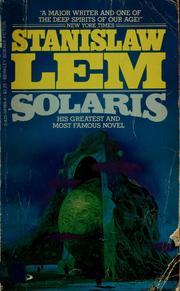
Stanisław Lem’s 1961 novel Solaris remains one of the strongest examples of a truly unfamiliar alien intelligence. Instead of presenting an alien creature that walks, speaks or builds machines, the novel focuses on a mysterious ocean covering an entire planet. Scientists debate whether this ocean is a single enormous living intelligence, but their attempts to communicate fail because they cannot determine whether its actions are messages, automatic processes or something beyond human interpretation.[The New Yorker]newyorker.comThe New Yorker The Beautiful Mind-Bending of Stanislaw LemThis blending of fiction with reality is a recurring theme in Lem's works, notably in his novel "Solaris," which explores a sentient ocea…
The importance of Solaris is that it changes the meaning of “first contact”. A meeting with alien life does not necessarily involve two individuals exchanging words. Contact might involve trying to understand an entity with a different scale of existence, different senses and different concepts of purpose. The story suggests that humanity’s greatest obstacle may not be distance between worlds, but the assumption that another intelligence must think in human categories.
Life without familiar bodies
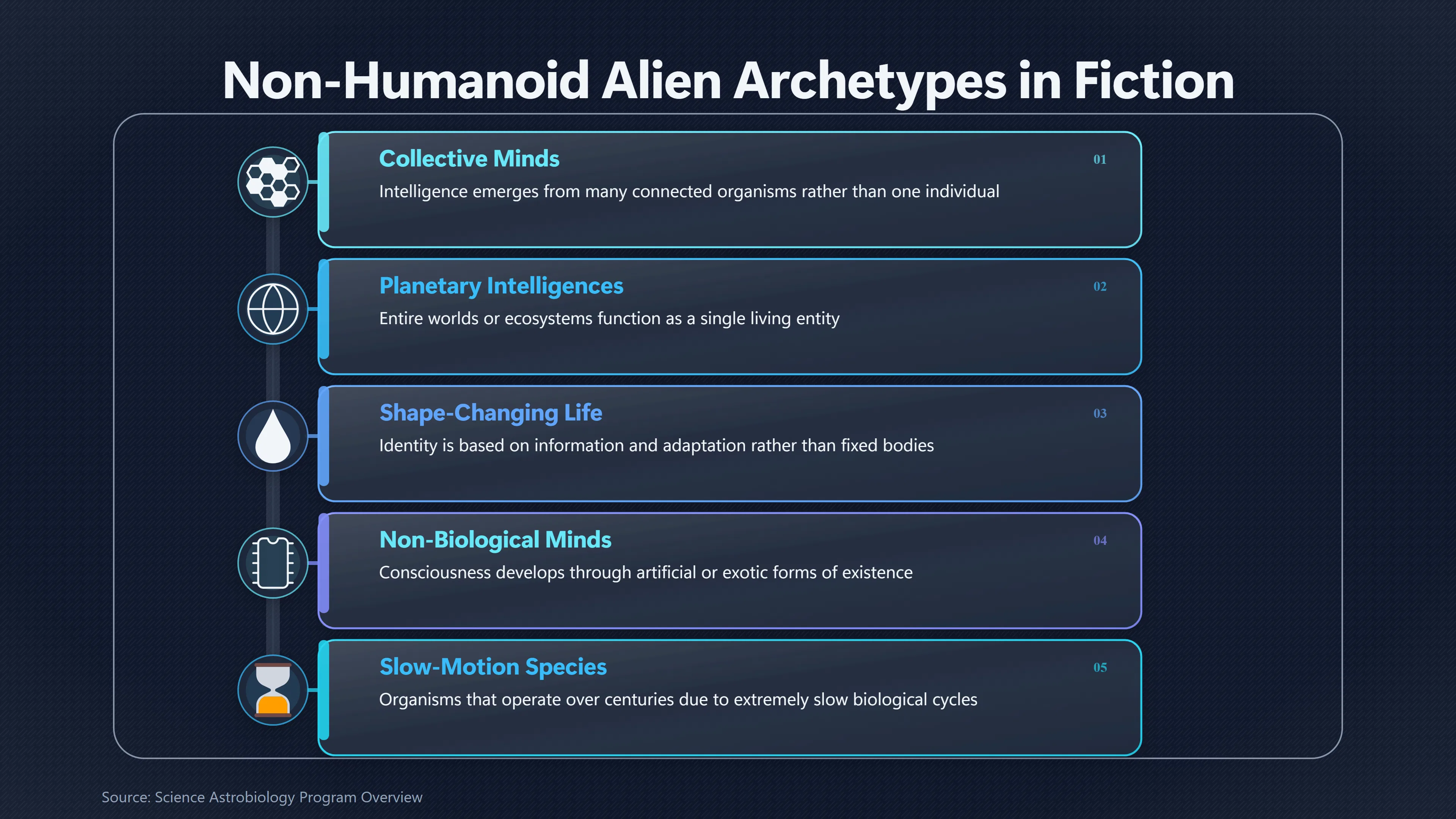
Other fictional aliens challenge the idea that an organism must have a single physical form. Science fiction has imagined:
- Collective minds, where intelligence emerges from many connected organisms rather than one individual.
- Planetary intelligences, where an entire world or ecosystem functions as a living entity.
- Shape-changing life forms, where identity is based on information, adaptation or transformation rather than a fixed body.
- Non-biological intelligences, where consciousness develops through artificial or exotic forms of existence.
These concepts are fictional, but they connect with real scientific questions about how broad the definition of life might become. Astrobiology examines life’s origins, evolution and possible distribution beyond Earth, including environments very different from modern Earth. Researchers study extreme environments on our own planet because they reveal how adaptable life can be.[NASA Science]science.nasa.govScience Space Biology and Astrobiology: What’s the difference?NASA ScienceSpace Biology and Astrobiology: What’s the difference? - NASA ScienceAugust 3, 2023…
Alternative forms of intelligence
The most challenging fictional aliens are often not the strangest-looking ones, but the ones whose minds work differently from ours. Science fiction uses these beings to explore whether intelligence must involve language, technology, emotion or individual identity.
The communication problem in Arrival
Denis Villeneuve’s Arrival, adapted from Ted Chiang’s short story Story of Your Life, focuses on aliens known as heptapods whose communication system is unlike human language. The story follows linguist Louise Banks as she attempts to understand their written symbols and avoid dangerous misunderstandings during first contact.[WIRED]wired.comarrival science fact fictionThe science of Arrival: what the film got right (and wrong) | WIREDNovember 12, 2016…
The heptapods are significant because they are not presented mainly as invaders or allies. Their unfamiliarity creates a scientific problem: humans must first understand how the aliens organise information before they can understand their intentions. The story treats language as a window into a different way of thinking rather than merely a tool for exchanging words.[WIRED]wired.comarrival science fact fictionThe science of Arrival: what the film got right (and wrong) | WIREDNovember 12, 2016…
This approach reflects a wider theme in alien fiction: intelligence may not share human priorities. A species might value cooperation, survival, creativity or knowledge in ways that humans cannot immediately recognise. The challenge of first contact would therefore involve interpretation, not just translation.
Intelligence beyond individuals
Many fictional life forms question the assumption that intelligence belongs to separate individuals. A human perspective usually begins with the idea of a person: one body, one mind and one identity. Alien fiction often removes those boundaries.
Examples include:
- A civilisation where individuals are temporary parts of a larger consciousness.
- Organisms that communicate through chemical signals, environmental changes or shared memory.
- Species that operate over centuries because their bodies or societies change extremely slowly.
- Minds that perceive time differently from humans.
These ideas are valuable because they expose a limitation in human thinking. On Earth, intelligence already appears in many forms, from social insect colonies to complex animal behaviour, even though none perfectly matches human consciousness. Fiction extends that uncertainty into imagined worlds and asks what other patterns intelligence could take.
Searching for unfamiliar life
Science fiction often influences how people imagine the search for extraterrestrial life, but the relationship also works in the other direction: discoveries about Earth and other worlds expand the range of alien possibilities writers explore.
From Earth-like planets to stranger possibilities
The scientific search for life beyond Earth does not assume that another planet must contain creatures resembling humans. NASA’s astrobiology programmes study how life emerged and evolved on Earth while investigating where life might exist elsewhere, including environments such as Mars and icy moons with possible subsurface oceans.[NASA]nasa.gov’s Search for Life: Astrobiology in the Solar System and BeyondNASA’s Search for Life: Astrobiology in the Solar System and Beyond - NASAJune 25, 2021…
This uncertainty creates space for fiction to explore unfamiliar possibilities. A planet with different chemistry, gravity, atmosphere or history could produce organisms unlike anything humans have encountered. Even Earth itself demonstrates that life can occupy extreme environments and follow many evolutionary paths.[NASA Science]science.nasa.govScience Space Biology and Astrobiology: What’s the difference?NASA ScienceSpace Biology and Astrobiology: What’s the difference? - NASA ScienceAugust 3, 2023…

The alien as a test of human assumptions
A major theme across fictional alien life forms is that humans may be limited by their own biology and culture when imagining the universe. A recent discussion in astrobiology and related fields has considered whether intelligence might leave signs that are not obvious technological signals, expanding ideas about what evidence of another intelligence could look like.[Space]space.comAre we overlooking signs of alien life that aren't technological or biological?Bread would be a signature of intelligence'July 27, 2026 — This article explores expanding the search for extraterrestrial intelligence…
Science fiction uses this uncertainty creatively. A fictional alien does not need to be a green humanoid, a monster or a superior civilisation. It can be something that forces humans to rethink the boundaries between life, intelligence and communication.
The most memorable alien species are therefore not necessarily the most powerful or frightening. They are the ones that make familiar concepts unstable: a mind without a body, a society without individuals, a language without human assumptions, or a living system so different that understanding it becomes the central adventure. Fiction’s greatest contribution to extraterrestrial questions is not imagining what aliens might look like, but asking what humanity might fail to recognise when it finally encounters something truly unfamiliar.
Amazon book picks
Further Reading
Books and field guides related to What if alien life looks nothing human?. Use these as the next step if you want deeper reading beyond the article.
The War of the Worlds
The War of the Worlds (1898), by H. G. Wells, is an early science fiction novel which describes an invasion of England by aliens from Mar...
Solaris
Rating: 3.9/5 from 28 Google Books ratings
First published 1961. Subjects: Translations into English, English fiction, Polish Science fiction, Polish fiction, Translations from Pol...
The Left Hand of Darkness
Rating: 4.0/5 from 13 Google Books ratings
50TH ANNIVERSARY EDITION—WITH A NEW INTRODUCTION BY DAVID MITCHELL AND A NEW AFTERWORD BY CHARLIE JANE ANDERS Ursula K. Le Guin’s groundb...
Blindsight
Rating: 4.1/5 from 67 Google Books ratings
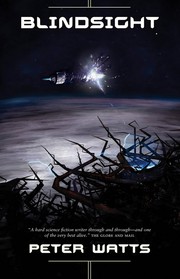
Blindsight is a hard science fiction novel by Canadian writer Peter Watts, published by Tor Books in 2006. It won the Seiun Award for bes...
eBay marketplace picks
Marketplace Samples
Live-tested eBay searches with available results related to this page.
Selected fromsci fi poster oneBay.co.uk.
Endnotes
1.
Source: science.nasa.gov
Title: Science Astrobiology Program Overview
Link:https://science.nasa.gov/astrobiology/program-overview/
Source snippet
NASA ScienceAstrobiology Program Overview - NASA ScienceJune 3, 2026...
Published: June 3, 2026
2.
Source: astrobiology.nasa.gov
Title: Astrobiology Alternative Earths | News | Astrobiology
Link:https://astrobiology.nasa.gov/news/alternative-earths/
3.
Source: hachette.co.uk
Title: the war of the worlds
Link:https://www.hachette.co.uk/titles/h-g-wells-6/the-war-of-the-worlds/9780751574760/
Source snippet
Hachette UKThe War of the Worlds by H. G. Wells | Hachette UKNovember 14, 2019...
Published: November 14, 2019
4.
Source: science.nasa.gov
Title: Science Space Biology and Astrobiology: What’s the difference?
Link:https://science.nasa.gov/biological-physical/stories/space-biology-and-astrobiology-whats-the-difference/
Source snippet
NASA ScienceSpace Biology and Astrobiology: What’s the difference? - NASA ScienceAugust 3, 2023...
Published: August 3, 2023
5.
Source: wired.com
Title: arrival science fact fiction
Link:https://www.wired.com/story/arrival-science-fact-fiction/
Source snippet
The science of Arrival: what the film got right (and wrong) | WIREDNovember 12, 2016...
Published: November 12, 2016
6.
Source: nasa.gov
Title: ’s Search for Life: Astrobiology in the Solar System and Beyond
Link:https://www.nasa.gov/missions/nasas-search-for-life-astrobiology-in-the-solar-system-and-beyond/
Source snippet
NASA’s Search for Life: Astrobiology in the Solar System and Beyond - NASAJune 25, 2021...
Published: June 25, 2021
7.
Source: space.com
Title: Are we overlooking signs of alien life that aren’t technological or biological?
Link:https://www.space.com/space-exploration/search-for-life/are-we-overlooking-signs-of-alien-life-that-arent-technological-or-biological-bread-would-be-a-signature-of-intelligence
Source snippet
'Bread would be a signature of intelligence'July 27, 2026 — This article explores expanding the search for extraterrestrial intelligence...
Published: July 27, 2026
8.
Source: astrobiology.nasa.gov
Link:https://astrobiology.nasa.gov/research/
9.
Source: science.nasa.gov
Title: can we find life
Link:https://science.nasa.gov/exoplanets/can-we-find-life/
10.
Source: science.nasa.gov
Title: finding life beyond earth what comes next
Link:https://science.nasa.gov/universe/search-for-life/finding-life-beyond-earth-what-comes-next/?linkId=256353932
11.
Source: science.nasa.gov
Title: life on other planets what is life and what does it need
Link:https://science.nasa.gov/universe/search-for-life/life-on-other-planets-what-is-life-and-what-does-it-need/
12.
Source: astrobiology.nasa.gov
Link:https://astrobiology.nasa.gov/about/
13.
Source: jpl.nasa.gov
Title: our living planet shapes the search for life beyond earth
Link:https://www.jpl.nasa.gov/news/our-living-planet-shapes-the-search-for-life-beyond-earth/
14.
Source: wired.com
Title: arrivals designers crafted mesmerizing alien alphabet
Link:https://www.wired.com/2016/11/arrivals-designers-crafted-mesmerizing-alien-alphabet/
15.
Source: astrobiology.nasa.gov
Title: one planet but many different earths
Link:https://astrobiology.nasa.gov/news/one-planet-but-many-different-earths/
16.
Source: wired.com
Title: solaris 2
Link:https://www.wired.com/2002/12/solaris-2/
17.
Source: science.jpl.nasa.gov
Link:https://science.jpl.nasa.gov/projects/icyworlds/
18.
Source: english.lem.pl
Title: pl Stanisław Lem
Link:https://english.lem.pl/works/novels/solaris/2-introduction-solaris
19.
Source: newyorker.com
Title: The New Yorker The Beautiful Mind-Bending of Stanislaw Lem
Link:https://www.newyorker.com/culture/culture-desk/the-beautiful-mind-bending-of-stanislaw-lem
Source snippet
This blending of fiction with reality is a recurring theme in Lem's works, notably in his novel "Solaris," which explores a sentient ocea...
20.
Source: archania.org
Link:https://archania.org/p/the-symbolic-world/symbolic-works/film/annihilation
Source snippet
July 11, 2026 — ANNIHILATION Folder: `the-symbolic-world/symbolic-works/film` Last updated: 2026-07-11 Revisions: 8 Annihilation --- Imag...
Published: July 11, 2026
21.
Source: archania.org
Link:https://archania.org/p/the-symbolic-world/symbolic-works/film/arrival
22.
Source: archania.org
Link:https://archania.org/p/the-symbolic-world/symbolic-works/literature/solaris
23.
Source: hachette.co.uk
Title: the war of the worlds
Link:https://www.hachette.co.uk/titles/h-g-wells-6/the-war-of-the-worlds/9780751574753/
24.
Source: penguin.co.uk
Title: The War of the Worlds
Link:https://www.penguin.co.uk/books/183685/the-war-of-the-worlds-by-wells-h-g/9780241387160
25.
Source: mediascot.org
Link:https://www.mediascot.org/atmosphere/arrival/extra
26.
Source: fivebooks.com
Link:https://fivebooks.com/book/solaris/
Additional References
27.
Source: youtube.com
Title: Annihilation ENDING EXPLAINED
Link:https://www.youtube.com/watch?v=vdAfah15V-Y
Source snippet
This collection of videos directly explores non-humanoid alien life forms, complex extraterrestrial biological concepts, and non-linear i...
28.
Source: youtube.com
Title: This Alien Ocean Reads Your Mind | “Solaris” by Stanisław Lem
Link:https://www.youtube.com/watch?v=v2HUBBywD3g
Source snippet
The [Alien Language]({{ 'alien-language/' | relative_url }}) in Arrival EXPLAINED || Heptapod B...
29.
Source: youtube.com
Title: What would alien life actually look like? | BBC Ideas
Link:https://www.youtube.com/watch?v=PPewLIo4k5A
Source snippet
This Alien Ocean Reads Your Mind | "Solaris" by Stanisław Lem...
30.
Source: youtube.com
Title: The Alien Language in Arrival EXPLAINED || Heptapod B
Link:https://www.youtube.com/watch?v=HTWOJtEPjDk
Source snippet
Annihilation ENDING EXPLAINED - Details You Missed...
31.
Source: projectblackecho.com
Link:https://www.projectblackecho.com/aliens/civilizations/hive-mind-[alien-civilizations
32.
Source: cambridge.org
Link:https://www.cambridge.org/core/journals/international-journal-of-astrobiology/article/intelligence-as-a-planetary-scale-process/5077C784D7FAC55F96072F7A7772C5E5
33.
Source: audible.com
Link:https://www.audible.com/blog/summary-the-war-of-the-worlds-by-h-g-wells/
34.
Source: en-academic.com
Link:https://en-academic.com/dic.nsf/enwiki/1053617/
35.
Source: everything.explained.today
Link:https://everything.explained.today/Group_mind_%28science_fiction%29/
36.
Source: 5-24-184-213-static.uwm.edu.pl
Link:https://5-24-184-213-static.uwm.edu.pl/index.php/pl/article/view/7857