Within UFO encounter categories
How UFO Categories Changed Public Language
The close encounter scale changed how people describe UFO reports by separating observation from claims about causes.
On this page
- Creation of encounter terminology
- Spread into media and fiction
- Limits of classification systems
Page outline Jump by section
Introduction
The close encounter scale changed the way people talked about UFO reports by turning vague stories of “sightings” into a shared vocabulary for describing different levels of claimed experience. Developed by astronomer J. Allen Hynek, the system classified reports according to what witnesses said they observed — from seeing an unusual object to reporting physical effects or apparent occupants — without claiming to identify the cause. Its lasting influence came from this separation between description and explanation: a “Close Encounter of the Third Kind” describes a type of report, not proof of extraterrestrial visitors.[Center for UFO Studies]cufos.orgCenter for UFO Studies Classification SystemsCenter for UFO StudiesClassification Systems - Center for UFO Studies…
The terminology became especially influential because it crossed from UFO investigation into science fiction and popular culture. The phrase “close encounter of the third kind” became widely recognised after Steven Spielberg’s 1977 film of the same name, helping a specialist classification system become everyday language.[IMDb]imdb.comClose Encounters of the Third Kind (1977) - IMDbDecember 14, 1977… The result was a rare case where an investigative framework did not simply organise reports; it reshaped how millions of people imagined contact with the unknown.
Creation of encounter terminology
Hynek’s solution: describe the report before explaining it
J. Allen Hynek created the close encounter categories while working on UFO investigations connected with the United States Air Force, later presenting the system in his 1972 book The UFO Experience: A Scientific Inquiry. His purpose was to organise reports more consistently and provide a way to discuss unusual observations without immediately deciding what they represented.[Center for UFO Studies]cufos.orgCenter for UFO Studies Classification SystemsCenter for UFO StudiesClassification Systems - Center for UFO Studies…
The importance of the system was not that it offered a scale of “how alien” an event was. Instead, it created a scale of reported involvement:
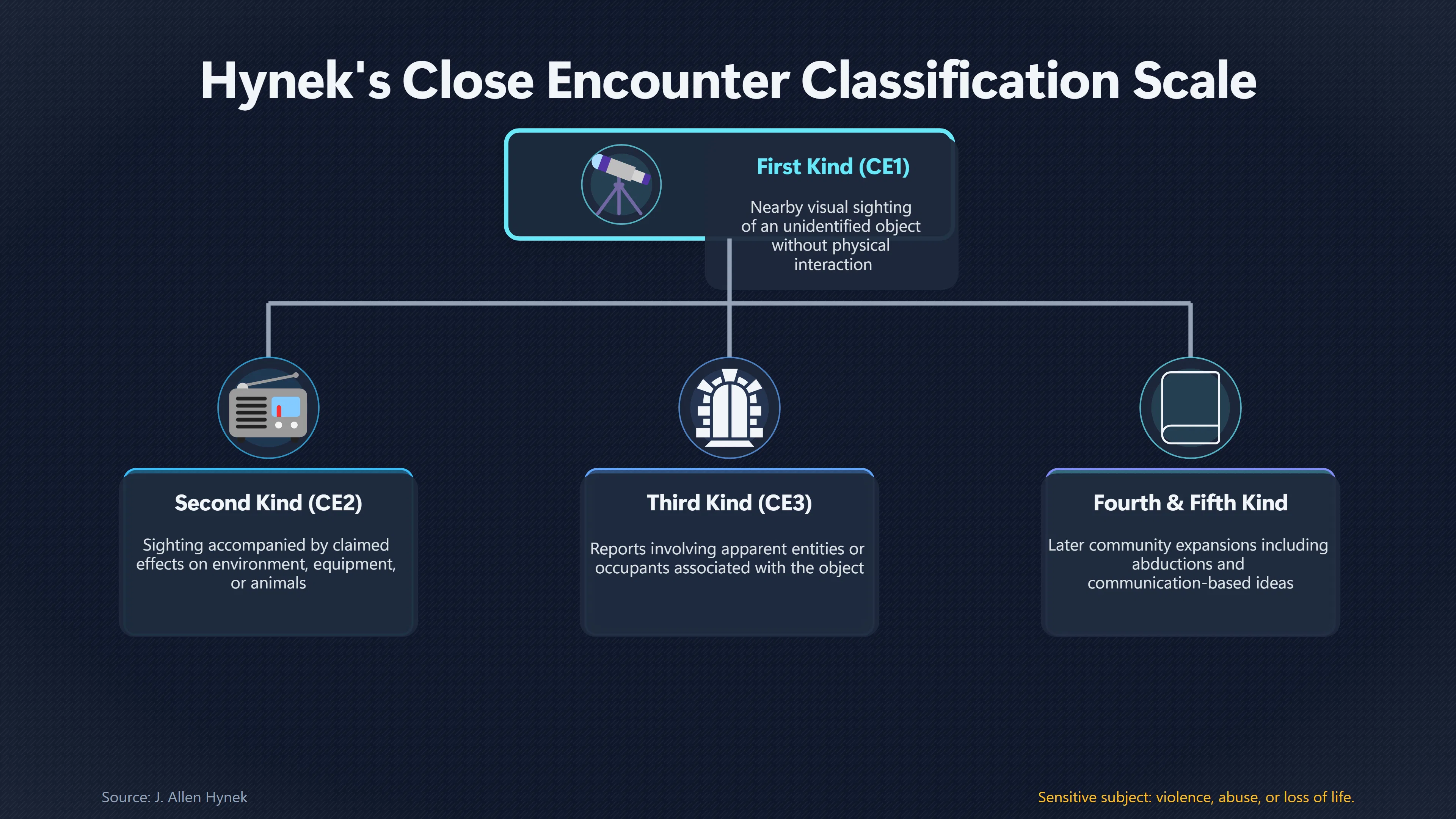
- Close Encounter of the First Kind (CE1): a nearby visual sighting of an unidentified object, with no reported physical interaction.
- Close Encounter of the Second Kind (CE2): a sighting accompanied by claimed effects on the environment, equipment, animals or witnesses.
- Close Encounter of the Third Kind (CE3): a report involving apparent entities or occupants associated with the object.[Center for UFO Studies]cufos.orgCenter for UFO Studies Classification SystemsCenter for UFO StudiesClassification Systems - Center for UFO Studies…
This structure changed public discussion because it gave people a way to distinguish between very different claims. A person reporting a strange light in the sky and a person reporting an encounter with an occupant were no longer described using the same broad label. The terminology introduced levels of narrative involvement while leaving the question of cause unresolved.[Archania]archania.orgJ. Allen HynekJ. Allen HynekMay 25, 2026…
That distinction mattered because UFO debates often mixed together observation, interpretation and belief. Encounter terminology created a middle ground: a report could be recorded as a CE3 claim without requiring investigators or audiences to accept an extraterrestrial explanation. In this sense, the system functioned as a classification language rather than a conclusion about reality.[Center for UFO Studies]cufos.orgCenter for UFO Studies Classification SystemsCenter for UFO StudiesClassification Systems - Center for UFO Studies…
Why the wording became powerful
The word “encounter” itself changed the tone of UFO discussions. Earlier descriptions often focused on objects, sightings or unexplained aerial phenomena. “Encounter” suggested a relationship between witness and phenomenon: something had not merely been seen, but experienced.
This made the terminology particularly useful for science fiction. Stories about alien contact often depend on increasing stages of involvement — discovery, interaction, communication and transformation. Hynek’s categories provided a ready-made vocabulary for those narrative stages, even though they were originally designed for organising reports rather than writing fiction.[Exopaedia]exopaedia.orgHynek, Joseph AllenExopaedia:: Hynek, Joseph Allen…
Spread into media and fiction
The phrase that entered everyday culture
The biggest cultural turning point came with Spielberg’s Close Encounters of the Third Kind (1977). The film borrowed Hynek’s terminology directly, bringing the phrase from UFO research into mainstream entertainment. Hynek was involved as a consultant and appeared briefly in the film, further connecting the scientific-sounding language with popular audiences.[Biography]biography.comJ. Allen HynekBiographyJ. Allen Hynek - Project Blue Book, Quotes & Facts
The film also influenced how audiences understood the idea of alien contact. Instead of presenting an encounter only as an invasion or threat, it framed contact as a moment of communication and curiosity. The phrase “third kind” became shorthand for the most dramatic imagined step: not simply seeing something unknown, but meeting another intelligence.[Turner Classic Movies]tcm.comTurner Classic Movies Pop Culture 101Turner Classic MoviesPop Culture 101 - Close Encounters of the Third KindDecember 30, 2011…
The wider effect was that encounter terminology became a bridge between UFO culture and science fiction. Writers, filmmakers and audiences could use the language as a narrative shorthand:
- A first-kind encounter represented discovery and uncertainty.
- A second-kind encounter introduced consequences and physical evidence.
- A third-kind encounter represented direct contact with another being.
Science fiction did not simply copy the classification system; it transformed it into a storytelling framework. The categories became less about documenting reports and more about exploring human reactions to possible contact.

Later expansions changed the meaning again
After Hynek’s original three categories became popular, later writers expanded encounter terminology. Additional categories, including abduction-focused “fourth kind” encounters and communication-based “fifth kind” ideas, circulated within UFO communities. These additions were not part of Hynek’s original three-level system and became more associated with later interpretations of encounter experiences.[Center for UFO Studies]cufos.orgCenter for UFO Studies Classification SystemsCenter for UFO StudiesClassification Systems - Center for UFO Studies…
This expansion shows both the strength and weakness of the language. The categories were memorable enough to grow beyond their original purpose, but that popularity also made the terminology less precise. New meanings accumulated around familiar phrases, sometimes blurring the distinction between a classification of a claim and acceptance of the claim itself.
Limits of classification systems
Categories organise reports, not causes
The main limitation of encounter terminology is that it describes what a witness reports, not what actually happened. A CE2 label, for example, does not establish that an object caused physical effects; it records that a witness or investigator placed the report into that category. Likewise, a CE3 label does not demonstrate the existence of extraterrestrial beings.[Archania]archania.orgJ. Allen HynekJ. Allen HynekMay 25, 2026…
This limitation is also what made the system useful. A classification framework can preserve information without prematurely resolving uncertainty. Researchers can compare different types of reports while keeping open multiple explanations, including misidentification, perception errors, environmental causes or genuinely unexplained observations.
The distinction is important because public language often moves faster than scientific interpretation. Once a term becomes familiar through films and media, audiences may attach stronger meanings to it than the original classification intended.
Popular language became more dramatic than the original framework
The phrase “close encounter of the third kind” is now often understood simply as “meeting aliens”, largely because of its association with science fiction. In Hynek’s system, however, it referred only to reports involving apparent entities connected with a UFO. The category did not settle whether those entities were extraterrestrial, psychological, mistaken observations or something else.[Center for UFO Studies]cufos.orgCenter for UFO Studies Classification SystemsCenter for UFO StudiesClassification Systems - Center for UFO Studies…
This gap between technical meaning and popular meaning illustrates a broader challenge in public science communication. Classifications are designed to simplify complex information, but simplified terms can gain cultural meanings that exceed their original boundaries.
Why the terminology still matters
Despite its limitations, the encounter scale remains influential because it changed the vocabulary available for discussing UFO reports. It allowed journalists, researchers, fictional creators and the public to talk about different kinds of experiences with more precision than a single category of “sighting”.
Its most lasting contribution was therefore linguistic rather than evidential. The close encounter scale did not prove a particular explanation for UFO reports, but it provided a durable way to describe how people claimed to experience the unknown — from observation, to physical interaction, to imagined contact with another intelligence. That language became one of the clearest points where UFO reporting and science fiction began shaping each other.[Center for UFO Studies]cufos.orgCenter for UFO Studies Classification SystemsCenter for UFO StudiesClassification Systems - Center for UFO Studies…
Amazon book picks
Further Reading
Books and field guides related to How UFO Categories Changed Public Language. Use these as the next step if you want deeper reading beyond the article.
The UFO Experience: A Scientific Inquiry
Cited by the New York Review of Books as "the best brief for visitation," this classic study presents an analysis of UFO reports and conc...
The Hynek UFO Report
The ultimate guide to Project Blue Book by one of the lead astronomers for the US Air Force program to investigate UFO sightings—and feat...
The Report on Unidentified Flying Objects
The Report on Unidentified Flying Objects, written by Captain Edward Ruppelt in 1956, was the first serious, unbiased account written abo...
UFOs: Generals, Pilots, and Government Officials Go on the Re...
NEW YORK TIMES BESTSELLER • Impeccably researched, this riveting journalistic investigation separates fact from fiction, and documents th...
eBay marketplace picks
Marketplace Samples
Live-tested eBay searches with available results related to this page.
Selected fromufo poster oneBay.co.uk.


Endnotes
1.
Source: imdb.com
Link:https://www.imdb.com/title/tt0075860/
Source snippet
Close Encounters of the Third Kind (1977) - IMDbDecember 14, 1977...
Published: December 14, 1977
2.
Source: biography.com
Title: J. Allen Hynek
Link:https://www.biography.com/scientists/[j-allen-hynek
Source snippet
J. Allen Hynek - Project Blue Book, Quotes & Facts...
3.
Source: exopaedia.org
Link:https://www.exopaedia.org/Encounters
Source snippet
Exopaedia:: Encounters...
4.
Source: archania.org
Title: J. Allen Hynek
Link:https://archania.org/p/individuals/scientists/astronomers/j-allen-hynek
Source snippet
J. Allen HynekMay 25, 2026...
Published: May 25, 2026
5.
Source: exopaedia.org
Title: Hynek, Joseph Allen
Link:https://www.exopaedia.org/Hynek%2C%2BJoseph%2BAllen
Source snippet
Exopaedia:: Hynek, Joseph Allen...
6.
Source: biography.com
Title: j allen hynek project blue book
Link:https://www.biography.com/scientists/a71083752/j-allen-hynek-project-blue-book
Source snippet
Allen Hynek and Project Blue Book: UFO Secrets RevealedApril 21, 2026 — WHO WAS J. ALLEN HYNEK? Image: Denver Post Archives Denver Post//...
Published: April 21, 2026
7.
Source: ufo.at
Title: alt.alien.visitors Frequently Asked Questions
Link:https://www.ufo.at/ufo-faq.html
8.
Source: imdb.com
Link:https://www.imdb.com/title/tt0075860/?fc=1%3Bft%3D8%3Bfm%3D1
9.
Source: m.imdb.com
Link:https://m.imdb.com/title/tt0075860/
10.
Source: imdb.com
Link:https://www.imdb.com/de/title/tt0075860/
11.
Source: cufos.org
Title: Center for UFO Studies Classification Systems
Link:https://cufos.org/types-of-ufos/classification-systems/
Source snippet
Center for UFO StudiesClassification Systems - Center for UFO Studies...
12.
Source: cufos.org
Title: Center for UFO Studies About Us
Link:https://cufos.org/about-us/
Source snippet
Center for UFO StudiesAbout Us - Center for UFO Studies...
13.
Source: tcm.com
Title: Turner Classic Movies Pop Culture 101
Link:https://www.tcm.com/articles/467315/pop-culture-101-close-encounters-of-the-third-kind
Source snippet
Turner Classic MoviesPop Culture 101 - Close Encounters of the Third KindDecember 30, 2011...
Published: December 30, 2011
14.
Source: en.wikiquote.org
Title: Close Encounters Of The Third Kind
Link:https://en.wikiquote.org/wiki/Close_Encounters_Of_The_Third_Kind
15.
Source: culture.fandom.com
Title: Close Encounters of the Third Kind
Link:https://culture.fandom.com/wiki/Close_Encounters_of_the_Third_Kind
16.
Source: rottentomatoes.com
Title: Close Encounters of the Third Kind | Rotten Tomatoes
Link:https://www.rottentomatoes.com/m/close_encounters_of_the_third_kind
17.
Source: books.google.com
Title: The UFO Experience
Link:https://books.google.com/books/about/The_UFO_Experience.html?id=joJTAAAAMAAJ
18.
Source: openlibrary.org
Title: The UFO experience
Link:https://openlibrary.org/books/OL13688097M/The_UFO_experience
19.
Source: openlibrary.org
Title: The Ufo Experience
Link:https://openlibrary.org/books/OL7977758M/The_Ufo_Experience
20.
Source: openlibrary.org
Title: The UFO experience
Link:https://openlibrary.org/books/OL2205291M/The_UFO_experience
21.
Source: daviddarling.info
Link:https://www.daviddarling.info/encyclopedia/H/Hynek.html
22.
Source: ultimatepopculture.fandom.com
Title: Close Encounters of the Third Kind
Link:https://ultimatepopculture.fandom.com/wiki/Close_Encounters_of_the_Third_Kind
Additional References
23.
Source: time.com
Link:https://time.com/5015537/close-encounters-of-the-third-kind-1977/
Source snippet
Extreme secrecy surrounded its production to maintain the element of surprise. Critics acknowledged the movie's complexity even if it was...
24.
Source: youtube.com
Title: Hynek’s Scale
Link:https://www.youtube.com/watch?v=RLfRtygVlgk
Source snippet
J Allen Hynek Close Encounters scale UFO science fiction What If You Have A Close Encounter Of The Third Kind? | Unveiled Unveiled...
25.
Source: youtube.com
Link:https://www.youtube.com/watch?v=63yGG-lMpmE
Source snippet
Science Fiction's Influence on UFO Pop Culture...
26.
Source: youtube.com
Title: What If You Have A Close Encounter Of The Third Kind?
Link:https://www.youtube.com/watch?v=L043-gQmdZA
Source snippet
Film Crew Comments, Dr. Allen Hynek (Making of Close Encounters of the Third Kind)...
27.
Source: youtube.com
Title: Science Fiction’s Influence on UFO Pop Culture
Link:https://www.youtube.com/watch?v=cGtPAOJSTEo
Source snippet
Pop Culture's Impact On UFO's Ahead Of US Intelligence Report...
28.
Source: stason.org
Link:https://stason.org/TULARC/new-age/alien-visitors/1-05-Classification-of-UFO-Reports.html
29.
Source: ufo-database.blogspot.com
Link:https://ufo-database.blogspot.com/2009/03/close-encounter-classification-system.html
30.
Source: sonypictures.com
Link:https://www.sonypictures.com/movies/closeencountersofthethirdkind
31.
Source: paranormal-encyclopedia.com
Link:https://www.paranormal-encyclopedia.com/u/ufo/close-encounters/first-kind.html
32.
Source: goodreads.com
Link:https://www.goodreads.com/work/editions/699401-the-ufo-experience-a-scientific-inquiry