Within Cold War alien
How Nuclear Fears Created Monster Aliens
Science fiction linked extraterrestrial threats with atomic testing, radiation fears and worries about science escaping human control.
On this page
- Atomic science in science fiction
- Radiation and mutation stories
- The UFO age and nuclear anxiety
Page outline Jump by section
Introduction
Cold War science fiction often turned nuclear science into a source of alien danger because the atomic age created a new fear: that humanity’s greatest scientific achievement might also become its greatest threat. In films, novels and popular culture, extraterrestrials were frequently linked with atomic testing, radiation, mutation and uncontrolled technological power. The alien was not only a visitor from another planet; it became a way to imagine what might happen when scientific progress moved faster than human understanding.[Encyclopedia.com]encyclopedia.comScience Fiction Films and Cold War Anxiety | Encyclopedia.comJune 24, 2026…

This connection shaped some of the most memorable science fiction of the 1950s. Stories such as The Day the Earth Stood Still (1951), Them! (1954) and Godzilla (1954) used space visitors or monstrous transformations to explore anxiety about nuclear weapons and the possibility that experiments with atomic energy could create consequences beyond human control.[loc.gov]loc.govThe Library of Congress The day the earth stood still | Library of CongressThe Library of CongressThe day the earth stood still | Library of CongressJanuary 1, 2002… The key mechanism was simple but powerful: science fiction made invisible dangers — radiation, fallout and technological escalation — visible through creatures, invasions and encounters with the unknown.
Atomic science in science fiction
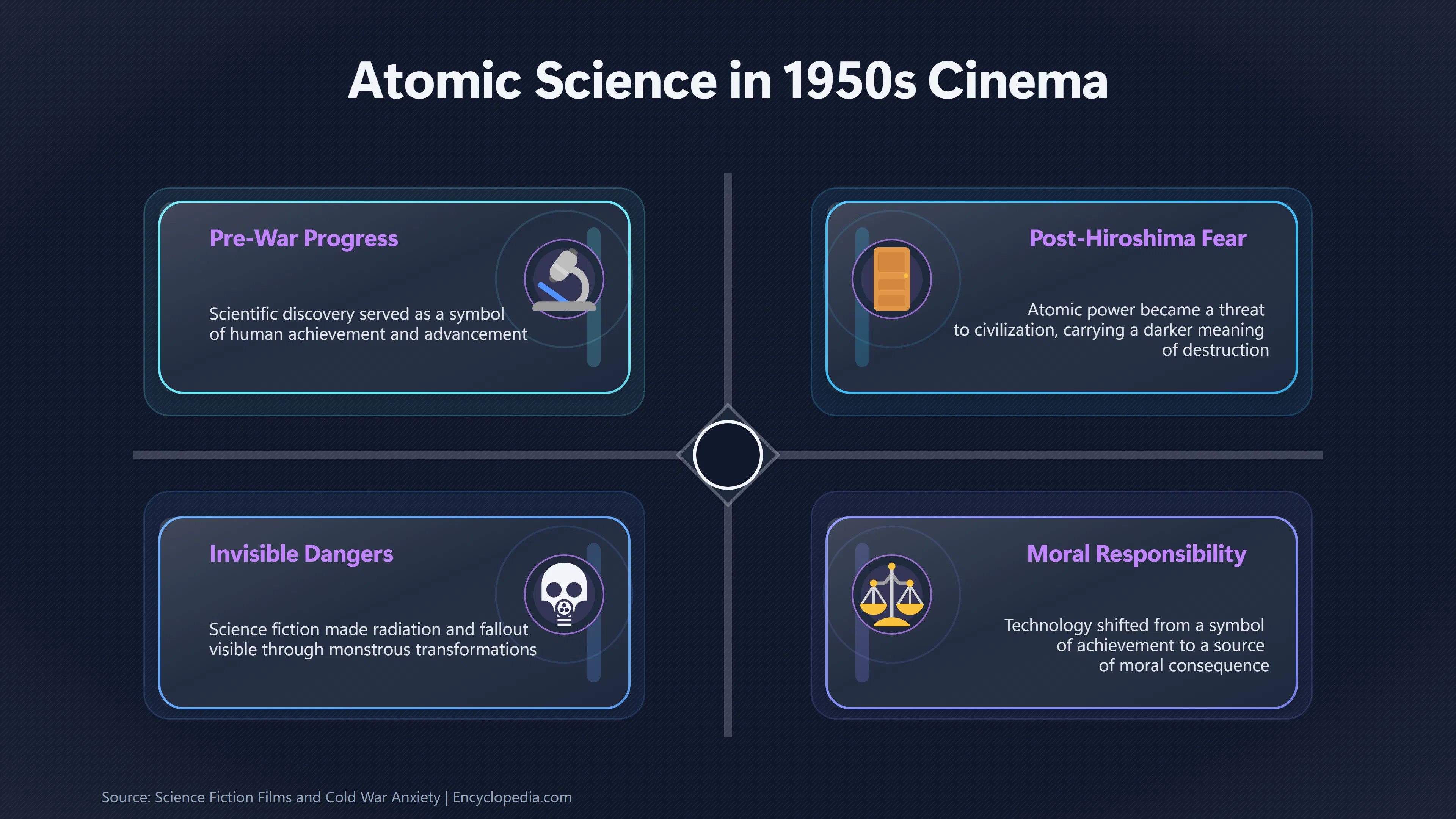
The atomic bomb changed the role of science in public imagination. Before the Second World War, scientific discovery was often presented as a symbol of progress and human achievement. After Hiroshima and Nagasaki, scientific power carried a darker meaning: experts could unlock forces that threatened civilisation itself. Cold War science fiction transformed this tension into stories about alien contact, scientific experiments and unexpected consequences.[Encyclopedia.com]encyclopedia.comScience Fiction Films and Cold War Anxiety | Encyclopedia.comJune 24, 2026…
The alien became a useful symbol because extraterrestrial life represented the ultimate unknown. A visitor from another world could stand for a foreign enemy, a technological rival or the consequences of human experimentation. Unlike ordinary war stories, science fiction could ask larger questions: what happens when a species develops weapons it cannot safely control? What if scientific advancement creates dangers that no government can contain?
The Day the Earth Stood Still: the warning from beyond Earth
One of the clearest examples came from The Day the Earth Stood Still. Instead of presenting aliens as monsters, the film introduced Klaatu, an extraterrestrial messenger who arrives on Earth with a warning about humanity’s destructive use of nuclear weapons. The film’s central conflict is not an alien attack but humanity’s inability to overcome fear and militarism.[The Library of Congress]loc.govThe Library of Congress The day the earth stood still | Library of CongressThe Library of CongressThe day the earth stood still | Library of CongressJanuary 1, 2002…
This reversed the usual invasion story. The alien was not the threat; human technology was. The film suggested that a civilisation capable of reaching the atomic age also had to develop the wisdom to survive it. In this sense, extraterrestrials became a moral outside perspective — a fictional observer who could expose the dangers created by human science.
Radiation and mutation stories
A different branch of atomic science fiction imagined nuclear technology escaping into the natural world. Instead of aliens arriving from space, Earth itself produced strange creatures because atomic experiments had altered the environment. These stories reflected uncertainty about radiation, fallout and the long-term effects of nuclear testing.
The mechanism was often biological transformation: radiation changed ordinary animals into enormous, aggressive versions of themselves. While these ideas were scientifically inaccurate, they captured a genuine public concern about invisible contamination and the difficulty of understanding nuclear risks.
Them! and the fear of scientific consequences
Them! became one of the defining examples of atomic mutation cinema. The film presents giant ants created by radiation from nuclear testing in the New Mexico desert. Rather than showing a simple monster attack, it links the creatures directly to human scientific activity: the danger exists because people released forces they did not fully understand.[BFI]bfi.org.ukOpen source on bfi.org.uk.
The film’s impact came from making nuclear anxiety concrete. Radiation itself could not be seen, but giant insects gave audiences a physical representation of what uncontrolled atomic power might mean. The monsters were not an enemy nation’s weapon; they were a consequence of human decisions.
This theme appeared across the wider atomic monster cycle of the 1950s. Creatures became symbols of unintended consequences: nuclear testing, military competition and scientific experimentation could create threats that crossed borders and affected everyone.
Godzilla: the nuclear age as a living nightmare
The Japanese film Godzilla offered one of the most serious treatments of nuclear fear in science fiction cinema. The monster’s origin was tied to atomic weapons and radiation, reflecting Japan’s unique experience of nuclear destruction and the continuing fear of nuclear testing.[hta.ac]hta.acradiophobia myth cultural traumaYou Have Your Fear: Radiophobia, Myth and Cultural Trauma in Ishiro Honda’s Godzilla (1954) | Humanities & Technology Review…
Unlike some American atomic monster films that focused mainly on spectacle, Godzilla connected nuclear science with human suffering and environmental damage. The creature represented the consequences of decisions made by powerful institutions, especially when ordinary people had little control over those choices.[hta.ac]hta.acradiophobia myth cultural traumaYou Have Your Fear: Radiophobia, Myth and Cultural Trauma in Ishiro Honda’s Godzilla (1954) | Humanities & Technology Review…
The film showed how nuclear anxiety could take different forms across cultures. In the United States, atomic monsters often reflected fears about experiments and invasion. In Japan, the imagery carried additional weight because nuclear destruction was a lived historical experience rather than a distant possibility.
The UFO age and nuclear anxiety
The rise of UFO culture in the late 1940s and 1950s developed alongside fears about nuclear weapons and Cold War rivalry. Reports of strange objects in the sky appeared during a period when governments were testing advanced aircraft, developing nuclear arsenals and competing for technological superiority.[Smithsonian Air and Space Museum]airandspace.si.edureports ufos 1947 roswell incidentSmithsonian Air and Space MuseumReports of UFOs: 1947 Roswell Incident | National Air and Space MuseumOctober 20, 2016…
The connection between UFOs and nuclear anxiety was not simply that people believed aliens were real. Rather, flying saucers became a cultural expression of uncertainty about technology. A mysterious object in the sky could represent an enemy weapon, a secret military project or an unknown civilisation observing humanity.
Government attention to UFO reports also reflected Cold War concerns. The United States Air Force investigated sightings through projects including Project Blue Book, while officials worried that UFO reports could create confusion during a period of military tension.[HISTORY]history.comufo sightings cia robertson condonHow the CIA Tried to Quell UFO Panic During the Cold War | HISTORYJanuary 6, 2020… This atmosphere helped science fiction connect alien stories with fears about surveillance, secrecy and technological competition.

Aliens as warnings about human science
Cold War alien stories often contained an important contradiction: extraterrestrials could represent both danger and wisdom. Some stories imagined aliens as invaders who exploited human weakness, while others presented them as advanced beings who warned humanity about its own mistakes.
This ambiguity made nuclear science fiction more powerful. The real fear was not always the alien itself. The deeper concern was whether humanity could control the technologies it had created. Atomic science fiction transformed that question into memorable images: a spaceship landing in a city, a scientist confronting a mutation, or a monster rising from the consequences of a nuclear test.
The lasting importance of these stories is that they changed how popular culture imagined scientific progress. Nuclear technology was no longer only a symbol of achievement; it became a source of moral responsibility. Through alien visitors and mutated creatures, Cold War science fiction explored a central atomic-age fear: that the greatest threat to humanity might come not from another world, but from humanity’s own discoveries.
Amazon book picks
Further Reading
Books and field guides related to How Nuclear Fears Created Monster Aliens. Use these as the next step if you want deeper reading beyond the article.
The Monster Show
First published 1993. Subjects: Horror films, History and criticism, Social problems in motion pictures, Horror in art, Horror.
The Cold War: A New History
Rating: 4.0/5 from 10 Google Books ratings
Beginning with World War II and ending with the collapse of the Soviet Union, the author provides a thrilling account of the strategic dy...
The Cold War
Rating: 4.0/5 from 10 Google Books ratings
Beginning with World War II and ending with the collapse of the Soviet Union, the author provides a thrilling account of the strategic dy...
Command and Control
From famed investigative journalist Eric Schlosser, author of Fast Food Nation, comes Command and Control a ground-breaking account of th...
eBay marketplace picks
Marketplace Samples
Live-tested eBay searches with available results related to this page.
Selected fromalien poster oneBay.co.uk.

Endnotes
1.
Source: encyclopedia.com
Title: Science Fiction Films and Cold War Anxiety | Encyclopedia.com
Link:https://www.encyclopedia.com/arts/culture-magazines/science-fiction-films-and-cold-war-anxiety
Source snippet
June 24, 2026...
Published: June 24, 2026
2.
Source: hta.ac
Title: radiophobia myth cultural trauma
Link:https://hta.ac/ojs/htr/article/view/radiophobia-myth-cultural-trauma
Source snippet
You Have Your Fear: Radiophobia, Myth and Cultural Trauma in Ishiro Honda’s Godzilla (1954) | Humanities & Technology Review...
3.
Source: history.com
Title: [Kenneth Arnold]({{ ‘kenneth-arnold/’ | relative_url }})
Link:https://www.history.com/articles/kenneth-arnold
Source snippet
Kenneth Arnold - UFO, 1947 & Flying Saucer | HISTORY...
4.
Source: history.com
Title: ufo sightings cia robertson condon
Link:https://www.history.com/articles/ufo-sightings-cia-robertson-condon
Source snippet
How the CIA Tried to Quell UFO Panic During the Cold War | HISTORYJanuary 6, 2020...
Published: January 6, 2020
5.
Source: history.com
Title: u s air force closes the book on ufos 45 years ago
Link:https://www.history.com/articles/u-s-air-force-closes-the-book-on-ufos-45-years-ago
6.
Source: history.com
Title: of UFOs
Link:https://www.history.com/articles/history-of-ufos
7.
Source: youtube.com
Link:https://www.youtube.com/watch?v=ESC6Ceqqflg
Source snippet
The Day the Earth Stood Still (1951) - The Sci-Fi Classic That Warned Humanity...
8.
Source: youtube.com
Link:https://www.youtube.com/watch?v=0v1DPRZK99Y
Source snippet
Earth vs. [the Flying Saucers]({{ 'the-flying-saucer/' | relative_url }}) (1956): The Cinema Secrets Behind the UFO Movie That Shocked America...
9.
Source: loc.gov
Title: The Library of Congress The day the earth stood still | Library of Congress
Link:https://www.loc.gov/item/2010610680/
Source snippet
The Library of CongressThe day the earth stood still | Library of CongressJanuary 1, 2002...
Published: January 1, 2002
10.
Source: bfi.org.uk
Link:https://www.bfi.org.uk/features/them-giant-ants-gordon-douglas
11.
Source: airandspace.si.edu
Title: reports ufos 1947 roswell incident
Link:https://airandspace.si.edu/stories/editorial/reports-ufos-1947-roswell-incident
Source snippet
Smithsonian Air and Space MuseumReports of UFOs: 1947 Roswell Incident | National Air and Space MuseumOctober 20, 2016...
Published: October 20, 2016
12.
Source: media.nationalarchives.gov.uk
Link:https://media.nationalarchives.gov.uk/index.php/ufo-files-national-archives/
13.
Source: tvinsider.com
Title: them 1954
Link:https://www.tvinsider.com/show/them-1954/
14.
Source: findingaids.loc.gov
Title: archival objects
Link:https://findingaids.loc.gov/repositories/5/archival_objects/215977
15.
Source: loc.gov
Link:https://www.loc.gov/item/2018601242/?embed=resources
16.
Source: loc.gov
Link:https://www.loc.gov/item/2023692763/
17.
Source: catalog.loc.gov
Link:https://catalog.loc.gov/
18.
Source: loc.gov
Link:https://www.loc.gov/item/93518001/
19.
Source: loc.gov
Link:https://www.loc.gov/pictures/item/2015648389/
20.
Source: filmsite.org
Link:https://www.filmsite.org/them.html
21.
Source: san.beck.org
Link:https://san.beck.org/MM/1954/Them%21.html
22.
Source: openlibrary.org
Title: The Day the Earth Stood Still
Link:https://openlibrary.org/books/OL7884630M/The_Day_the_Earth_Stood_Still
23.
Source: expeditiorepositorio.utadeo.edu.co
Link:https://expeditiorepositorio.utadeo.edu.co/handle/20.500.12010/16083
24.
Source: ruj.uj.edu.pl
Link:https://ruj.uj.edu.pl/entities/publication/b73839b2-7a2d-4444-b44e-1e45fa728a53
25.
Source: rottentomatoes.com
Title: Them! | Rotten Tomatoes
Link:https://www.rottentomatoes.com/m/1021186-them
26.
Source: rottentomatoes.com
Title: Them! | Cast and Crew | Rotten Tomatoes
Link:https://www.rottentomatoes.com/m/1021186-them/cast-and-crew
Additional References
27.
Source: youtube.com
Link:https://www.youtube.com/watch?v=HPaPWkttZ1E
Source snippet
Cold War science fiction atomic anxiety alien invasion video essay The Wailing Asteroid by Murray Leinster | Full Audiobook Vivid Audio L...
28.
Source: sciencefictionclassics.com
Title: Consequence and Catastrophe in the Original Godzilla
Link:https://www.sciencefictionclassics.com/consequence-and-catastrophe-in-the-original-godzilla/
Source snippet
The 1954 original "Godzilla" is not just a classic film—it is a timeless lesson in consequence...
29.
Source: youtube.com
Link:https://www.youtube.com/watch?v=_bLMi1nqDQQ
Source snippet
B-Movies of the 1950s: When Aliens Invaded America...
30.
Source: youtube.com
Link:https://www.youtube.com/watch?v=l5evk6lvo9Y
Source snippet
Cinema Secrets You Missed in 1950s Alien Invasion Movies...
31.
Source: cambridge.org
Link:https://www.cambridge.org/core/journals/journal-of-american-studies/article/doom-town-nevada-test-site-and-the-popular-imagination-of-atomic-disaster/6DE87BB384A26513C31571EC52EB1CDB
32.
Source: tandfonline.com
Link:https://www.tandfonline.com/doi/abs/10.1080/00295450.2025.2528179
33.
Source: tandfonline.com
Link:https://www.tandfonline.com/doi/full/10.1080/00295450.2025.2528179
34.
Source: apjjf.org
Link:https://apjjf.org/2012/10/26/robert-jacobs/3776/article
35.
Source: brattlefilm.org
Link:https://brattlefilm.org/movies/them/
36.
Source: revistas.usal.es
Link:https://revistas.usal.es/cinco/index.php/medicina_y_cine/article/view/13588