Within Human reactions
Why Alien Invasions Scare Humans
Invasion-focused science fiction reveals how imagined aliens often represent fears about conflict, vulnerability and losing control.
On this page
- Origins of the invasion scenario
- Fear of advanced unknown civilizations
- How stories reflect social anxieties
Page outline Jump by section
Introduction
Alien invasion stories are among science fiction’s most enduring ways of exploring human fear. Their central question is rarely only “What if aliens attacked?” More often, these stories ask what happens when humanity encounters a force it cannot understand, negotiate with or control. An extraterrestrial invasion becomes a dramatic model for fears about war, technological inequality, social collapse and the possibility that human civilisation is less secure than it appears.
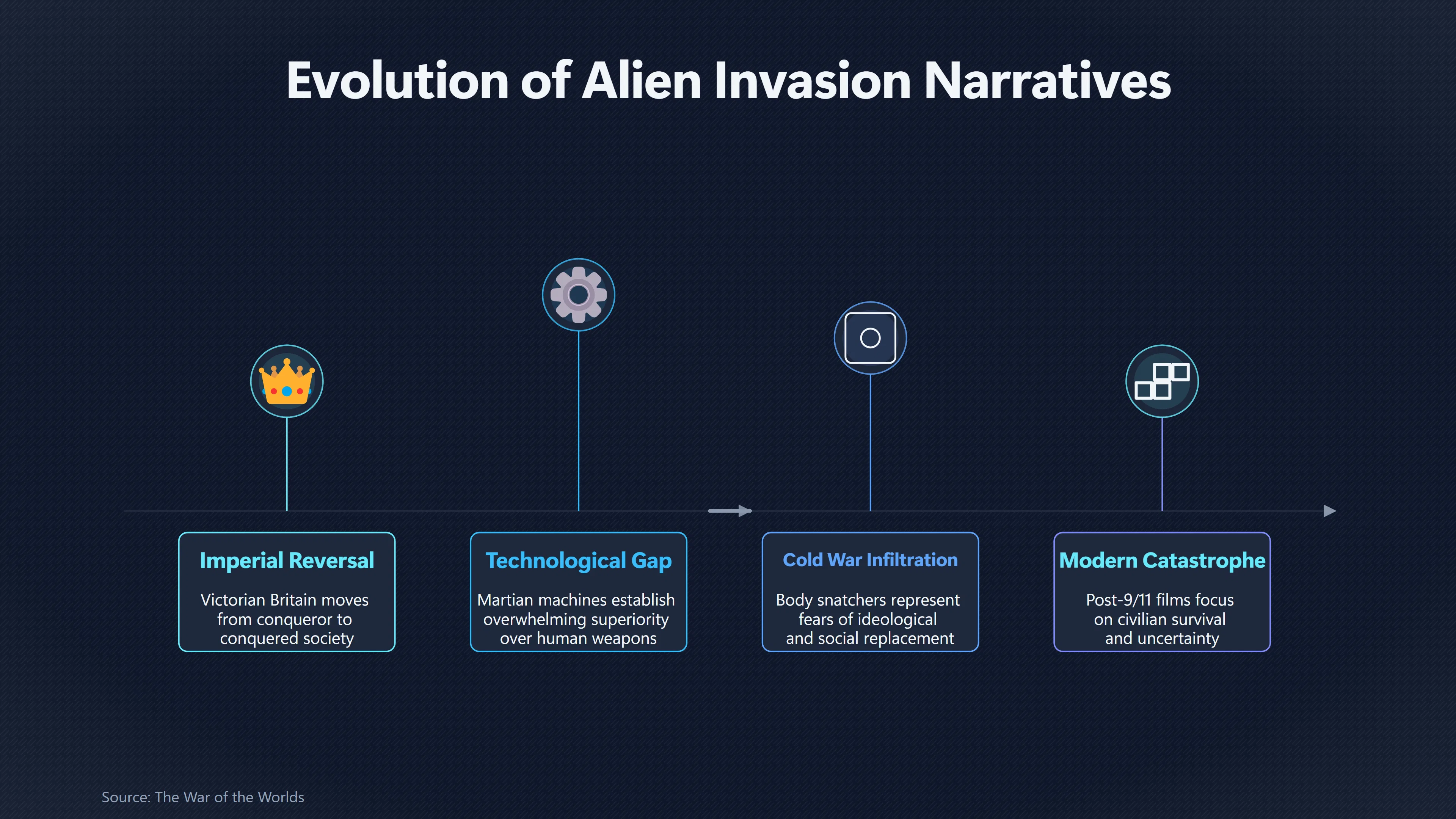
From H. G. Wells’s The War of the Worlds to Cold War-era films such as Invasion of the Body Snatchers and modern blockbusters such as War of the Worlds (2005), alien attackers have repeatedly represented threats that already existed in human societies. The alien is frightening not simply because it is unknown, but because it exposes familiar vulnerabilities: weak institutions, fragile identities and uncertainty about humanity’s place in a much larger universe.[Wikipedia]WikipediaThe War of the WorldsThe War of the Worlds
Origins of the invasion scenario
The modern alien invasion story developed from older invasion narratives, but it gained its distinctive power by reversing the direction of conquest. Instead of humans travelling outward to discover and dominate other worlds, an advanced civilisation arrives on Earth and makes humanity the vulnerable population.
H. G. Wells’s 1898 novel The War of the Worlds established many of the patterns still associated with alien invasion fiction: overwhelming technological superiority, sudden military defeat, civilian panic and the collapse of assumptions about human dominance. The Martians’ arrival was especially unsettling because Victorian Britain was accustomed to viewing itself as a powerful imperial force. By placing Britain in the position of a conquered society, Wells turned the invasion story into a critique of imperial violence and the confidence that technological progress guaranteed superiority.[Wikipedia]WikipediaThe War of the WorldsThe War of the Worlds
The story’s lasting influence came from its psychological mechanism. The Martians are frightening because humans cannot compete on equal terms. Their machines, weapons and methods of survival appear beyond human understanding. The fear is therefore not simply physical destruction; it is the discovery that civilisation may depend on advantages that disappear when faced with a more advanced opponent.
This idea became a foundation of later UFO-related science fiction. Alien visitors often represent a civilisation gap: the possibility that another species could possess knowledge, intelligence or technology so far beyond ours that familiar ideas of power and control become meaningless.
Fear of advanced unknown civilisations
Alien invasion narratives often turn scientific curiosity into anxiety. The search for extraterrestrial life is based on the hope of discovery, but fiction frequently explores the opposite possibility: what if discovery reveals that humanity is not the dominant intelligence in the universe?
The fear comes from several overlapping uncertainties:
- Technological imbalance: An advanced alien civilisation may possess abilities humans cannot defend against. Invasion stories amplify this fear by imagining spacecraft, weapons or biological advantages that make human responses ineffective.
- Communication failure: Humans may not understand alien motives, values or intentions. A civilisation that appears hostile might be misunderstood, while a seemingly peaceful one might remain unpredictable.
- Loss of human centrality: The existence of superior extraterrestrial intelligence could challenge ideas about human uniqueness and importance.
These fears appear in different forms across science fiction. Some stories imagine direct military conquest, while others focus on subtler forms of domination. Invasion of the Body Snatchers (1956), for example, used alien replacement as a metaphor for fears about infiltration and loss of identity during the Cold War. The threat was not merely death; it was the possibility that people could be transformed into something unfamiliar while society continued to function on the surface.[TIME]time.comHorror Films Have Always Tapped Into Pop Culture's Most Urgent FearsCOVID-19 Will Be Their Next InspirationOctober 7, 2020 — Horror films have historically reflected societal fears during pivotal moments i…
This distinction explains why alien invasion stories remain effective even when audiences know that extraterrestrial attacks are fictional. The alien threat provides a flexible symbol for situations where people feel powerless: military conflict, political instability, rapid technological change or cultural disruption.

The panic mechanism: when fiction feels real
One of the clearest examples of alien invasion fear affecting real audiences was the 1938 radio adaptation of The War of the Worlds by Orson Welles’s Mercury Theatre on the Air. The programme used simulated news bulletins to portray a Martian invasion, and some listeners who missed the opening explanation that it was fictional interpreted the broadcast as a real emergency. Reports described people contacting authorities and seeking information about the supposed attack.[HISTORY]history.cominside the war of the worlds broadcastHISTORY'The War of the Worlds' Broadcast | HISTORYOctober 30, 2013…
The event is often remembered as a nationwide panic, but historians have questioned how widespread the reaction actually was. Later analysis suggests that genuine confusion occurred, while newspaper coverage and later retellings exaggerated the scale of mass hysteria. The important lesson is not that people automatically believe invasion stories, but that realistic presentation, trusted communication channels and existing social anxieties can strongly influence public reactions.[National Geographic]nationalgeographic.comwar of the worlds behind the panicNational Geographic'War of the Worlds': Behind the 1938 Radio Show Panic | National Geographic…
The broadcast demonstrated a key feature of invasion fears: people respond not only to the imagined threat itself but also to the conditions surrounding it. A fictional alien attack becomes more believable when it arrives through familiar systems of authority, such as emergency broadcasts or official-looking reports.
How stories reflect social anxieties
Alien invasions frequently change meaning depending on the period in which they are created. The aliens remain fictional, but the fears they represent shift with society.
War, invasion and national vulnerability
Early invasion stories reflected concerns about military conflict and imperial competition. Wells’s Martians mirrored the logic of colonial conquest: a technologically superior power arriving, exploiting resources and dismissing the rights of those already there. This reversal encouraged readers to question the morality of human expansion and domination.[Wikipedia]WikipediaThe War of the WorldsThe War of the Worlds
Later films transformed alien attacks into reflections of newer fears. During the Cold War, invasion narratives often focused on infiltration, conformity and ideological conflict. The frightening possibility was not always an army landing in public view; it was the idea that society could be quietly changed from within.[TIME]time.comHorror Films Have Always Tapped Into Pop Culture's Most Urgent FearsCOVID-19 Will Be Their Next InspirationOctober 7, 2020 — Horror films have historically reflected societal fears during pivotal moments i…
Technology and the fear of losing control
Modern alien invasion stories often connect extraterrestrial threats with concerns about advanced technology. The alien civilisation becomes a representation of a future humanity cannot manage. This reflects a recurring science-fiction theme: progress can create new forms of vulnerability as well as new possibilities.
Films such as Steven Spielberg’s War of the Worlds (2005) placed the invasion story in a post-9/11 cultural environment, emphasising civilian survival, uncertainty and the experience of ordinary people facing a large-scale catastrophe.[Humanities Washington]humanities.orgHumanities WashingtonMovie Critic Robert Horton Discusses Sci-Fi Films, the Cold War and Today…

The “other” and the boundaries of humanity
At its deepest level, the alien invasion story is about encounters with difference. Aliens are often used to explore questions about who belongs, who has power and how societies react when confronted with something outside their experience.
This creates a tension at the centre of the genre. Alien invaders are usually presented as threatening outsiders, but the stories often reveal that the greatest source of fear is not the alien itself. It is human uncertainty: uncertainty about leadership, survival, identity and whether familiar systems can withstand a challenge.
Why alien invasions remain powerful
Alien invasion stories continue because they combine a cosmic question with everyday human concerns. A civilisation from another world may be imaginary, but the emotions surrounding the encounter are recognisably human: fear of attack, fear of replacement, fear of losing control and fear of discovering that humanity is not as powerful as it believes.
The strongest invasion narratives do not simply portray aliens as monsters. They use extraterrestrial threats as a way to examine human behaviour under pressure. They ask whether people respond to uncertainty with cooperation or conflict, whether institutions can manage extraordinary events and whether humanity can face the unknown without being overwhelmed by fear.
In this sense, alien invasions are less about visitors from distant worlds than about humanity’s reaction when its assumptions about safety and superiority are challenged.
Amazon book picks
Further Reading
Books and field guides related to Why Alien Invasions Scare Humans. Use these as the next step if you want deeper reading beyond the article.
Contact
Rating: 4.0/5 from 21 Google Books ratings
In the year 1999 a multinational team of astronauts sets out to discover the secrets of the universe.
Childhood's End
Arthur C. Clarke's classic in which he ponders humanity's future and possible evolution When the silent spacecraft arrived and took the l...
The Andromeda Strain
Rating: 4.0/5 from 17 Google Books ratings
From the author of Jurassic Park, Timeline, and Sphere comes a captivating thriller about a deadly extraterrestrial microorganism, which...
The Body Snatchers
Originally published in 1955 Jack Finney's sinister SF tale has outgrown the initial debate about whether it satirized Communism or the c...
eBay marketplace picks
Marketplace Samples
Live-tested eBay searches with available results related to this page.
Selected fromUFO art print oneBay.co.uk.


Endnotes
1.
Source: Wikipedia
Title: The War of the Worlds
Link:https://en.wikipedia.org/wiki/The_War_of_the_Worlds
2.
Source: humanities.org
Link:https://www.humanities.org/spark/movie-critic-robert-horton-discusses-sci-fi-films-the-cold-war-and-today/
Source snippet
Humanities WashingtonMovie Critic Robert Horton Discusses Sci-Fi Films, the Cold War and Today...
3.
Source: time.com
Title: Horror Films Have Always Tapped Into Pop Culture’s Most Urgent Fears
Link:https://time.com/5891305/horror-movies-coronavirus-history-genre/
Source snippet
COVID-19 Will Be Their Next InspirationOctober 7, 2020 — Horror films have historically reflected societal fears during pivotal moments i...
Published: October 7, 2020
4.
Source: history.com
Title: inside the war of the worlds broadcast
Link:https://www.history.com/articles/inside-the-war-of-the-worlds-broadcast
Source snippet
HISTORY'The War of the Worlds' Broadcast | HISTORYOctober 30, 2013...
Published: October 30, 2013
5.
Source: time.com
Title: the real legacy of orson welles war of the worlds broadcast
Link:https://time.com/archive/7116667/the-real-legacy-of-orson-welles-war-of-the-worlds-broadcast/
6.
Source: history.com
Title: welles scares nation
Link:https://www.history.com/this-day-in-history/October-30/welles-scares-nation
7.
Source: time.com
Title: radio 1938 orson welless broadcast of the war of the worlds by h g wells
Link:https://time.com/archive/6697838/radio-1938-orson-welless-broadcast-of-the-war-of-the-worlds-by-h-g-wells/
8.
Source: nationalgeographic.com
Title: war of the worlds behind the panic
Link:https://www.nationalgeographic.com/science/article/war-of-the-worlds-behind-the-panic
Source snippet
National Geographic'War of the Worlds': Behind the 1938 Radio Show Panic | National Geographic...
9.
Source: pbs.org
Link:https://www.pbs.org/wgbh/americanexperience/films/worlds/
10.
Source: historylink.org
Link:https://www.historylink.org/File/4002
11.
Source: en-academic.com
Title: Invasion of the Body Snatchers
Link:https://en-academic.com/dic.nsf/enwiki/45756/
12.
Source: bornalone.org
Title: The War of the Worlds
Link:https://www.bornalone.org/war_of_the_worlds.html
Additional References
13.
Source: encyclopedia.com
Title: Science Fiction Films and Cold War Anxiety | Encyclopedia.com
Link:https://www.encyclopedia.com/arts/culture-magazines/science-fiction-films-and-cold-war-anxiety
Source snippet
June 24, 2026 — SCIENCE FICTION FILMS AND COLD WAR ANXIETY views updated 8 Science Fiction Films and Cold War Anxiety Extraterrestrial Tr...
Published: June 24, 2026
14.
Source: penguinrandomhouse.com
Title: Penguin Random House The War of the Worlds by H. G. Wells
Link:https://www.penguinrandomhouse.com/books/188559/the-war-of-the-worlds-by-h-g-wells/9780525564164/readers-guide/
Source snippet
Penguin Random HouseThe War of the Worlds by H. G. Wells - Reading Guide: 9780525564164 - PenguinRandomHouse.com: Books...
15.
Source: sciencefictionclassics.com
Title: the enemy within in 1950s science fiction
Link:https://www.sciencefictionclassics.com/the-enemy-within-in-1950s-science-fiction/
Source snippet
May 14, 2026 — THE ENEMY WITHIN IN 1950S SCIENCE FICTION Explore how 1950s sci-fi films like "[Invaders from Mars]({{ 'invaders-control/' | relative_url }})" turned alien invasion i...
Published: May 14, 2026
16.
Source: revisionworld.com
Title: Revision World Themes (The War of the Worlds)
Link:https://revisionworld.com/a2-level-level-revision/english-literature-gcse-level/[war-worlds
Source snippet
Revision WorldThemes (The War of the Worlds) - GCSE English Literature Revision...
17.
Source: youtube.com
Title: The War of the Worlds: The Novel That Changed Science Fiction Forever
Link:https://www.youtube.com/watch?v=d6leAYIVKHc
Source snippet
191: Halloween Special V: “The War of the Worlds” on the Radio...
18.
Source: youtube.com
Title: H.G. Wells and the War of the Worlds: A Documentary (FULL MOVIE)
Link:https://www.youtube.com/watch?v=h8sSKMZiPMI
Source snippet
The Lethal 1,000,000-Volt Secret of The War of the Worlds (1953)...
19.
Source: youtube.com
Title: 191: Halloween Special V: “The War of the Worlds” on the Radio
Link:https://www.youtube.com/watch?v=1h0taqL0aKU
Source snippet
H.G. Wells and the War of the Worlds: A Documentary (FULL MOVIE)...
20.
Source: youtube.com
Link:https://www.youtube.com/watch?v=QKogpJ2Wa-U
Source snippet
If Aliens Invaded Earth | Alien Encounters (Full Episode)...
21.
Source: researchgate.net
Link:https://www.researchgate.net/publication/354064225_Human_Monsters_The_Function_of_the_Horror_Motif_in_Don_Siegel%27s_Invasion_of_the_Body_Snatchers_and_Its_Remakes
22.
Source: researchgate.net
Link:https://www.researchgate.net/publication/304799529_The_Return_of_the_Pod_People_Remaking_Cultural_Anxieties_in_Invasion_of_the_Body_Snatchers