Within UFO encounter categories
When UFO Sightings Become First Contact
First-kind encounters show how unexplained objects became stories about uncertainty, detection, and the first moment of possible contact.
On this page
- How first kind reports are defined
- Famous sighting patterns and explanations
- Why science fiction uses uncertainty
Page outline Jump by section
Introduction
First-kind sightings are the simplest and most enduring form of UFO encounter report: a person claims to have seen an unusual object at close range, but reports no physical traces, injuries, communication or measurable effects. The importance of these cases is not that they prove an unknown craft exists; rather, they capture the central problem of observation itself — how humans interpret something that appears real but cannot immediately be identified. Astronomer J. Allen Hynek created the “close encounter of the first kind” category as part of a system for describing reports, not confirming their causes.[ufodepartment.com]ufodepartment.comClose EncountersThe Department of UFOs - The Department of UFOs…
Within the relationship between UFOs and science fiction, first-kind sightings occupy a distinctive narrative space. They represent the moment before contact: a light in the sky, a strange object over a landscape, or an unexplained shape observed by a witness. Science fiction repeatedly returns to this structure because uncertainty creates the possibility of discovery. A first sighting can become a story about alien arrival, secret technology, mistaken perception, or humanity confronting the limits of its own knowledge.
How first-kind reports are defined
The encounter begins with seeing, not touching
A first-kind encounter is based on a visual observation. In Hynek’s classification, the witness reports seeing an unidentified object at relatively close range, with enough apparent detail to distinguish it from an ordinary distant light or indistinct object. Unlike second-kind encounters, there are no claimed physical effects such as interference with equipment or marks on the ground. Unlike third-kind encounters, there are no reported occupants or beings.[ufodepartment.com]ufodepartment.comClose EncountersThe Department of UFOs - The Department of UFOs…
This makes first-kind reports fundamentally different from other encounter categories. The evidence begins and ends with perception: what someone saw, how they described it, and whether later investigation could identify a conventional explanation. The category therefore sits at the boundary between observation and interpretation. A witness may accurately describe an unusual appearance while still being uncertain about what caused it.
That distinction became important during official investigations such as the US Air Force’s Project Blue Book, which collected and analysed UFO reports between 1947 and 1969. The surviving records show thousands of reports classified and investigated, with some remaining unidentified after review. However, the Air Force concluded that no investigated sighting demonstrated evidence of extraterrestrial vehicles. The files are now available through the National Archives for public examination.[National Archives]archives.govNational Archives Project BLUE BOOKNational ArchivesProject BLUE BOOK - Unidentified Flying Objects | National ArchivesJune 25, 2024…
Why seeing something unusual is scientifically difficult
Observation feels direct, but it is shaped by human limitations. A witness does not record reality like a camera; they interpret light, distance, movement and shape using incomplete information. Night-time conditions, unfamiliar aircraft, astronomical objects, atmospheric effects and perspective errors can all transform ordinary phenomena into something unfamiliar.
This does not mean every sighting has an obvious explanation. The investigative challenge is that an unexplained observation is not the same as evidence for a specific explanation. A report can remain unresolved because there is insufficient information, because the original conditions cannot be recreated, or because available data do not allow researchers to distinguish between competing possibilities.
For science fiction, this uncertainty is precisely what makes the first-kind encounter powerful. The unknown object becomes a blank space onto which societies project hopes and fears: exploration, invasion, technological progress or the discovery of another intelligence.
Famous sighting patterns and explanations
The classic “strange object in the sky” pattern
Many first-kind reports follow a recognisable structure: an ordinary person or trained observer notices something unexpected, attempts to identify it, and is left uncertain. Reports often involve unusual lights, silent movement, unexpected speed or shapes that do not resemble familiar aircraft.
One historically important example is the 1947 sighting by pilot Kenneth Arnold, whose report of unusual objects near Mount Rainier helped popularise the modern UFO era. The event became influential not because it established a cause, but because it demonstrated how a single observation could generate a wider cultural conversation about unidentified objects and possible visitors from beyond Earth.[AP News]apnews.comsince World War II has been a blend of sightings, investigations, and cultural fascination. The saga began with Kenneth Arnold's 1947 sig…
Other famous cases, such as the 1952 Washington, DC sightings, show the same tension between observation and explanation. Reports of unusual objects near the US capital attracted public attention, while later interpretations considered possibilities including atmospheric effects, aircraft and other conventional causes. Such cases became models for science-fiction stories because they placed ordinary observers and institutions in a situation where certainty was difficult to achieve.[AP News]apnews.comsince World War II has been a blend of sightings, investigations, and cultural fascination. The saga began with Kenneth Arnold's 1947 sig…

The role of explanation: identified, unidentified and unresolved
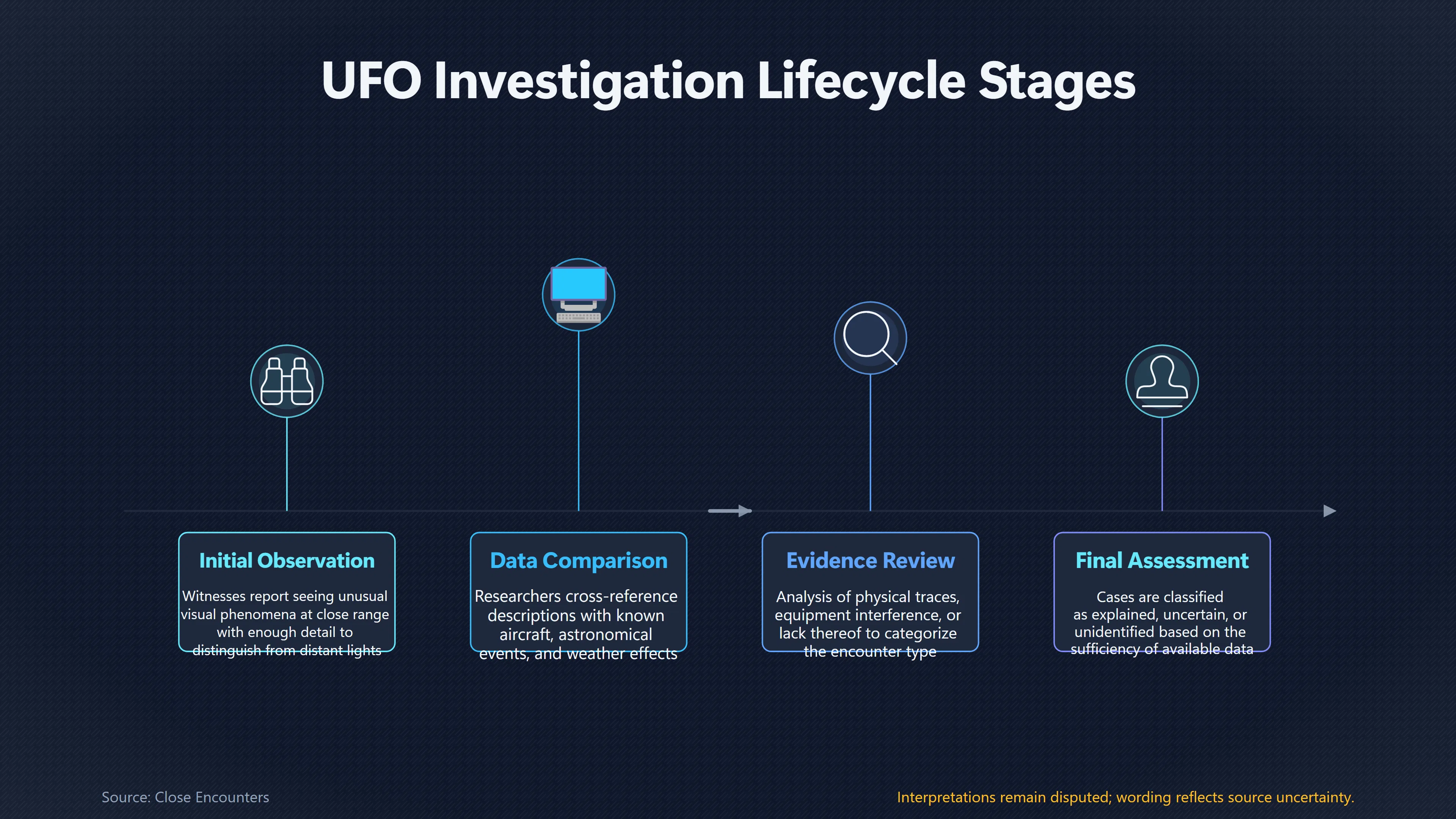
A first-kind sighting can move through several stages:
- Initial observation: a witness reports something unusual.
- Investigation: researchers compare the description with known aircraft, astronomical events, weather effects and human-made objects.
- Assessment: the case may be explained, remain uncertain, or be classified as unidentified because available evidence is insufficient.
The word “unidentified” is therefore a statement about knowledge, not origin. It describes a gap in explanation rather than confirming a particular cause. This distinction is central to responsible UFO research and also explains why first-kind encounters remain attractive in fiction: the unknown is a narrative starting point rather than a final answer.
Why science fiction uses uncertainty
The first sighting as the beginning of contact
Science-fiction stories often treat a first-kind encounter as humanity’s first glimpse of a larger reality. The sighting itself becomes a dramatic threshold: before the encounter, humans assume they understand their environment; after it, that assumption is challenged.
This structure appears throughout alien-contact fiction. A mysterious object allows writers to explore questions before any direct communication occurs: How would governments react? Would scientists believe witnesses? Would society cooperate or panic? What happens when evidence arrives before understanding?
The 1977 film Close Encounters of the Third Kind illustrates how the idea of the unexplained sighting became a cultural language. Although its title refers to a later encounter category involving reported beings, the story begins with observations of strange phenomena and the human attempt to interpret them. Hynek’s terminology itself helped shape popular culture by providing a vocabulary that fiction could adapt.[Wikipedia]WikipediaClose encounterClose encounter
Observation creates mystery without requiring a solution
First-kind encounters are especially useful in science fiction because they preserve ambiguity. A story does not need to immediately reveal whether an object is an alien spacecraft, experimental technology, a natural phenomenon or a misunderstanding. The uncertainty allows writers to focus on human reactions rather than only on the object itself.
This is also why first-kind sightings remain culturally significant even when many individual cases receive conventional explanations. The enduring idea is not simply “something was seen”; it is that seeing something unfamiliar forces people to confront the limits of their perception and knowledge.
The lasting meaning of the first-kind encounter
First-kind sightings are the foundation of UFO encounter storytelling because they begin with the smallest possible claim: someone saw something they could not identify. They do not require physical evidence or direct communication to create significance. Their power comes from the unresolved space between observation and explanation.
For science fiction, that space represents the moment before humanity changes its understanding of the universe. A first sighting may lead to discovery, misunderstanding, fear or wonder, but its central question remains the same: what happens when people encounter something real enough to observe, yet uncertain enough to challenge what they believe?
Amazon book picks
Further Reading
Books and field guides related to When UFO Sightings Become First Contact. Use these as the next step if you want deeper reading beyond the article.
The UFO Experience: A Scientific Inquiry
Cited by the New York Review of Books as "the best brief for visitation," this classic study presents an analysis of UFO reports and conc...
The Report on Unidentified Flying Objects
The Report on Unidentified Flying Objects, written by Captain Edward Ruppelt in 1956, was the first serious, unbiased account written abo...
UFOs: Generals, Pilots, and Government Officials Go on the Re...
NEW YORK TIMES BESTSELLER • Impeccably researched, this riveting journalistic investigation separates fact from fiction, and documents th...
UFOs and the National Security State: Chronology of a Coverup...
"The documentation is spectacularly good, the best ever on the UFO subject. And the conclusion is overwhelmingly powerful." —Whitley Stri...
eBay marketplace picks
Marketplace Samples
Live-tested eBay searches with available results related to this page.
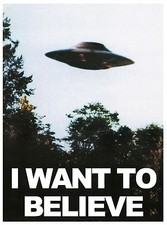
Selected fromUFO poster oneBay.co.uk.



Endnotes
1.
Source: ufodepartment.com
Title: Close Encounters
Link:https://www.ufodepartment.com/ufo-glossary/close-encounters/
Source snippet
The Department of UFOs - The Department of UFOs...
2.
Source: Wikipedia
Title: Close encounter
Link:https://en.wikipedia.org/wiki/Close_encounter
3.
Source: archives.gov
Title: National Archives Project BLUE BOOK
Link:https://www.archives.gov/research/military/air-force/ufos
Source snippet
National ArchivesProject BLUE BOOK - Unidentified Flying Objects | National ArchivesJune 25, 2024...
Published: June 25, 2024
4.
Source: archives.gov
Link:https://www.archives.gov/research/topics/uaps/textual-and-microfilm
Source snippet
National ArchivesRecords Related to Unidentified Flying Objects (UFOs) and Unidentified Anomalous Phenomena (UAPs) at the National Archiv...
5.
Source: archives.gov
Link:https://www.archives.gov/research/topics/uaps/rg-collections
6.
Source: archives.gov
Link:https://www.archives.gov/research/catalog/catalog-bulk-downloads/uap-bulk-download
7.
Source: archives.gov
Link:https://www.archives.gov/news/articles/project-blue-book-50th-anniversary
8.
Source: prologue.blogs.archives.gov
Title: ufos natural explanations
Link:https://prologue.blogs.archives.gov/2018/04/16/ufos-natural-explanations/
9.
Source: archives.gov
Title: Do Records Show Proof of UFOs? | National Archives
Link:https://www.archives.gov/news/articles/do-records-show-proof-of-ufos
10.
Source: archives.gov
Title: Project BLUE BOOK
Link:https://www.archives.gov/foia/ufos.html
11.
Source: apnews.com
Link:https://apnews.com/article/57c6c3190457d5188d59745df2e0bd3c
Source snippet
since World War II has been a blend of sightings, investigations, and cultural fascination. The saga began with Kenneth Arnold's 1947 sig...
12.
Source: daviddarling.info
Link:https://www.daviddarling.info/encyclopedia/H/Hynek.html
Additional References
13.
Source: magazine.columbia.edu
Title: how seriously should we take ufo sightings
Link:https://magazine.columbia.edu/article/how-seriously-should-we-take-ufo-sightings
Source snippet
Columbia MagazineJune 17, 2026 — HOW SERIOUSLY SHOULD WE TAKE UFO SIGHTINGS? Columbia alien hunter David Kipping on the odds of finding...
Published: June 17, 2026
14.
Source: archania.org
Title: [j allen hynek]({{ ‘j-allen-hynek/’ | relative_url }})
Link:https://archania.org/p/individuals/scientists/astronomers/j-allen-hynek
Source snippet
Allen HynekMay 25, 2026 — CLOSE ENCOUNTERS, BOOKS, AND CUFOS After Blue Book closed, Hynek turned his case experience into books and orga...
Published: May 25, 2026
15.
Source: youtube.com
Title: Have You Met an Alien? The Hynek Scale Explained
Link:https://www.youtube.com/watch?v=aOW8VQnKoWo
Source snippet
Close Encounters: The Terrifying Real UFO History Inside the Movie...
16.
Source: ufouap.net
Title: This g
Link:https://www.ufouap.net/en/explainers/common-ufo-misidentifications
Source snippet
Common UFO misidentifications: drones, satellites, balloons, aircraft, planets, and camera artifacts | Global UFO ArchiveJuly 15, 2026 —...
Published: July 15, 2026
17.
Source: isaackoi.com
Link:https://isaackoi.com/ufog/best-ufo-cases/20-quantitative-criteria-hynek-strangeness-and-probability/
18.
Source: paranormal-encyclopedia.com
Link:https://www.paranormal-encyclopedia.com/u/ufo/close-encounters/first-kind.html
19.
Source: brevitymag.com
Link:https://brevitymag.com/craft-essays/close-encounters/
20.
Source: exopaedia.org
Link:https://www.exopaedia.org/Encounters
21.
Source: bufora.org.uk
Link:https://www.bufora.org.uk/guide-to-ufos
22.
Source: exopaedia.org
Link:https://www.exopaedia.org/Hynek%2C%2BJoseph%2BAllen