Within Flying saucer imagery
Why Brands Used Flying Saucers
Advertisers and designers used saucer imagery because the shape instantly communicated futurism, mystery and alien ideas.
On this page
- The saucer as a visual shortcut
- Futurism in commercial imagery
- Everyday uses beyond science fiction
Page outline Jump by section
Introduction
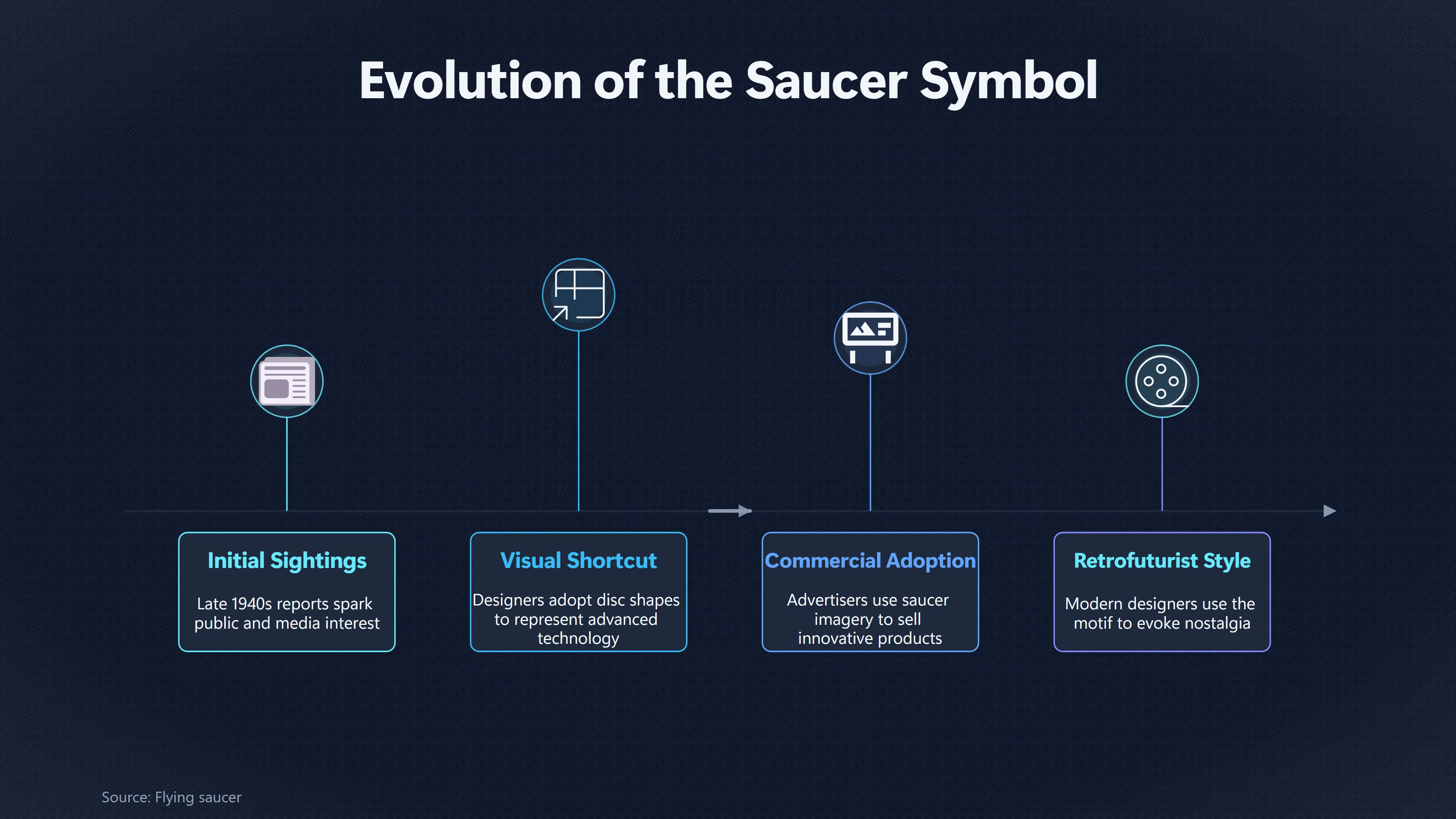
Flying saucers became a powerful advertising and design symbol because the shape communicated a complete idea almost instantly: the future had arrived, and it came from somewhere unknown. Unlike a rocket, which suggested engineering and human exploration, the saucer suggested mystery, advanced technology and contact with something beyond Earth. After the late 1940s UFO reports and the explosion of science-fiction imagery in the 1950s, designers began using the disc-shaped craft as a visual shortcut for progress, novelty and the possibilities of tomorrow.[National Archives]media.nationalarchives.gov.ukNational Archives The Cold War and UFOs | The National ArchivesNational ArchivesThe Cold War and UFOs | The National ArchivesMay 23, 2019…
The commercial appeal of the flying saucer was not based on belief that such vehicles existed. Instead, advertisers borrowed a recognisable science-fiction language. A curved metallic form, glowing lights or a hovering disc could make an ordinary product appear innovative, futuristic or imaginative. From consumer goods and exhibitions to architecture and branding, saucer imagery helped turn ideas about space travel and alien technology into everyday visual culture.[OUP Academic]academic.oup.comOUP AcademicAdvertising and Design | The Oxford Handbook of Science Fiction | Oxford AcademicOctober 2, 2014…
The saucer as a visual shortcut
The flying saucer worked in design because it reduced a complicated concept into a simple silhouette. A viewer did not need an explanation to understand what the image suggested: advanced technology, exploration beyond Earth and a future different from the present. The disc shape was especially effective because it looked unfamiliar but not impossible, combining smooth modern geometry with the mystery associated with UFO reports.[Wikipedia]WikipediaFlying saucerFlying saucer
This made the saucer useful for advertisers selling products that wanted an association with innovation. A household appliance, vehicle or entertainment product could borrow the emotional meaning of space exploration without needing to depict actual spacecraft engineering. The design language implied that the product belonged to the same imagined future as rockets, satellites and alien machines.
The symbol also benefited from ambiguity. A saucer could suggest friendly discovery, playful fantasy or technological power depending on the context. In commercial design, this flexibility allowed the same basic image to support different messages: a product could be presented as exciting, unusual, advanced or simply fun. The flying saucer became less a picture of a specific object and more a sign for “the future”.[ResearchGate]researchgate.netSky and Stardust: The Flying Saucer in American Popular Culture, 1947–1957 | Request PDF…
Futurism in commercial imagery
From space-age products to imagined lifestyles
The rise of saucer imagery coincided with the broader Space Age design movement, which used scientific and technological references to create visions of modern living. Advertising and product design in the mid-20th century frequently adopted science-fiction ideas, using futuristic displays, streamlined forms and imagined technologies to suggest that consumer goods represented progress.[OUP Academic]academic.oup.comOUP AcademicAdvertising and Design | The Oxford Handbook of Science Fiction | Oxford AcademicOctober 2, 2014…
The flying saucer became part of this visual vocabulary because it matched the period’s fascination with smooth curves, new materials and unconventional shapes. Designers applied similar ideas to objects that had no connection to space travel, creating a sense that everyday life itself was becoming futuristic. Space-age forms appeared in furniture, household objects and architectural experiments, where rounded shapes could evoke spacecraft interiors or imagined worlds of tomorrow.[Space Age Museum]spaceagemuseum.comOpen source on spaceagemuseum.com.
A notable example is the Futuro House, designed by Matti Suuronen in the late 1960s. Its oval structure, elevated entrance and plastic construction gave it a strong resemblance to a landed spacecraft. Although it was a real architectural object rather than a fictional vehicle, its appearance depended on the same cultural connection between unusual rounded forms and futuristic living.[Wikipedia]WikipediaOpen source on wikipedia.org.
The promise behind the image
Saucer-inspired design often sold a mood rather than a practical technological claim. The image suggested speed, convenience and escape from ordinary limitations. A consumer product styled with space-age cues appeared connected to a world where technology could transform daily life.
This explains why flying saucer imagery often appeared in promotional environments and exhibitions as well as traditional advertisements. Companies used futuristic settings to present products as part of a coming era. The goal was not simply to show an object but to place consumers inside a story about modernity and progress.[OUP Academic]academic.oup.comOUP AcademicAdvertising and Design | The Oxford Handbook of Science Fiction | Oxford AcademicOctober 2, 2014…
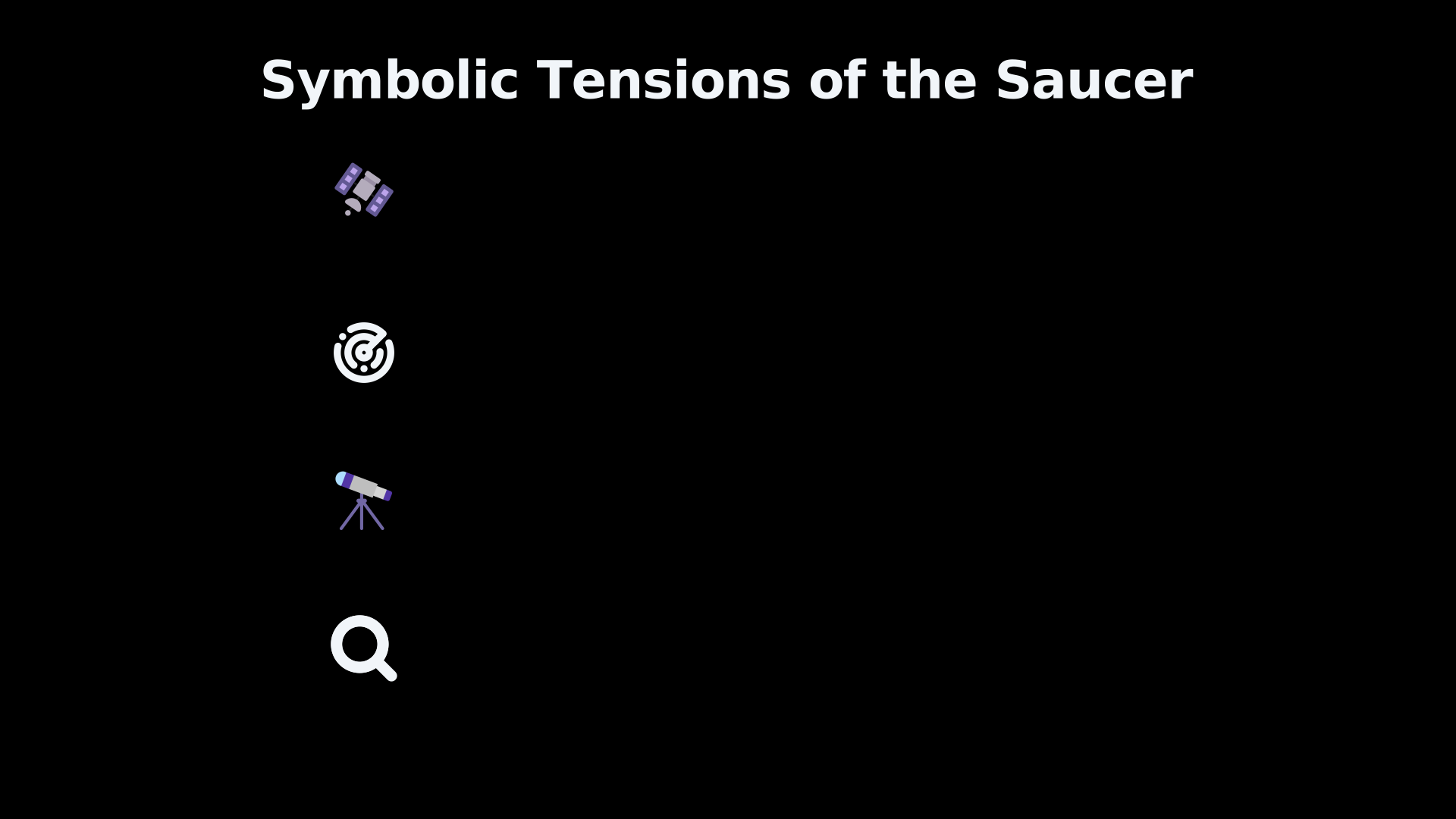
At the same time, the symbolism carried a tension. The flying saucer represented both optimism about the future and uncertainty about what advanced technology might bring. The same cultural image that suggested exploration could also recall invasion stories and Cold War fears. Designers could use this uncertainty creatively because mystery itself attracted attention.[ResearchGate]researchgate.netSky and Stardust: The Flying Saucer in American Popular Culture, 1947–1957 | Request PDF…
Everyday uses beyond science fiction
The influence of the flying saucer extended beyond films and fictional spacecraft. Once the shape became familiar, it could be separated from UFO stories and used simply as a design reference. Objects, buildings and visual identities borrowed the saucer form because audiences associated it with modernity and imagination.[Space Age Museum]spaceagemuseum.comOpen source on spaceagemuseum.com.
One reason the motif survived was its strong recognition value. A circle or dome alone might not communicate anything specific, but a disc-shaped object hovering above a landscape or surrounded by space imagery immediately suggested a connection with science fiction. This made the saucer useful in packaging, promotional graphics and themed environments where designers needed to establish a futuristic atmosphere quickly.
The motif also became valuable as a retro style. Later designers used flying saucers not only to represent the future but to reference earlier visions of the future from the 1950s and 1960s. This approach, often described as retrofuturism, combines nostalgia for past predictions with contemporary design. The appeal comes from the contrast between what earlier generations imagined the future would look like and how the future actually developed.[wix.com]wix.comWhat is retrofuturism? A look at the trend and history of the styleNovember 19, 2024…

Why the symbol remains effective
The flying saucer continues to appear in design because it occupies a rare position between familiarity and mystery. It is instantly recognisable but still suggests the unknown. For advertisers, that combination is valuable: the image attracts attention while allowing a brand to associate itself with creativity, discovery and new possibilities.
The enduring strength of the saucer symbol comes from this balance. It is not important because it represents a proven spacecraft design; it matters because decades of science fiction and popular culture transformed a simple geometric form into a shared visual language. In advertising and design, the flying saucer became a way to make the future visible.[Wikipedia]WikipediaFlying saucerFlying saucer
Amazon book picks
Further Reading
Books and field guides related to Why Brands Used Flying Saucers. Use these as the next step if you want deeper reading beyond the article.
Ways of Seeing
"Seeing comes before words. The child looks and recognizes before it can speak. "But there is also another sense in which seeing comes be...
The Design of Everyday Things
Even the smartest among us can feel inept as we fail to figure out which light switch or oven burner to turn on, or whether to push, pull...
UFOs: Generals, Pilots, and Government Officials Go on the Re...
NEW YORK TIMES BESTSELLER • Impeccably researched, this riveting journalistic investigation separates fact from fiction, and documents th...

The Visual Encyclopedia of Science Fiction
First published 1977. Subjects: Science fiction, Encyclopedias, Science-fiction, Dictionnaires anglais, Thèmes, motifs.
eBay marketplace picks
Marketplace Samples
Live-tested eBay searches with available results related to this page.
Selected fromufo sign oneBay.co.uk.



Endnotes
1.
Source: Wikipedia
Title: Flying saucer
Link:https://en.wikipedia.org/wiki/Flying_saucer
2.
Source: academic.oup.com
Link:https://academic.oup.com/edited-volume/28054/chapter/212004634
Source snippet
OUP AcademicAdvertising and Design | The Oxford Handbook of Science Fiction | Oxford AcademicOctober 2, 2014...
Published: October 2, 2014
3.
Source: researchgate.net
Link:https://www.researchgate.net/publication/295261724_Sky_and_Stardust_The_Flying_Saucer_in_American_Popular_Culture
Source snippet
Sky and Stardust: The Flying Saucer in American Popular Culture, 1947–1957 | Request PDF...
4.
Source: Wikipedia
Link:https://en.wikipedia.org/wiki/Futuro
5.
Source: wix.com
Title: What is retrofuturism? A look at the trend and history of the style
Link:https://www.wix.com/studio/blog/retrofuturism
Source snippet
November 19, 2024...
Published: November 19, 2024
6.
Source: academic.oup.com
Link:https://academic.oup.com/jdh/article-pdf/25/1/55/1244192/epr052.pdf
7.
Source: researchgate.net
Link:https://www.researchgate.net/publication/364975297_Flying_Saucers_and_UFOs_in_US_Advertising_During_the_Cold_War
8.
Source: youtube.com
Title: Futuro. House of the Future
Link:https://www.youtube.com/watch?v=SjuErc7ZCps
Source snippet
The Futuro House | Exploring Abandoned Japan...
9.
Source: youtube.com
Title: The Futuro House | Exploring Abandoned Japan
Link:https://www.youtube.com/watch?v=yHJYnN5zNUM
Source snippet
1950s Retro-Futurism | A Nostalgic Journey Into the Future That Never Was...
10.
Source: media.nationalarchives.gov.uk
Title: National Archives The Cold War and UFOs | The National Archives
Link:https://media.nationalarchives.gov.uk/index.php/cold-war-ufos/
Source snippet
National ArchivesThe Cold War and UFOs | The National ArchivesMay 23, 2019...
Published: May 23, 2019
11.
Source: spaceagemuseum.com
Link:https://www.spaceagemuseum.com/flying-saucers
12.
Source: artincontext.org
Link:https://artincontext.org/retrofuturism/
13.
Source: retrofuturismblog.blogspot.com
Link:https://retrofuturismblog.blogspot.com/2016/05/aircraft.html
14.
Source: aesthetics.fandom.com
Title: Space Age
Link:https://aesthetics.fandom.com/wiki/Space_Age
Additional References
15.
Source: ft.com
Link:https://www.ft.com/content/20c075c6-270e-46cd-b894-1ef2814cf87e
Source snippet
Modernist pioneers like Alvar and Aino Aalto exemplified how architecture could champion collective ideals. Despite modernism's democrati...
16.
Source: youtube.com
Link:https://www.youtube.com/watch?v=LEFRzYfdSFc
Source snippet
This collection highlights architectural design, space age aesthetics, and Googie style, demonstrating how the flying saucer shape was us...
17.
Source: skyatnightmagazine.com
Title: Why are we so obsessed with UFOs?
Link:https://www.skyatnightmagazine.com/space-science/why-are-we-so-obssessed-with-ufos
Source snippet
A history of flying saucers and why they continue to fascinate us | BBC Sky at Night MagazineMay 11, 2026 — MAGAZINES FAN THE FLAMES Ther...
Published: May 11, 2026
18.
Source: vam.ac.uk
Link:https://www.vam.ac.uk/articles/post-war-design-an-introduction
Source snippet
introduction · V&AJuly 28, 2026 — THE FESTIVAL OF BRITAIN, 1951 Six years after the end of [the war]({{ 'the-war/' | relative_url }}), and exactly 100 years since the famou...
Published: July 28, 2026
19.
Source: youtube.com
Link:https://www.youtube.com/watch?v=RmmTPV78wzU
Source snippet
1970's Futuro 'UFO' House: A Vision Of The Future From The Past...
20.
Source: phys.org
Link:https://phys.org/news/2022-11-fun-cold-war-era-ads-flying.html
21.
Source: dribbble.com
Link:https://dribbble.com/search/flying%20saucer%20logo
22.
Source: dribbble.com
Link:https://dribbble.com/search/flying-saucer-logo
23.
Source: dribbble.com
Link:https://dribbble.com/search/flying-saucer
24.
Source: dribbble.com
Link:https://dribbble.com/search/logo%20ufo