Within Early science fiction
Why Early Spacecraft Looked Like Ships
Early spacecraft designs borrowed from ships, trains, and aircraft, creating futuristic vehicles rooted in familiar engineering ideas.
On this page
- Industrial influences on spacecraft
- Verne and Wells approaches
- Changing ideas of space vehicles
Page outline Jump by section
Introduction
Early fictional rockets looked like the machines of the industrial age because writers had no real spacecraft to copy. Before rockets became practical vehicles, authors imagined space travel by extending technologies they already understood: naval vessels, railway locomotives, artillery shells and aircraft. These imagined vehicles were futuristic, but their shapes and operating ideas were often built from familiar engineering assumptions about engines, metal structures, enclosed cabins and mechanical power. This connection explains why early science fiction spacecraft often resembled advanced versions of earthly machines rather than the streamlined rockets and capsules that later defined the Space Age.[Smithsonian Air and Space Museum]airandspace.si.eduSmithsonian Air and Space Museum Science Fiction | National Air and Space MuseumSmithsonian Air and Space Museum Science Fiction | National Air and Space Museum
The result was a distinctive stage in the development of spacecraft imagination. Early writers were not simply guessing what a rocket would look like; they were translating the industrial world around them into a possible future. Their fictional machines helped create the visual and conceptual background from which later ideas about space travel — including some of the imagery associated with UFOs — developed.[The British Interplanetary Society]bis-space.comThe British Interplanetary SocietyFrom Amazing Stories to the BIS: 100 Years of “Scientifiction” - The British Interplanetary SocietyMarc…
Industrial influences on spacecraft
Why early rockets resembled ships and machines
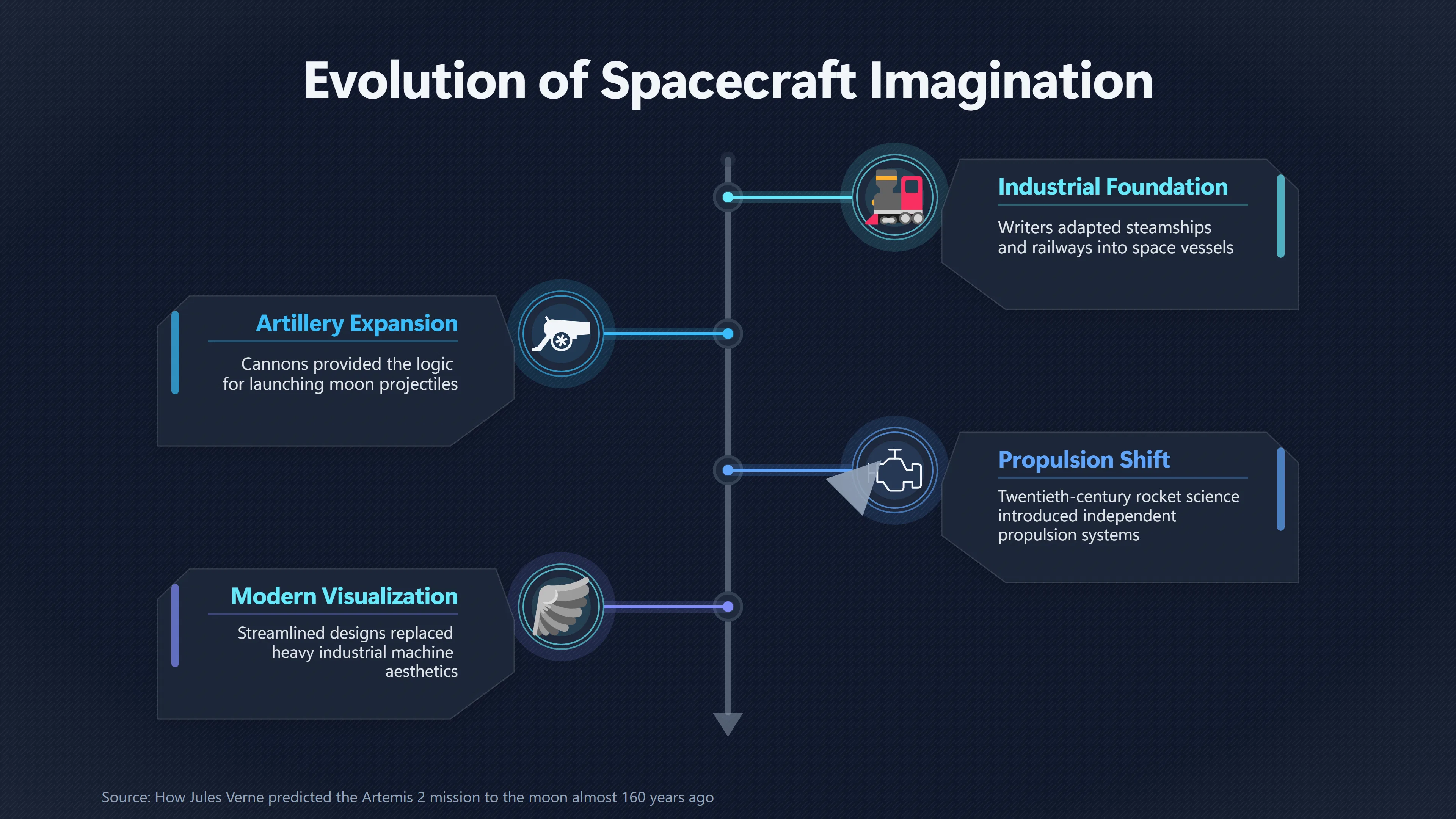
Nineteenth- and early twentieth-century technology shaped how authors imagined leaving Earth. The dominant machines of the industrial era were large, mechanical and highly visible: steamships crossed oceans, railways connected continents, factories produced complex metal structures, and artillery demonstrated the power of controlled explosions. When writers imagined a journey beyond Earth, they naturally borrowed from these examples.
A fictional spacecraft therefore often functioned like a combination of a ship and a vehicle of exploration. It had a hull to protect passengers, an internal space for a crew, instruments for navigation and a powerful propulsion system. The idea of travelling through space was treated as an extension of existing exploration rather than a completely new form of movement. The spacecraft was frequently imagined as a vessel that carried humans through a hostile environment, much like a submarine beneath the sea or a ship crossing an unknown ocean.[Smithsonian Air and Space Museum]airandspace.si.eduSmithsonian Air and Space Museum Science Fiction | National Air and Space MuseumSmithsonian Air and Space Museum Science Fiction | National Air and Space Museum
This approach also affected the scale of fictional rockets. Early illustrations and stories often presented enormous vehicles because industrial culture associated size with power. A larger machine suggested stronger engines, greater carrying capacity and greater national or scientific ambition. These designs reflected the age of steamships and heavy engineering, where technological progress was commonly represented through increasingly massive structures.
Artillery, trains and the idea of launching into space
One of the clearest examples of industrial thinking in early space fiction appears in Jules Verne’s From the Earth to the Moon (1865). Verne did not imagine a modern rocket launch; instead, his travellers were sent toward the Moon inside a projectile fired from the giant Columbiad cannon built by the Baltimore Gun Club. The method reflected the nineteenth century’s confidence in artillery, metallurgy and precision engineering. The spacecraft was essentially a highly advanced cannon projectile adapted for human passengers.[Space]space.comHow Jules Verne predicted the Artemis 2 mission to the moon almost 160 years agoPublished in 1865, Verne’s story involves a projectile launched to the moon from Florida, near the equator—mirroring NASA’s launch site a…
Although the mechanism was scientifically inaccurate by modern standards, the concept revealed an important imaginative step. Verne was taking a familiar industrial technology — the cannon — and pushing it into an extreme future application. The question was not yet “what kind of vehicle naturally belongs in space?” but rather “how can the most powerful machine of the industrial world be enlarged until it reaches space?”[Space]space.comHow Jules Verne predicted the Artemis 2 mission to the moon almost 160 years agoPublished in 1865, Verne’s story involves a projectile launched to the moon from Florida, near the equator—mirroring NASA’s launch site a…
This pattern appeared repeatedly in early science fiction. Authors often imagined progress as an accumulation of existing technologies: stronger engines, tougher metals and larger machines. Space travel became the next stage of industrial expansion.
Verne and Wells approaches
Verne’s engineered projectile
Verne’s approach was closely tied to nineteenth-century engineering culture. His fictional spacecraft was a carefully described technical object, with attention given to construction, launch conditions and the practical challenges faced by travellers. The limitations of the design reveal the period’s technological assumptions: the spacecraft had to be launched by a known force, and the solution came from improving existing machinery rather than inventing an entirely new propulsion system.[Space]space.comHow Jules Verne predicted the Artemis 2 mission to the moon almost 160 years agoPublished in 1865, Verne’s story involves a projectile launched to the moon from Florida, near the equator—mirroring NASA’s launch site a…
The importance of Verne’s design was not that it predicted a real rocket. Instead, it showed how industrial imagination could transform familiar mechanisms into visions of the future. The cannon became a gateway to space, just as railways and steamships had opened new regions on Earth.

Wells and the alien machine beyond human industry
H. G. Wells approached spacecraft differently in The War of the Worlds (1898). His Martian vehicle was not a human-built rocket but an alien projectile: a cylindrical craft fired from Mars and arriving on Earth. The machine still carried industrial characteristics, however. It was a constructed object made of metal, designed for transport and capable of surviving a difficult journey between worlds.[ETC at USF]etc.usf.eduOpen source on usf.edu.
The difference between Verne and Wells is significant. Verne imagined humans extending their own engineering abilities into space, while Wells imagined a civilisation whose technology had advanced beyond humanity’s. Yet both writers used the industrial language of machines, materials and transport systems. Their spacecraft were not magical objects; they were technological devices with a physical presence.
This distinction later influenced science fiction’s relationship with UFO imagery. Some fictional spacecraft represented human progress, while others represented unknown visitors arriving in superior machines. Both traditions depended on the same early idea: that advanced beings would travel in engineered vehicles.
Changing ideas of space vehicles
From industrial vessels to dedicated rockets
The image of the spacecraft began changing as rocket science developed in the early twentieth century. Real rocket pioneers and theoretical studies introduced the possibility that rockets could operate through their own propulsion rather than being fired like artillery shells. The National Air and Space Museum notes that twentieth-century advances in rocket propulsion transformed rockets from earlier devices into technologies capable of changing space exploration.[Smithsonian Air and Space Museum]airandspace.si.eduSmithsonian Air and Space Museum Rockets | National Air and Space MuseumSmithsonian Air and Space Museum Rockets | National Air and Space Museum
Science fiction magazines helped spread this new vision. When Hugo Gernsback launched Amazing Stories in 1926, he promoted stories that combined scientific ideas with imagination. The magazine featured earlier writers such as Verne and Wells alongside new space adventures, while artists created dramatic images of rockets and other future machines.[The British Interplanetary Society]bis-space.comThe British Interplanetary SocietyFrom Amazing Stories to the BIS: 100 Years of “Scientifiction” - The British Interplanetary SocietyMarc…
These illustrations gradually moved spacecraft away from the appearance of ordinary industrial vehicles. Rockets became taller, more streamlined and more clearly designed for flight beyond Earth. However, many still retained familiar features: windows like ships, metal bodies like industrial machines and engines resembling exaggerated versions of aircraft technology.

The industrial legacy in later spacecraft imagination
Even when fictional spacecraft became more advanced, the industrial foundations remained visible. Early science fiction established several lasting assumptions: spacecraft would be mechanical, constructed, powerful and purposeful. They would have interiors, controls and systems that reflected human ideas of engineering.
This legacy helped shape the wider cultural image of unknown spacecraft. When UFO reports emerged in the twentieth century, many people interpreted unusual objects through a visual language already developed by science fiction. The connection was not that fictional rockets predicted UFOs, but that both drew from the same human habit of imagining advanced vehicles through the technologies of their own time.[The British Interplanetary Society]bis-space.comThe British Interplanetary SocietyFrom Amazing Stories to the BIS: 100 Years of “Scientifiction” - The British Interplanetary SocietyMarc…
Early fictional rockets therefore occupy an important middle ground between the industrial world and the Space Age. They were not accurate models of future spacecraft, but they provided a bridge between familiar machines and the possibility of travel beyond Earth.
Amazon book picks
Further Reading
Books and field guides related to Why Early Spacecraft Looked Like Ships. Use these as the next step if you want deeper reading beyond the article.
From the Earth to the Moon
From the Earth to the Moon is one of the first books discussing space traveling from a scientific perspective. Written by Jules Verne in...
The War of the Worlds
The War of the Worlds (1898), by H. G. Wells, is an early science fiction novel which describes an invasion of England by aliens from Mar...
Ignition!: An Informal History of Liquid Rocket Propellants
John Clark tells here, with irreverent and eyewitness immediacy, the story of the search for a power packaging which could be trusted to...
The History of Science Fiction
This book is the definitive critical history of science fiction. The 2006 first edition of this work traced the development of the genre...
eBay marketplace picks
Marketplace Samples
Live-tested eBay searches with available results related to this page.
Selected fromspacecraft model oneBay.co.uk.
Endnotes
1.
Source: space.com
Title: How Jules Verne predicted the Artemis 2 mission to the moon almost 160 years ago
Link:https://www.space.com/entertainment/how-jules-verne-predicted-the-artemis-2-mission-to-the-moon-almost-160-years-ago
Source snippet
Published in 1865, Verne’s story involves a projectile launched to the moon from Florida, near the equator—mirroring NASA’s launch site a...
2.
Source: etc.usf.edu
Link:https://etc.usf.edu/lit2go/135/the-war-of-the-worlds/2461/book-onethe-coming-of-the-martians-chapter-4-the-cylinder-opens/
3.
Source: etc.usf.edu
Title: book onethe coming of the martians chapter 3 on horsell common
Link:https://etc.usf.edu/lit2go/135/the-war-of-the-worlds/2460/book-onethe-coming-of-the-martians-chapter-3-on-horsell-common/
4.
Source: etc.usf.edu
Title: book onethe coming of the martians chapter 17 the thunder child
Link:https://etc.usf.edu/lit2go/135/the-war-of-the-worlds/2474/book-onethe-coming-of-the-martians-chapter-17-the-thunder-child/
5.
Source: jules-verne.org
Link:https://jules-verne.org/Jules_Verne%27s_Books/From_The_Earth_To_Moon_Jules_Verne%27s.html
6.
Source: time.com
Title: The Press: Amazing! Astounding!
Link:https://time.com/archive/6760974/the-press-amazing-astounding/
7.
Source: airandspace.si.edu
Title: Smithsonian Air and Space Museum Science Fiction | National Air and Space Museum
Link:https://airandspace.si.edu/explore/stories/science-fiction
8.
Source: airandspace.si.edu
Title: Smithsonian Air and Space Museum Rockets | National Air and Space Museum
Link:https://airandspace.si.edu/explore/topics/technology-and-engineering/rockets
9.
Source: bis-space.com
Link:https://www.bis-space.com/from-amazing-stories-to-the-bis-100-years-of-scientifiction/
Source snippet
The British Interplanetary SocietyFrom Amazing Stories to the BIS: 100 Years of “Scientifiction” - The British Interplanetary SocietyMarc...
10.
Source: Wikipedia
Title: From the Earth to the Moon
Link:https://en.wikipedia.org/wiki/From_the_Earth_to_the_Moon
11.
Source: fancyclopedia.org
Title: Jules Verne
Link:https://fancyclopedia.org/wiki/Jules_Verne
12.
Source: airandspace.si.edu
Title: imagining faster light travel
Link:https://airandspace.si.edu/stories/editorial/imagining-faster-light-travel
13.
Source: encyclopedia.com
Title: Jules Verne | Encyclopedia.com
Link:https://www.encyclopedia.com/people/literature-and-arts/french-literature-biographies/jules-verne
14.
Source: encyclopedia.com
Title: Science Fiction | Encyclopedia.com
Link:https://www.encyclopedia.com/literature-and-arts/language-linguistics-and-literary-terms/literature-general/science-fiction
15.
Source: airandspace.si.edu
Title: buck rogers spaceship toy
Link:https://airandspace.si.edu/stories/editorial/buck-rogers-spaceship-toy
16.
Source: si.edu
Title: smithsonian libraries unveils fantastic worlds science and fiction 1780 1910
Link:https://www.si.edu/newsdesk/releases/smithsonian-libraries-unveils-fantastic-worlds-science-and-fiction
17.
Source: airandspace.si.edu
Title: airplane and streamlined design
Link:https://airandspace.si.edu/stories/editorial/airplane-and-streamlined-design
18.
Source: waroftheworlds.fandom.com
Link:https://waroftheworlds.fandom.com/wiki/Cylinder
19.
Source: civilwar-history.fandom.com
Title: From the Earth to the Moon
Link:https://civilwar-history.fandom.com/wiki/From_the_Earth_to_the_Moon
20.
Source: pioneersofflight.si.edu
Title: science fiction
Link:https://pioneersofflight.si.edu/culture/science_fiction
21.
Source: si.edu
Link:https://www.si.edu/object/rockets-and-revolution-cultural-history-early-spaceflight-michael-g-smith%3Asiris_sil_1037369
22.
Source: airandspace.si.edu
Link:https://airandspace.si.edu/learn/programs/on-air/rockets
23.
Source: airandspace.si.edu
Title: rockets and missiles
Link:https://airandspace.si.edu/exhibitions/rockets-and-missiles
24.
Source: airandspace.si.edu
Title: innovative people early rocketry
Link:https://airandspace.si.edu/explore/stories/innovative-people-early-rocketry
25.
Source: gutenberg.org
Link:https://www.gutenberg.org/files/36/36-h/36-h.htm
26.
Source: paperzz.com
Title: From the Earth to the Moon
Link:https://paperzz.com/doc/7890330/from-the-earth-to-the-moon—cleveland-state-university
27.
Source: co-curate.ncl.ac.uk
Link:https://co-curate.ncl.ac.uk/rocket/
28.
Source: daviddarling.info
Link:https://www.daviddarling.info/encyclopedia/C/Columbiad.html
Additional References
29.
Source: gpb.org
Link:https://www.gpb.org/news/2026/04/25/sci-fi-was-everywhere-pioneering-magazine-championed-scientifiction
Source snippet
April 25, 2026 — BEFORE SCI-FI WAS EVERYWHERE, THIS PIONEERING MAGAZINE CHAMPIONED 'SCIENTIFICTION' April 25, 2026 7:00 AM By: * Chris Kl...
Published: April 25, 2026
30.
Source: wrkf.org
Title: before sci fi was everywhere this pioneering magazine championed scientifiction
Link:https://www.wrkf.org/npr-news/2026-04-24/before-sci-fi-was-everywhere-this-pioneering-magazine-championed-scientifiction
Source snippet
Before sci-fi was everywhere, this pioneering magazine championed 'scientifiction' | WRKFApril 24, 2026 — BEFORE SCI-FI WAS EVERYWHERE, T...
Published: April 24, 2026
31.
Source: encyclopedia.com
Title: Verne, Jules | Encyclopedia.com
Link:https://www.encyclopedia.com/history/encyclopedias-almanacs-transcripts-and-maps/verne-jules-0
Source snippet
For many years, Jules Verne was routinely paired with H. G. Wells as one of the founding fathers of modern scien...
32.
Source: youtube.com
Title: Jules Verne’s From the Earth to the Moon: Part 1, To the Moon!
Link:https://www.youtube.com/watch?v=IYZuJLlyubE
Source snippet
Woman in the Moon (1929) Fritz Lang Colorized Rocket Launch...
33.
Source: smithsonianmag.com
Link:https://www.smithsonianmag.com/air-space-magazine/space-gets-weird-180963189/
34.
Source: downthetubes.net
Link:https://downthetubes.net/artist-spotlight-frank-r-paul-the-father-of-science-fiction-illustrators/
35.
Source: online-literature.com
Link:https://www.online-literature.com/verne/earth_to_moon/25/
36.
Source: encyclopedia.com
Link:https://www.encyclopedia.com/arts/educational-magazines/science-fiction-and-fantasy-literature
37.
Source: railwaymuseum.org.uk
Link:https://www.railwaymuseum.org.uk/objects-and-stories/stephensons-rocket-rainhill-and-rise-locomotive
38.
Source: ebsco.com
Link:https://www.ebsco.com/research-starters/literature-and-writing/[war-worlds