Within UFO imagery
How UFO Art Shaped Alien Visions
Magazine covers and illustrations helped establish the spacecraft shapes, lighting and scenes audiences expected from alien encounters.
On this page
- Magazine illustrations and paperback covers
- Recurring visual formulas
- Artwork influencing later films
Page outline Jump by section
Introduction
Science fiction artwork helped create many of the UFO expectations that audiences later carried into films and popular culture. Long before cinema could convincingly show alien spacecraft, magazine covers, paperback illustrations and astronomical paintings taught readers what an encounter with visitors from another world might look like: metallic ships hovering above landscapes, strange lights cutting through dark skies, and machines whose designs suggested technology far beyond human engineering. These images did not simply decorate stories; they created a shared visual vocabulary that filmmakers later adapted.[Society of Illustrators]societyillustrators.orgSociety of IllustratorsFrank R. Paul – Hall of Fame 2025 - Society of Illustrators…
The influence was especially strong during the early and mid-20th century, when science fiction magazines became a major source of speculative imagery. Artists such as Frank R. Paul established recurring ideas about rockets, alien worlds and advanced machines, while later illustrators refined the appearance of spacecraft through changes in shape, lighting and scale. By the time UFOs became major cinematic subjects, audiences were already familiar with many of the visual formulas used to represent them.[Amazing Stories]amazingstories.comAmazing Stories Spaceships from the Covers of the V1N1 CollectionAmazing StoriesSpaceships from the Covers of the V1N1 Collection - Amazing StoriesSeptember 2, 2023…
Magazine illustrations and paperback covers
Frank R. Paul and the invention of a visual future
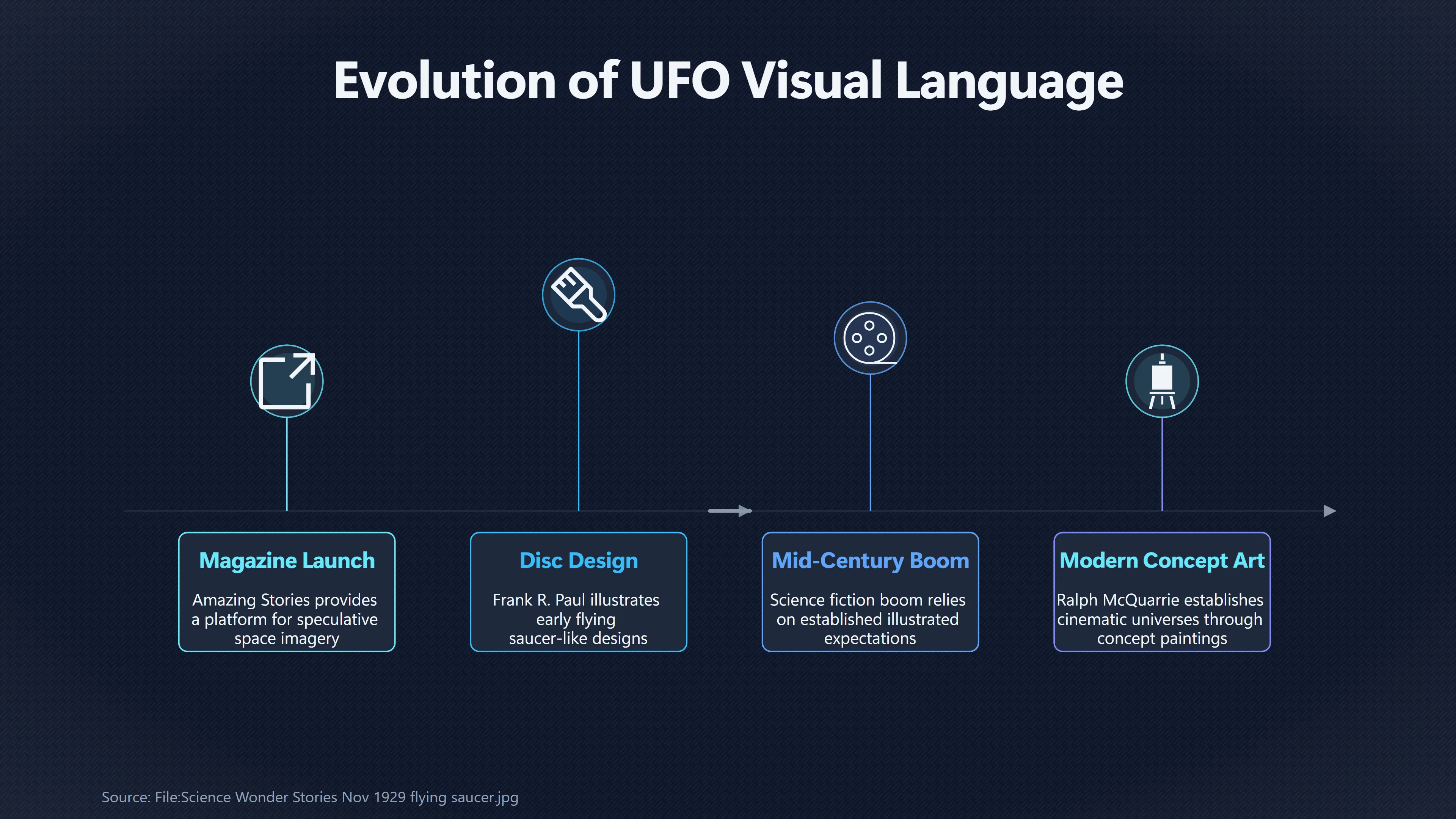
One of the most important figures in shaping science fiction’s visual language was Frank R. Paul, whose cover illustrations for magazines including Amazing Stories helped define what imagined space technology looked like before modern spacecraft existed. The magazine, launched in 1926, gave artists a platform to create images of interplanetary travel, alien environments and futuristic machines for a mass audience.[Society of Illustrators]societyillustrators.orgSociety of IllustratorsFrank R. Paul – Hall of Fame 2025 - Society of Illustrators…
Paul’s artwork often combined technical detail with dramatic spectacle. His spacecraft were usually large, brightly lit machines with clear mechanical features, designed to communicate both wonder and scientific possibility. These illustrations encouraged readers to imagine alien vehicles not as vague supernatural objects, but as engineered systems with recognizable structures, controls and propulsion methods.[Society of Illustrators]societyillustrators.orgSociety of IllustratorsFrank R. Paul – Hall of Fame 2025 - Society of Illustrators…
Some of the visual ideas associated with UFOs appeared in science fiction art before they became dominant in public reports of unexplained objects. A 1929 cover of Science Wonder Stories illustrated by Paul is frequently discussed as an early example of a flying-saucer-like design, showing that circular or disc-shaped spacecraft already existed within speculative art traditions before the term “flying saucer” became widely popular in the late 1940s.[Wikimedia Commons]commons.wikimedia.orgFile:Science Wonder Stories Nov 1929 flying saucer.jpgWikimedia CommonsFile:Science Wonder Stories Nov 1929 - flying saucer.jpg - Wikimedia Commons…
This does not mean that artwork alone created later UFO reports, but it demonstrates an important cultural process: artists supplied audiences with ready-made ways of imagining unfamiliar objects. When people encountered descriptions of strange aerial phenomena, science fiction imagery provided a familiar visual framework for interpreting them.[Wikimedia Commons]commons.wikimedia.orgFile:Science Wonder Stories Nov 1929 flying saucer.jpgWikimedia CommonsFile:Science Wonder Stories Nov 1929 - flying saucer.jpg - Wikimedia Commons…
Paperback covers turned spacecraft into everyday symbols
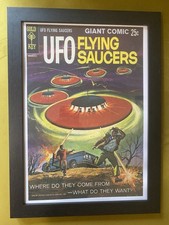
As science fiction moved beyond specialist magazines into affordable paperback editions, cover art brought UFO imagery to a much wider audience. Illustrated covers had to communicate a complete story in a single image, so artists relied on instantly recognisable elements: distant planets, glowing spacecraft, alien landscapes and dramatic encounters between humans and unknown beings.[BOOK RIOT]bookriot.comBOOK RIOTA History of Sci-Fi Book Cover TrendsBOOK RIOTA History of Sci-Fi Book Cover Trends
The importance of these covers was not only artistic but commercial. A reader browsing a bookshop might encounter dozens of imagined futures through cover paintings before ever seeing a science fiction film. The repeated appearance of similar spacecraft designs gradually made certain forms feel natural: smooth metallic surfaces, domed cockpits, glowing engines and hovering movement became visual shortcuts for alien technology.[BOOK RIOT]bookriot.comBOOK RIOTA History of Sci-Fi Book Cover TrendsBOOK RIOTA History of Sci-Fi Book Cover Trends
Recurring visual formulas
Science fiction artwork created UFO expectations by repeating a small number of powerful visual ideas. These formulas worked because they translated abstract concepts — alien intelligence, technological superiority and unknown destinations — into images that audiences could immediately understand.
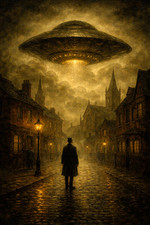
The hovering craft. Many illustrations presented alien vehicles suspended above Earth rather than travelling like ordinary aircraft. This created a sense that UFOs operated according to unfamiliar technology. The ability to hover, appear silently and ignore normal aviation rules became one of the strongest visual markers of alien presence.
The glowing encounter. Artists frequently used bright illumination against dark skies to separate alien technology from ordinary human machines. Later films adopted this approach because light could suggest mystery, scale and otherworldly power without requiring complex explanations.
The advanced but recognisable machine. Early science fiction artists often designed spacecraft that looked futuristic while borrowing from familiar engineering principles. They used windows, landing systems, antennae, engines and control areas to make imaginary vehicles appear believable. This balance between the familiar and the impossible became central to later UFO design.
The human viewpoint. Many illustrations placed small human figures beneath enormous spacecraft. The comparison of scale communicated vulnerability and wonder, turning the UFO into a symbol of humanity confronting something larger than itself.
These repeated patterns mattered because audiences learned them visually. By the time films began creating their own alien spacecraft, viewers already understood the emotional meaning of a glowing object descending from the sky or a vast machine appearing above a landscape.

Artwork influencing later films
The transition from illustration to cinema was not a simple replacement of one medium by another. Film-makers often drew directly from the traditions established by science fiction artists, adapting illustrated concepts into moving images.
The 1950s science fiction boom relied heavily on imagery that had already circulated through magazines and books. Films featuring alien machines, distant worlds and mysterious visitors benefited from decades of audience familiarity with illustrated science fiction. The artwork had already established expectations about what alien technology should communicate: power, mystery and a sense of technological advancement.
A later example can be seen in the relationship between concept art and film production. Artists working on major science fiction films often created images that shaped how audiences would eventually see fictional spacecraft on screen. Ralph McQuarrie’s concept paintings for Star Wars demonstrate how artwork could establish an entire cinematic universe before filming began, creating visual designs that guided production choices.[StarWars.com]starwars.comCelebrating a Master: Inside Star Wars Art: Ralph McQuarrie | StarWars.comSeptember 20, 2016…
Although Star Wars focused on space adventure rather than UFO encounters specifically, its development shows the continuing role of artwork as a bridge between imagination and cinema. Concept illustrations do not merely represent finished films; they can determine the appearance, atmosphere and emotional tone of the worlds that films create.[StarWars.com]starwars.comCelebrating a Master: Inside Star Wars Art: Ralph McQuarrie | StarWars.comSeptember 20, 2016…
The same principle shaped UFO imagery in films such as Close Encounters of the Third Kind (1977), where the spacecraft’s appearance depended on creating a sense of awe rather than simply presenting a machine. The tradition of using light, scale and unusual forms to make alien craft feel extraordinary had deep roots in earlier science fiction illustration.
The lasting effect of illustrated UFOs
Science fiction artwork did not establish a single permanent design for UFOs, but it created a collection of expectations that remain influential. The classic flying saucer, the glowing arrival scene and the enormous alien vessel are not purely products of film; they were developed through decades of illustrated speculation.
The lasting significance of this artwork lies in how it shaped imagination before evidence was available. Illustrators gave physical form to ideas that could not be observed directly, allowing readers to picture possible encounters with extraterrestrial technology. Later films inherited these visual conventions because they already carried emotional meaning for audiences.
In this sense, science fiction artwork acted as a testing ground for alien visions. Before cameras, special effects and digital graphics brought UFOs to life on screen, artists had already taught generations how to look at the sky and imagine something unknown arriving from beyond Earth.
Amazon book picks
Further Reading
Books and field guides related to How UFO Art Shaped Alien Visions. Use these as the next step if you want deeper reading beyond the article.
Science Fiction of the 20th Century: An Illustrated History
Newly reprinted and redesigned, this special edition is vividly illustrated with images of film posters, magazines, and books. From dime...
The Art of the Pulps: An Illustrated History
Experts in the ten major Pulp genres, from action Pulps to spicy Pulps and more, chart for the first time the complete history of Pulp ma...
Pulp Art: Original Cover Paintings for the Great American Pul...
The American pulp magazines of the 1930s, '40s, and '50s had some of the most colorful, exciting, and memorable covers ever to appear in...
eBay marketplace picks
Marketplace Samples
Live-tested eBay searches with available results related to this page.
Selected fromUFO art print oneBay.co.uk.
Endnotes
1.
Source: commons.wikimedia.org
Title: File:Science Wonder Stories Nov 1929 flying saucer.jpg
Link:https://commons.wikimedia.org/wiki/File%3AScience_Wonder_Stories_Nov_1929_-_flying_saucer.jpg
Source snippet
Wikimedia CommonsFile:Science Wonder Stories Nov 1929 - flying saucer.jpg - Wikimedia Commons...
2.
Source: starwars.com
Link:https://www.starwars.com/news/celebrating-a-master-inside-star-wars-art-ralph-mcquarrie
Source snippet
Celebrating a Master: Inside Star Wars Art: Ralph McQuarrie | StarWars.comSeptember 20, 2016...
Published: September 20, 2016
3.
Source: commons.wikimedia.org
Title: Category:Science fiction magazine covers
Link:https://commons.wikimedia.org/wiki/Category%3AScience_fiction_magazine_covers
4.
Source: starwars.com
Title: How To Spot a Ralph Mc Quarrie | Star Wars.com
Link:https://www.starwars.com/news/how-to-spot-a-ralph-mcquarrie
5.
Source: commons.wikimedia.org
Title: File:Amazing Stories October 1957.jpg
Link:https://commons.wikimedia.org/wiki/File%3AAmazing_Stories_October_1957.jpg
Published: October 1957
6.
Source: omeka.drew.edu
Title: featured fears
Link:https://omeka.drew.edu/exhibits/show/featured-fears
7.
Source: societyillustrators.org
Link:https://societyillustrators.org/award-winners/frankrpaul/
Source snippet
Society of IllustratorsFrank R. Paul – Hall of Fame 2025 - Society of Illustrators...
8.
Source: bookriot.com
Title: BOOK RIOTA History of Sci-Fi Book Cover Trends
Link:https://bookriot.com/history-of-sci-fi-book-cover-trends/
9.
Source: amazingstories.com
Title: Amazing Stories Spaceships from the Covers of the V1N1 Collection
Link:https://amazingstories.com/2023/09/spaceships-from-the-covers-of-the-v1n1-collection/
Source snippet
Amazing StoriesSpaceships from the Covers of the V1N1 Collection - Amazing StoriesSeptember 2, 2023...
Published: September 2, 2023
10.
Source: amazingstories.com
Title: Favorite Magazine Covers (from my collection)
Link:https://amazingstories.com/2023/08/favorite-magazine-covers-from-my-collection/
11.
Source: amazingstories.com
Title: The Very First
Link:https://amazingstories.com/2016/08/the-very-first/
12.
Source: amazingstories.com
Title: I Dreamed I Saw the Silver Spaceships
Link:https://amazingstories.com/2013/01/i-dreamed-i-saw-the-silver-spaceships%E2%80%A8/
13.
Source: tcm.com
Title: Close Encounters Of The Third Kind
Link:https://www.tcm.com/articles/18629/close-encounters-of-the-third-kind-close-encounters-of-the-third-kind
14.
Source: criterion.com
Title: Close Encounters of the Third Kind | Current | The Criterion Collection
Link:https://www.criterion.com/current/posts/877-close-encounters-of-the-third-kind
15.
Source: ultimatepopculture.fandom.com
Title: Flying saucer
Link:https://ultimatepopculture.fandom.com/wiki/Flying_saucer
16.
Source: starwars.fandom.com
Title: Ralph Mc Quarrie
Link:https://starwars.fandom.com/wiki/Ralph_McQuarrie
17.
Source: astro-boy-productions.fandom.com
Title: Close Encounters of the Third Kind
Link:https://astro-boy-productions.fandom.com/wiki/Close_Encounters_of_the_Third_Kind
Additional References
18.
Source: dailyartmagazine.com
Title: The Artist Behind Star Wars—Ralph Mc Quarrie’s Concept Art
Link:https://www.dailyartmagazine.com/ralph-mcquarrie-concept-art-star-wars/
Source snippet
The Artist Behind Star Wars—Ralph McQuarrie's Concept ArtMay 4, 2026 — THE ARTIST BEHIND STAR WARS—HOW RALPH MCQUARRIE CREATED THE ICONIC...
Published: May 4, 2026
19.
Source: airandspace.si.edu
Title: Visitors to the National Air and Space Museum’s Steven
Link:https://airandspace.si.edu/air-and-space-quarterly/issue-18/hollywood-close-encounters-model
Source snippet
Mothership’s Stowaways | National Air and Space MuseumMarch 10, 2026 — Air & Space Quarterly THE MOTHERSHIP’S STOWAWAYS Mar 10, 2026 By M...
Published: March 10, 2026
20.
Source: youtube.com
Link:https://www.youtube.com/watch?v=jUzzNL6iCUg
Source snippet
Frank R Paul: Father of Science Fiction Art This video explores the work of illustrator Frank R. Paul, whose pioneering cover art for pul...
21.
Source: manuscriptsandmore.liverpool.ac.uk
Link:https://manuscriptsandmore.liverpool.ac.uk/science-fiction-at-100/
Source snippet
Fiction at 100 – Manuscripts and MoreApril 28, 2026 — MANUSCRIPTS AND MORE SPECIAL COLLECTIONS & ARCHIVES AT THE UNIVERSITY OF LIVERPOOL...
Published: April 28, 2026
22.
Source: youtube.com
Title: The AMAZING STORIES of the PULP MAGAZINES AGE
Link:https://www.youtube.com/watch?v=_TAZkrwmKN8
Source snippet
Pulp Science: A Brief History of Science Fiction Magazines...
23.
Source: downthetubes.net
Link:https://downthetubes.net/artist-spotlight-frank-r-paul-the-father-of-science-fiction-illustrators/
24.
Source: pulpmags.org
Link:https://www.pulpmags.org/content/info/astounding-stories.html
25.
Source: theguardian.com
Link:https://www.theguardian.com/film/gallery/2020/sep/22/ron-cobb-films-in-pictures-alien-back-to-the-future
26.
Source: tandfonline.com
Link:https://www.tandfonline.com/doi/full/10.1080/02666286.2025.2481787
27.
Source: openculture.com
Link:https://www.openculture.com/2020/02/jules-vernes-voyages-extraordinaires.html