Within Kenneth Arnold
How Newspapers Built the Saucer Image
Newspaper coverage turned an ambiguous aerial report into a memorable image that connected UFO sightings with science fiction ideas.
On this page
- Reporters and the first flying saucer headlines
- The spread of a new public phrase
- Media influence on later UFO descriptions
Page outline Jump by section
Introduction
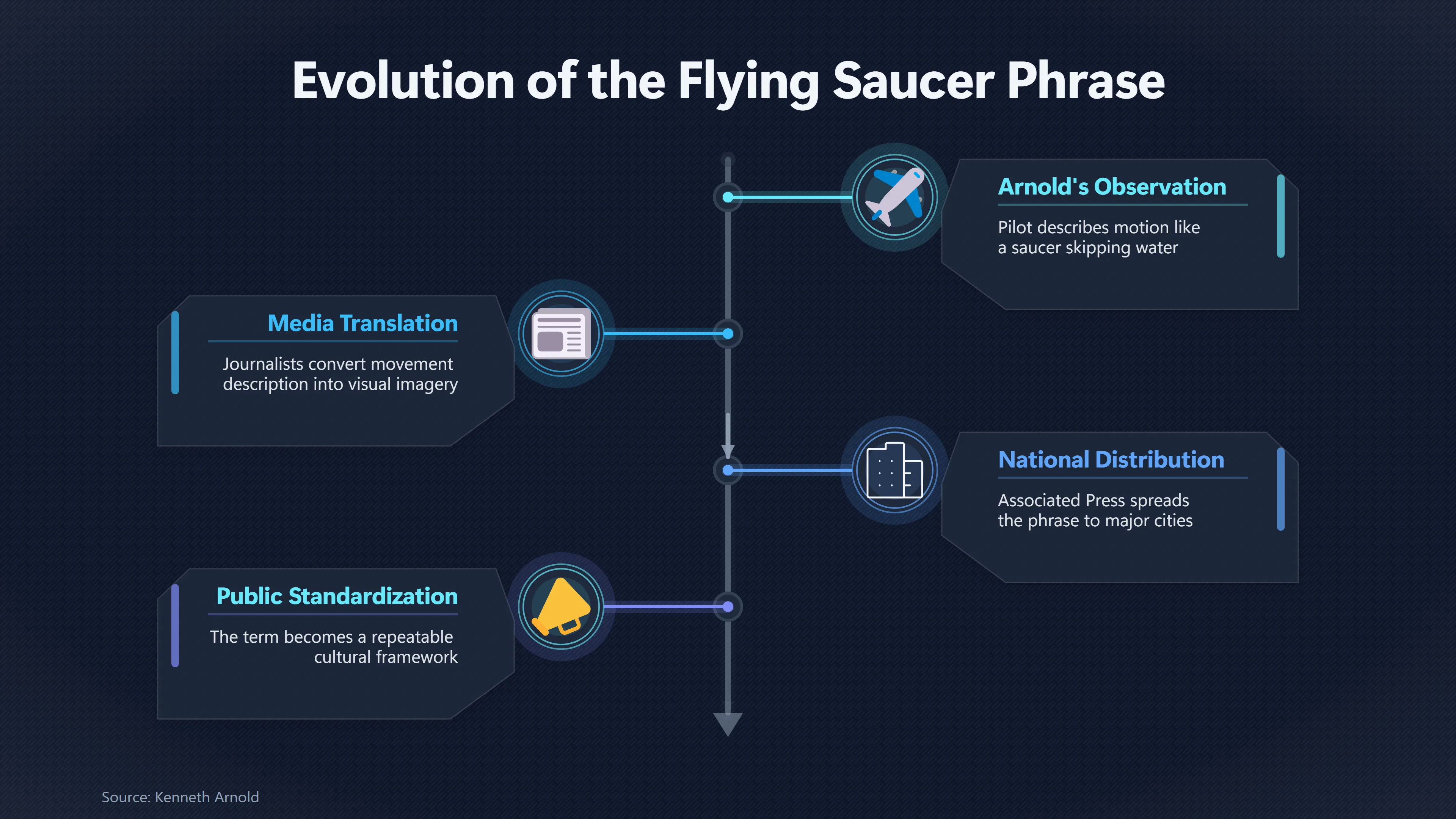
The flying saucer became a cultural symbol not because Kenneth Arnold described a clear disc-shaped craft, but because newspapers converted an ambiguous observation into a powerful visual phrase. In June 1947, Arnold reported seeing unusual objects moving near Mount Rainier and compared their motion to “a saucer if you skip it across water”. Journalists transformed that comparison about movement into an image of saucer-like vehicles, creating a phrase that quickly became attached to unidentified aerial phenomena.[HISTORY]history.comKenneth ArnoldKenneth Arnold - UFO, 1947 & Flying Saucer | HISTORYFebruary 22, 2010…
This media transformation created a bridge between UFO reports and science fiction. The phrase “flying saucer” gave the public a simple mental picture for something that had previously been difficult to describe. Newspapers, magazines, films and television then reinforced that picture until the saucer-shaped spacecraft became one of the most recognisable symbols of imagined alien technology.[Smithsonian Air and Space Museum]airandspace.si.edu1947 year flying saucerSmithsonian Air and Space Museum1947: Year of the Flying Saucer | National Air and Space Museum…
Reporters and the first flying saucer headlines
The crucial change happened between Arnold’s spoken account and its appearance in print. On 24 June 1947, Arnold, an experienced pilot, reported seeing a formation of unusual objects while flying in Washington State. When he described how they moved, he used a comparison involving a saucer skipping across water. The phrase was memorable, but it did not originally mean that the objects themselves were shaped like dishes.[HISTORY]history.comKenneth ArnoldKenneth Arnold - UFO, 1947 & Flying Saucer | HISTORYFebruary 22, 2010…
Reporters needed a short description that could communicate a strange event quickly to a mass audience. The resulting wording fitted the needs of newspaper headlines: it was visual, unusual and easy to remember. The Associated Press carried the story widely, and newspapers soon adopted “flying saucer” as a label for Arnold’s sighting. The Chicago Sun published the headline “Supersonic Flying Saucers Sighted by Idaho Pilot”, helping turn the phrase into a national expression.[Smithsonian Air and Space Museum]airandspace.si.edu1947 year flying saucerSmithsonian Air and Space Museum1947: Year of the Flying Saucer | National Air and Space Museum…
The headline-friendly nature of the phrase was a major part of its success. “Unidentified aerial objects” was accurate but abstract; “flying saucer” immediately suggested an object with a shape, direction and possible origin. The media did not simply report a mystery — it supplied the public with an image through which future mysteries could be understood.[National Archives]archives.govNational ArchivesPublic Interest in UFOs Persists 50 Years After Project Blue Book Termination | National ArchivesDecember 5, 2019…
This process also shows why the flying saucer was different from many earlier stories about strange things in the sky. The key innovation was not only the sighting itself, but the creation of a repeatable cultural term. Once newspapers established the phrase, later witnesses, editors and illustrators had a ready-made framework for describing unfamiliar aerial events.[Smithsonian Air and Space Museum]airandspace.si.edu1947 year flying saucerSmithsonian Air and Space Museum1947: Year of the Flying Saucer | National Air and Space Museum…
The spread of a new public phrase
The phrase spread rapidly because it arrived at a moment when audiences were already fascinated by aviation, rockets and the possibility of advanced technology. The Second World War had demonstrated the speed of technological change, while post-war science fiction was increasingly exploring space travel, alien worlds and futuristic machines. The flying saucer image connected these fictional ideas with a real-world news story.[CIA]cia.govHow To Investigate a Flying SaucerHow To Investigate a Flying Saucer - CIAJanuary 21, 2016…
Newspapers also encouraged a feedback loop. Once “flying saucer” became familiar, reports of other unexplained objects were often described using the same vocabulary. The term shaped expectations: people encountering unusual lights or objects increasingly interpreted them through the image of a mysterious craft. The public symbol began influencing the descriptions it was meant to represent.[National Archives]archives.govNational ArchivesPublic Interest in UFOs Persists 50 Years After Project Blue Book Termination | National ArchivesDecember 5, 2019…
The transformation was not limited to newspapers. Popular magazines, illustrations and advertisements helped standardise the appearance of the saucer as a metallic disc or dome-shaped vehicle. Although Arnold’s own later drawings did not match the classic saucer image, the simplified disc design proved far more useful for storytelling and visual communication.[Smithsonian Air and Space Museum]airandspace.si.edu1947 year flying saucerSmithsonian Air and Space Museum1947: Year of the Flying Saucer | National Air and Space Museum…
The phrase also gained institutional significance. As reports increased after 1947, the US government began investigating unidentified aerial reports, first through Project Sign and later through Project Blue Book. These official investigations did not create the saucer image, but their existence reinforced the idea that flying saucers were a major public phenomenon worthy of attention.[CIA]cia.govHow To Investigate a Flying SaucerHow To Investigate a Flying Saucer - CIAJanuary 21, 2016…

Media influence on later UFO descriptions
Once established, the flying saucer became a visual shorthand for alien visitation in science fiction. Films of the 1950s used the disc-shaped craft because audiences already understood what it represented. Movies such as The Flying Saucer (1950), The Day the Earth Stood Still (1951) and Earth vs. the Flying Saucers (1956) helped merge UFO reports with familiar science-fiction themes of alien contact, invasion and futuristic technology.[Wikipedia]WikipediaThe Flying SaucerThe Flying Saucer
The influence worked in both directions. Science fiction borrowed the flying saucer from UFO culture, while fictional portrayals strengthened the public expectation that mysterious aerial objects should look like saucers. The result was a shared image used by journalists, filmmakers and witnesses alike. A sighting report no longer existed in isolation; it was interpreted against decades of popular imagery.[Wikipedia]WikipediaFlying saucerFlying saucer
The cultural power of the saucer came from its simplicity. A disc-shaped craft suggested advanced engineering without requiring technical explanation. It looked unlike conventional aircraft, yet it was instantly recognisable as a machine. For science fiction creators, it offered a perfect visual symbol of a technology beyond human capability. For the public, it provided a memorable shape for the unknown.[Classic Film Noir]classicfilmnoir.comthe flying saucer 1950Classic Film NoirThe Flying Saucer (1950) - Film Noir…
The legacy of the 1947 media shift is that “flying saucer” became more than a description of an object. It became a cultural category linking eyewitness reports, government investigations and science-fiction imagination. The phrase created a shared language for discussing possible visitors from beyond Earth, even though the original event that inspired it was far less visually definite than the symbol that followed.[Smithsonian Air and Space Museum]airandspace.si.edu1947 year flying saucerSmithsonian Air and Space Museum1947: Year of the Flying Saucer | National Air and Space Museum…
Amazon book picks
Further Reading
Books and field guides related to How Newspapers Built the Saucer Image. Use these as the next step if you want deeper reading beyond the article.
UFOs
NEW YORK TIMES BESTSELLER • Impeccably researched, this riveting journalistic investigation separates fact from fiction, and documents th...
The War of the Worlds
The War of the Worlds (1898), by H. G. Wells, is an early science fiction novel which describes an invasion of England by aliens from Mar...
The UFO Experience: A Scientific Inquiry
Cited by the New York Review of Books as "the best brief for visitation," this classic study presents an analysis of UFO reports and conc...
eBay marketplace picks
Marketplace Samples
Live-tested eBay searches with available results related to this page.
Selected fromufo collectible oneBay.co.uk.
Endnotes
1.
Source: history.com
Title: Kenneth Arnold
Link:https://www.history.com/articles/kenneth-arnold
Source snippet
Kenneth Arnold - UFO, 1947 & Flying Saucer | HISTORYFebruary 22, 2010...
Published: February 22, 2010
2.
Source: Wikipedia
Title: Flying saucer
Link:https://en.wikipedia.org/wiki/Flying_saucer
3.
Source: archives.gov
Link:https://www.archives.gov/news/articles/project-blue-book-50th-anniversary
Source snippet
National ArchivesPublic Interest in UFOs Persists 50 Years After Project Blue Book Termination | National ArchivesDecember 5, 2019...
Published: December 5, 2019
4.
Source: cia.gov
Title: How To Investigate a Flying Saucer
Link:https://www.cia.gov/stories/story/how-to-investigate-a-flying-saucer/
Source snippet
How To Investigate a Flying Saucer - CIAJanuary 21, 2016...
Published: January 21, 2016
5.
Source: prologue.blogs.archives.gov
Link:https://prologue.blogs.archives.gov/2019/12/19/saucers-over-washington-the-history-of-project-blue-book/
6.
Source: Wikipedia
Title: The Flying Saucer
Link:https://en.wikipedia.org/wiki/The_Flying_Saucer
7.
Source: archives.gov
Title: Project BLUE BOOK
Link:https://www.archives.gov/research/military/air-force/ufos
8.
Source: history.com
Title: [j allen hynek]({{ ‘j-allen-hynek/’ | relative_url }}) ufos project blue book
Link:https://www.history.com/articles/j-allen-hynek-ufos-project-blue-book
9.
Source: history.com
Title: Project Blue Book
Link:https://www.history.com/articles/project-blue-book
10.
Source: airandspace.si.edu
Title: 1947 year flying saucer
Link:https://airandspace.si.edu/stories/editorial/1947-year-flying-saucer
Source snippet
Smithsonian Air and Space Museum1947: Year of the Flying Saucer | National Air and Space Museum...
11.
Source: en.wikiquote.org
Title: Kenneth Arnold
Link:https://en.wikiquote.org/wiki/Kenneth_Arnold
Source snippet
Kenneth Arnold - Wikiquote...
12.
Source: classicfilmnoir.com
Title: the flying saucer 1950
Link:https://www.classicfilmnoir.com/2024/01/the-flying-saucer-1950.html
Source snippet
Classic Film NoirThe Flying Saucer (1950) - Film Noir...
13.
Source: media.nationalarchives.gov.uk
Title: nationalarchives.gov.uk The Cold War and UFOs | The National Archives
Link:https://media.nationalarchives.gov.uk/index.php/cold-war-ufos/
14.
Source: media.nationalarchives.gov.uk
Link:https://media.nationalarchives.gov.uk/index.php/ufo-files-national-archives/
15.
Source: historylink.org
Link:https://www.historylink.org/File/5336
16.
Source: ultimatepopculture.fandom.com
Title: Flying saucer
Link:https://ultimatepopculture.fandom.com/wiki/Flying_saucer
17.
Source: jhmovie.fandom.com
Title: Flying saucer
Link:https://jhmovie.fandom.com/wiki/Flying_saucer
18.
Source: thelivingmoon.com
Title: Kenneth Arnold
Link:https://www.thelivingmoon.com/49ufo_files/03files2/1947_Kenneth_Arnold.html
19.
Source: priory-of-sion.com
Title: Supersonic Flying Saucers Sighted by Idaho Pilot
Link:https://www.priory-of-sion.com/biblios/links/arnold.html
Additional References
20.
Source: wired.com
Title: how ufo [sightings]({{ ‘sightings/’ | relative_url }}) became an american obsession
Link:https://www.wired.com/story/how-ufo-sightings-became-an-american-obsession
Source snippet
The period following his sighting saw a surge in UFO sightings across the U.S. This surge, or "flap," is linked to societal fears of inva...
21.
Source: uapinvestigations.com
Title: kenneth arnold 1947 mount rainier 2
Link:https://uapinvestigations.com/kenneth-arnold-1947-mount-rainier-2/
Source snippet
IMMEDIATE AFTERMATH: HOW “FLYING SAUCER” ENTERED THE LEXICON JUNE 25, 1947 – THE FIRST ARTICLE Bill Bequette of the East Oregonian (Pendl...
Published: June 25, 1947
22.
Source: youtube.com
Title: Where Did The Term ‘Flying Saucer’ Come From? | Mossback’s Northwest
Link:https://www.youtube.com/watch?v=ap0whDDDU1Y
Source snippet
24th June 1947: The first widely-reported UFO sighting was made by private pilot Kenneth Arnold...
Published: June 1947
23.
Source: youtube.com
Link:https://www.youtube.com/watch?v=01sVLTO8xmo
Source snippet
Roswell, 1947: The Crash That Launched UFO Culture...
Published: June 1947
24.
Source: youtube.com
Link:https://www.youtube.com/watch?v=RbbiPBaNZrg
Source snippet
The UFO Deluge of July 4th, 1947 | Part 1: Omens (Before the Storm)...
25.
Source: llewellyn.com
Link:https://www.llewellyn.com/encyclopedia/term/Flying%2BSaucer
26.
Source: hangar1publishing.com
Link:https://hangar1publishing.com/blogs/ufos-uaps-and-aliens/flying-saucers
27.
Source: spaceagemuseum.com
Link:https://www.spaceagemuseum.com/flying-saucers
28.
Source: grumpire.com
Link:https://www.grumpire.com/out-of-the-sky-how-earth-vs-the-flying-saucers-1956-channeled-war-trauma-into-cinematic-fantasy/
29.
Source: everything.explained.today
Link:https://everything.explained.today/Flying_saucer/