Within Early science fiction
Why Flying Saucers Became Iconic
The flying saucer became powerful because its simple shape suggested a mysterious technology unlike ordinary aircraft.
On this page
- The appeal of the disc shape
- Human aircraft versus alien craft
- Saucers in science fiction
Page outline Jump by section
Introduction
The flying saucer became an enduring symbol of alien technology because its shape communicated one powerful idea: a machine that did not belong to ordinary human aviation. A disc with a smooth, featureless surface looked unlike the aircraft people knew in the 1940s and 1950s, allowing writers, filmmakers and the public to associate it with hidden capabilities, advanced engineering and visitors from elsewhere. The shape was not created by proof of extraterrestrial craft; rather, it grew through a feedback loop between unusual sighting reports, science-fiction imagery and popular culture.[Origins]origins.osu.eduOrigins The Air Force Investigation into UFOs | OriginsOrigins The Air Force Investigation into UFOs | Origins
The saucer’s importance was therefore symbolic as much as technological. Its simplicity made it easy to recognise, easy to reproduce and difficult to explain using familiar categories. A rocket resembled a future version of human engineering, while a flying saucer suggested a technology based on principles humanity had not discovered. That visual gap helped transform the disc shape into the standard language of alien machines.[HISTORY]history.comProject Blue BookProject Blue Book - Alien, Definition & Files | HISTORYFebruary 22, 2010…
The appeal of the disc shape
A saucer was powerful because it looked both familiar and impossible. The word itself came from everyday experience: people understood a saucer as a simple household object, yet a giant metallic version moving through the sky seemed completely out of place. This combination created an immediate contrast between the ordinary and the unknown.
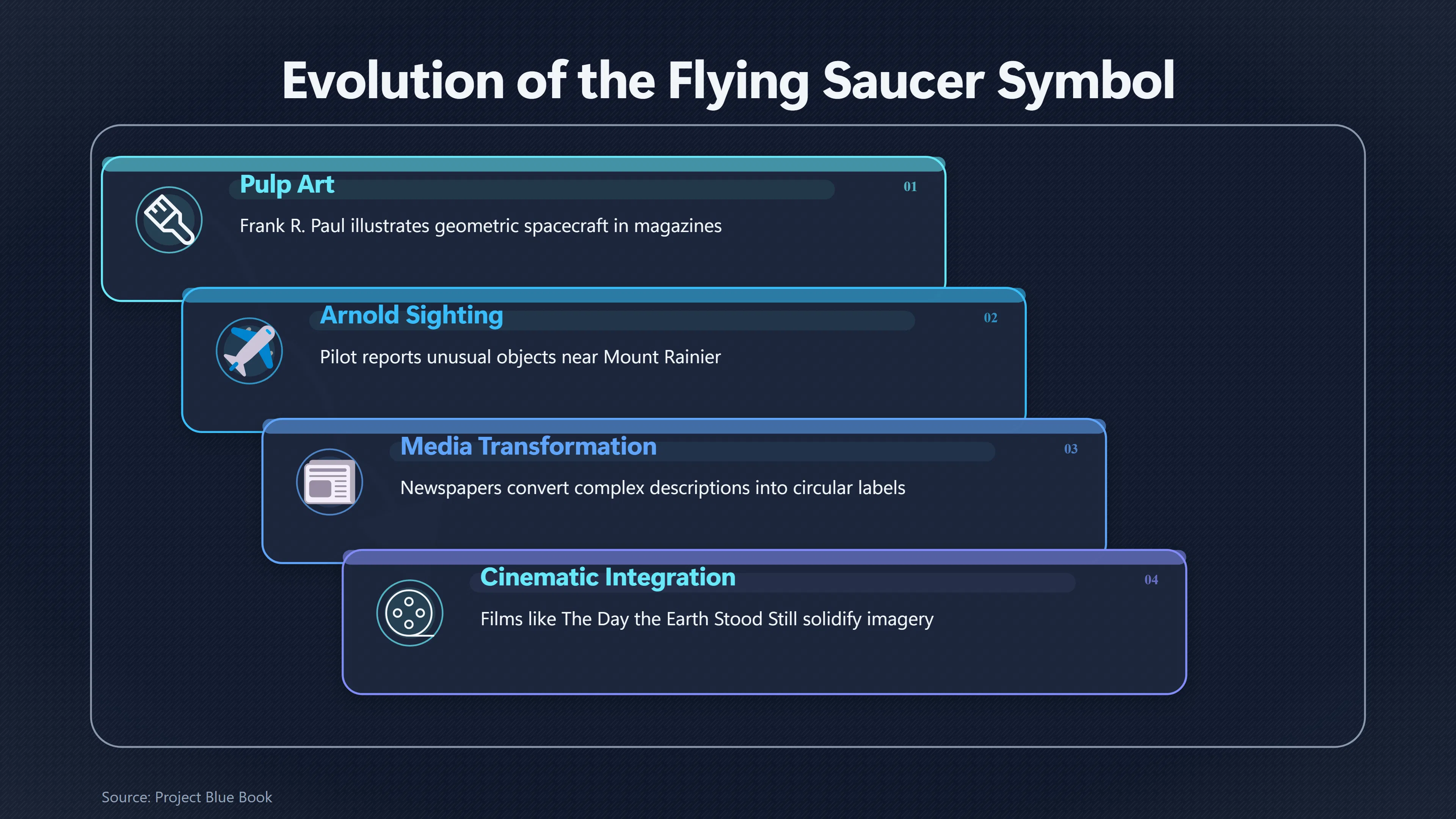
The modern association began with the 1947 sighting of pilot Kenneth Arnold, whose report of unusual objects near Mount Rainier was widely publicised. Although Arnold’s own description was more complicated than a simple circular craft, newspaper language transformed the event into the idea of “flying saucers”, giving the public a memorable visual label.[HISTORY]history.comKenneth ArnoldKenneth Arnold - UFO, 1947 & Flying Saucer | HISTORYFebruary 22, 2010…
The disc shape also worked well as a symbol because it avoided the design features of existing aircraft. Conventional planes had wings, tails and visible engines; rockets had pointed noses and exhaust systems. A saucer appeared self-contained, with no obvious propulsion method or control surfaces. For audiences encountering the image in fiction, this absence became evidence of imagined superiority: the machine seemed to operate through technology beyond human understanding.
Science-fiction artists had already explored unusual spacecraft designs before the UFO era. Illustrators such as Frank R. Paul created imaginative vehicles for pulp science-fiction magazines, helping establish a visual culture in which strange geometric spacecraft represented future possibilities. A 1929 cover of Science Wonder Stories by Paul is often cited as an early example of a saucer-like spacecraft appearing in popular science fiction imagery.[Wikimedia Commons]commons.wikimedia.orgFile:Science Wonder Stories Nov 1929 flying saucer.jpgWikimedia CommonsFile:Science Wonder Stories Nov 1929 - flying saucer.jpg - Wikimedia Commons…
Human aircraft versus alien craft
The flying saucer became meaningful partly because it challenged the design logic of real aircraft. Early aviation was shaped by visible engineering problems: wings generated lift, propellers or jets provided thrust, and pilots needed clear systems for control. The saucer appeared to bypass those constraints.
This difference made the shape attractive to science fiction because it visually separated alien intelligence from human progress. A futuristic human spacecraft could be imagined as a better rocket or a faster aircraft, but an alien saucer implied a completely different technological path. The design suggested not simply “more advanced machinery” but a civilisation with a different understanding of physics.
However, the saucer’s apparent technological superiority was mostly a cultural interpretation rather than an engineering conclusion. Real attempts to build saucer-like aircraft showed the difficulties of turning the image into a practical vehicle. The Canadian-built Avro VZ-9 Avrocar, developed in the 1950s as a genuine “flying saucer” aircraft concept, struggled with stability and performance problems and was eventually cancelled.[arXiv]arxiv.orgarXiv Avrocar: a real flying saucerAvrocar: a real flying saucerJuly 24, 2015…
This contrast reveals why the saucer worked better as an alien symbol than as a human aircraft design. Its strength was not aerodynamic efficiency but visual communication. The shape told audiences that the builders of the craft possessed knowledge beyond current human capabilities.
Saucers in science fiction
Science fiction cemented the flying saucer’s association with alien technology by repeatedly using the design as a visual shortcut for first contact. Films and television adopted the disc because audiences instantly understood what it represented: a visitor from another world.
One of the most influential examples was The Day the Earth Stood Still, in which the alien Klaatu arrives on Earth in a sleek flying saucer that lands in Washington, D.C. The spacecraft’s smooth, metallic appearance reinforced the idea that alien technology was advanced, controlled and mysterious rather than simply a larger version of human machinery.[IMDb]imdb.comThe Day the Earth Stood Still (1951) - FAQ - IMDb…
Later films continued to use saucers for different purposes. In invasion stories, the disc could represent overwhelming power because it appeared capable of arriving anywhere without warning. In more optimistic stories, the same shape could represent exploration and communication. The design became flexible: it could suggest threat, wonder or curiosity depending on the story.
The relationship between UFO reports and science fiction was therefore not a simple case of fiction predicting reality. Instead, each influenced the other. Reports of unusual objects borrowed meaning from existing science-fiction imagery, while films and books used the growing UFO mythology to make their fictional spacecraft feel familiar. The result was a shared cultural image in which the flying saucer became almost inseparable from the idea of alien technology.[AP News]apnews.comsince World War II has been a blend of sightings, investigations, and cultural fascination. The saga began with Kenneth Arnold's 1947 sig…
Why the saucer remains the alien machine
The flying saucer survived because it solved a storytelling problem: how to show technology that humans cannot fully understand. Its circular form is instantly recognisable but leaves unanswered questions. How does it fly? Where is the engine? How does it travel between worlds? Those unanswered questions are exactly what make the design effective.
The shape also became a cultural shorthand. A disc in the sky requires very little explanation; audiences immediately connect it with extraterrestrial possibilities. Even when modern science fiction chooses different spacecraft designs, the classic saucer remains the reference point against which alien machines are compared.
The lasting power of the flying saucer is therefore not based on evidence that alien craft use that form. It comes from the way the design captured a twentieth-century idea of the future: a technology so advanced that it appears almost impossible. The saucer became a symbol because it looked like a machine humanity could imagine, but not yet build.
Amazon book picks
Further Reading
Books and field guides related to Why Flying Saucers Became Iconic. Use these as the next step if you want deeper reading beyond the article.
The War of the Worlds
The War of the Worlds (1898), by H. G. Wells, is an early science fiction novel which describes an invasion of England by aliens from Mar...
The UFO Experience: A Scientific Inquiry
Cited by the New York Review of Books as "the best brief for visitation," this classic study presents an analysis of UFO reports and conc...
UFOs: Generals, Pilots, and Government Officials Go on the Re...
NEW YORK TIMES BESTSELLER • Impeccably researched, this riveting journalistic investigation separates fact from fiction, and documents th...
Flying Saucers: A Modern Myth of Things Seen in the Skies
Unidentified flying objects viewed by the eminent contemporary psychoanalyst as projections of the unconscious, with analogues in legends...
eBay marketplace picks
Marketplace Samples
Live-tested eBay searches with available results related to this page.
Selected fromufo poster oneBay.co.uk.
Endnotes
1.
Source: history.com
Title: Project Blue Book
Link:https://www.history.com/articles/project-blue-book
Source snippet
Project Blue Book - Alien, Definition & Files | HISTORYFebruary 22, 2010...
Published: February 22, 2010
2.
Source: history.com
Title: Kenneth Arnold
Link:https://www.history.com/articles/kenneth-arnold
Source snippet
Kenneth Arnold - UFO, 1947 & Flying Saucer | HISTORYFebruary 22, 2010...
Published: February 22, 2010
3.
Source: commons.wikimedia.org
Title: File:Science Wonder Stories Nov 1929 flying saucer.jpg
Link:https://commons.wikimedia.org/wiki/File%3AScience_Wonder_Stories_Nov_1929_-_flying_saucer.jpg
Source snippet
Wikimedia CommonsFile:Science Wonder Stories Nov 1929 - flying saucer.jpg - Wikimedia Commons...
4.
Source: arxiv.org
Title: arXiv Avrocar: a real flying saucer
Link:https://arxiv.org/abs/1507.06916
Source snippet
Avrocar: a real flying saucerJuly 24, 2015...
Published: July 24, 2015
5.
Source: imdb.com
Link:https://www.imdb.com/title/tt0043456/faq/
Source snippet
The Day the Earth Stood Still (1951) - FAQ - IMDb...
6.
Source: imdb.com
Link:https://www.imdb.com/title/tt0247746/
7.
Source: imdb.com
Link:https://www.imdb.com/title/tt0043456/plotsummary/
8.
Source: imdb.com
Link:https://www.imdb.com/title/tt0049169/
9.
Source: imdb.com
Link:https://www.imdb.com/title/tt0049900/
10.
Source: imdb.com
Link:https://www.imdb.com/title/tt0043456/?c=1
11.
Source: origins.osu.edu
Title: Origins The Air Force Investigation into UFOs | Origins
Link:https://origins.osu.edu/read/air-force-investigation-ufos
12.
Source: Wikipedia
Title: Flying saucer
Link:https://en.wikipedia.org/wiki/Flying_saucer
13.
Source: apnews.com
Link:https://apnews.com/article/57c6c3190457d5188d59745df2e0bd3c
Source snippet
since World War II has been a blend of [sightings]({{ 'sightings/' | relative_url }}), investigations, and cultural fascination. The saga began with Kenneth Arnold's 1947 sig...
14.
Source: newyorker.com
Title: The Day the Earth Stood Still | The New Yorker
Link:https://www.newyorker.com/goings-on-about-town/movies/the-day-the-earth-stood-still
15.
Source: airandspace.si.edu
Link:https://airandspace.si.edu/learn/programs/soar-together/ufos
16.
Source: jhmovie.fandom.com
Title: Flying saucer
Link:https://jhmovie.fandom.com/wiki/Flying_saucer
17.
Source: ultimatepopculture.fandom.com
Title: Flying saucer
Link:https://ultimatepopculture.fandom.com/wiki/Flying_saucer
Additional References
18.
Source: youtube.com
Link:https://www.youtube.com/watch?v=bg58bW1oZRo
Source snippet
This video is relevant because The Origin of Flying Saucers examines how the media frenzy following early 1947 sighting reports establish...
19.
Source: youtube.com
Title: UFOs History in TV, Movies, and Pop Culture Explained
Link:https://www.youtube.com/watch?v=dGvkWAYr7a4
Source snippet
Earth VS The Flying Saucers (1956)-16 Facts About The Movie That Turned UFO Mania Into Movie History...
20.
Source: archives.gov
Link:https://www.archives.gov/news/articles/project-blue-book-50th-anniversary
21.
Source: visit.archives.gov
Title: gov50 Years Ago: Government Stops Investigating UFOs | National Archives Museum
Link:https://visit.archives.gov/whats-on/explore-exhibits/50-years-ago-government-stops-investigating-ufos
22.
Source: websites.umich.edu
Title: Websites The Day the Earth Stood Still
Link:https://websites.umich.edu/~engb415/film/Earth.html
Source snippet
UMich WebsitesThe Day the Earth Stood Still...
23.
Source: downthetubes.net
Link:https://downthetubes.net/artist-spotlight-frank-r-paul-the-father-of-science-fiction-illustrators/
24.
Source: reddit.com
Link:https://www.reddit.com/r/UFOs/comments/zrowqo/kenneth_arnold_and_his_description_of_ufos/
25.
Source: airandspace.si.edu
Link:https://airandspace.si.edu/stories/editorial/study-flying-saucer-sightings
26.
Source: gutenberg.org
Link:https://www.gutenberg.org/cache/epub/17346/pg17346.html
27.
Source: gutenberg.org
Link:https://www.gutenberg.org/files/66639/66639-h/66639-h.htm