Within UFO Fiction Exchange
Human reactions
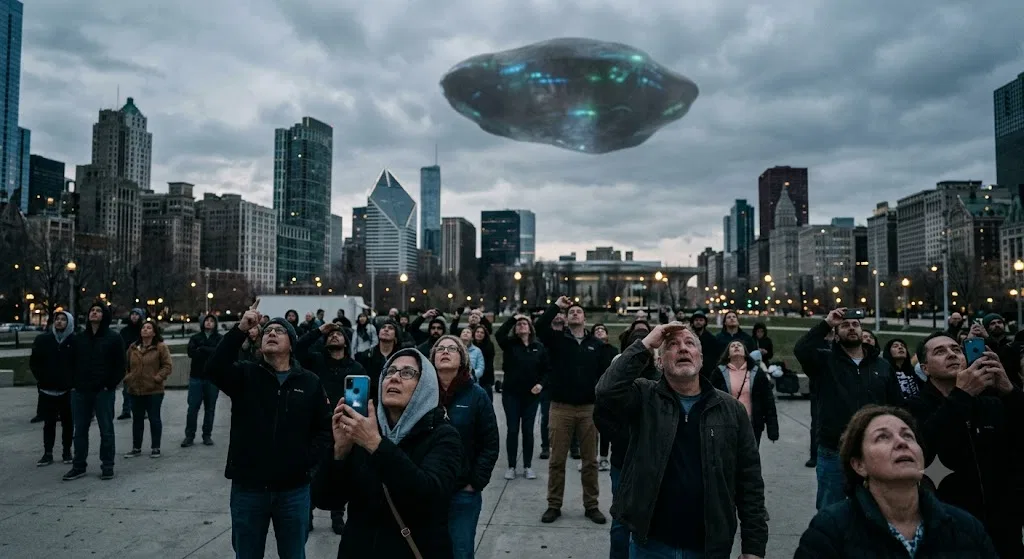
Imagined first contact with extraterrestrial intelligence has become one of science fiction’s most powerful ways of exploring human psychology and social behaviour.
Page outline Jump by section
Introduction
Imagined first contact with extraterrestrial intelligence has become one of science fiction’s most powerful ways of exploring human psychology and social behaviour. Stories about UFOs and alien visitors are rarely only about aliens; they are about how humans respond when confronted with something that challenges assumptions about safety, identity, religion, politics, science and humanity’s place in the universe. Across novels, films and public debates, imagined contact has produced recurring reactions: fear of invasion, fascination with discovery, demands for proof, attempts at communication and struggles over who should represent Earth.[AP News]apnews.comAP News Hollywood's narrative on UFOs and ETs reaches back many decadesFrom classic films like The Day the Earth Stood Still to blockbusters such as E.T. and Close Encounters of the Third Kind, cinemati…
Science fiction has provided a testing ground for these reactions long before any confirmed extraterrestrial contact has occurred. From The War of the Worlds to The Day the Earth Stood Still, fictional encounters have reflected contemporary concerns about warfare, technology and social change. These stories matter because they shape the expectations people bring to real discussions of UFOs, unidentified phenomena and the possibility of discovering life beyond Earth.[AP News]apnews.comAP News Hollywood's narrative on UFOs and ETs reaches back many decadesFrom classic films like The Day the Earth Stood Still to blockbusters such as E.T. and Close Encounters of the Third Kind, cinemati…
Why imagined contact creates such strong reactions
A first-contact scenario combines two powerful human experiences: curiosity about the unknown and anxiety about losing control. An alien civilisation represents both a scientific opportunity and a challenge to familiar ideas about human uniqueness. Science fiction often uses this tension to ask whether humanity would respond with cooperation, conflict or confusion.
The imagined arrival of an extraterrestrial intelligence also forces questions about authority. Who would speak for Earth? Would governments control information, would scientists lead communication, or would public opinion shape events? These questions are not limited to fiction. Organisations involved in the search for extraterrestrial intelligence (SETI) have developed principles for how possible discoveries should be verified and communicated, recognising that even an initial detection could have major social consequences.[IAASeti]iaaseti.orgDeclaration of Principles Concerning Activities Following the Detection of Extraterrestrial Intelligence…
Researchers studying possible contact scenarios have noted that outcomes would depend heavily on the type of encounter imagined. A distant radio signal, a message from an advanced civilisation, and a physical arrival on Earth would produce very different human responses. Discussions often reveal more about human hopes and fears than about the hypothetical visitors themselves.[arXiv]arxiv.orgWould contact with extraterrestrials benefit or harm humanity? A scenario analysisApril 22, 2011…
Fear, confusion and the power of realistic storytelling
One of the most famous examples of human reaction to imagined first contact came from Orson Welles’s 1938 radio adaptation of H. G. Wells’s The War of the Worlds. The programme presented a fictional Martian invasion through the style of emergency news reporting. Some listeners who missed the introduction understood the drama as a real event and reacted with alarm. Reports described people contacting authorities and seeking information about the supposed attack.[National Geographic]nationalgeographic.comwar of the worlds behind the panicNational Geographic'War of the Worlds': Behind the 1938 Radio Show Panic | National GeographicJune 17, 2005…
The event is often remembered as a nationwide panic, although later historical research has argued that the scale of the reaction was exaggerated. Studies of the broadcast suggest that genuine confusion occurred among some listeners, but the idea of widespread mass hysteria was amplified by contemporary media coverage and later retellings. The more important lesson for understanding human reactions is not that people universally panic, but that realistic communication formats can strongly influence how audiences interpret extraordinary claims.[Wikipedia]WikipediaThe War of the Worlds (1938 radio dramaThe War of the Worlds (1938 radio drama
The broadcast became an early example of how science-fiction scenarios can move beyond entertainment and affect public thinking about real-world possibilities. It demonstrated that people respond not only to the idea of alien contact itself, but also to the credibility of the messenger, the surrounding political atmosphere and the information environment in which the event occurs.[National Geographic]nationalgeographic.comwar of the worlds behind the panicNational Geographic'War of the Worlds': Behind the 1938 Radio Show Panic | National GeographicJune 17, 2005…
From invasion fears to hopes of communication
Early alien-contact stories often presented extraterrestrials as threats. During the twentieth century, many science-fiction narratives reflected fears about war, invasion and technological destruction. However, other works gradually shifted towards communication and mutual understanding, presenting first contact as a test of human maturity rather than simply a military crisis.
The 1951 film The Day the Earth Stood Still is a key example. Instead of portraying an alien visitor only as an attacker, it imagined contact as a warning about humanity’s use of dangerous technology and its inability to cooperate. The film used an extraterrestrial encounter to examine Cold War fears about nuclear weapons and global conflict.[Rotten Tomatoes]rottentomatoes.comRotten Tomatoes The Day the Earth Stood Still | Rotten TomatoesRotten Tomatoes The Day the Earth Stood Still | Rotten Tomatoes
Later stories such as Close Encounters of the Third Kind and Arrival continued this shift by focusing on curiosity, translation and emotional responses to the unknown. These narratives suggest that the biggest challenge of first contact may not be recognising an alien presence, but learning how to communicate across completely different forms of experience and intelligence.[AP News]apnews.comAP News Hollywood's narrative on UFOs and ETs reaches back many decadesFrom classic films like The Day the Earth Stood Still to blockbusters such as E.T. and Close Encounters of the Third Kind, cinemati…

Scientists, governments and the question of who responds
Imagined first contact often becomes a debate about expertise and trust. Science-fiction stories frequently depict governments attempting to control information, while scientists argue for careful investigation and open communication. These fictional conflicts reflect real discussions about how humanity should respond to a possible detection of extraterrestrial intelligence.
SETI researchers have developed international guidance stating that potential signals should be carefully verified before public announcements are made. The reason is not only scientific accuracy but also social responsibility: a false alarm or poorly interpreted signal could create unnecessary confusion.[IAASeti]iaaseti.orgDeclaration of Principles Concerning Activities Following the Detection of Extraterrestrial Intelligence…
At the same time, the search for extraterrestrial intelligence is influenced by public imagination. Science fiction has helped popularise ideas about alien civilisations while also creating assumptions that scientists must separate from evidence. Researchers have noted that fictional portrayals can shape how society understands space exploration, including expectations about discovery, communication and humanity’s future.[arXiv]arxiv.orgVisions of Human Futures in Space and SETIAugust 17, 2017…
The human emotions behind first-contact stories
Across different eras, science fiction repeatedly returns to a small set of emotional responses:
- Wonder: Contact represents the possibility that humanity is not alone and that the universe contains forms of life beyond current understanding.
- Fear: Alien visitors can symbolise invasion, loss of control or the consequences of encountering a more advanced civilisation.
- Hope: Some stories imagine contact as a chance for humanity to overcome divisions and see itself as part of a larger cosmic community.
- Suspicion: Narratives about secrecy and misinformation reflect concerns about whether institutions would reveal the truth.
- Self-reflection: Many first-contact stories use aliens as a mirror, asking what humanity values and how it behaves when confronted with difference.
These reactions explain why UFOs and science fiction remain closely connected. The alien visitor is often less important than the human response: the arguments, emotions and social changes that follow the possibility of discovering another intelligence.
What imagined first contact reveals about humanity
The enduring appeal of first-contact stories comes from their ability to turn an astronomical question into a human one. Whether the imagined visitors are peaceful explorers, mysterious signals or hostile invaders, the central drama usually concerns humanity’s ability to adapt.
Science fiction therefore acts as a rehearsal space for possible futures. It allows societies to explore difficult questions before they become real decisions: how evidence should be judged, how information should be shared and whether humans can respond to the unknown with cooperation rather than fear. The continuing discussion around SETI and potential extraterrestrial discovery shows that these fictional scenarios remain connected to genuine scientific and social planning.[SETI Institute]seti.orgInstitute HomeSETI InstituteHome…
Amazon book picks
Further Reading
Books and field guides related to Human reactions. Use these as the next step if you want deeper reading beyond the article.
Contact
Rating: 4.0/5 from 21 Google Books ratings
In the year 1999 a multinational team of astronauts sets out to discover the secrets of the universe.
The Three-Body Problem
The inspiration for the Netflix series 3 Body Problem! WINNER OF THE HUGO AWARD FOR BEST NOVEL Over 1 million copies sold in North Americ...
Childhood's End
Arthur C. Clarke's classic in which he ponders humanity's future and possible evolution When the silent spacecraft arrived and took the l...
The Left Hand of Darkness
Rating: 4.0/5 from 13 Google Books ratings
50TH ANNIVERSARY EDITION—WITH A NEW INTRODUCTION BY DAVID MITCHELL AND A NEW AFTERWORD BY CHARLIE JANE ANDERS Ursula K. Le Guin’s groundb...
eBay marketplace picks
Marketplace Samples
Live-tested eBay searches with available results related to this page.
Selected fromalien poster oneBay.co.uk.



Endnotes
1.
Source: seti.org
Title: Institute Home
Link:https://www.seti.org/
Source snippet
SETI InstituteHome...
2.
Source: iaaseti.org
Link:https://iaaseti.org/en/declaration-principles-concerning-activities-following-detection/
Source snippet
Declaration of Principles Concerning Activities Following the Detection of Extraterrestrial Intelligence...
3.
Source: arxiv.org
Link:https://arxiv.org/abs/1104.4462
Source snippet
Would contact with extraterrestrials benefit or harm humanity? A scenario analysisApril 22, 2011...
Published: April 22, 2011
4.
Source: Wikipedia
Title: The War of the Worlds (1938 radio drama)
Link:https://en.wikipedia.org/wiki/The_War_of_the_Worlds_%281938_radio_drama%29
5.
Source: arxiv.org
Link:https://arxiv.org/abs/1708.05318
Source snippet
Visions of Human Futures in Space and SETIAugust 17, 2017...
Published: August 17, 2017
6.
Source: seti.org
Title: Activity Report SETI INSTITUTE ACHIEVE
Link:https://www.seti.org/?pid=1241
Source snippet
HomeJuly 17, 2026 — News A REMARKABLY ANCIENT VISITOR: 3I/ATLAS A new study published in Nature suggests that the interstellar comet 3I/A...
Published: July 17, 2026
7.
Source: seti.org
Title: Protocols for an ETI Signal Detection
Link:https://www.seti.org/research/seti-101/protocols-for-an-eti-signal-detection/
8.
Source: space.com
Link:https://www.space.com/42287-war-of-the-worlds-broadcast-alien-invasion-reaction.html
9.
Source: time.com
Title: radio 1938 orson welless broadcast of the war of the worlds by h g wells
Link:https://time.com/archive/6697838/radio-1938-orson-welless-broadcast-of-the-war-of-the-worlds-by-h-g-wells/
10.
Source: seti.org
Link:https://www.seti.org/about/
11.
Source: seti.org
Link:https://www.seti.org/research/
12.
Source: meetings.seti.org
Link:https://meetings.seti.org/
13.
Source: communicating.seti.org
Link:https://communicating.seti.org/
14.
Source: seti.org
Link:https://www.seti.org/?gad_campaignid=12473793516&gad_source=1&gbraid=0AAAAAD-e8FtWAxs-g5zejstmkPraPZVEG
15.
Source: iaaseti.org
Link:https://iaaseti.org/en/
16.
Source: iaaseti.org
Link:https://iaaseti.org/en/protocols/
17.
Source: time.com
Title: Radio: Anatomy of a Panic
Link:https://time.com/archive/6780662/radio-anatomy-of-a-panic/
18.
Source: apnews.com
Title: AP News Hollywood’s narrative on UFOs and ETs reaches back many decades
Link:https://apnews.com/article/b529dafa810051226842b49523fdab77
Source snippet
From classic films like *The Day the Earth Stood Still* to blockbusters such as *E.T.* and *Close Encounters of the Third Kind*, cinemati...
19.
Source: rottentomatoes.com
Title: Rotten Tomatoes The Day the Earth Stood Still | Rotten Tomatoes
Link:https://www.rottentomatoes.com/m/1005371-day_the_earth_stood_still
20.
Source: nationalgeographic.com
Title: war of the worlds behind the panic
Link:https://www.nationalgeographic.com/science/article/war-of-the-worlds-behind-the-panic
Source snippet
National Geographic'War of the Worlds': Behind the 1938 Radio Show Panic | National GeographicJune 17, 2005...
Published: June 17, 2005
21.
Source: rottentomatoes.com
Title: The Day the Earth Stood Still | Rotten Tomatoes
Link:https://www.rottentomatoes.com/m/day_the_earth_stood_still
Additional References
22.
Source: newyorker.com
Link:https://www.newyorker.com/magazine/2017/09/04/the-fake-news-fallacy
Source snippet
While the event is remembered for creating mass hysteria, researcher A. Brad Schwartz argues it was exaggerated by the newspapers to unde...
23.
Source: nasa.gov
Link:https://www.nasa.gov/news-release/nasa-study-to-find-an-extraterrestrial-civilization-pollution-could-be-the-solution/
24.
Source: researchgate.net
Link:https://www.researchgate.net/publication/396542303_SETI_Post-Detection_Protocols_Progress_Towards_a_New_Version
25.
Source: ebsco.com
Link:https://www.ebsco.com/research-starters/military-history-and-science/analysis-war-worlds-[radio-broadcast
26.
Source: sciencedirect.com
Link:https://www.sciencedirect.com/science/article/pii/0094576590901358
27.
Source: tandfonline.com
Link:https://www.tandfonline.com/doi/abs/10.1080/02604027.2025.2592181
28.
Source: sciencedirect.com
Link:https://www.sciencedirect.com/science/article/abs/pii/S009457652300629X
29.
Source: post-detection-protocol.webflow.io
Link:https://post-detection-protocol.webflow.io/
30.
Source: cambridge.org
Link:https://www.cambridge.org/core/journals/proceedings-of-the-international-astronomical-union/article/preparing-humanity-for-the-discovery-of-[extraterrestrial-life
31.
Source: sciencedirect.com
Link:https://www.sciencedirect.com/science/article/pii/S0094576500000412