Within UFO documentaries
UFO documentary editing and mystery construction
Documentary editing choices shape how viewers experience UFO mysteries through interviews, archives, pacing, and unresolved questions.
On this page
- Building suspense from real material
- Interviews archives and narrative order
- How presentation affects belief
Page outline Jump by section
Introduction
UFO documentary editing does not create mystery by adding fiction to a factual subject; it creates mystery by deciding how real-world material is arranged. Interviews, archive clips, military documents, witness statements, maps, silence, music and unanswered questions are combined into a narrative that guides viewers through uncertainty. The central editing mechanism is not simply showing unusual events, but controlling when information appears, whose perspective is prioritised and how different pieces of evidence are made to relate to one another.
This matters because UFO documentaries often operate at the boundary between investigation and science-fiction storytelling. They borrow familiar science-fiction structures — discovery, hidden knowledge, unknown technology and possible contact — while using documentary techniques that imply factual examination. Films such as The Phenomenon use government interviews, historical footage and witness testimony to build a chronological investigation of UFO reports, demonstrating how editing can transform scattered events into a coherent public narrative.[Rotten Tomatoes]rottentomatoes.comRotten Tomatoes The Phenomenon | Rotten TomatoesRotten TomatoesThe Phenomenon | Rotten TomatoesOctober 6, 2020…
The editing choices do not by themselves prove or disprove UFO claims. Instead, they shape the experience of uncertainty: whether viewers feel they are watching a careful investigation, an unresolved puzzle, a personal testimony collection or a dramatic mystery.
Building suspense from real material
UFO documentaries construct suspense differently from fictional science-fiction films because they usually cannot rely on invented scenes or predetermined endings. Editors work with incomplete material: interviews recorded years after events, damaged archive footage, conflicting accounts and documents with uncertain significance. The mystery emerges from the gaps between these pieces.
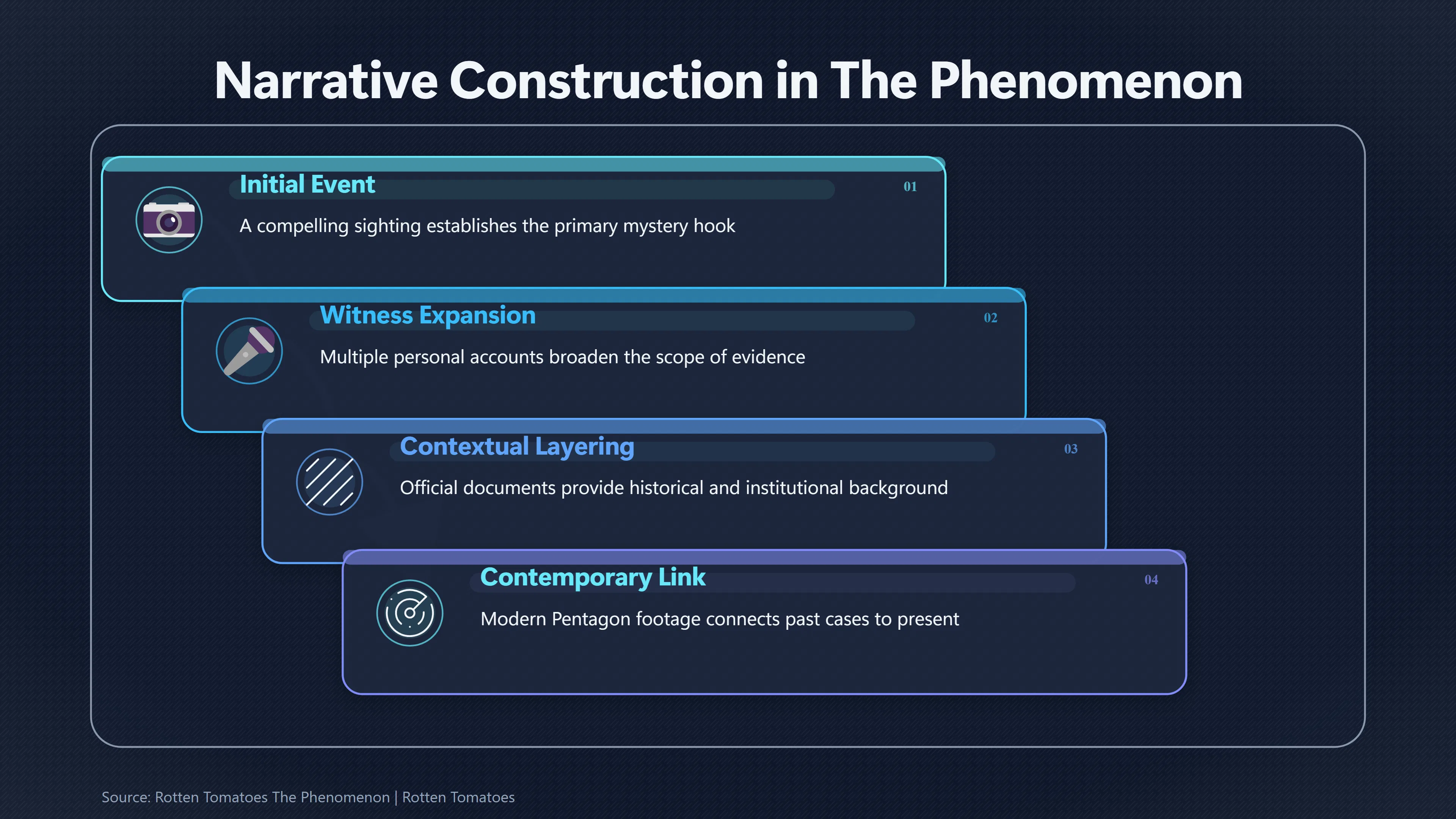
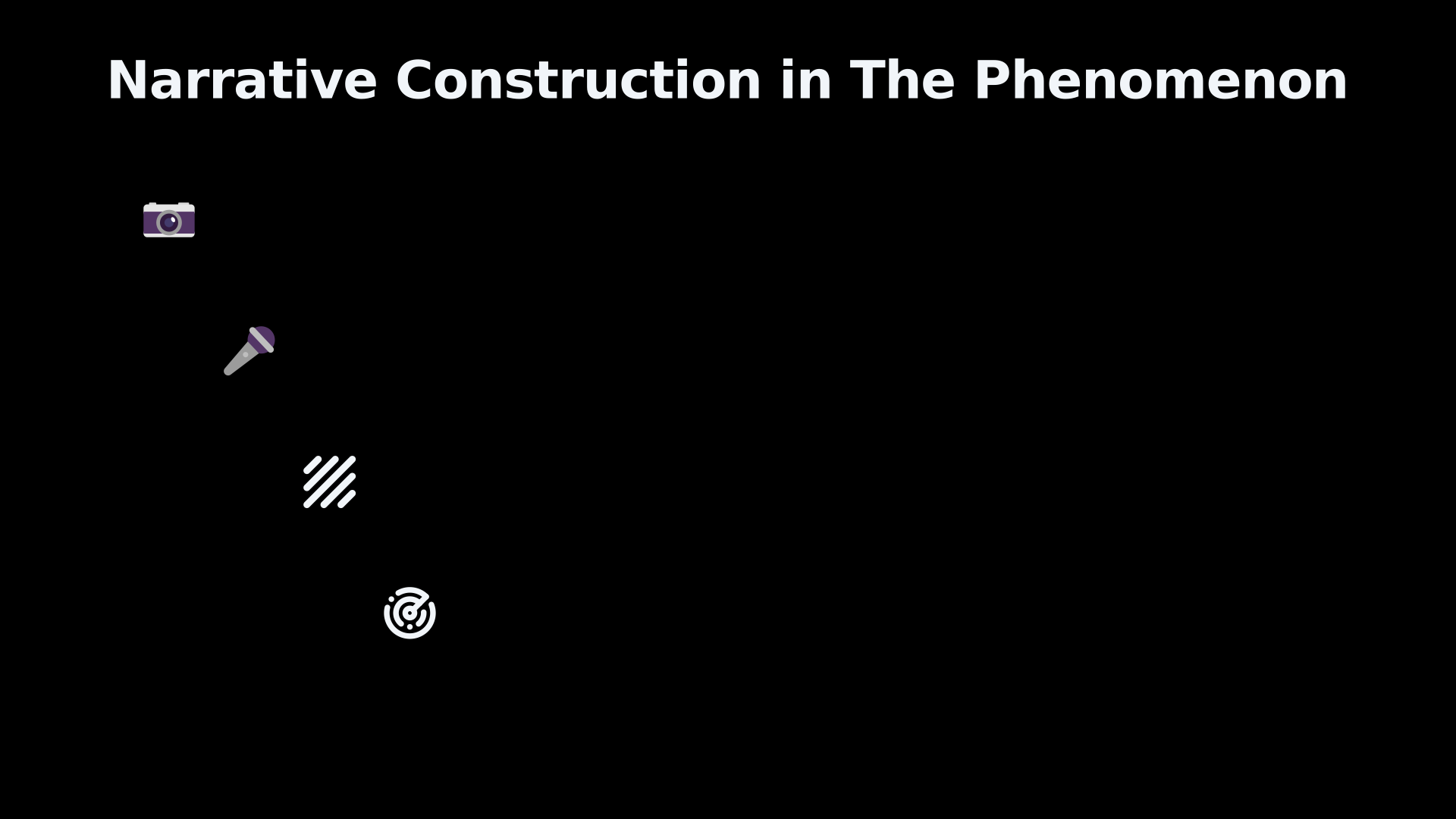
A common structure begins with a compelling event, introduces witnesses, expands the circle of participants and gradually adds official or historical context. The viewer is encouraged to hold several possibilities in mind before a final interpretation is offered — or deliberately withheld. This resembles investigative storytelling, where the order of disclosure becomes part of the argument.
For example, The Phenomenon organises decades of UFO reports into a historical progression, moving between archival interviews, modern commentary and accounts involving military personnel and government officials. Its effectiveness depends heavily on sequencing: older cases establish a long-running pattern, while later material involving Pentagon UFO videos gives the story contemporary relevance.[Rotten Tomatoes]rottentomatoes.comRotten Tomatoes The Phenomenon | Rotten TomatoesRotten TomatoesThe Phenomenon | Rotten TomatoesOctober 6, 2020…
The power of delayed answers
One of the strongest editing tools in mystery documentaries is delayed explanation. Editors may introduce a witness before revealing all available background information, or show an unusual piece of footage before explaining its limitations. This creates a temporary information imbalance between filmmaker and audience.
The technique resembles suspense methods used in fiction, where uncertainty encourages attention. In documentary form, however, it carries an additional responsibility: viewers may interpret the order of presentation as evidence that the filmmaker has discovered a meaningful connection.
This is where editing can influence perception without altering individual facts. A statement from one witness placed directly before an official response may feel like a confrontation; the same statements separated by historical explanation may feel like a broader debate.
Film theory has long examined this effect. The Kuleshov effect describes how audiences create meaning from the relationship between shots rather than from isolated images alone. The principle demonstrates why the placement of archive footage, interview reactions and contextual material can change interpretation even when the original material remains unchanged.[Facing the Mind]facingthemind.leeds.ac.ukFacing the Mind The Kuleshov Effect | Facing the MindFacing the MindThe Kuleshov Effect | Facing the Mind - Film/Art/Mental Health…
Interviews, archives and narrative order
Interviews are the foundation of many UFO documentaries because they provide human experience as the emotional centre of the mystery. Editing determines whether a witness appears as a reliable observer, a personal storyteller or part of a larger pattern.
A typical UFO documentary may combine several interview categories:
- Eyewitnesses provide personal accounts and emotional detail.
- Military or government figures add institutional authority.
- Researchers and historians provide interpretation.
- Sceptics or alternative explanations may introduce uncertainty or challenge conclusions.
The order of these voices strongly affects audience response. Beginning with a witness describing a dramatic event creates a different impression from beginning with a scientist explaining limitations in the evidence. Neither approach is automatically more accurate, but each creates a different narrative experience.
Archive footage as a credibility signal
Archive material plays a particularly important role in UFO documentary editing because old photographs, news broadcasts, government clips and declassified documents visually suggest historical authenticity. Even when the meaning of an archive item remains disputed, its appearance within a carefully structured sequence can make it feel like part of an unfolding investigation.
This is especially visible in documentaries that revisit famous cases. Historical footage can connect past and present, allowing editors to create a sense of continuity between earlier UFO reports and modern discussions of unidentified anomalous phenomena. Films such as The Phenomenon use archival interviews and historical cases alongside contemporary officials and footage to create this bridge.[Rotten Tomatoes]rottentomatoes.comRotten Tomatoes The Phenomenon | Rotten TomatoesRotten TomatoesThe Phenomenon | Rotten TomatoesOctober 6, 2020…
However, archive footage does not automatically resolve uncertainty. A document proving that a sighting was reported is not the same as a document proving what caused it. Editing can preserve that distinction, or it can blur it if different types of evidence are presented with the same dramatic weight.
How presentation affects belief
The most important feature of UFO documentary editing is not whether it persuades viewers toward belief or disbelief, but how it frames the process of interpretation. A viewer rarely encounters a UFO claim as a single fact; they encounter a carefully arranged sequence of voices, images and explanations.
A documentary that emphasises official statements, technical analysis and competing explanations creates a different relationship with uncertainty than one that focuses mainly on personal testimony and unresolved questions.
Music, pacing and atmosphere
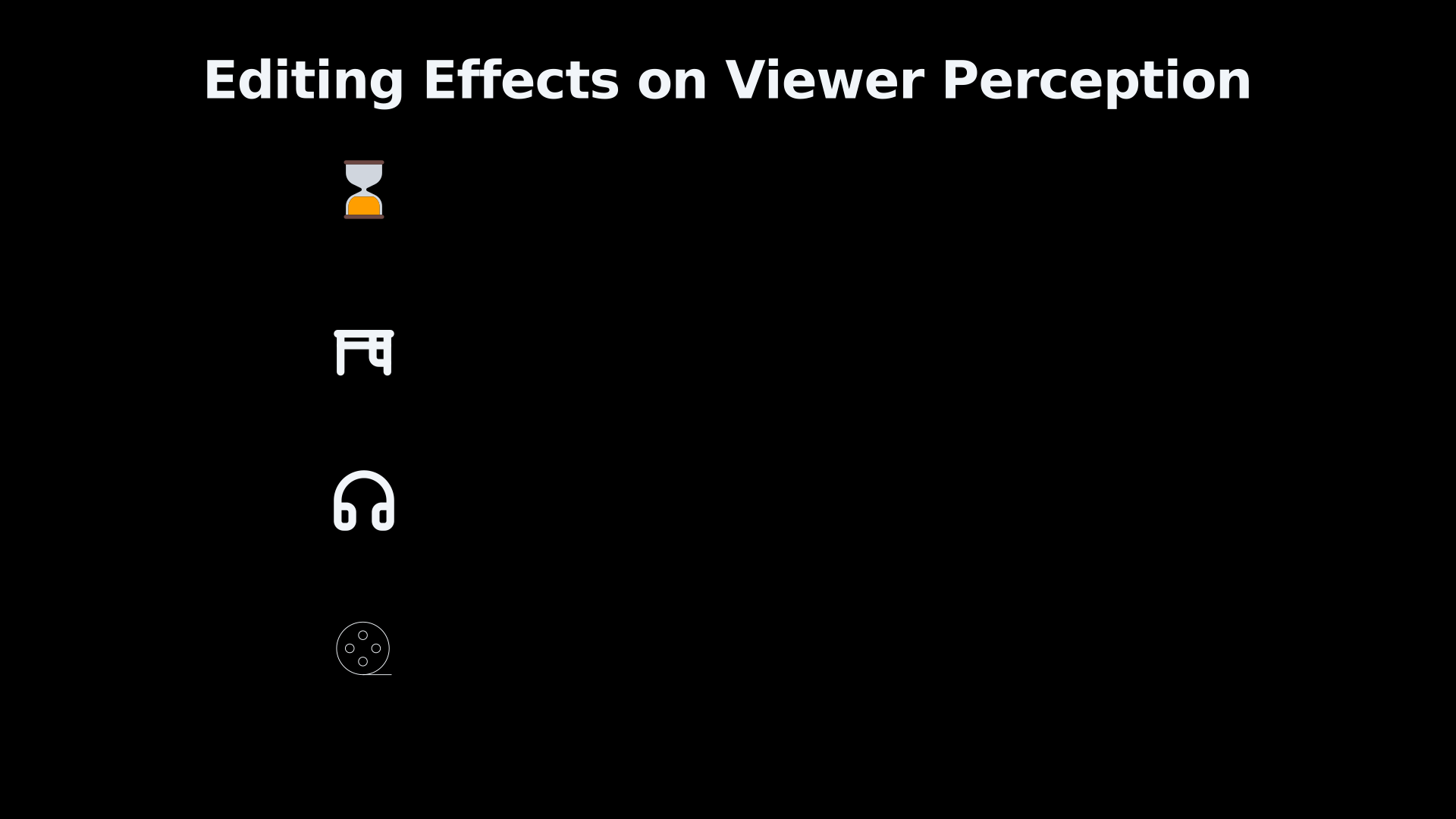
Sound design and pacing also contribute to mystery construction. Slow reveals, pauses before important statements, dramatic music and repeated visual motifs can increase emotional intensity. These techniques are common in documentary storytelling generally, but they become especially significant in subjects where the evidence itself is incomplete.
The use of atmosphere can make a viewer feel that an unanswered question is important. That feeling may encourage curiosity and further investigation, but it can also make uncertainty feel like confirmation if emotional presentation is mistaken for evidence.
This distinction has become a major discussion point around modern UFO documentaries. Recent productions have attracted attention partly because polished filmmaking techniques can make contested claims appear more culturally significant, while critics argue that presentation quality should not substitute for independently verified evidence.[The Guardian]theguardian.comFeaturing interviews with 34 individuals, including prominent U.S. political and intelligence figures, it seeks to shift the UFO narrativ…
Mystery construction versus manipulation
Editing is unavoidable in documentary filmmaking. Every documentary selects some material and excludes other material. The key issue is transparency: whether the structure helps audiences understand complexity or pushes them towards a predetermined conclusion.
A documentary can responsibly create suspense by showing what is known, what remains uncertain and why disagreement exists. Problems arise when editing removes important context, presents speculation alongside established facts without distinction, or uses cinematic techniques to imply certainty.
The documentary Mirage Men provides an interesting contrast because its mystery structure focuses not only on alleged UFO events but on how UFO stories themselves are produced, including claims about government influence and myth-making. Its approach demonstrates that the construction of a mystery can itself become the subject of investigation.[British Council UK Films Database]filmsandfestivals.britishcouncil.orgBritish Council UK Films DatabaseBritish Council UK Films Database: Mirage MenMay 12, 2025…

The role of editing in the UFO–science fiction relationship
UFO documentaries connect strongly with science fiction because their editing methods often reproduce science-fiction themes without openly becoming fictional. The unknown object becomes a narrative device; the investigation becomes a journey; missing information becomes a dramatic force.
This does not mean UFO documentaries are simply fictional stories. Rather, they use some of the same storytelling mechanisms that make science fiction compelling: anticipation, discovery, hidden possibilities and questions about humanity’s place in a larger universe.
The result is a distinctive form of public storytelling. Through editing, a collection of reports, interviews and historical fragments can become a mystery narrative that influences how audiences imagine unexplained phenomena. The central creative act is not inventing the unknown, but organising uncertainty into a story.
Amazon book picks
Further Reading
Books and field guides related to UFO documentary editing and mystery construction. Use these as the next step if you want deeper reading beyond the article.
Documentary Storytelling: Creative Nonfiction on Screen
Now updated with new case studies and conversations with award-winning filmmakers, "Documentary Storytelling" offers advice for producers...
Introduction to Documentary
Introduction to Documentary provides a one-of-a-kind overview of the most important topics and issues in documentary history and criticis...
In the Blink of an Eye: A Perspective on Film Editing
Comprises a revised second edition of film editor Walter Murch's thought-provoking essay on the art and process of film editing. Original...
Directing the Documentary
Directing the Documentary, Sixth Edition is the definitive book on the form, offering time-tested principles to help you master the craft...
eBay marketplace picks
Marketplace Samples
Live-tested eBay searches with available results related to this page.
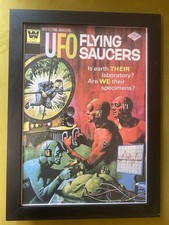
Selected fromUFO poster oneBay.co.uk.


Endnotes
1.
Source: documentary.org
Link:https://www.documentary.org/feature/what-do-about-documentary-distortion-toward-code-ethics
3.
Source: rottentomatoes.com
Title: Rotten Tomatoes The Phenomenon | Rotten Tomatoes
Link:https://www.rottentomatoes.com/m/the_phenomenon
Source snippet
Rotten TomatoesThe Phenomenon | Rotten TomatoesOctober 6, 2020...
Published: October 6, 2020
4.
Source: facingthemind.leeds.ac.uk
Title: Facing the Mind The Kuleshov Effect | Facing the Mind
Link:https://facingthemind.leeds.ac.uk/face-as-window/the-kuleshov-effect/
Source snippet
Facing the MindThe Kuleshov Effect | Facing the Mind - Film/Art/Mental Health...
5.
Source: theguardian.com
Link:https://www.theguardian.com/film/2025/dec/15/the-age-of-disclosure-ufo-documentary
Source snippet
Featuring interviews with 34 individuals, including prominent U.S. political and intelligence figures, it seeks to shift the UFO narrativ...
6.
Source: filmsandfestivals.britishcouncil.org
Link:https://filmsandfestivals.britishcouncil.org/projects/mirage-men
Source snippet
British Council UK Films DatabaseBritish Council UK Films Database: Mirage MenMay 12, 2025...
Published: May 12, 2025
7.
Source: wfcn.co
Title: Kuleshov Effect | Cinecyclopedia
Link:https://www.wfcn.co/ccp/article/kuleshov-effect
8.
Source: rottentomatoes.com
Title: Mirage Men | Rotten Tomatoes
Link:https://www.rottentomatoes.com/m/mirage_men
9.
Source: theguardian.com
Link:https://www.theguardian.com/film/2014/aug/14/men-in-black-ufo-[sightings
10.
Source: rottentomatoes.com
Title: cast and crew
Link:https://www.rottentomatoes.com/m/the_phenomenon/cast-and-crew
11.
Source: rottentomatoes.com
Link:https://www.rottentomatoes.com/m/the_phenomenon/reviews
12.
Source: howtofilmschool.com
Title: Kuleshov Effect
Link:https://howtofilmschool.com/dictionary/kuleshov-effect/
Additional References
13.
Source: human.libretexts.org
Title: org5.2: Documentary Ethics are Different Than Journalism Ethics
Link:https://human.libretexts.org/Bookshelves/Theater_Film_and_Storytelling/Documentary_Culture/05%3A_Ethical_Considerations/5.02%3A_Documentary_Ethics_are_Different_Than_Journalism_Ethics
Source snippet
libretexts.org5.2: Documentary Ethics are Different Than Journalism Ethics - Humanities LibreTextsJune 7, 2026 — 5: Ethical Consideration...
Published: June 7, 2026
14.
Source: human.libretexts.org
Title: 15.01: Taming Chaos
Link:https://human.libretexts.org/Bookshelves/Theater_Film_and_Storytelling/Documentary_Culture/15%3A_Editing_the_Documentary/15.01%3A_Taming_Chaos
Source snippet
libretexts.org15.1: Taming Chaos - Humanities LibreTextsJune 7, 2026 — Sun, 07 Jun 2026 18:56:56 GMT 15.1: Taming Chaos 382542 382542 Jos...
Published: June 7, 2026
15.
Source: sklairfilms.com
Title: By Steve Sklair · 1
Link:https://sklairfilms.com/blog/how-documentary-editing-shapes-a-story.php
Source snippet
How Documentary Editing Shapes a Story | Steve SklairJuly 13, 2026 — HOW DOCUMENTARY EDITING SHAPES A STORY A practical look at how docum...
Published: July 13, 2026
16.
Source: jstor.org
Title: Kuleshov on Film: Writings of Lev Kuleshov | JSTOR
Link:https://www.jstor.org/stable/jj.15707007.2
Source snippet
Kuleshov on Film: Writings of Lev Kuleshov | JSTOR...
17.
Source: youtube.com
Link:https://www.youtube.com/watch?v=hSRgC1zAoIE
Source snippet
How to Edit a Documentary (Step-by-Step)...
18.
Source: accuskills.com
Link:https://www.accuskills.com/fst/lesson/editing-documentaries
19.
Source: jiyushe.com
Link:https://jiyushe.com/film-editor/editing-documentary-films-challenges-and-techniques.html
20.
Source: tvi.show
Link:https://www.tvi.show/close-encounters/how-alien-abductions-are-portrayed-in-documentary-film-examining-narrative-techniques-and-public-perceptions
21.
Source: docfilmacademy.com
Link:https://www.docfilmacademy.com/blog/how-to-build-suspense-in-a-documentary
22.
Source: waynesablesproject.co.uk
Link:https://www.waynesablesproject.co.uk/blog/how-to-edit-your-documentary