Within Science fiction alien
How CGI Expanded Alien Possibilities
Digital effects expanded alien design by allowing filmmakers to create complex creatures, ecosystems and environments beyond physical limits.
On this page
- Limits of practical creature effects
- Digital alien ecosystems
- Balancing realism and storytelling
Page outline Jump by section
Introduction
CGI transformed alien design by removing many of the physical limits that had shaped earlier science fiction creatures. Instead of designing only what could be built as a costume, puppet or miniature, filmmakers could create lifeforms with impossible anatomy, complex movement, entire alien ecosystems and environments that existed only inside a computer. This shift did not simply make aliens look more detailed; it changed the kinds of extraterrestrial beings that could be imagined and placed on screen.
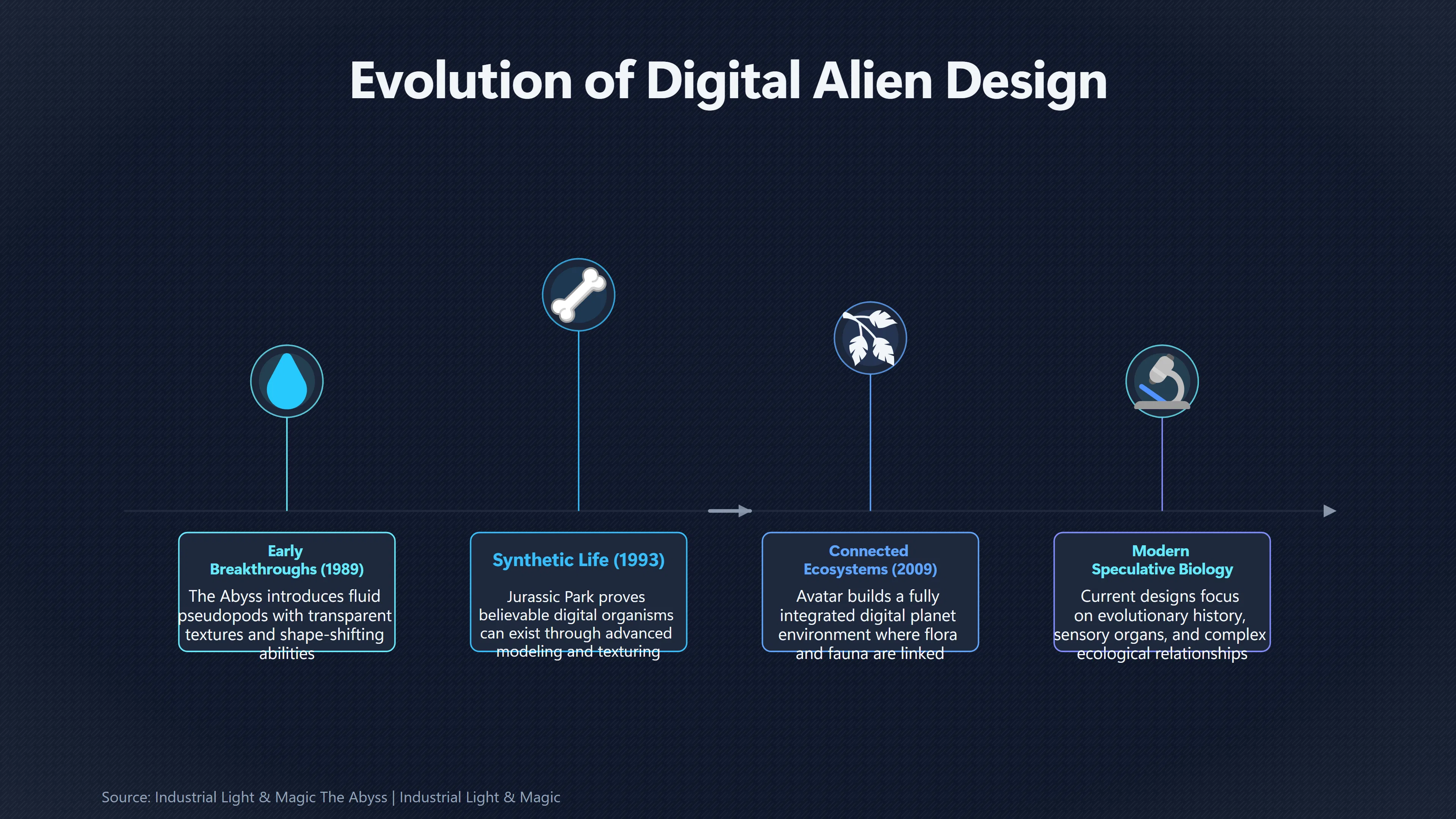
The development of digital creatures followed a gradual move from isolated effects shots to fully constructed worlds. Early breakthroughs such as the liquid alien creature in The Abyss and the digital dinosaurs of Jurassic Park demonstrated that computer graphics could convincingly represent living forms. Later films such as Avatar expanded the idea further by creating complete alien environments where characters, plants and animals were digitally designed as parts of a connected ecosystem.[Industrial Light & Magic]ilm.comIndustrial Light & Magic The Abyss | Industrial Light & MagicIndustrial Light & Magic The Abyss | Industrial Light & Magic
Limits of practical creature effects
Before CGI became widespread, alien designers were constrained by physical materials and performance requirements. Costumes, animatronics and puppets could create memorable creatures, but they imposed limits on size, movement, facial expression and interaction with environments. A creature had to fit around a performer, operate through mechanical systems or remain practical enough to build and control on set.
Digital effects changed the design process because artists could create creatures from the inside out. A filmmaker could begin with an imagined biology rather than a physical object: extra limbs, unusual body structures, transparent surfaces, non-human movement patterns or species that would be impossible for a performer to inhabit. CGI also allowed designers to revise proportions and behaviour throughout production, making experimentation less expensive than rebuilding a physical model.
One early example was The Abyss (1989), where Industrial Light & Magic created a computer-generated “pseudopod” — a fluid alien entity that could change shape and mimic human expressions. The effect required new approaches to digital modelling, rendering and compositing because the creature needed to appear as a living, transparent organism interacting with real actors.[Industrial Light & Magic]ilm.comIndustrial Light & Magic The Abyss | Industrial Light & MagicIndustrial Light & Magic The Abyss | Industrial Light & Magic Its importance was not only visual; it showed that aliens no longer needed to resemble animals, humans or traditional monsters. They could be forms of life based on unfamiliar physical rules.
The next major step came with Jurassic Park (1993). Although not an alien film, its digital creatures changed science fiction by proving that believable synthetic organisms could exist on screen. Industrial Light & Magic developed new tools for modelling, texturing and animating creatures, showing that filmmakers could create convincing digital life rather than simply add visual effects around existing footage.[Industrial Light & Magic]ilm.comIndustrial Light & Magic Jurassic Park | Industrial Light & MagicIndustrial Light & Magic Jurassic Park | Industrial Light & Magic This opened the way for more ambitious extraterrestrial designs because audiences became more willing to accept creatures that had no practical equivalent.
Digital alien ecosystems
The biggest change introduced by CGI was the move from individual alien creatures to complete digital worlds. Traditional creature effects usually focused on a single being: an alien visitor, a monster or a mysterious lifeform. Digital production allowed filmmakers to imagine entire environments where alien biology, landscapes and behaviour could be designed together.
Avatar (2009) represents one of the clearest examples of this approach. Rather than creating only a few alien characters, Weta Digital built the planet Pandora as a connected digital ecosystem containing the Na’vi, plants, flying creatures and other lifeforms. The production used motion capture, digital environments and new approaches to lighting and facial animation to integrate the characters into a world that existed almost entirely through computer graphics.[Computer Graphics World]cgw.comComputer Graphics World Avatar | Computer Graphics WorldComputer Graphics World Avatar | Computer Graphics World
This approach changed alien design because creatures could now be created with ecological relationships in mind. Designers could consider how an organism moved through its environment, how it hunted, communicated or adapted, and how its anatomy reflected its imaginary planet. A six-legged animal, a bioluminescent plant or a species with unfamiliar sensory organs could exist as part of a larger system rather than as a standalone visual spectacle.
Digital environments also expanded the relationship between UFO-inspired imagery and science fiction. Earlier alien depictions often relied on recognisable symbols: humanoid bodies, strange faces or unusual costumes. CGI allowed filmmakers to move further towards speculative biology, creating beings that appeared less like disguised humans and more like imagined products of different evolutionary histories.
Balancing realism and storytelling
Greater digital freedom created a new challenge: realistic technology does not automatically create convincing aliens. Audiences judge creatures not only by their appearance but by whether they seem to have weight, intention, emotion and believable behaviour.
Successful CGI creatures usually combine technological detail with storytelling choices. Animators study animal movement, human expression and physical forces so that imaginary beings appear to follow consistent rules. The goal is not simply to make an alien look complex, but to make viewers believe it exists within its fictional world.
This balance can be seen in the difference between visual complexity and emotional connection. A creature covered in detailed textures may still feel artificial if its movements lack purpose, while a simpler design can feel convincing if it has distinctive behaviour. CGI therefore expanded alien possibilities, but it also shifted creative responsibility from physical construction to digital performance.
Films continue to combine practical and digital methods rather than treating CGI as a replacement for all earlier techniques. Physical references, models and performers can provide realism, while digital tools add movement, scale and impossible features. The most effective alien designs often use CGI to overcome physical limits while retaining the sense that the creature is a living organism rather than merely an effect.
The lasting impact of CGI aliens is that extraterrestrial life in science fiction is no longer restricted by what filmmakers can build. Digital creatures allow artists to explore alien evolution, ecosystems and forms of intelligence that could not previously be represented, making visual effects a tool not just for spectacle but for imagining what life beyond Earth might look like.
Amazon book picks
Further Reading
Books and field guides related to How CGI Expanded Alien Possibilities. Use these as the next step if you want deeper reading beyond the article.
Aliens and Alien Societies
A thoughtful, clear and utterly fascinating reference, this book is absolutely vital to writers who want to put extraterrestrial life-for...
The Encyclopedia of Science Fiction
Encompassing 4,360 entries that provide critical insight and biographical and bibliographical data, an updated edition of a popular scien...
Solaris
En av de stora science fiction-klassikerna Kris Kelvin anländer till forskningsstationen på den havstäckta planeten Solaris bara timmar e...
The Making of Jurassic Park
Made by Hollywood's most inventive and successful director, Steven Spielberg, JURASSIC PARK was one of the most talked about, most antici...
eBay marketplace picks
Marketplace Samples
Live-tested eBay searches with available results related to this page.
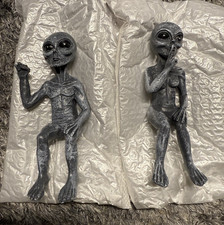
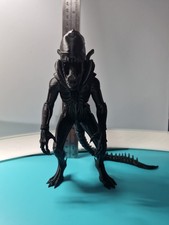
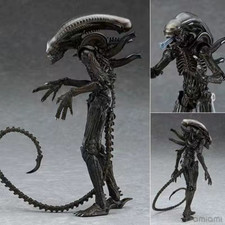
Selected fromalien figure collectible oneBay.co.uk.

Endnotes
1.
Source: ilm.com
Title: Industrial Light & Magic The Abyss | Industrial Light & Magic
Link:https://www.ilm.com/vfx/the-abyss/
2.
Source: ilm.com
Title: Industrial Light & Magic Jurassic Park | Industrial Light & Magic
Link:https://www.ilm.com/vfx/jurassic-park/
3.
Source: cgw.com
Title: Computer Graphics World Avatar | Computer Graphics World
Link:https://www.cgw.com/Press-Center/Web-Exclusives/2009/Avatar.aspx
4.
Source: Wikipedia
Title: The Abyss
Link:https://en.wikipedia.org/wiki/The_Abyss
5.
Source: ilm.com
Link:https://www.ilm.com/creating-dinosaurs-jurassic-park/
6.
Source: cgw.com
Title: Computer Graphics World CG In Another World | Computer Graphics World
Link:https://www.cgw.com/Publications/CGW/2009/Volume-32-Issue-12-Dec-2009-/CG-In-Another-World.aspx
7.
Source: ilm.com
Title: IL M VFX Supervisor Nelson Sepulveda-Fauser on Alien: Romulus
Link:https://www.ilm.com/alien-romulus-sepulveda-fauser-ilm/
8.
Source: cgw.com
Title: Weta Digital Ascends to the Cloud with AWS | Computer Graphics World
Link:https://www.cgw.com/Press-Center/News/2020/Weta-Digital-Ascends-to-the-Cloud-with-AWS.aspx
9.
Source: cgw.com
Title: Creature Feature: ‘The Shape of Water’ | Computer Graphics World
Link:https://www.cgw.com/Press-Center/In-Focus/2018/Creature-Feature-The-Shape-of-Water.aspx
10.
Source: cgw.com
Link:https://www.cgw.com/Press-Center/Web-Exclusives/2010/Nvidia-Collaborates-with-Weta-to-Accelerate-Visu.aspx
11.
Source: cgw.com
Title: Doggie Doubles | Computer Graphics World
Link:https://www.cgw.com/Publications/CGW/2007/Volume-30-Issue-8-Aug-2007-/Doggie-Doubles.aspx
12.
Source: the-jh-movie-collection-official.fandom.com
Title: The Abyss
Link:https://the-jh-movie-collection-official.fandom.com/wiki/The_Abyss
13.
Source: ultimatepopculture.fandom.com
Title: The Abyss
Link:https://ultimatepopculture.fandom.com/wiki/The_Abyss
14.
Source: culture.fandom.com
Title: The Abyss
Link:https://culture.fandom.com/wiki/The_Abyss
15.
Source: ilm.com
Link:https://www.ilm.com/vfx/the-lost-world-jurassic-park/
16.
Source: ilm.com
Link:https://www.ilm.com/vfx/a-quiet-place/
17.
Source: ilm.com
Link:https://www.ilm.com/vfx/frankenstein/
18.
Source: ilm.com
Link:https://www.ilm.com/vfx/rogue-one/
19.
Source: ilm.com
Link:https://www.ilm.com/vfx/cocoon/
20.
Source: ilm.com
Link:https://www.ilm.com/vfx/avatar/
21.
Source: lucasfilm.com
Link:https://www.lucasfilm.com/what-we-do/visual-effects/
22.
Source: cgw.com
Title: Creature Feature.aspx
Link:https://www.cgw.com/Publications/CGW/2018/Volume-41-Issue-1-Edition-1-2018-/Creature-Feature.aspx
23.
Source: cgw.com
Title: Of Gollum and Wargs and Goblins Oh My.aspx
Link:https://www.cgw.com/Publications/CGW/2013/Volume-36-Issue-2-Jan-Feb-2013-/Of-Gollum-and-Wargs-and-Goblins-Oh-My-.aspx
24.
Source: cgw.com
Link:https://www.cgw.com/Publications/CGW/2009/Volume-32-Issue-9-Sep-2009-/Alien-Achievement.aspx
25.
Source: www-ext.wetafx.co.nz
Link:https://www-ext.wetafx.co.nz/films/filmography/avatar
26.
Source: youtube.com
Title: The Abyss
Link:https://www.youtube.com/watch?v=FshV_6o35e0
Source snippet
Making of the Water Creature in "The Abyss"...
Additional References
27.
Source: motionpictures.org
Link:https://www.motionpictures.org/2026/01/how-weta-fx-brought-the-villainous-ash-people-to-life-in-james-camerons-avatar-fire-and-ash/
Source snippet
The CreditsJanuary 21, 2026 — HOW WETA FX BROUGHT THE VILLAINOUS ASH PEOPLE TO LIFE IN JAMES CAMERON’S “AVATAR: FIRE AND ASH” By Daron Ja...
Published: January 21, 2026
28.
Source: washingtonpost.com
Title: What’s real or VFX in ‘Wicked, ‘Severance,’ ‘Avatar’ and ‘Jurassic Park’?
Link:https://www.washingtonpost.com/style/interactive/2025/wicked-severance-avatar-jurassic-world-rebirth-cgi-effects/
Source snippet
Washington PostNovember 24, 2025 — WHICH OF THESE TWO SCENES HAS REAL MONKEYS? First scene Second scene Early, simple 3D models can also...
Published: November 24, 2025
29.
Source: nationalgeographic.com
Title: Image: An illustra
Link:https://www.nationalgeographic.com/culture/article/avatar-fire-and-ash-production-design-science
Source snippet
How the Avatar team created the fantastic world of Fire and Ash | National GeographicDecember 19, 2025 — HOW THE AVATAR TEAM CREATED THE...
Published: December 19, 2025
30.
Source: youtube.com
Link:https://www.youtube.com/watch?v=bUrf0lDeF-E
Source snippet
Behind the Scenes | ALIEN: ROMULUS | Legacy Effects...
31.
Source: youtube.com
Title: The Visual Effects of Alien Romulus | Wētā FX
Link:https://www.youtube.com/watch?v=C6qQotLG5hU
Source snippet
Avatar (2009) Making-of & Behind the Scenes | James Cameron, Sam Worthington, Zoë Saldaña...
32.
Source: papers.ssrn.com
Link:https://papers.ssrn.com/sol3/Delivery.cfm/20f70780-deb4-4361-a4cb-f0839a62a018-MECA.pdf?abstractid=6876559&mirid=1
Source snippet
the Effect of Visual Realism, Familiarity, and Synthetic Facial Animations on the Perception of Digital Doubles in Desktop and VR by Kazi...
33.
Source: wetafx.co.nz
Link:https://www.wetafx.co.nz/research-and-tech/technology/facets
34.
Source: wetaworkshop.com
Link:https://www.wetaworkshop.com/frequently-asked-questions
35.
Source: secondsight.dev
Link:https://www.secondsight.dev/dose/Jurassic_Park_VFX.html
36.
Source: starwars.com
Link:https://www.starwars.com/video/rogue-one-a-star-wars-story-creature-featurette