Within Media shaping public
How The Internet Changed UFO Beliefs
Online UFO communities changed belief culture by allowing users to share footage, debate evidence and reinforce competing explanations.
On this page
- From media audiences to active communities
- Viral footage and rapid speculation
- Digital tools for investigation and critique
Page outline Jump by section
Introduction
Online UFO communities changed UFO culture by turning audiences into participants. Instead of receiving UFO stories mainly through films, television and newspapers, internet users began collecting sightings, analysing images, debating explanations and building shared interpretations in real time. Digital platforms did not create UFO beliefs, but they changed how those beliefs formed: a blurry video, witness account or leaked document could now become the centre of a global discussion within hours.
This shift is especially important within the relationship between UFOs and science fiction because online communities often operate in the space between entertainment, speculation and investigation. Users draw on familiar science-fiction ideas such as extraterrestrial visitors, hidden technologies and future possibilities while also applying tools associated with research, including image analysis, data comparison and crowdsourced review. The result is a culture where belief is negotiated collectively rather than simply delivered by traditional media.[PubMed]pubmed.ncbi.nlm.nih.govHaunting Messages: Online Videos and Public Belief in Paranormal Phenomena - PubMedJune 25, 2024…
From media audiences to active communities
Before widespread internet access, UFO discussions were often shaped by a limited number of media producers: television programmes, magazines, authors and documentary makers. Online communities altered this relationship by allowing ordinary users to become researchers, commentators and distributors. A sighting report no longer needed to pass through a newspaper editor or television producer before reaching an audience; witnesses could upload accounts, photographs or videos directly to public platforms.
Organisations such as the National UFO Reporting Center (NUFORC) and the Mutual UFO Network (MUFON) developed online systems that encouraged this participatory model. NUFORC’s database allows users to submit and browse large collections of reported sightings, while MUFON provides reporting tools and databases intended to support the collection and investigation of UFO claims. These systems transformed UFO discussion into an ongoing archive where users could compare events across locations, dates and descriptions.[NUFORC]nuforc.orgData Bank | NUFORCData Bank | NUFORC - Latest UFO Sightings…
The community element changed the meaning of a UFO report. A single witness account became the starting point for a collaborative process: other users might identify a possible aircraft, satellite, camera effect or natural explanation, while others might connect the event to broader ideas about extraterrestrial life or government secrecy. The same piece of media could therefore generate competing interpretations rather than a single accepted narrative.
Online discussion spaces also created specialised roles within UFO communities. Some users focused on analysing footage, others tracked government statements, and others collected historical cases. This division of labour gave UFO communities some features of research networks, even though the quality of evidence and methods varied widely between participants.[NUFORC]nuforc.orgData Bank | NUFORCData Bank | NUFORC - Latest UFO Sightings…
Viral footage and rapid speculation
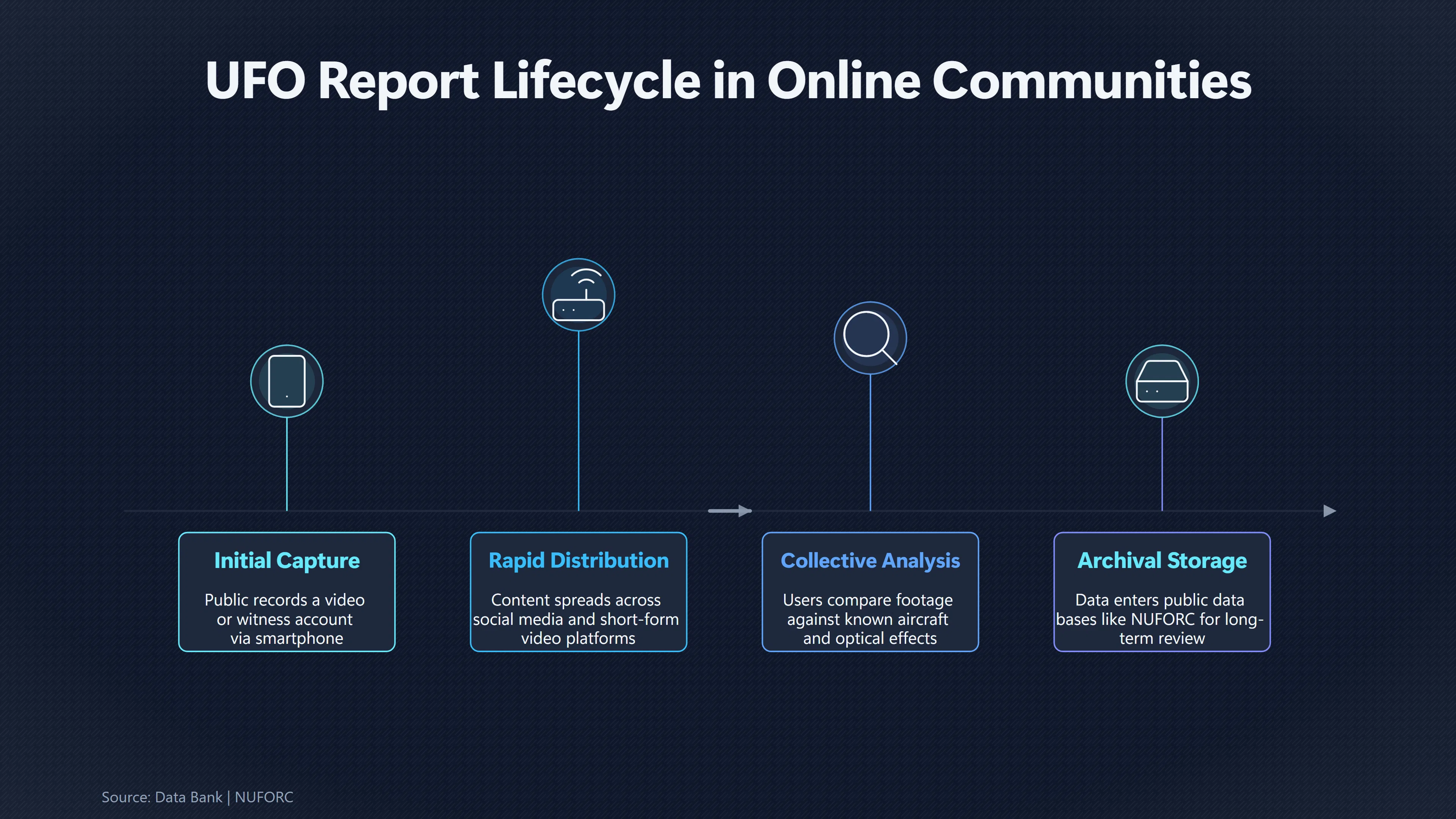
The spread of smartphones and social media made visual evidence central to modern UFO discussions. A short video recorded by a member of the public can quickly become a shared object of analysis, with thousands of viewers offering explanations, comparisons and theories. This speed changes the life cycle of UFO stories: interpretation often begins before reliable information about the recording is available.
Research into online paranormal content shows why videos are influential. A study examining highly viewed YouTube videos about paranormal topics, including UFOs, found that many presented alleged footage as evidence and often relied on claims rather than scientific sources. The researchers also found links between exposure to paranormal online content and stronger paranormal beliefs, suggesting that repeated digital exposure can influence how audiences understand unusual events.[PubMed]pubmed.ncbi.nlm.nih.govHaunting Messages: Online Videos and Public Belief in Paranormal Phenomena - PubMedJune 25, 2024…
Short-form video platforms have intensified this process. Research examining UFO-related TikTok content found that many videos featured paranormal claims and supposed evidence, while scientific or government sources appeared less frequently. Because these platforms reward attention and engagement, emotionally compelling interpretations can spread more easily than cautious explanations that require context.[Taylor & Francis Online]tandfonline.comTaylor & Francis OnlineUFOs, ghosts, and cryptids on TikTok: How short-form videos on a social media platform present paranormal phenomen…
However, viral discussion does not always move in one direction. Online communities also produce rapid sceptical responses. Users may compare footage with known aircraft, optical effects, astronomy events or editing techniques. This creates a constant debate between amplification and correction: the same network that spreads an extraordinary interpretation can also provide the tools for challenging it.
Digital tools for investigation and critique
The internet changed UFO investigation by making large amounts of information searchable and comparable. Databases, maps and discussion archives allow users to examine patterns that were difficult to study when reports existed mainly in books, magazines or private collections.
Public databases such as NUFORC allow users to explore reports by factors including location, date and description. MUFON similarly provides tools for tracking and reviewing submitted cases. These resources encourage a form of citizen investigation, where participants attempt to organise observations and identify similarities across thousands of reports.[NUFORC]nuforc.orgData Bank | NUFORCData Bank | NUFORC - Latest UFO Sightings…
At the same time, digital investigation creates new challenges. Online communities often evaluate evidence without shared standards for reliability. A convincing-looking video may be widely discussed even when key information is missing, such as the original file, recording conditions, location details or independent verification. The availability of more information does not automatically produce better conclusions; it can also create larger spaces for speculation.
This tension is central to online UFO culture. Communities may encourage careful analysis by bringing together people with different skills, but they may also reinforce preferred explanations through repeated discussion among like-minded users. Research on social media and conspiracy-related communities more broadly shows that online platforms can create environments where information, identity and group interpretation become closely connected.[arXiv]arxiv.orgarXiv A Longitudinal Analysis of You Tube's Promotion of Conspiracy VideosA Longitudinal Analysis of YouTube's Promotion of Conspiracy VideosMarch 6, 2020…
Competing interpretations in the digital UFO landscape
Online UFO communities are not a single movement with one shared belief. They contain many overlapping groups with different approaches to unexplained aerial phenomena. Some participants approach UFO reports as possible evidence of unknown technology or extraterrestrial activity. Others focus on identifying conventional explanations. Some discussions also connect UFO topics with wider ideas about secrecy, institutions and trust.
This diversity reflects a major change from earlier UFO media culture. Traditional media often presented a finished story: a documentary, news report or fictional narrative with a clear structure. Online communities instead create ongoing conversations where evidence is repeatedly reinterpreted. A video can move through several stages: initial excitement, competing explanations, technical analysis, renewed debate and eventual fading from attention.
Studies of UFO-related online spaces have also examined how communities use ideas of expertise. Research on alien-related UFO conspiracy narratives found that social media discussions frequently rely on references to experts or authority figures to strengthen particular interpretations. This shows how online communities do not simply exchange information; they also debate who should be trusted and what counts as convincing evidence.[Nature]nature.comExploring expert figures in alien-related UFO conspiracy theories | Humanities and Social Sciences CommunicationsApril 15, 2025…
The connection with science fiction remains visible throughout this process. Online users often interpret ambiguous events through cultural ideas already familiar from science-fiction films and television: advanced spacecraft, hidden discoveries, alien contact or future technologies. These narratives provide a vocabulary for imagining possibilities, but they can also influence expectations about what unexplained evidence should look like.
The lasting effect on UFO belief culture
Online UFO communities changed public engagement with the subject by making interpretation itself a collective activity. The internet did not remove disagreement; instead, it made disagreements more visible and more continuous. Believers, sceptics, researchers and casual viewers now encounter the same videos and reports, but they may place them within very different explanatory frameworks.
The most significant transformation is that UFO beliefs are increasingly shaped through participation. People do not only consume UFO stories; they comment on them, investigate them, classify them and share them. This participatory culture has made UFO discussions larger and more immediate, while also making questions about evidence, expertise and interpretation more important than ever.[NUFORC]nuforc.orgData Bank | NUFORCData Bank | NUFORC - Latest UFO Sightings…
Amazon book picks
Further Reading
Books and field guides related to How The Internet Changed UFO Beliefs. Use these as the next step if you want deeper reading beyond the article.
The UFO Experience: A Scientific Inquiry
Cited by the New York Review of Books as "the best brief for visitation," this classic study presents an analysis of UFO reports and conc...
American Cosmic: UFOs, Religion, Technology
More than half of American adults and more than seventy-five percent of young Americans believe in intelligent extraterrestrial life. Thi...
Suspicious Minds: Why We Believe Conspiracy Theories
Suspicious Minds decodes the psychology of why we all believe in conspiracy theories--some of us just hide it better than others.
The Demon-Haunted World: Science as a Candle in the Dark
Are we on the brink of a new Dark Age of irrationality and superstition? In this book, the writer shows how scientific thinking is necess...
eBay marketplace picks
Marketplace Samples
Live-tested eBay searches with available results related to this page.
Selected fromufo poster oneBay.co.uk.




Endnotes
1.
Source: nuforc.org
Title: Data Bank | NUFORC
Link:https://nuforc.org/databank/
Source snippet
Data Bank | NUFORC - Latest UFO Sightings...
2.
Source: nuforc.org
Title: File a UFO Report | NUFORC
Link:https://nuforc.org/report-a-ufo/
Source snippet
File a UFO Report | NUFORC...
3.
Source: test.mufon.com
Title: Home 1
Link:https://test.mufon.com/
Source snippet
Home 1 - Test MUFON...
4.
Source: mufon.com
Title: JULY 2023 MUFON Journal WEB
Link:https://mufon.com/wp-content/uploads/2024/11/JULY_2023_MUFON_Journal_WEB.pdf
Source snippet
No. 663 $5.99 A NEWCOMER’S GUIDE TO MUF...
Published: JULY 2023
5.
Source: arxiv.org
Title: arXiv A Longitudinal Analysis of You Tube’s Promotion of Conspiracy Videos
Link:https://arxiv.org/abs/2003.03318
Source snippet
A Longitudinal Analysis of YouTube's Promotion of Conspiracy VideosMarch 6, 2020...
Published: March 6, 2020
6.
Source: arxiv.org
Title: arXiv You NICon: You Tube’s Commu NIty of Conspiracy Videos
Link:https://arxiv.org/abs/2304.05274
7.
Source: nature.com
Link:https://www.nature.com/articles/s41599-025-04799-8
Source snippet
Exploring expert figures in alien-related UFO conspiracy theories | Humanities and Social Sciences CommunicationsApril 15, 2025...
Published: April 15, 2025
8.
Source: nuforc.org
Title: report confirmation
Link:https://nuforc.org/report-confirmation/
9.
Source: helpdesk.mufon.com
Link:https://helpdesk.mufon.com/
10.
Source: nuforc.org
Link:https://nuforc.org/newmap/
11.
Source: nuforc.org
Title: about us
Link:https://nuforc.org/about-us/
12.
Source: nuforc.org
Link:https://nuforc.org/?wordfence_syncAttackData=1774187432.1091
13.
Source: nuforc.org
Title: UF O | NUFORCA NEW HISTORICAL RADAR CASE SURFACES *
Link:https://nuforc.org/category/ufo/
14.
Source: ufos.wiki
Link:https://ufos.wiki/links/
15.
Source: youtube.com
Title: Chatter: UFO Culture, with Sarah Scoles
Link:https://www.youtube.com/watch?v=0pK3coF4Sm0
Source snippet
Disclosure Day & UFO Culture | Giles Crouch...
16.
Source: youtube.com
Title: Disclosure Day & UFO Culture | Giles Crouch
Link:https://www.youtube.com/watch?v=_eloL6wNlC4
Source snippet
Carl Jung on UFOs: A Modern Myth of Hope and Fear...
17.
Source: youtube.com
Title: Carl Jung on UFOs: A Modern Myth of Hope and Fear
Link:https://www.youtube.com/watch?v=ASnRs1ri44o
Source snippet
Distinguishing Paranormal Facts from Fiction with Darcy Weir...
18.
Source: youtube.com
Title: Distinguishing Paranormal Facts from Fiction with Darcy Weir
Link:https://www.youtube.com/watch?v=g3YxKeJrlfo
Source snippet
Overthinking About UFOs...
19.
Source: youtube.com
Title: Overthinking About UFOs
Link:https://www.youtube.com/watch?v=8cJUlW2S6XQ
20.
Source: pubmed.ncbi.nlm.nih.gov
Link:https://pubmed.ncbi.nlm.nih.gov/38916099/
Source snippet
Haunting Messages: Online Videos and Public Belief in Paranormal Phenomena - PubMedJune 25, 2024...
Published: June 25, 2024
21.
Source: tandfonline.com
Link:https://www.tandfonline.com/doi/abs/10.1080/15456870.2025.2489367
Source snippet
Taylor & Francis OnlineUFOs, ghosts, and cryptids on TikTok: How short-form videos on a social media platform present paranormal phenomen...
22.
Source: tandfonline.com
Link:https://www.tandfonline.com/doi/abs/10.1080/1369118X.2026.2645882
23.
Source: tandfonline.com
Link:https://www.tandfonline.com/doi/full/10.1080/1369118X.2026.2645882?af=R
24.
Source: tandfonline.com
Link:https://www.tandfonline.com/doi/full/10.1080/15456870.2025.2489367?src=exp-la
25.
Source: pmc.ncbi.nlm.nih.gov
Link:https://pmc.ncbi.nlm.nih.gov/articles/PMC11346665/
26.
Source: pmc.ncbi.nlm.nih.gov
Link:https://pmc.ncbi.nlm.nih.gov/articles/PMC10721628/
27.
Source: pubmed.ncbi.nlm.nih.gov
Link:https://pubmed.ncbi.nlm.nih.gov/37988360/
28.
Source: tandfonline.com
Link:https://www.tandfonline.com/doi/full/10.1080/15456870.2023.2187803
29.
Source: tandfonline.com
Link:https://www.tandfonline.com/doi/abs/10.1080/15456870.2023.2187803
30.
Source: theufodatabase.com
Link:https://theufodatabase.com/organizations/mufon
31.
Source: theufodatabase.com
Link:https://theufodatabase.com/organizations/national-ufo-reporting-center
Additional References
32.
Source: researchgate.net
Link:https://www.researchgate.net/publication/281741635_Why_won%27t_aliens_talk_to_us_Content_and_community_dynamics_in_online_citizen_science
33.
Source: eurekamag.com
Link:https://eurekamag.com/research/105/306/105306887.php
34.
Source: tvi.show
Link:https://www.tvi.show/close-encounters/how-alien-encounter-stories-spread-in-the-digital-age
35.
Source: sciencedirect.com
Link:https://www.sciencedirect.com/science/article/pii/S0376042125000259
36.
Source: guinnessworldrecords.com
Link:https://www.guinnessworldrecords.com/world-records/116241-largest-civilian-ufo-investigative-group
37.
Source: mimufon.org
Link:https://mimufon.org/mimufon/
38.
Source: reveil.blog
Link:https://reveil.blog/
39.
Source: theufodatabase.com
Link:https://theufodatabase.com/docs
40.
Source: ufoslice.com
Link:https://ufoslice.com/
41.
Source: kaggle.com
Link:https://www.kaggle.com/datasets/nuforc/ufo-sightings/data