Within J Allen Hynek
What UFO Sightings Actually Meant
Hynek's sighting categories separated common UFO report patterns by what witnesses observed rather than by assumed causes.
On this page
- Night lights and daytime objects
- Radar and visual observations
- Classification without conclusions
Page outline Jump by section
Introduction
J. Allen Hynek’s categories of Nocturnal Lights and Daylight Discs were designed to describe what witnesses reported seeing before attempting to explain why they saw it. In his 1972 book The UFO Experience: A Scientific Inquiry, Hynek separated distant UFO reports into observation types: lights seen at night, structured objects seen in daylight, and cases supported by radar and visual observation. The purpose was not to prove a particular cause, but to create a more consistent way of studying reports that ranged from easily explained observations to genuinely unresolved cases.[Center for UFO Studies]cufos.orgCenter for UFO Studies Classification SystemsCenter for UFO StudiesClassification Systems - Center for UFO Studies…

These two categories became especially influential because they captured the two most recognisable forms of UFO reporting during the mid-20th century: the mysterious light in the sky and the classic “flying saucer” object. They also shaped later science-fiction imagery, where glowing objects arriving at night and metallic discs crossing daytime skies became recurring visual ideas. Yet Hynek’s original system was less about extraterrestrial stories than about evidence quality: what was actually observed, under what conditions, and how reliably it could be identified.[Center for UFO Studies]cufos.orgCenter for UFO Studies Classification SystemsCenter for UFO StudiesClassification Systems - Center for UFO Studies…
Night lights and daytime objects
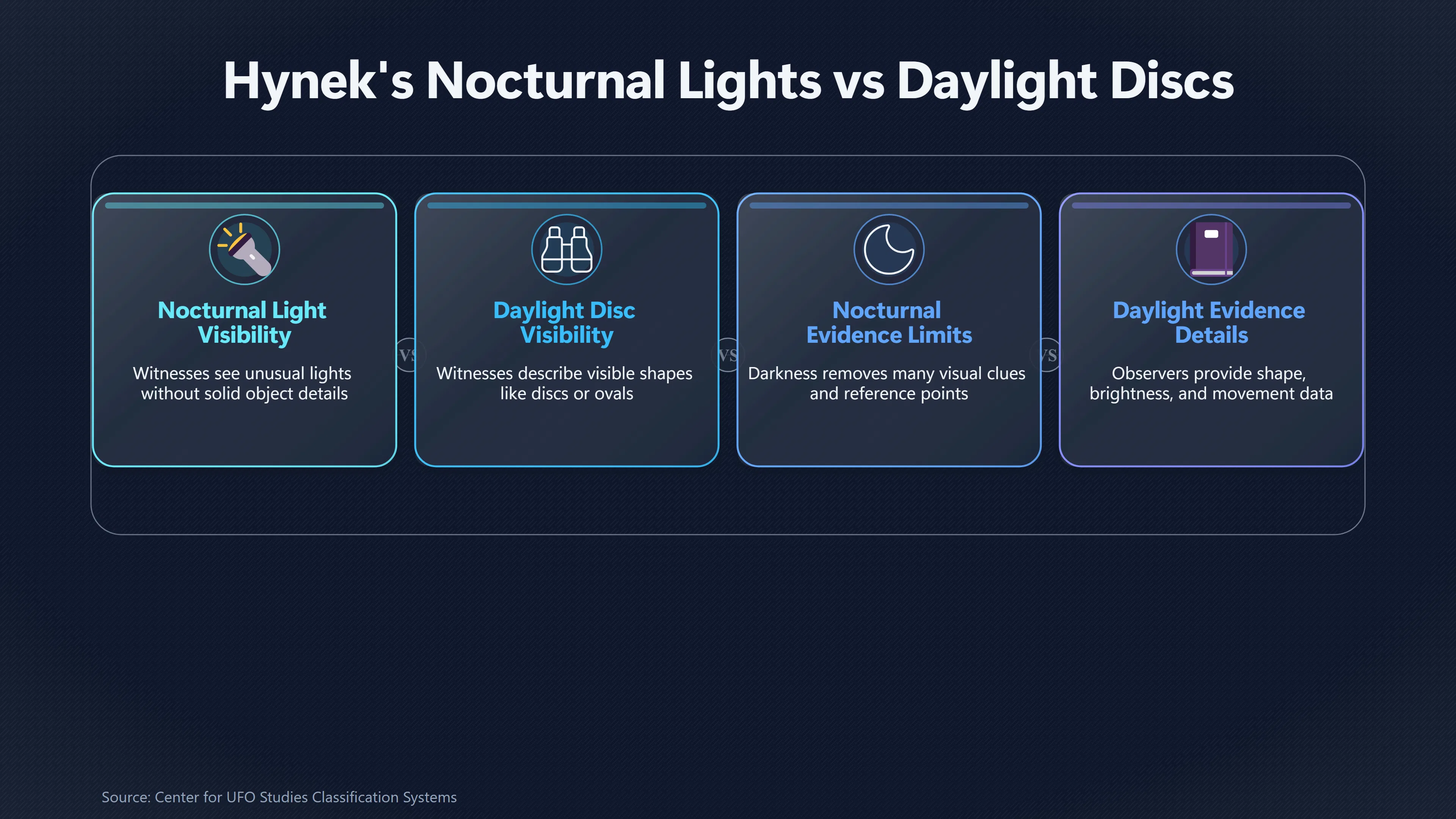
Hynek treated Nocturnal Lights (NL) and Daylight Discs (DD) as distant sightings. They involved observations where the witness generally saw something in the sky but did not have the close physical interaction associated with later “close encounter” categories. The distinction reflected the limits of human observation: a distant light and a distant object present different identification problems and require different kinds of evidence.[Center for UFO Studies]cufos.orgCenter for UFO Studies Classification SystemsCenter for UFO StudiesClassification Systems - Center for UFO Studies…
Nocturnal Lights: when a light becomes a report
Nocturnal Lights referred to cases where witnesses saw an unusual light at night, often without being able to determine whether a solid object was present. These reports were among the largest groups in Hynek’s classification because nighttime observations naturally remove many visual clues. Distance, darkness, atmospheric conditions and lack of reference points can make ordinary objects appear unusual.[Center for UFO Studies]cufos.orgCenter for UFO Studies Classification SystemsCenter for UFO StudiesClassification Systems - Center for UFO Studies…
A bright point moving across the sky may be interpreted differently depending on the observer’s information. A planet close to the horizon can appear to shimmer or change colour; an aircraft approaching from a distance may appear to hover if its movement is judged against an empty sky; satellites and meteors can produce brief but striking observations. Hynek’s category did not decide that such reports were either mistakes or extraordinary events. It simply grouped them as a type of observation requiring investigation.[Center for UFO Studies]cufos.orgCenter for UFO Studies Classification SystemsCenter for UFO StudiesClassification Systems - Center for UFO Studies…
The difficulty of Nocturnal Light cases is that the most memorable feature — the light itself — is often the least informative piece of evidence. Without a clear outline, scale reference or independent measurements, investigators must rely heavily on witness descriptions, timing, location and attempts to reconstruct the sky conditions. This made NL reports particularly important in debates about how eyewitness testimony should be evaluated.

Daylight Discs: the origin of the classic UFO shape
Daylight Discs represented reports of visible objects seen in daylight, traditionally described as disc-shaped or oval. The category reflected the importance of the “flying saucer” image that became widespread after the 1947 Kenneth Arnold sighting and the broader UFO wave that followed. However, Hynek’s category was not limited to perfect saucer shapes; later descriptions included unusual objects of various forms when they did not appear to match conventional aircraft or known objects.[Center for UFO Studies]cufos.orgCenter for UFO Studies Classification SystemsCenter for UFO StudiesClassification Systems - Center for UFO Studies…
Daylight observations usually offered more information than night-light reports because witnesses could describe shape, brightness, apparent size and movement. At the same time, daylight cases introduced other complications. Estimating distance and size from a sky background is difficult, and unfamiliar aircraft, balloons, astronomical objects visible in unusual conditions, and optical effects can all contribute to mistaken identification.
The famous “disc” description therefore became both a useful reporting pattern and a cultural symbol. In science fiction, the disc-shaped craft became a shorthand for alien technology, appearing in films, television and artwork. Hynek’s classification itself did not endorse that interpretation; it preserved the observation category that popular culture later transformed into an icon.
Radar and visual observations
Although Nocturnal Lights and Daylight Discs were visual categories, Hynek also recognised a separate class for cases where human observation was supported by radar evidence: Radar-Visual (RV) cases. These reports were significant because they appeared to combine two different forms of detection, although interpretation remained complex because radar systems can also produce misleading returns caused by atmospheric conditions, equipment issues or operator judgement.[Center for UFO Studies]cufos.orgCenter for UFO Studies Classification SystemsCenter for UFO StudiesClassification Systems - Center for UFO Studies…
Radar-Visual cases illustrate the broader principle behind Hynek’s approach: different kinds of evidence have different strengths and weaknesses. A witness seeing a light, a pilot observing an object and a radar operator detecting a signal each provide different information. Combining them can strengthen a report, but it does not automatically establish what the phenomenon was.
This distinction mattered because UFO debates often focused on whether a report was “real” or “false”. Hynek’s categories instead separated the existence of a report from the explanation of the report. A person could accurately describe an unusual sighting while investigators remained uncertain about its cause.
Classification without conclusions
The lasting value of Nocturnal Lights and Daylight Discs was their attempt to separate description from interpretation. Hynek’s categories were not a ladder from ordinary events to extraterrestrial ones; they were a filing system for different types of observations. A Nocturnal Light report was not automatically more mysterious than a Daylight Disc report, and a Daylight Disc was not automatically evidence of an advanced craft.[Center for UFO Studies]cufos.orgCenter for UFO Studies Classification SystemsCenter for UFO StudiesClassification Systems - Center for UFO Studies…
This approach influenced both serious UFO investigation and science-fiction storytelling. Writers and filmmakers adopted the visual language of glowing night objects, silent discs and unexplained aerial visitors, but Hynek’s original framework was more cautious. It encouraged investigators to ask: What was observed? How reliable was the observation? What conventional explanations fit the evidence? What remained unexplained after investigation?[Smithsonian Institution]si.eduOpen source on si.edu.
The categories also reveal a continuing tension in UFO research. Human perception is powerful but imperfect, especially when judging distant objects in the sky. At the same time, a classification system that records observations before explaining them can preserve unusual reports for further study rather than dismissing them immediately. That balance — neither accepting every sighting as extraordinary nor ignoring unusual observations — was the central idea behind Hynek’s classification of Nocturnal Lights and Daylight Discs.[Center for UFO Studies]cufos.orgCenter for UFO Studies Classification SystemsCenter for UFO StudiesClassification Systems - Center for UFO Studies…
Amazon book picks
Further Reading
Books and field guides related to What UFO Sightings Actually Meant. Use these as the next step if you want deeper reading beyond the article.
The UFO Experience: A Scientific Inquiry
Cited by the New York Review of Books as "the best brief for visitation," this classic study presents an analysis of UFO reports and conc...
The Report on Unidentified Flying Objects
The Report on Unidentified Flying Objects, written by Captain Edward Ruppelt in 1956, was the first serious, unbiased account written abo...
UFOs: Generals, Pilots, and Government Officials Go on the Re...
NEW YORK TIMES BESTSELLER • Impeccably researched, this riveting journalistic investigation separates fact from fiction, and documents th...
The Demon-Haunted World
Rating: 4.5/5 from 43 Google Books ratings
NEW YORK TIMES BESTSELLER • From the renowned astronomer and author of Cosmos comes a “powerful [and] stirring defense of informed ration...
eBay marketplace picks
Marketplace Samples
Live-tested eBay searches with available results related to this page.
Selected fromufo poster oneBay.co.uk.
Endnotes
1.
Source: cufos.org
Title: Center for UFO Studies Classification Systems
Link:https://cufos.org/types-of-ufos/classification-systems/
Source snippet
Center for UFO StudiesClassification Systems - Center for UFO Studies...
2.
Source: si.edu
Link:https://www.si.edu/object/siris_sil_16876
3.
Source: books.google.com
Title: The UFO Experience
Link:https://books.google.com/books/about/The_UFO_Experience.html?id=joJTAAAAMAAJ
4.
Source: scribd.com
Title: The UFO Experience
Link:https://www.scribd.com/document/319738297/The-UFO-Experience-A-Scientific-Inquiry-[J-Allen-Hynek
5.
Source: daviddarling.info
Link:https://www.daviddarling.info/encyclopedia/H/Hynek.html
6.
Source: cufos.org
Title: Project Blue Book
Link:https://cufos.org/resources/project-blue-book/
Additional References
7.
Source: theoriesofanything.com
Link:https://theoriesofanything.com/research/close-encounters-classification-system-and-case-study-methodology
Source snippet
VERIFIED CLAIMS (TIER 1 — PEER-REVIEWED / ARCHAEOLOGICAL RECORD) 1.1 HYNEK'S CLOSE ENCOUNTER CLASSIFICATION (1972) * J. Allen Hynek (1910...
8.
Source: medium.com
Title: Project Blue Book: Unidentified, Unexplained, or Misunderstood?
Link:https://medium.com/illumination/project-blue-book-unidentified-unexplained-or-misunderstood-0a9524ba3664
Source snippet
by Mats | ILLUMINATION | MediumJune 10, 2024 — THE BEGINNING OF PROJECT BLUE BOOK Blue Book was set up as the center point for UFO-rela...
Published: June 10, 2024
9.
Source: biography.com
Title: J. Allen Hynek and Project Blue Book: UFO Secrets Revealed
Link:https://www.biography.com/scientists/a71083752/j-allen-hynek-project-blue-book
Source snippet
Allen Hynek and Project Blue Book: UFO Secrets RevealedApril 21, 2026 — MORE ASTRONOMERS Nicolaus Copernicus Edwin Hubble Maria Mitchell...
Published: April 21, 2026
10.
Source: popularmechanics.com
Title: j allen hynek project blue book ufo investigation truth
Link:https://www.popularmechanics.com/military/a70995826/j-allen-hynek-project-blue-book-ufo-investigation-truth/
Source snippet
Allen Hynek & Project Blue Book: UFO Secrets RevealedApril 12, 2026 — WHAT DID J. ALLEN HYNEK DO AFTER PROJECT BLUE BOOK? Freed from the...
Published: April 12, 2026
11.
Source: youtube.com
Title: Project Blue Book’s J. Allen Hynek’s Son Paul On His Famous Father
Link:https://www.youtube.com/watch?v=7LYqfZ70yGY
Source snippet
Have You Met an Alien? The Hynek Scale Explained...
12.
Source: archania.org
Title: j allen hynek
Link:https://archania.org/p/individuals/scientists/astronomers/j-allen-hynek
Source snippet
Allen HynekMay 25, 2026 — CLOSE ENCOUNTERS, BOOKS, AND CUFOS After Blue Book closed, Hynek turned his case experience into books and orga...
Published: May 25, 2026
13.
Source: youtube.com
Title: What If You Have A Close Encounter Of The [Third Kind]({{ ‘third-kind/’ | relative_url }})?
Link:https://www.youtube.com/watch?v=L043-gQmdZA
Source snippet
First Ever UFO Database Reveals Strange Pattern...
14.
Source: youtube.com
Title: Have You Met an Alien? The Hynek Scale Explained
Link:https://www.youtube.com/watch?v=aOW8VQnKoWo
Source snippet
What If You Have A Close Encounter Of The Third Kind?...
15.
Source: youtube.com
Title: Project Blue Book Proves UFO Phenomenon
Link:https://www.youtube.com/watch?v=hYYVwXCpgj4
Source snippet
Project Blue Book's J. Allen Hynek's Son Paul On His Famous Father...
16.
Source: stason.org
Link:https://stason.org/TULARC/new-age/alien-visitors/1-05-Classification-of-UFO-Reports.html