Within Kenneth Arnold
What Did Arnold Actually Describe?
Kenneth Arnold's drawings and later comments show how his original description differed from the classic disc-shaped saucer image.
On this page
- Arnold's reported object shapes
- The gap between words and images
- Later debates over the sighting details
Page outline Jump by section
Introduction
Kenneth Arnold’s sketches are central to a long-running debate over what he actually described during his famous 1947 sighting near Mount Rainier. The drawings show that the objects were not simply the smooth, circular “flying saucers” that later became a standard science-fiction image. Arnold’s own notes described objects that appeared thin, elongated and shaped differently from the classic disc seen in films and illustrations. At the same time, his spoken comparisons to “saucers” and “pie plates” helped create the visual language that connected UFO reports with science fiction.[The UFO Database]theufodatabase.comThe UFO DatabaseLetter and drawing by Arnold to Air Force Intelligence | The UFO DatabaseJuly 12, 1947…
The importance of the sketches is not that they settle exactly what Arnold saw, but that they reveal a gap between observation, language and later cultural interpretation. The original evidence shows a more complicated shape description than the iconic spacecraft design that emerged after 1947.[Smithsonian Air and Space Museum]airandspace.si.edu1947 year flying saucerSmithsonian Air and Space Museum1947: Year of the Flying Saucer | National Air and Space MuseumJune 24, 2022…
Arnold’s reported object shapes
The July 1947 drawings
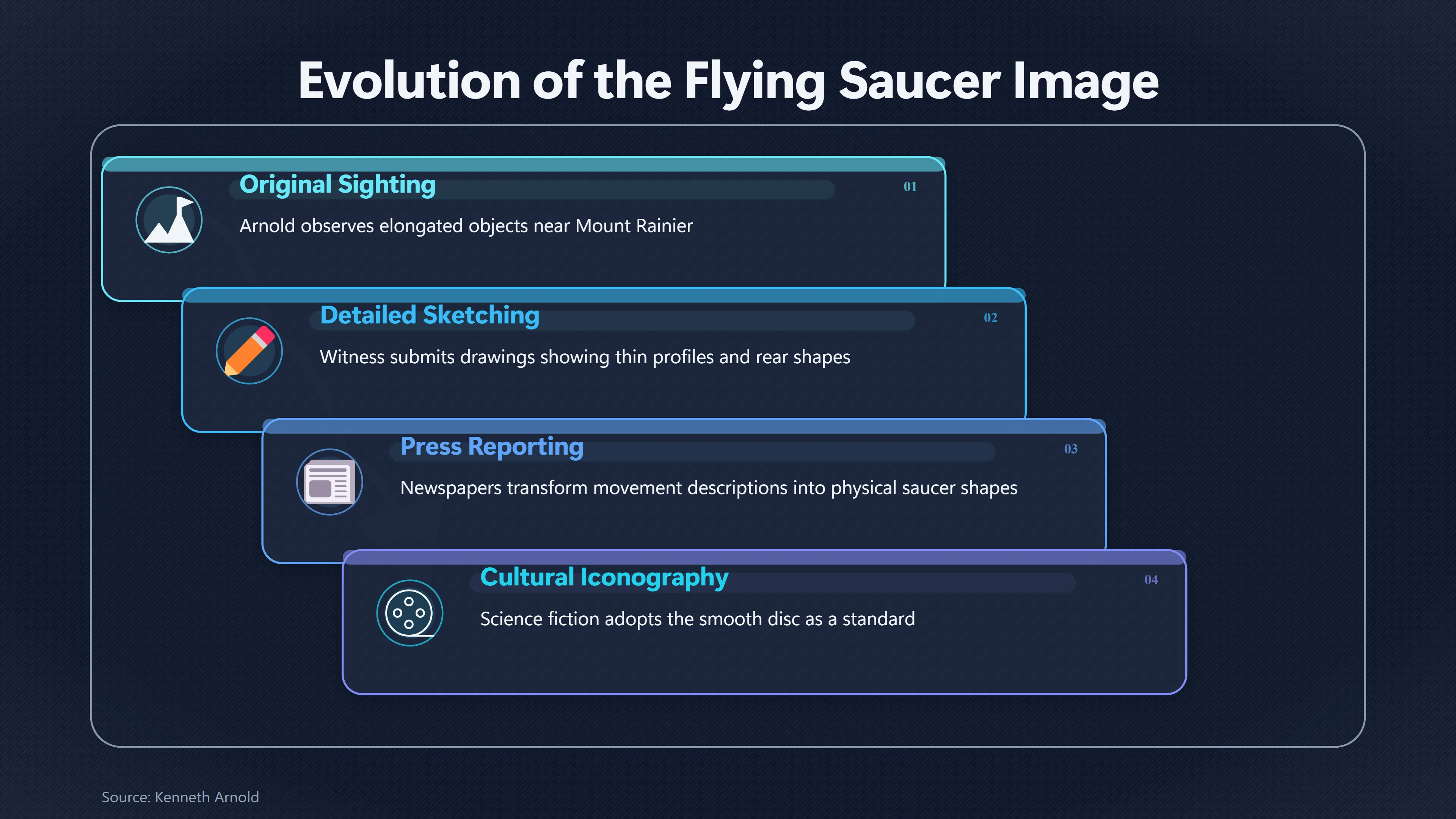
Shortly after the sighting, Arnold submitted a detailed report to Army Air Forces intelligence. Included with the report were sketches showing the appearance of the objects from different angles. In the accompanying notes, Arnold wrote that the objects “seemed longer than wide” and that their thickness was about one twentieth of their width. He also indicated that they appeared mirror-bright and that they did not seem to spin as they travelled.[The UFO Database]theufodatabase.comThe UFO DatabaseLetter and drawing by Arnold to Air Force Intelligence | The UFO DatabaseJuly 12, 1947…
These details complicate the later image of a perfectly round flying saucer. Arnold’s drawing presented an object with a thin profile and a distinctive rear shape rather than a simple circular disc. The side view was particularly important because it suggested that the object’s appearance changed depending on its orientation in flight. When viewed edge-on, Arnold said the objects could appear almost like a line; when they tilted and reflected sunlight, he could judge their form more clearly.[Nicap]nicap.org470624arnold…
Arnold’s verbal descriptions were also more varied than the later stereotype suggests. In early interviews, he compared the objects to a pie plate cut in half with a raised or triangular rear section. He also described them as “saucer-like” or “disk”-like, terms that reflected attempts to explain an unfamiliar shape using ordinary objects.[The Living Moon]thelivingmoon.comThe Living Moon Kenneth ArnoldThe Living MoonKenneth Arnold - First Flying Saucer Sighting June 1947…
The evidence therefore points to a description somewhere between several familiar categories: a flattened object, a disc-like form, a crescent or wing-like shape, and something unlike ordinary aircraft of the period. The ambiguity became one reason the report remained open to different interpretations.
The gap between words and images
The famous phrase “flying saucer” did not come from a precise technical description of Arnold’s sketches. It developed from the way his comparisons were reported in the press. Arnold had used the image of a saucer mainly when describing the objects’ movement, saying they moved like a saucer skipping across water. Newspapers transformed that comparison into a description of the objects themselves, helping create a phrase that spread internationally.[HISTORY]history.comKenneth ArnoldKenneth Arnold - UFO, 1947 & Flying Saucer | HISTORYFebruary 22, 2010…
This distinction mattered because the new phrase immediately created a ready-made visual form. Once “flying saucer” entered popular culture, artists, magazine publishers and filmmakers could represent UFOs as smooth, circular spacecraft. That design became closely associated with alien technology in science fiction, even though Arnold’s own sketches showed a more unusual and less standardised form.[Smithsonian Air and Space Museum]airandspace.si.edu1947 year flying saucerSmithsonian Air and Space Museum1947: Year of the Flying Saucer | National Air and Space MuseumJune 24, 2022…
The shift illustrates how UFO imagery was shaped by communication as much as by eyewitness reports. A witness might describe movement, angle, brightness and approximate shape, while audiences often preferred a simple visual symbol. The saucer became memorable because it was easy to draw and immediately recognisable, allowing science-fiction creators to adopt it as the default appearance of extraterrestrial machines.
Arnold himself continued to distinguish between what he saw and the public image that followed. His later comments reflected frustration that the phrase “flying saucer” had become a fixed idea that did not fully capture his original account. The debate was therefore not only about the object’s possible identity, but also about whether the public had preserved or transformed his description.[Smithsonian Air and Space Museum]airandspace.si.edu1947 year flying saucerSmithsonian Air and Space Museum1947: Year of the Flying Saucer | National Air and Space MuseumJune 24, 2022…
Later debates over the sighting details
Was Arnold’s object really a “saucer”?
The main disagreement among later researchers concerns how much the original report should be considered a saucer description. One interpretation argues that Arnold clearly described thin, disc-like objects and used comparisons such as “pie plate” and “saucer-like,” making the later term a reasonable shorthand. Early newspaper accounts also recorded Arnold using similar comparisons when explaining the appearance of the objects.[The Living Moon]thelivingmoon.comThe Living Moon Kenneth ArnoldThe Living MoonKenneth Arnold - First Flying Saucer Sighting June 1947…
A competing interpretation emphasises the differences between Arnold’s sketches and the smooth circular spacecraft that became popular afterwards. Supporters of this view argue that the drawings show that the cultural image of the flying saucer simplified and altered the original report. The important point is not that Arnold described no disc-like qualities, but that his account contained more specific features than the later stereotype retained.[The UFO Database]theufodatabase.comThe UFO DatabaseLetter and drawing by Arnold to Air Force Intelligence | The UFO DatabaseJuly 12, 1947…
Why the sketches became important in UFO history
The sketches remain significant because they preserve a rare piece of first-hand evidence from the moment when the modern UFO idea was forming. Unlike later artistic depictions influenced by science fiction, Arnold’s drawings were produced close to the event and before the flying saucer image had fully developed.[Wikimedia Commons]commons.wikimedia.orgCommons File:Arnold AAF document.jpgWikimedia CommonsFile:Arnold AAF document.jpg - Wikimedia Commons…
For historians of UFO culture, the drawings show a transition point. Before 1947, science fiction had already imagined advanced aircraft and visitors from other worlds, but Arnold’s report provided a real-world image that could be adapted into a widely shared symbol. The movement from Arnold’s irregular shapes to the familiar saucer design demonstrates how popular culture can reshape eyewitness accounts into lasting icons.[Smithsonian Air and Space Museum]airandspace.si.edu1947 year flying saucerSmithsonian Air and Space Museum1947: Year of the Flying Saucer | National Air and Space MuseumJune 24, 2022…
The lasting debate over Arnold’s sketches is therefore less about choosing between “saucer” and “not saucer” than about understanding how a complex observation became a simple cultural image. His drawings preserve the uncertainty of the original sighting, while the flying saucer became one of science fiction’s most recognisable designs.
Amazon book picks
Further Reading
Books and field guides related to What Did Arnold Actually Describe?. Use these as the next step if you want deeper reading beyond the article.
UFOs
NEW YORK TIMES BESTSELLER • Impeccably researched, this riveting journalistic investigation separates fact from fiction, and documents th...
The Report on Unidentified Flying Objects
The Report on Unidentified Flying Objects, written by Captain Edward Ruppelt in 1956, was the first serious, unbiased account written abo...
The UFO Experience: A Scientific Inquiry
Cited by the New York Review of Books as "the best brief for visitation," this classic study presents an analysis of UFO reports and conc...
UFOs and the National Security State: Chronology of a Coverup...
"The documentation is spectacularly good, the best ever on the UFO subject. And the conclusion is overwhelmingly powerful." —Whitley Stri...
eBay marketplace picks
Marketplace Samples
Live-tested eBay searches with available results related to this page.
Selected fromufo poster oneBay.co.uk.


Endnotes
1.
Source: nicap.org
Link:https://www.nicap.org/reports/470624arnold.htm
Source snippet
470624arnold...
2.
Source: history.com
Title: Kenneth Arnold
Link:https://www.history.com/articles/kenneth-arnold
Source snippet
Kenneth Arnold - UFO, 1947 & Flying Saucer | HISTORYFebruary 22, 2010...
Published: February 22, 2010
3.
Source: commons.wikimedia.org
Title: Commons File:Arnold AAF document.jpg
Link:https://commons.wikimedia.org/wiki/File%3AArnold_AAF_document.jpg
Source snippet
Wikimedia CommonsFile:Arnold AAF document.jpg - Wikimedia Commons...
4.
Source: history.com
Title: Project Blue Book
Link:https://www.history.com/articles/project-blue-book
5.
Source: commons.wikimedia.org
Title: File:Project Blue Book report 1960 07 7819459 Arnold California
Link:https://commons.wikimedia.org/wiki/File%3AProject_Blue_Book_report_-_1960-07-7819459-Arnold-California.pdf
6.
Source: theufodatabase.com
Link:https://theufodatabase.com/docs/kenneth-arnold-1947-07-12-kenneth-arnold-letter-and-drawing
Source snippet
The UFO DatabaseLetter and drawing by Arnold to Air Force Intelligence | The UFO DatabaseJuly 12, 1947...
Published: July 12, 1947
7.
Source: thelivingmoon.com
Title: The Living Moon Kenneth Arnold
Link:https://www.thelivingmoon.com/49ufo_files/03files2/1947_Kenneth_Arnold.html
Source snippet
The Living MoonKenneth Arnold - First Flying Saucer Sighting June 1947...
Published: June 1947
8.
Source: airandspace.si.edu
Title: 1947 year flying saucer
Link:https://airandspace.si.edu/stories/editorial/1947-year-flying-saucer
Source snippet
Smithsonian Air and Space Museum1947: Year of the Flying Saucer | National Air and Space MuseumJune 24, 2022...
Published: June 24, 2022
9.
Source: en.wikiquote.org
Title: Kenneth Arnold
Link:https://en.wikiquote.org/wiki/Kenneth_Arnold
Source snippet
I looked at my watch and it showed one minute and 42 seconds. Well, I felt that was pretty fast and I didn't stop to think what the dista...
10.
Source: historylink.org
Link:https://www.historylink.org/File/5336
11.
Source: theufodatabase.com
Link:https://theufodatabase.com/docs/kenneth-arnold-1947-06-27-chicago-tribune
12.
Source: theufodatabase.com
Link:https://theufodatabase.com/docs/ufo-material-1947-08-04-los-angeles-times
13.
Source: academickids.com
Title: Kenneth Arnold
Link:https://academickids.com/encyclopedia/index.php/Kenneth_Arnold
15.
Source: Wikipedia
Title: Flying saucer
Link:https://en.wikipedia.org/wiki/Flying_saucer
16.
Source: theufodatabase.com
Link:https://theufodatabase.com/docs/kenneth-arnold-1966-03-30-the-baltimore-sun
17.
Source: theufodatabase.com
Link:https://theufodatabase.com/docs/kenneth-arnold-1947-06-25-corvallis-gazette-times
18.
Source: theufodatabase.com
Title: Kenneth Arnold UFO Sighting | The UFO Database
Link:https://theufodatabase.com/incidents/kenneth-arnold-ufo-sighting
Additional References
19.
Source: uapedia.ai
Title: kenneth arnold and the modern uap era 1947
Link:https://www.uapedia.ai/wiki/kenneth-arnold-and-the-modern-uap-era-1947/
Source snippet
In his earliest descriptions, captured on radio the next day and later in interviews, he said the objects looked “like a pie plate...
20.
Source: youtube.com
Title: KENNETH ARNOLD SCORING
Link:https://www.youtube.com/watch?v=gMMqdhkpQzk
Source snippet
This video discusses the historical origins of the "flying saucer" concept stemming from Kenneth Arnold's 1947 sighting, providing detail...
21.
Source: youtube.com
Link:https://www.youtube.com/watch?v=jqJzZ-V5Jv8
Source snippet
The UFO Deluge of July 4th, 1947 | Part 1: Omens (Before the Storm)...
22.
Source: archives.gov
Link:https://www.archives.gov/news/articles/project-blue-book-50th-anniversary
23.
Source: youtube.com
Title: The First UFO Sighting In America | UFOs: The Lost Evidence
Link:https://www.youtube.com/watch?v=MJp-YR34XBs
Source snippet
1947: The Kenneth [Arnold Sighting]({{ 'arnold-sighting/' | relative_url }}) | Weird History Ep. #5...
24.
Source: llewellyn.com
Link:https://www.llewellyn.com/encyclopedia/term/Flying%2BSaucer
25.
Source: en-academic.com
Link:https://en-academic.com/dic.nsf/enwiki/303304
26.
Source: facebook.com
Link:https://www.facebook.com/newspaperscom/posts/the-encounter-that-launched-the-modern-ufo-era-in-june-1947-pilot-kenneth-arnold/1159047999569842/
27.
Source: clip.cafe
Link:https://clip.cafe/project-blue-book-exposed-2020/in-later-drawings-arnold-elaborated/
28.
Source: abebooks.co.uk
Link:https://www.abebooks.co.uk/9781590033005/Project-Blue-Book-Top-Secret-1590033000/plp