Within Kenneth Arnold
How Saucers Changed Alien Stories
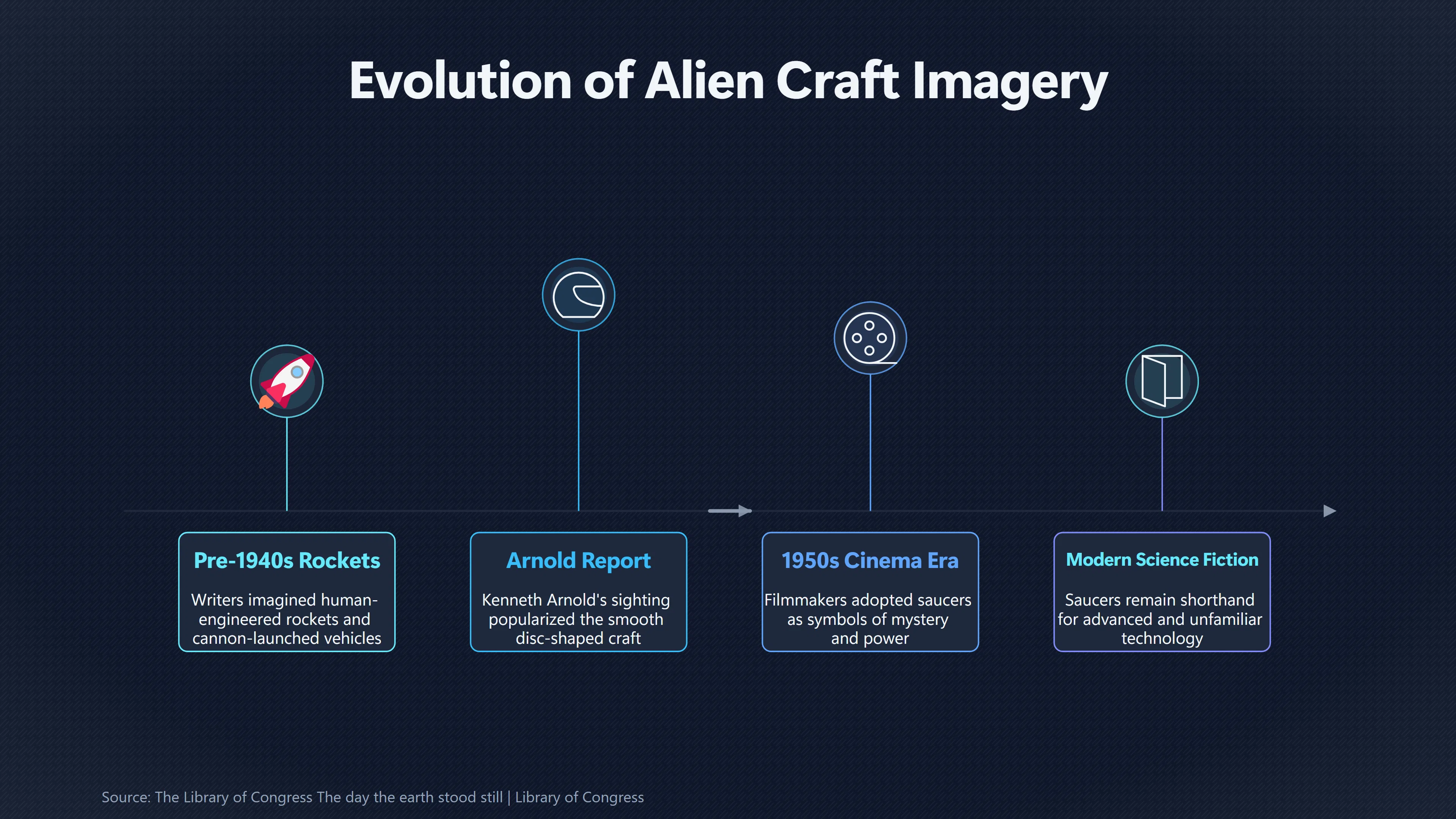
The saucer became a recurring science fiction symbol for alien visitors, space travel and encounters with unknown worlds.
On this page
- Early fictional spacecraft imagery
- UFO reports entering entertainment
- The lasting alien spacecraft design
Page outline Jump by section
Introduction
Flying saucer imagery changed science fiction by giving alien visitors a simple, recognisable vehicle. Before the late 1940s, writers had imagined many forms of interplanetary travel, from rockets and cosmic vessels to mysterious machines from other worlds. The rapid spread of the “flying saucer” image after Kenneth Arnold’s 1947 report created a new visual language: a smooth disc-shaped craft became a shorthand for alien arrival, advanced technology and contact with unknown civilisations. That image mattered because it connected real-world UFO reports with fictional storytelling, allowing films, television and literature to turn the saucer into the defining spacecraft of the early space-age imagination.[Smithsonian Institution Archives]siarchives.si.eduOpen source on si.edu.
The transformation was not simply that science fiction copied UFO reports. Instead, the relationship worked in both directions. Existing science fiction helped audiences interpret strange aerial reports, while the new UFO imagery gave creators a powerful design that could instantly communicate “visitor from another world”. Over the following decades, the saucer became one of the most influential symbols in alien stories, shaping how audiences imagined extraterrestrial technology long before humans had sent spacecraft beyond Earth.[Smithsonian Institution Archives]siarchives.si.eduOpen source on si.edu.

Early fictional spacecraft imagery
From rockets to recognisable alien machines
Early science fiction often imagined space travel through the technology of its own era. Nineteenth- and early twentieth-century stories frequently focused on rockets, cannon-launched vehicles and engineered spacecraft that resembled advanced versions of human machines. These designs reflected a belief that future exploration would be an extension of existing engineering: larger engines, stronger materials and better navigation.
The flying saucer introduced a different idea. Its smooth, symmetrical form suggested a technology that was not merely an improved aircraft but something fundamentally unfamiliar. The disc shape implied unusual methods of propulsion, control and movement. It became a visual way of showing that an alien civilisation might possess scientific abilities far beyond humanity’s own.
This distinction helped the saucer fit the concerns of post-war science fiction. The late 1940s and 1950s were shaped by rapid developments in aviation, rocketry and nuclear technology. A mysterious craft arriving from the sky could represent both hope and anxiety: evidence of a more advanced civilisation, but also a reminder that humanity might be technologically outmatched.
The design’s strength was its simplicity. A reader or cinema audience did not need a technical explanation to understand the meaning of a glowing disc descending from space. The image itself carried the story: something unknown had arrived.
UFO reports entered entertainment
The connection between UFO reports and science fiction became especially visible in 1950s cinema, when filmmakers adopted the flying saucer as a central element of alien storytelling. Films such as The Day the Earth Stood Still presented a spacecraft arriving on Earth as a dramatic encounter between humanity and a more advanced civilisation. The film’s famous arrival sequence used the spacecraft as a symbol of mystery and power rather than simply as a military threat.[The Library of Congress]loc.govThe Library of Congress The day the earth stood still | Library of CongressThe Library of CongressThe day the earth stood still | Library of CongressJanuary 1, 2002…
The 1956 film Earth vs. the Flying Saucers pushed the image in a different direction, using fleets of flying saucers as instruments of invasion. The film reflected Cold War fears about surprise attacks and technological vulnerability, turning the saucer into a symbol that could represent both extraterrestrial possibility and human insecurity. The Smithsonian Institution notes that the film portrayed flying saucers threatening Earth at a moment when public interest in space technology was increasing, shortly before the launch of Sputnik.[Smithsonian Institution Archives]siarchives.si.eduOpen source on si.edu.
This period established a lasting pattern in science fiction. The saucer could be adapted to almost any alien narrative:
- A message from another world: the craft represented communication, diplomacy or a warning.
- A technological threat: the craft represented a civilisation with overwhelming power.
- A mystery to investigate: the craft represented the unknown and the limits of human understanding.
Because the same basic shape could support different stories, it became more than a vehicle design. It became a storytelling device.

The lasting alien spacecraft design
The flying saucer’s greatest impact was its durability. Even after science fiction developed more varied spacecraft designs, the disc remained an instantly understood symbol of alien presence. Later films and television programmes could use saucer-like forms to establish an extraterrestrial connection within seconds, without needing lengthy explanations.
The design also influenced public expectations about UFOs themselves. Once films and illustrations repeatedly showed aliens arriving in metallic discs, the image became part of popular culture’s shared vocabulary. Reports of unusual objects were often described or interpreted through familiar science fiction imagery, creating a feedback loop between fictional depictions and public ideas about UFOs.[Smithsonian Institution Archives]siarchives.si.eduOpen source on si.edu.
However, the saucer’s dominance did not mean every science fiction creator accepted it as the ideal spacecraft. Some writers and filmmakers moved towards more realistic-looking rockets, modular spacecraft or organic alien technology. As scientific understanding of space travel developed, science fiction increasingly explored alternatives to the classic disc. The saucer survived because it represented something broader than engineering: the moment when humanity encounters a civilisation that is technologically and culturally beyond itself.
The enduring appeal of the flying saucer comes from this symbolic power. It is not just a shape in the sky; it is a visual shorthand for discovery, uncertainty and the possibility that humanity is not alone. By transforming a 1947 media phenomenon into a global science fiction symbol, the saucer permanently changed how alien worlds were imagined.[Smithsonian Institution Archives]siarchives.si.eduOpen source on si.edu.
Amazon book picks
Further Reading
Books and field guides related to How Saucers Changed Alien Stories. Use these as the next step if you want deeper reading beyond the article.
The War of the Worlds
The War of the Worlds (1898), by H. G. Wells, is an early science fiction novel which describes an invasion of England by aliens from Mar...
The World Treasury of Science Fiction
First published 1989. Subjects: Science fiction, Translations into English, Short stories.
The Encyclopedia of Science Fiction
Encompassing 4,360 entries that provide critical insight and biographical and bibliographical data, an updated edition of a popular scien...
The History of Science Fiction
This book is the definitive critical history of science fiction. The 2006 first edition of this work traced the development of the genre...
eBay marketplace picks
Marketplace Samples
Live-tested eBay searches with available results related to this page.
Selected fromalien poster oneBay.co.uk.



Endnotes
1.
Source: siarchives.si.edu
Link:https://siarchives.si.edu/history/smithsonian-movies
2.
Source: siarchives.si.edu
Link:https://siarchives.si.edu/history/pop_culture
3.
Source: loc.gov
Title: The Library of Congress The day the earth stood still | Library of Congress
Link:https://www.loc.gov/item/2010610680/
Source snippet
The Library of CongressThe day the earth stood still | Library of CongressJanuary 1, 2002...
Published: January 1, 2002
4.
Source: media.nationalarchives.gov.uk
Title: nationalarchives.gov.uk The Cold War and UFOs | The National Archives
Link:https://media.nationalarchives.gov.uk/index.php/cold-war-ufos/
Source snippet
The term is reportedly from either an American pilot who reported the shape he saw was `nine saucer-like aircraft’, whilst the B...
5.
Source: newyorker.com
Title: The Day the Earth Stood Still | The New Yorker
Link:https://www.newyorker.com/goings-on-about-town/movies/the-day-the-earth-stood-still
6.
Source: si.edu
Link:https://www.si.edu/exhibitions/yesterdays-tomorrows-past-visions-american-future-event-exhib-3389
7.
Source: siarchives.si.edu
Title: pop culture
Link:https://siarchives.si.edu/history/pop_culture?field_medium_value=film
8.
Source: siarchives.si.edu
Title: smithsonian popular culture
Link:https://siarchives.si.edu/history/smithsonian-popular-culture
9.
Source: Wikipedia
Title: The Flying Saucer
Link:https://en.wikipedia.org/wiki/The_Flying_Saucer
Additional References
10.
Source: theguardian.com
Link:https://www.theguardian.com/film/2010/oct/21/day-earth-stood-still-wise
Source snippet
The GuardianThe Day the Earth Stood Still: No 20 best sci-fi and fantasy film of all time | Science fiction and fantasy films | The Guardian...
11.
Source: youtube.com
Link:https://www.youtube.com/watch?v=7PwYPC73B3k
Source snippet
This video 1950s Flying Saucer, UFO, and Alien Encounter Movies breaks down how 1950s Hollywood cinema embraced post-1947 flying saucer r...
12.
Source: d23.com
Title: 20th century fox spooktacular 1950s the day the earth stood still
Link:https://d23.com/20th-century-fox-spooktacular-1950s-the-day-the-earth-stood-still/
Source snippet
20th Century Fox "Spooktacular" – 1950s: The Day the Earth Stood Still - D23September 28, 2021 — Image: the day the earth stood still 20T...
Published: September 28, 2021
13.
Source: bloomsbury.com
Title: science fiction cinema and 1950s britain 9781501322532
Link:https://www.bloomsbury.com/uk/science-fiction-cinema-and-1950s-britain-9781501322532/
Source snippet
Science Fiction Cinema and 1950s Britain: Recontextualizing Cultural Anxiety: Matthew Jones: Bloomsbury Academic - BloomsburyNovember 30...
14.
Source: bfi.org.uk
Title: first ever british sci fi feature film released
Link:https://www.bfi.org.uk/news/first-ever-british-sci-fi-feature-film-released
Source snippet
First ever British sci-fi feature film released | BFIDecember 4, 2014 — FIRST EVER BRITISH SCI-FI FEATURE FILM RELEASED Britain’s first e...
Published: December 4, 2014
15.
Source: bfi.org.uk
Title: 10 great british sci fi films
Link:https://www.bfi.org.uk/lists/10-great-british-sci-fi-films
Source snippet
10 great British sci-fi films | BFINovember 27, 2014 — 10 GREAT BRITISH SCI-FI FILMS We fly the flag for homegrown science fiction with a...
Published: November 27, 2014
16.
Source: youtube.com
Link:https://www.youtube.com/watch?v=gfEx5mfGFIQ
Source snippet
Ultimate 1950s Flying Saucer, UFO, and Alien Encounter Movies...
17.
Source: youtube.com
Link:https://www.youtube.com/watch?v=_bLMi1nqDQQ
Source snippet
A Month of Hollywood Legends | The Day the Earth Stood Still (1951) Original Klaatu Flying Saucer...
18.
Source: youtube.com
Link:https://www.youtube.com/watch?v=jUzzNL6iCUg
Source snippet
Earth vs. the Flying Saucers (1956) B&W | Fred F. Sears' Sci-Fi Invasion Masterpiece...
19.
Source: youtube.com
Link:https://www.youtube.com/watch?v=l5evk6lvo9Y
Source snippet
Cinema Secrets You Missed in 1950s Alien Invasion Movies...