Within Scientific explanations
Why The Brain Misreads Strange Objects
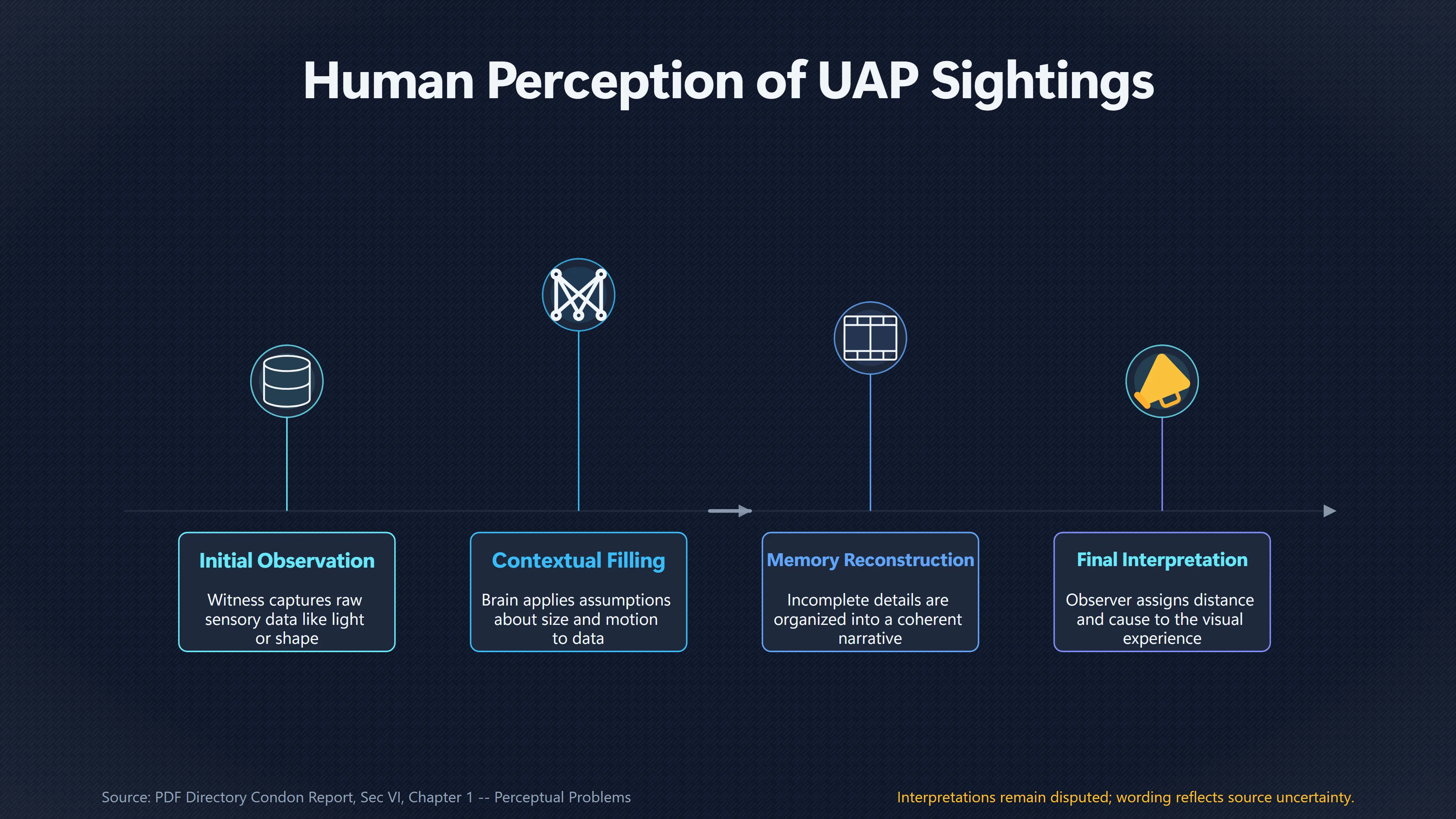
Human perception can accurately record an experience while misjudging distance, speed, or cause during brief and unfamiliar observations.
On this page
- Limits of visual perception
- Distance and motion illusions
- Memory after unusual sightings
Page outline Jump by section
Introduction
UFO reports often begin with a real observation but become difficult to explain because the human brain must interpret incomplete information very quickly. A witness can accurately describe what they experienced — a bright light, an unusual shape, a sudden movement — while still reaching an incorrect conclusion about the object’s distance, speed or cause. This distinction between seeing and identifying is central to scientific explanations of UFO reports.[NCAS PDF Directory]files.ncas.orgPDF Directory Condon Report, Sec VI, Chapter 1 – Perceptual ProblemsNCAS PDF DirectoryCondon Report, Sec VI, Chapter 1 – Perceptual Problems…
Human perception is not a camera that records the world without interpretation. The visual system combines incoming signals with assumptions about size, motion, distance and context. When a sighting occurs at night, in poor visibility, without reference points, or during a brief encounter, the brain has fewer clues to construct an accurate explanation. NASA’s review of unidentified anomalous phenomena (UAP) emphasised that many reports lack the high-quality data needed for firm conclusions, highlighting the importance of better observations and measurements rather than relying only on human accounts.[NASA Science]science.nasa.govScience UAPNASA ScienceUAP - NASA ScienceFebruary 23, 2026…
Limits of visual perception
The main difficulty in many UFO sightings is not whether a person saw something, but whether the available visual information was sufficient to identify it. Human vision evolved to interpret familiar objects in ordinary environments, where distance, scale and movement are usually supported by surrounding features. A small object close to the observer and a large object far away can produce similar images on the retina, leaving the brain to estimate size and distance using context.
The problem becomes greater when an object appears against an empty sky. Without buildings, trees or terrain for comparison, observers have limited ability to judge how far away something is. The classic psychological analysis of UFO reports in the Condon Report described perception as an interpretive process in which the observer assigns characteristics such as distance, direction, shape and colour even when the visual information does not uniquely determine those properties.[NCAS PDF Directory]files.ncas.orgPDF Directory Condon Report, Sec VI, Chapter 1 – Perceptual ProblemsNCAS PDF DirectoryCondon Report, Sec VI, Chapter 1 – Perceptual Problems…
Why a clear sighting can still be misidentified
A common misunderstanding is that a confident witness must have made an accurate identification. In reality, confidence and correctness are separate issues. A person may honestly report a striking event while being mistaken about what produced it.
Several normal visual processes contribute to this:
- Limited reference points: A light moving across a dark sky can appear to perform unusual manoeuvres because the observer cannot easily judge its true path or distance.
- Expectation effects: The brain uses previous knowledge to interpret ambiguous shapes. If an object does not immediately match a familiar category, the mind may create a more unusual explanation.
- Attention limits: People cannot process every detail of a rapidly changing scene. The brain fills gaps using assumptions and patterns.
The Condon Report’s psychological review divided possible reporting errors into broad categories, including misidentification of real stimuli, perception of unreal stimuli as real, and deliberate falsification. Importantly, the researchers did not treat all witnesses as unreliable; instead, they noted that normal perceptual processes can create mistakes even among sincere observers.[NCAS PDF Directory]files.ncas.orgNCAS PDF DirectoryCondon Report, Sec VI, Chap 3: Psychological Aspects of UFO Reports…
Distance and motion illusions
Many dramatic UFO descriptions involve extraordinary speed, hovering, sudden turns or impossible acceleration. However, judging motion in the sky is particularly difficult because the observer often lacks the information needed to calculate true movement.
The difficulty of judging speed in the sky
An object’s apparent movement depends on both its actual motion and its distance from the observer. A nearby object moving slowly can appear to move rapidly across the field of view, while a distant aircraft travelling at high speed may appear almost stationary.
This is especially relevant for pilots and trained observers. Aviation experience improves recognition of many aircraft-related phenomena, but it does not eliminate the basic limits of human perception. Without accurate distance measurements, even experienced observers can misjudge an object’s trajectory.
The same principle applies to apparent hovering. An aircraft approaching directly towards an observer may show little sideways movement, making it appear stationary until it changes direction. Balloons and other objects carried by wind layers can also appear to make unexpected movements because their motion is not always aligned with the direction a viewer expects. Scientific investigations of UFO reports have repeatedly identified aircraft, balloons, satellites and atmospheric effects as important categories requiring careful analysis.[Secrets Declassified]secretsdeclassified.af.milOpen source on af.mil.
The role of optical conditions
Light itself can create misleading impressions. Bright objects near the horizon may appear distorted because atmospheric conditions affect how light travels through the air. Reflections, glare and camera limitations can also transform ordinary objects into unusual shapes.
These issues become particularly important with photographs and videos. A recording may appear to provide objective evidence, but cameras have their own limitations: lens flare, focus problems, digital processing and lack of depth information can all change how an object appears. NASA’s UAP study therefore recommended improving data quality, sensor calibration and the recording of technical information alongside observations.[NASA]nasa.govUPDATE: NASA Shares UAP Independent Study Report; Names DirectorUPDATE: NASA Shares UAP Independent Study Report; Names Director - NASASeptember 14, 2023…
Memory after unusual sightings
A UFO report is rarely just a record of the first few seconds of observation. Most accounts are created after the event, when memory, discussion and interpretation have already influenced the original experience.
Human memory is reconstructive rather than a perfect recording. When people recall an unusual event, they may unintentionally organise incomplete details into a coherent story. Later conversations, questions from investigators or exposure to other interpretations can influence how the memory is described.
Research on eyewitness testimony has shown that confidence is not always a reliable indicator of accuracy, particularly when memories have been influenced by outside information or repeated retelling. Studies of eyewitness identification have found that memory can be altered by questioning methods and later information, demonstrating why unusual observations must be evaluated alongside independent evidence.[PubMed]pubmed.ncbi.nlm.nih.govPractice and feedback effects on the confidence-accuracy relation in eyewitness memory - PubMed…
Why unusual events become stronger memories
Strange experiences are often remembered vividly because they attract attention and emotional significance. A person who sees an unexplained light may spend hours or years thinking about the event, searching for explanations and comparing it with similar reports. This continued focus can strengthen certain details while other details become less certain.
For UFO investigations, this creates a careful balance. A witness account remains valuable because it provides information about what was observed. However, the scientific question is not only “what did the witness experience?” but also “which parts of that experience can be independently verified?”
The scientific value of understanding perception errors
Understanding perception errors does not mean dismissing UFO witnesses. Scientific investigation separates two questions that are often confused: whether someone genuinely experienced something unusual, and whether the explanation they assigned to it is correct.
Historical investigations such as the US Air Force’s Project Blue Book examined thousands of UFO reports and found that many could be attributed to known objects or phenomena, while some remained unresolved because the available information was insufficient. The project recorded 12,618 reports between 1947 and 1969, with 701 classified as unidentified, but it found no evidence that these cases represented technology beyond known science.[Secrets Declassified]secretsdeclassified.af.milOpen source on af.mil.
Modern UAP research follows a similar principle. The challenge is not simply finding unusual observations; it is collecting enough reliable information — multiple measurements, calibrated sensors and detailed context — to distinguish genuine unknowns from situations where human perception has been pushed beyond its normal limits.[NASA]nasa.govUPDATE: NASA Shares UAP Independent Study Report; Names DirectorUPDATE: NASA Shares UAP Independent Study Report; Names Director - NASASeptember 14, 2023…
Perception errors are therefore not a minor detail in UFO research. They are a central mechanism explaining how ordinary events can become extraordinary reports. The gap between observation and interpretation is where many UFO mysteries begin.
Amazon book picks
Further Reading
Books and field guides related to Why The Brain Misreads Strange Objects. Use these as the next step if you want deeper reading beyond the article.
Thinking, Fast and Slow
Why is there more chance we'll believe something if it's in a bold type face? Why are judges more likely to deny parole before lunch? Why...
The Invisible Gorilla: How Our Intuitions Deceive Us
NEW YORK TIMES BESTSELLER • Our minds don’t work the way we think they do. Two renowned psychologists explain how and why our intuitions...
The Seven Sins of Memory: How the Mind Forgets and Remembers
Rating: 3.5/5 from 5 Google Books ratings
A New York Times Notable Book: A psychologist's "gripping and thought-provoking" look at how and why our brains sometimes fail us (Steven...
Why People Believe Weird Things
Rating: 4.5/5 from 5 Google Books ratings
"This sparkling book romps over the range of science and anti-science." --Jared Diamond, author of Guns, Germs, and Steel Revised and Exp...
eBay marketplace picks
Marketplace Samples
Live-tested eBay searches with available results related to this page.
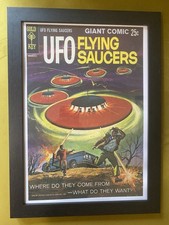
Selected fromUFO art print oneBay.co.uk.



Endnotes
1.
Source: files.ncas.org
Title: PDF Directory Condon Report, Sec VI, Chapter 1 – Perceptual Problems
Link:https://files.ncas.org/condon/text/s6chap01.htm
Source snippet
NCAS PDF DirectoryCondon Report, Sec VI, Chapter 1 -- Perceptual Problems...
2.
Source: files.ncas.org
Link:https://files.ncas.org/condon/text/s6chap03.htm
Source snippet
NCAS PDF DirectoryCondon Report, Sec VI, Chap 3: Psychological Aspects of UFO Reports...
3.
Source: science.nasa.gov
Title: Science UAP
Link:https://science.nasa.gov/uap/
Source snippet
NASA ScienceUAP - NASA ScienceFebruary 23, 2026...
Published: February 23, 2026
4.
Source: science.nasa.gov
Title: Science UAP FAQs
Link:https://science.nasa.gov/uap/faqs/
Source snippet
Trump’s direction for whole-of-government transparency and will alw...
5.
Source: nasa.gov
Title: UPDATE: NASA Shares UAP Independent Study Report; Names Director
Link:https://www.nasa.gov/news-release/update-nasa-shares-uap-independent-study-report-names-director/
Source snippet
UPDATE: NASA Shares UAP Independent Study Report; Names Director - NASASeptember 14, 2023...
Published: September 14, 2023
6.
Source: nasa.gov
Title: NAS A to Release, Discuss Unidentified Anomalous Phenomena Report
Link:https://www.nasa.gov/news-release/nasa-to-release-discuss-unidentified-anomalous-phenomena-report/
7.
Source: nasa.gov
Title: NAS A Provides Coverage of Unidentified Anomalous Phenomena Meeting
Link:https://www.nasa.gov/news-release/nasa-provides-coverage-of-unidentified-anomalous-phenomena-meeting/
8.
Source: nasa.gov
Title: NAS A Announces Unidentified Aerial Phenomena Study Team Members
Link:https://www.nasa.gov/general/nasa-announces-unidentified-aerial-phenomena-study-team-members/
9.
Source: files.ncas.org
Link:https://files.ncas.org/condon/text/appndx-a.htm
10.
Source: files.ncas.org
Title: sec ii
Link:https://files.ncas.org/condon/text/sec-ii.htm
11.
Source: files.ncas.org
Link:https://files.ncas.org/condon/text/contents.htm
12.
Source: files.ncas.org
Link:https://files.ncas.org/condon/text/sec-i.htm
13.
Source: files.ncas.org
Link:https://files.ncas.org/condon/text/s6chap02.htm
14.
Source: condon.ncas.org
Link:https://condon.ncas.org/text/intro.htm
15.
Source: secretsdeclassified.af.mil
Link:https://www.secretsdeclassified.af.mil/Fact-Sheets/Display/Article/459832/project-blue-book/
16.
Source: pubmed.ncbi.nlm.nih.gov
Link:https://pubmed.ncbi.nlm.nih.gov/10932793/
Source snippet
Practice and feedback effects on the confidence-accuracy relation in eyewitness memory - PubMed...
17.
Source: pmc.ncbi.nlm.nih.gov
Link:https://pmc.ncbi.nlm.nih.gov/articles/PMC11557702/
18.
Source: pubmed.ncbi.nlm.nih.gov
Link:https://pubmed.ncbi.nlm.nih.gov/26348334/
19.
Source: pmc.ncbi.nlm.nih.gov
Link:https://pmc.ncbi.nlm.nih.gov/articles/PMC3021061/
20.
Source: history.com
Title: Project Blue Book
Link:https://www.history.com/articles/project-blue-book
21.
Source: pubmed.ncbi.nlm.nih.gov
Link:https://pubmed.ncbi.nlm.nih.gov/18719983/
22.
Source: pubmed.ncbi.nlm.nih.gov
Link:https://pubmed.ncbi.nlm.nih.gov/11459058/
23.
Source: cufos.org
Title: Project Blue Book
Link:https://cufos.org/resources/project-blue-book/
24.
Source: pubmed.ncbi.nlm.nih.gov
Link:https://pubmed.ncbi.nlm.nih.gov/12118867/
25.
Source: pubmed.ncbi.nlm.nih.gov
Link:https://pubmed.ncbi.nlm.nih.gov/2345688/
26.
Source: pubmed.ncbi.nlm.nih.gov
Link:https://pubmed.ncbi.nlm.nih.gov/2708267/
27.
Source: zenodo.org
Link:https://zenodo.org/records/10588816
Additional References
28.
Source: psychologicalscience.org
Link:https://www.psychologicalscience.org/journals/pspi/1529100616686966/
Source snippet
Association for Psychological ScienceThe Relationship Between Eyewitness Confidence and Identification Accuracy: A New Synthesis - Psycho...
29.
Source: disclosuremonitor.com
Title: nasa uap report 2023
Link:https://disclosuremonitor.com/documents/nasa-uap-report-2023
Source snippet
NASA UAP Independent Study Report (2023) | Disclosure MonitorMarch 14, 2026 — NASA UAP INDEPENDENT STUDY REPORT (2023) The NASA Independe...
Published: March 14, 2026
30.
Source: nature.com
Link:https://www.nature.com/articles/s41598-017-09424-6
31.
Source: nature.com
Link:https://www.nature.com/articles/nn1641
32.
Source: youtube.com
Title: The SHOCKING Math Error Behind Viral UFO Videos | Mick West
Link:https://www.youtube.com/watch?v=ypfbhfEXnBo
Source snippet
The HIDDEN Stats on Pilot Error That Crush UFO Testimony | Mick West...
33.
Source: archives.gov
Link:https://www.archives.gov/news/articles/project-blue-book-50th-anniversary
34.
Source: nature.com
Title: Physiological Mechanisms Underlying Motion-Induced Blindness | Nature Precedings
Link:https://www.nature.com/articles/npre.2008.1506.1
35.
Source: youtube.com
Title: GOFAST UFO Analysis (yeah no, probably just a balloon)
Link:https://www.youtube.com/watch?v=-3NYowlCoDc
Source snippet
The SHOCKING Math Error Behind Viral UFO Videos | Mick West...
36.
Source: bibliotecapleyades.net
Link:https://www.bibliotecapleyades.net/sociopolitica/condonreport/full_report/s3chap07.htm
37.
Source: project1947.com
Link:https://www.project1947.com/shg/condon/s6chap03.html