Within Science fiction
The Giant Alien Structures Scientists Search For
The Dyson sphere concept changed how researchers imagine detecting advanced civilisations through large-scale technological traces.
On this page
- Dyson sphere origins and concept
- Searching for technological signatures
- Evidence and unanswered questions
Page outline Jump by section
Introduction
Dyson sphere searches are attempts to find evidence of extremely advanced alien civilisations by looking for the energy footprints of giant space-based structures. The idea is not to search for a visible “alien shell” around a star, but for the physical consequences of a civilisation capturing enormous amounts of stellar power: unusual dimming of starlight and, especially, excess infrared radiation produced as captured energy is released as heat. Freeman Dyson proposed this approach in 1960 as a way to search for artificial stellar sources rather than relying only on radio communication.[PubMed]pubmed.ncbi.nlm.nih.govPub Med Search for Artificial Stellar Sources of Infrared RadiationSearch for Artificial Stellar Sources of Infrared Radiation - PubMedJune 3, 1960…
No confirmed Dyson sphere has been found. However, the concept transformed the search for extraterrestrial intelligence by introducing a broader question: what detectable changes would a technologically mature civilisation leave on a cosmic scale? Modern searches treat Dyson spheres as one possible technosignature — an observable sign of technology — alongside radio signals, lasers, artificial atmospheric chemicals and other possible traces of engineering.[NASA Science]science.nasa.govScience Searching for Signs of Intelligent Life: TechnosignaturesNASA ScienceSearching for Signs of Intelligent Life: Technosignatures - NASA ScienceJuly 11, 2023…
Dyson sphere origins and concept
From science fiction imagery to an astronomical search strategy
The Dyson sphere concept is often associated with science fiction because it represents the kind of civilisation-scale engineering frequently imagined in futuristic stories. The scientific idea, however, came from physicist Freeman Dyson’s 1960 proposal that a sufficiently advanced civilisation might surround its star with energy-collecting structures. Dyson argued that such a civilisation would transform a large fraction of starlight into usable energy and that this process should create detectable infrared radiation.[PubMed]pubmed.ncbi.nlm.nih.govPub Med Search for Artificial Stellar Sources of Infrared RadiationSearch for Artificial Stellar Sources of Infrared Radiation - PubMedJune 3, 1960…
The original concept was not necessarily a rigid, solid shell. A complete shell around a star would create serious engineering and stability problems, so researchers commonly discuss a Dyson swarm instead: a vast collection of independent satellites, solar collectors or habitats orbiting a star. The swarm idea is important because it connects the fictional image of an enclosed star with a more physically plausible collection of orbiting structures.
The key prediction is based on thermodynamics. A structure collecting energy cannot make that energy disappear. After using the power for industry, computation or other activities, the civilisation must eventually release waste heat into space. That heat would appear primarily at infrared wavelengths, creating a possible signature for distant astronomers.[NASA Science]science.nasa.govScience Searching for Signs of Intelligent Life: TechnosignaturesNASA ScienceSearching for Signs of Intelligent Life: Technosignatures - NASA ScienceJuly 11, 2023…
Searching for technological signatures
Why infrared light is the main target
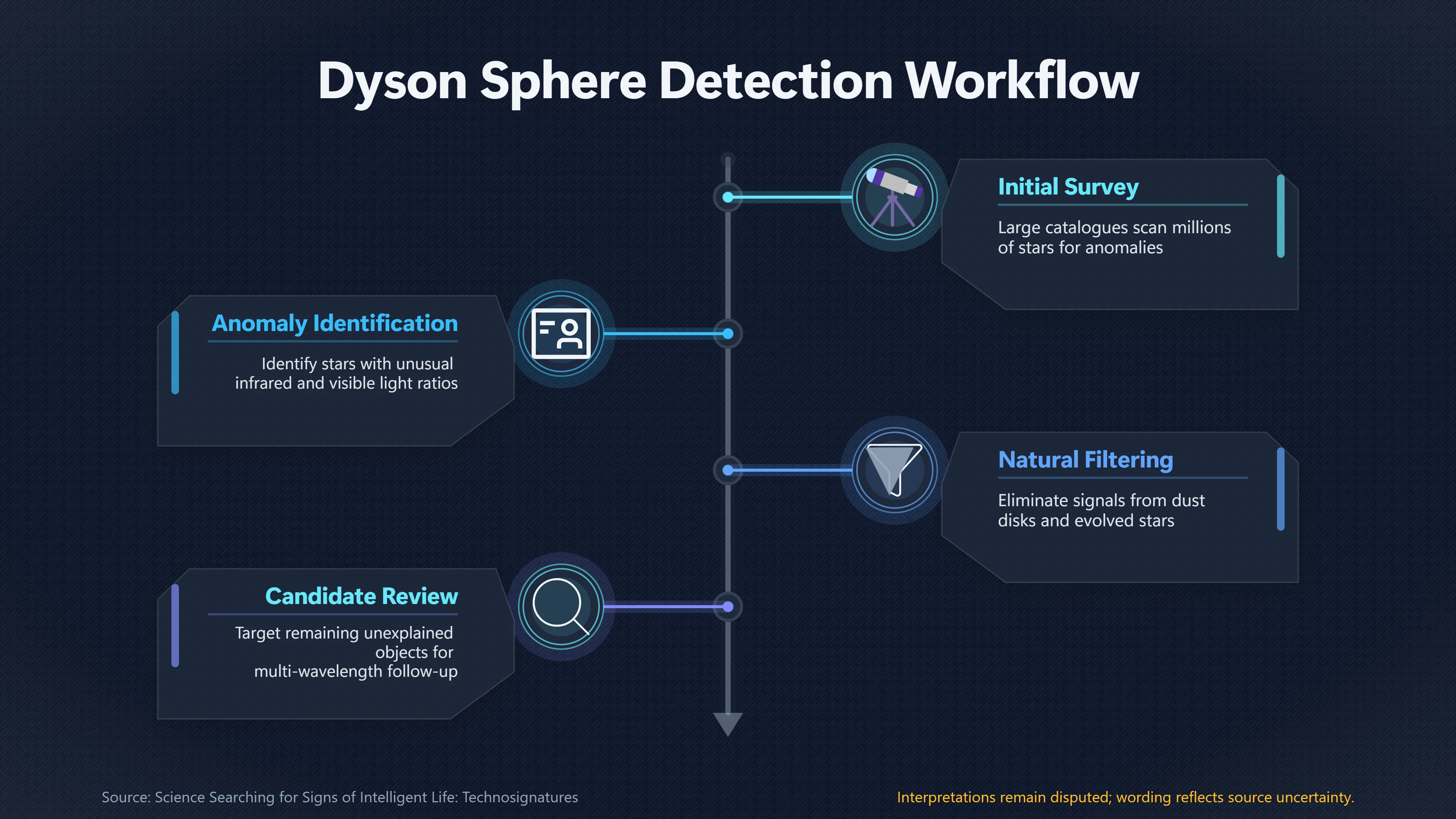
A Dyson swarm would not necessarily look like a spacecraft or artificial object through a telescope. At interstellar distances, individual structures would be invisible. Instead, astronomers search for unusual combinations of observations:
- a star that appears unusually faint in visible wavelengths;
- a star with unexpectedly strong infrared emission;
- a spectrum inconsistent with normal stellar or dust processes;
- changes in brightness that suggest large artificial objects crossing the star.
The reason infrared searches are valuable is that natural stars already emit large amounts of visible light, while technological activity can create a distinctive imbalance between absorbed energy and emitted heat. An old, mature star with a large unexplained infrared excess would be more interesting than a young star naturally surrounded by planet-forming dust, because dust disks are common around young stars and can imitate some of the same signals.[NASA Science]science.nasa.govScience Searching for Signs of Intelligent Life: TechnosignaturesNASA ScienceSearching for Signs of Intelligent Life: Technosignatures - NASA ScienceJuly 11, 2023…
Astronomers have used large astronomical surveys to look for these anomalies. Earlier searches examined data from infrared missions such as the Infrared Astronomical Satellite (IRAS), while newer approaches combine catalogues from missions including Gaia, 2MASS and NASA’s Wide-field Infrared Survey Explorer (WISE).[Space]space.comWhat is a Dyson sphere? | SpaceWhat is a Dyson sphere? | Space…
The challenge of separating aliens from ordinary astronomy
The biggest difficulty is that nature can produce signals that resemble a Dyson sphere. Infrared excess can come from:
- dusty debris disks left over from planetary formation;
- evolved stars shedding material;
- distant galaxies hidden behind dust;
- unusual stellar environments.
Because of this, a candidate is not considered evidence of alien technology simply because it produces infrared light. Researchers must first eliminate ordinary explanations through follow-up observations at multiple wavelengths.
This requirement has shaped the field’s approach. The goal is not to find a strange object and immediately label it artificial, but to identify objects whose properties remain unexplained after careful astronomical analysis.
Candidate searches and disputed evidence
Tabby’s Star: the famous false alarm
The most famous Dyson sphere discussion centred on KIC 8462852, also known as Tabby’s Star. Observations from NASA’s Kepler space telescope revealed irregular dips in brightness, some reaching roughly 20 per cent, unlike the regular patterns expected from planets passing in front of a star.[Cambridge Repository]repository.cam.ac.ukbridge RepositoryPlanet Hunters IX. KIC 8462852 - Where's the flux?…
Because a large artificial structure could theoretically block starlight, some researchers and commentators considered whether a partial Dyson swarm might explain the observations. However, follow-up studies found no strong infrared excess of the type expected from a large energy-harvesting structure. Studies of the star’s light across different wavelengths instead supported natural explanations involving dust or other astrophysical material rather than a confirmed artificial structure.[Cambridge Repository]repository.cam.ac.ukbridge RepositoryPlanet Hunters IX. KIC 8462852 - Where's the flux?…
Tabby’s Star became an important example because it demonstrated both the value and the limits of technosignature searches. A strange astronomical observation can motivate a search for alien technology, but unusual behaviour alone is not enough. The strongest evidence would need to show a pattern that is difficult to explain through known physics.
Project Hephaistos and modern large-scale searches
More recent work has used machine-assisted searches through millions of stars to identify possible Dyson sphere candidates. Project Hephaistos analysed data from Gaia, 2MASS and WISE to search for stars with unusual optical and infrared properties. In one study, researchers examined a sample of five million objects and identified seven candidates requiring further investigation. The researchers emphasised that these objects were not discoveries of alien structures, but targets for additional study because their infrared signatures were unusual.[arXiv]arxiv.orgarXiv Project HephaistosProject Hephaistos - II. Dyson sphere candidates from Gaia DR3, 2MASS, and WISE…
Other data-driven studies have searched large catalogues of main-sequence stars for mid-infrared excesses. These projects aim to improve the balance between finding rare anomalies and avoiding false positives caused by ordinary astronomical sources.[arXiv]arxiv.orgA Data-Driven Search For Mid-Infrared Excesses Among Five Million Main-Sequence FGK StarsMarch 27, 2024…
The importance of these surveys is that they change the scale of the question. Instead of examining a handful of unusual stars, astronomers can now compare millions of objects and ask whether any occupy a region of parameter space that natural astrophysical processes struggle to explain.
Evidence and unanswered questions
What a confirmed Dyson sphere signature would require
A convincing detection would likely need several independent lines of evidence:
- A persistent infrared excess that matches the expected heat output of a large artificial structure.
- A lack of convincing natural explanations, such as dust or stellar activity.
- Additional signs of artificial organisation, such as unusual light patterns, repeating structures or other technosignatures.
- Independent confirmation from different observatories and instruments.
A single unusual measurement would be unlikely to settle the question because astronomy regularly discovers objects that challenge existing models before finding conventional explanations.
Why the search remains scientifically useful
Even without finding alien technology, Dyson sphere searches have expanded how scientists think about advanced civilisations. Traditional searches often focused on deliberate communication, such as radio transmissions. Dyson sphere searches instead ask whether a civilisation could reveal itself accidentally through its energy use.
This connects the idea to broader studies of technological development. A civilisation capable of large-scale engineering might not be broadcasting messages into space, but it could still alter its environment in ways visible across interstellar distances. NASA’s discussions of technosignatures include Dyson spheres among possible examples of technological traces that could be detected remotely.[NASA Science]science.nasa.govScience Searching for Signs of Intelligent Life: TechnosignaturesNASA ScienceSearching for Signs of Intelligent Life: Technosignatures - NASA ScienceJuly 11, 2023…
The unresolved question is not simply whether Dyson spheres exist, but whether advanced civilisations would actually build them. A civilisation might develop more efficient technologies, use smaller distributed systems, or avoid large visible engineering projects. The absence of detected Dyson spheres therefore does not prove that advanced life is rare; it only limits the number of detectable civilisations that leave this particular kind of energy signature.
For now, Dyson sphere searches remain one of the clearest examples of science fiction influencing real astronomy: an imagined alien technology became a testable scientific idea, turning a fictional megastructure into a measurable question about energy, engineering and the limits of civilisation.
Amazon book picks
Further Reading
Books and field guides related to The Giant Alien Structures Scientists Search For. Use these as the next step if you want deeper reading beyond the article.
The Eerie Silence: Renewing Our Search for Alien Intelligence
"Refreshing . . . A penetrating analysis of the assumptions that underlie SETI and the entire enterprise of searching for life beyond Ear...
The Future of Humanity
A SUNDAY TIMES BOOK OF THE YEAR Human civilization is on the verge of spreading beyond Earth. More than a possibility, it is becoming a n...
Rare Earth: Why Complex Life Is Uncommon in the Universe
What determines whether complex life will arise on a planet, or even any life at all? Questions such as these are investigated in this gr...
The Cosmic Connection: An Extraterrestrial Perspective
The question we will always be asking but will never know the answer is the question: Is there life in Outer Space? I think that almost e...
eBay marketplace picks
Marketplace Samples
Live-tested eBay searches with available results related to this page.
Selected fromscience fiction poster oneBay.co.uk.



Endnotes
1.
Source: science.nasa.gov
Title: Science Searching for Signs of Intelligent Life: Technosignatures
Link:https://science.nasa.gov/universe/search-for-life/searching-for-signs-of-intelligent-life-technosignatures/
Source snippet
NASA ScienceSearching for Signs of Intelligent Life: Technosignatures - NASA ScienceJuly 11, 2023...
Published: July 11, 2023
2.
Source: space.com
Title: What is a Dyson sphere? | Space
Link:https://www.space.com/dyson-sphere.html
Source snippet
What is a Dyson sphere? | Space...
3.
Source: arxiv.org
Title: arXiv Project Hephaistos
Link:https://arxiv.org/abs/2405.02927
Source snippet
Project Hephaistos - II. Dyson sphere candidates from Gaia DR3, 2MASS, and WISE...
4.
Source: arxiv.org
Link:https://arxiv.org/abs/2403.18941
Source snippet
A Data-Driven Search For Mid-Infrared Excesses Among Five Million Main-Sequence FGK StarsMarch 27, 2024...
Published: March 27, 2024
5.
Source: space.com
Title: Did a NASA telescope detect cosmic ‘hot dogs’ or Dyson spheres? | Space
Link:https://www.space.com/hot-dogs-wise-nasa-dyson-spheres
6.
Source: nasa.gov
Title: Heat Shield Testing Recycles Waste on Earth
Link:https://www.nasa.gov/humans-in-space/heat-shield-testing-recycles-waste-on-earth/
7.
Source: cambridge.org
Link:https://www.cambridge.org/core/journals/international-journal-of-astrobiology/article/nine-axes-of-merit-for-technosignature-searches/2F3C599B95AB00A0DF414F1389089D58
8.
Source: cambridge.org
Link:https://www.cambridge.org/core/journals/international-journal-of-astrobiology/article/pulsar-positioning-system-a-quest-for-evidence-of-extraterrestrial-engineering/E4CCF6D8F46B4B64F7AB99972C30903E
9.
Source: space.com
Title: The Puzzle of ‘Tabby’s Star’: 9 NASA Explanations for Star’s Odd Dimming | Space
Link:https://www.space.com/38536-tabbys-star-mystery-9-nasa-theories.html
10.
Source: cambridge.org
Link:https://www.cambridge.org/core/journals/publications-of-the-astronomical-society-of-australia/article/abs/some-thoughts-on-dyson-spheres/F384268FB8AFF5AF6B45E18742047925
11.
Source: cambridge.org
Link:https://www.cambridge.org/core/journals/international-journal-of-astrobiology/article/on-the-search-for-artificial-dysonlike-structures-around-pulsars/F81897B07199173A573226D4DC8B77A7
12.
Source: spinoff.nasa.gov
Link:https://spinoff.nasa.gov/node/10608
13.
Source: pubmed.ncbi.nlm.nih.gov
Title: Pub Med Search for Artificial Stellar Sources of Infrared Radiation
Link:https://pubmed.ncbi.nlm.nih.gov/17780673/
Source snippet
Search for Artificial Stellar Sources of Infrared Radiation - PubMedJune 3, 1960...
Published: June 3, 1960
14.
Source: repository.cam.ac.uk
Link:https://www.repository.cam.ac.uk/items/503825b9-3666-466f-87d7-51c2320ac24e
Source snippet
bridge RepositoryPlanet Hunters IX. KIC 8462852 - Where's the flux?...
15.
Source: baas.aas.org
Link:https://baas.aas.org/pub/2024n7i106p01/release/1
16.
Source: scholarpedia.org
Title: Dyson sphere
Link:https://www.scholarpedia.org/article/Dyson_sphere
Additional References
17.
Source: astrobiology.com
Link:https://astrobiology.com/2026/01/17/wise-catwise-constraints-on-dysonian-waste-heat-technosignatures-in-nearby-galaxies/
Source snippet
WISE/CatWISE Constraints On Dysonian Waste-Heat Technosignatures In Nearby Galaxies - AstrobiologyJanuary 17, 2026 — WISE/CATWISE CONSTRA...
Published: January 17, 2026
18.
Source: sciencedirect.com
Title: Machine learning for the prioritization of Dyson sphere candidates
Link:https://www.sciencedirect.com/science/article/pii/S0957417426001466
Source snippet
May 10, 2026 — EXPERT SYSTEMS WITH APPLICATIONS Date: 10 May 2026 Article: 131232 Volume: Volume 310 PUBLISHED BY: ELSEVIER...
Published: May 10, 2026
19.
Source: osti.gov
Link:https://www.osti.gov/biblio/4165164
Source snippet
Search for Artificial Stellar Sources of Infrared Radiation (Journal Article) | OSTI.GOV...
20.
Source: youtube.com
Title: Searching for Technosignatures with Dr. Jacob Haqq-Misra
Link:https://www.youtube.com/watch?v=-M4hGuDDsgM
Source snippet
Dyson sphere search alien energy signatures technosignatures Technosignatures -The Hunt for Alien Technosignatures and Dyson Spheres 📡 Pi...
21.
Source: youtube.com
Title: New Searches for Dyson Spheres Found Something Featuring Jason Wright
Link:https://www.youtube.com/watch?v=rZ3FQNU7L6U
Source snippet
Did We Just Detect Dyson Spheres? Featuring Dr. Gabriella Contardo...
22.
Source: youtube.com
Title: Did We Just Detect Dyson Spheres? Featuring Dr. Gabriella Contardo
Link:https://www.youtube.com/watch?v=xLF3SYka3qU
Source snippet
A Search for Dyson Spheres using IRAS - Richard Carrigan (SETITalks)...
23.
Source: youtube.com
Link:https://www.youtube.com/watch?v=VqmBHaYlYnA
Source snippet
Searching for Technosignatures with Dr. Jacob Haqq-Misra...
24.
Source: youtube.com
Title: A Search for Dyson Spheres using IRAS
Link:https://www.youtube.com/watch?v=HwcLEwAshr4
Source snippet
Searching for Dyson Spheres with Gaia and WISE (TechnoClimes 2020)...
25.
Source: livescience.com
Link:https://www.livescience.com/alien-megastructure-mysteriously-dimming-stars.html
26.
Source: livescience.com
Link:https://www.livescience.com/freeman-dyson-sphere-sci-fi-seti-legacy.html