Within Alien invasion versus
How humans might react to alien contact
First contact stories often focus on whether fear, curiosity or misunderstanding shapes humanity's response to unknown visitors.
On this page
- Fear and curiosity in first encounters
- Misunderstanding between civilisations
- Lessons from science fiction scenarios
Page outline Jump by section
Introduction
If humanity ever encounters an extraterrestrial intelligence, the first challenge may not be surviving the meeting but understanding it. Science fiction has repeatedly imagined that the outcome of first contact depends on a human reaction: fear can turn uncertainty into conflict, while curiosity and patience can create the possibility of communication. The key mechanism behind many alien contact stories is not the visitor itself, but the gap between what humans know and what they assume.
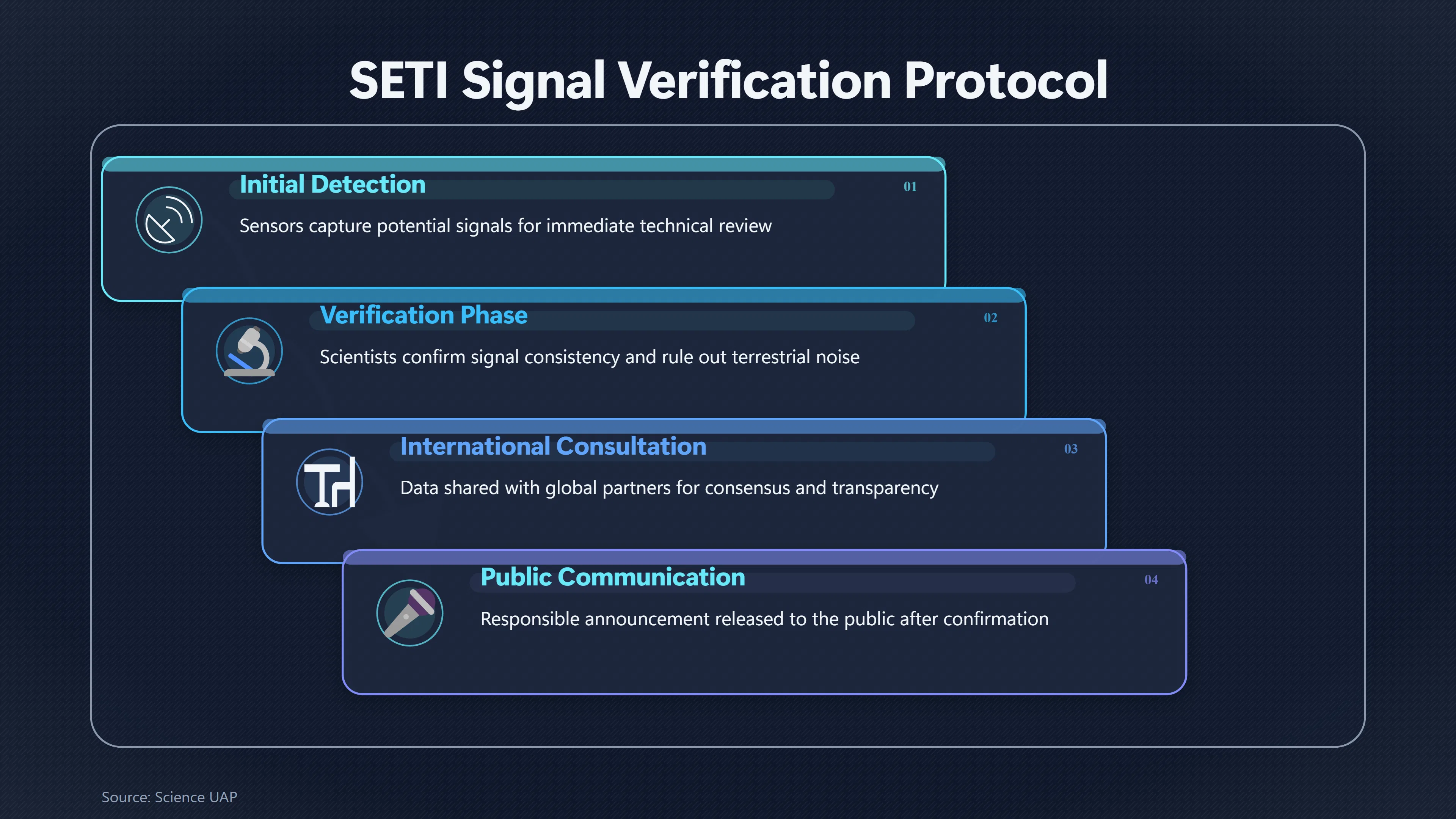
Real scientific discussions about extraterrestrial intelligence face the same uncertainty. Researchers have no confirmed evidence that intelligent aliens exist or that UFOs are extraterrestrial, but organisations studying the possibility of detection already consider how societies should respond to an unexpected discovery. NASA has stated that unidentified anomalous phenomena (UAP) remain unexplained observations rather than evidence of alien activity, while SETI researchers have developed procedures for verifying possible signals and communicating discoveries responsibly.[NASA Science]science.nasa.govScience UAPNASA ScienceUAP - NASA ScienceFebruary 23, 2026…
Science fiction explores this uncertainty through imagined encounters. Stories about alien visitors often reveal human concerns about trust, power, language and cooperation. The most memorable first-contact narratives ask not only “What would aliens do?” but also “How would humans behave when faced with something completely unfamiliar?”

Fear and curiosity in first encounters
The first human response to an unknown intelligence would likely be shaped by uncertainty. When people cannot determine another civilisation’s intentions, they may interpret the same evidence in opposite ways. A mysterious signal, spacecraft or message could be viewed as an opportunity for discovery or as a possible threat.
This tension is central to the difference between invasion stories and peaceful-contact stories. Invasion narratives often begin with a failure of trust: humanity sees unfamiliar technology and assumes hostile intent. Peaceful-contact stories reverse the emphasis by showing that fear itself can become the source of conflict. The alien may not be dangerous, but human institutions may respond defensively because they cannot assess the situation.
A real-world equivalent can be seen in scientific planning for a possible extraterrestrial signal. SETI protocols focus heavily on verification, transparency and international consultation because a premature announcement could create confusion before scientists know what has actually been detected. Updated guidance from the International Academy of Astronautics emphasises careful confirmation of possible signals and responsible communication with the public.[SETI Institute]seti.orgInstitute Protocols for an ETI Signal DetectionSETI InstituteProtocols for an ETI Signal DetectionJune 1, 2026…
Science fiction often exaggerates these reactions for dramatic effect, but it uses them to explore realistic social mechanisms:
- Threat perception: Humans tend to interpret unknown forces through familiar experiences, including war, competition and historical conflicts.
- Curiosity and exploration: Scientists, explorers and individuals may approach the unknown as a chance to learn rather than a danger to avoid.
- Institutional caution: Governments and security organisations in fiction frequently prioritise control and defence because they must make decisions with incomplete information.
- Public uncertainty: Ordinary people may respond with fascination, fear, disbelief or a mixture of all three.
The famous example of the 1938 radio adaptation of The War of the Worlds is often remembered as proof that people would immediately panic during an apparent alien event. However, later historical analysis has challenged the scale of that panic, showing that the event’s reputation became larger than the documented reaction itself. The lasting importance of the broadcast is not that millions irrationally believed aliens had arrived, but that it demonstrated how communication systems, trust and social expectations influence responses to extraordinary claims.[The Daily Beast]thedailybeast.comThe Daily Beast The ‘War of the Worlds’ Panic Is a MythThe Daily BeastThe ‘War of the Worlds’ Panic Is a MythJuly 3, 2015…
Misunderstanding between civilisations
The deepest problem in first contact may be communication rather than aggression. Two intelligent species could struggle to understand each other because they would not share assumptions about language, biology, emotions, technology or social behaviour.
Science fiction frequently uses alien communication failures as a way to examine human misunderstandings. The problem is not simply translating words. A civilisation’s language reflects how it categorises reality, what it values and what concepts it considers important. An alien message might be perfectly clear to its creators but confusing to humans because the underlying ideas are unfamiliar.
WIRED(https://www.wired.com/story/arrival-science-fact-fiction/)[wired.com]wired.comarrival science fact fictionThe science of Arrival: what the film got right (and wrong) | WIREDNovember 12, 2016…
The film Arrival is one of the clearest modern examples of this approach. Instead of beginning with a military battle, the story focuses on linguist Louise Banks attempting to understand an alien writing system. The central conflict comes from uncertainty: different human groups interpret the visitors’ arrival in different ways, and a lack of shared understanding creates tension. The film draws attention to a real scientific issue: communication with a non-human intelligence would require patience, evidence gathering and careful interpretation rather than immediate assumptions.[WIRED]wired.comarrival science fact fictionThe science of Arrival: what the film got right (and wrong) | WIREDNovember 12, 2016…
Earlier science fiction explored similar ideas through different forms. Close Encounters of the Third Kind presents contact as a gradual process of recognising patterns and building trust. The important event is not a battle between species but the discovery that communication is possible. Likewise, The Day the Earth Stood Still portrays an alien visitor whose message is initially misunderstood because humans interpret his arrival through the expectations of conflict and military danger.
These stories reflect a broader idea in science fiction studies: first contact is often a test of humanity’s ability to understand another perspective. Researchers examining first-contact themes in science fiction have noted that these stories function as thought experiments about communication, cultural difference and the possibility of mutual understanding.[JAXA Repository]jaxa.repo.nii.ac.jpJAXA RepositoryChallenges of Space Anthropology 2014-2015August 31, 2024…
The misunderstanding mechanism works in both directions. Humans may fear aliens because they cannot read their intentions, but a fictional alien civilisation might also misunderstand humans by judging them through incomplete information. A species observing Earth could see warfare, environmental damage and political conflict and conclude that humanity is dangerous. Alternatively, it might see scientific cooperation, art and exploration as evidence of a more complex civilisation.
Lessons from science fiction scenarios
First-contact stories remain influential because they provide imagined models for how humanity might respond to uncertainty. They do not predict a single outcome; instead, they examine different choices humans might make when faced with an unknown intelligence.
A recurring lesson is that the first reaction may shape everything that follows. In many invasion stories, fear creates a cycle: humans assume danger, respond aggressively, and then interpret the resulting tension as confirmation that conflict was inevitable. Peaceful-contact narratives suggest a different path in which observation, communication and restraint create opportunities for understanding.
Modern scientific discussions similarly avoid assuming either extreme. Researchers studying possible extraterrestrial contact consider a wide range of scenarios, from beneficial exchanges of knowledge to situations where contact could create social disruption. Analysis of potential contact outcomes emphasises that consequences would depend heavily on the circumstances of the encounter rather than on a simple distinction between “friendly aliens” and “hostile aliens”.[arXiv]arxiv.orgWould contact with extraterrestrials benefit or harm humanity? A scenario analysisApril 22, 2011…
Science fiction also highlights the role of information management. A confirmed discovery of intelligent life would not only be a scientific event; it would become a global social event. Questions about who announces the discovery, how evidence is verified and how misinformation is controlled are already part of scientific planning. Recent SETI discussions have highlighted the growing challenge of communicating extraordinary discoveries in an environment affected by rapid online sharing, misinformation and artificial intelligence-generated content.[SETI Institute]seti.orgInstitute Humanity's Plan for First Contact: Who Speaks for EarthInstitute Humanity's Plan for First Contact: Who Speaks for Earth
The most important insight from alien-contact stories is therefore not that humans would definitely welcome or reject extraterrestrials. It is that uncertainty itself becomes the defining challenge. Whether the imagined visitors arrive as explorers, observers or unknown forces, science fiction repeatedly returns to the same question: can humanity respond to the unfamiliar with enough curiosity and discipline to understand it before reacting?
Amazon book picks
Further Reading
Books and field guides related to How humans might react to alien contact. Use these as the next step if you want deeper reading beyond the article.
The War of the Worlds
The War of the Worlds (1898), by H. G. Wells, is an early science fiction novel which describes an invasion of England by aliens from Mar...
Contact
Rating: 4.0/5 from 21 Google Books ratings
In the year 1999 a multinational team of astronauts sets out to discover the secrets of the universe.
Childhood's End
Arthur C. Clarke's classic in which he ponders humanity's future and possible evolution When the silent spacecraft arrived and took the l...
The Day of the Triffids
John Wyndham's 1951 classic post-apocalypse novel introduced the world to triffids, walking man-eating plants, preying on humanity in a w...
eBay marketplace picks
Marketplace Samples
Live-tested eBay searches with available results related to this page.
Selected fromsci fi collectible oneBay.co.uk.

Endnotes
1.
Source: science.nasa.gov
Title: Science UAP
Link:https://science.nasa.gov/uap/
Source snippet
NASA ScienceUAP - NASA ScienceFebruary 23, 2026...
Published: February 23, 2026
2.
Source: science.nasa.gov
Title: Science UAP FAQs
Link:https://science.nasa.gov/uap/faqs/
Source snippet
NASA ScienceUAP FAQs - NASA Science...
3.
Source: seti.org
Title: Institute Protocols for an ETI Signal Detection
Link:https://www.seti.org/research/seti-101/protocols-for-an-eti-signal-detection/
Source snippet
SETI InstituteProtocols for an ETI Signal DetectionJune 1, 2026...
Published: June 1, 2026
4.
Source: wired.com
Title: arrival science fact fiction
Link:https://www.wired.com/story/arrival-science-fact-fiction/
Source snippet
The science of Arrival: what the film got right (and wrong) | WIREDNovember 12, 2016...
Published: November 12, 2016
5.
Source: arxiv.org
Link:https://arxiv.org/abs/1104.4462
Source snippet
Would contact with extraterrestrials benefit or harm humanity? A scenario analysisApril 22, 2011...
Published: April 22, 2011
6.
Source: seti.org
Title: Institute Humanity’s Plan for First Contact: Who Speaks for Earth
Link:https://www.seti.org/news/humanitys-plan-for-first-contact/
7.
Source: nasa.gov
Title: UPDAT E: NASA Shares UAP Independent Study Report; Names Director
Link:https://www.nasa.gov/news-release/update-nasa-shares-uap-independent-study-report-names-director/
8.
Source: nasa.gov
Title: NAS A to Release, Discuss Unidentified Anomalous Phenomena Report
Link:https://www.nasa.gov/news-release/nasa-to-release-discuss-unidentified-anomalous-phenomena-report/
9.
Source: nasa.gov
Title: NAS A Provides Coverage of Unidentified Anomalous Phenomena Meeting
Link:https://www.nasa.gov/news-release/nasa-provides-coverage-of-unidentified-anomalous-phenomena-meeting/
10.
Source: nasa.gov
Title: NAS A Announces Unidentified Aerial Phenomena Study Team Members
Link:https://www.nasa.gov/general/nasa-announces-unidentified-aerial-phenomena-study-team-members/
11.
Source: nasa.gov
Title: Are We Alone in the Universe? NASA Calls for New Framework
Link:https://www.nasa.gov/centers-and-facilities/goddard/are-we-alone-in-the-universe-nasa-calls-for-new-framework/
12.
Source: seti.org
Link:https://www.seti.org/what-happens-if-we-find-signal
13.
Source: seti.org
Link:https://www.seti.org/seti-institute/project/details/social-implications-seti-success
14.
Source: iaaseti.org
Link:https://iaaseti.org/en/protocols/
Source snippet
Protocols...
15.
Source: thedailybeast.com
Title: The Daily Beast The ‘War of the Worlds’ Panic Is a Myth
Link:https://www.thedailybeast.com/the-war-of-the-worlds-panic-is-a-myth/
Source snippet
The Daily BeastThe ‘War of the Worlds’ Panic Is a MythJuly 3, 2015...
Published: July 3, 2015
16.
Source: jaxa.repo.nii.ac.jp
Link:https://jaxa.repo.nii.ac.jp/record/2472/files/AA1530028004.pdf
Source snippet
JAXA RepositoryChallenges of Space Anthropology 2014-2015August 31, 2024...
Published: August 31, 2024
17.
Source: books.google.com
Title: First Contact
Link:https://books.google.com/books/about/First_Contact.html?id=KseZ0QEACAAJ
Additional References
18.
Source: space.com
Link:https://www.space.com/space-exploration/search-for-life/how-should-we-handle-alien-detection-in-a-world-of-ai-deepfakes-and-social-media-this-committee-is-writing-the-rulebook
Source snippet
Authored by astrophysicist Michael Garrett and an interdisciplinary team, the new guidelines stress the importance of openness—calling fo...
19.
Source: time.com
Link:https://time.com/4566458/arrival-review-amy-adams/
Source snippet
Starring Amy Adams as Dr. Louise Banks, a linguist tasked by the US military to decipher the language of seven-legged aliens called hepta...
20.
Source: youtube.com
Title: First 72 Hours After Aliens Make Contact (Hour by Hour)
Link:https://www.youtube.com/watch?v=TGAD16PJQ1Y
Source snippet
What would happen if we found alien life Kurtzgesagt What Actual Aliens Might Look Like Kurzgesagt – In a Nutshell...
21.
Source: prospect.org
Title: The American Prospect The “War of the Worlds” Myth
Link:https://prospect.org/2013/10/30/[war-worlds
Source snippet
The American ProspectThe "War of the Worlds" Myth - The American Prospect...
22.
Source: nature.com
Link:https://www.nature.com/articles/s41599-023-01746-3
23.
Source: neh.gov
Link:https://www.neh.gov/article/fake-news-orson-welles-war-worlds-80
24.
Source: youtube.com
Title: Why We Should NOT Look For Aliens
Link:https://www.youtube.com/watch?v=xAUJYP8tnRE
Source snippet
Arrival: The Enigma Of Alien-Human Communication...
25.
Source: sciencedirect.com
Link:https://www.sciencedirect.com/science/article/pii/S0094576511002906
26.
Source: theguardian.com
Link:https://www.theguardian.com/film/2016/nov/10/arrival-review-amy-adams-jeremy-renner-science-fiction
27.
Source: theguardian.com
Link:https://www.theguardian.com/film/2016/sep/01/arrival-review-amy-adams-denis-villeneuve-alien-contact